
Blog
Most Popular Liquor Brands in the World: 40 Famous Liqueurs, Aperitifs & Flavored Spirits

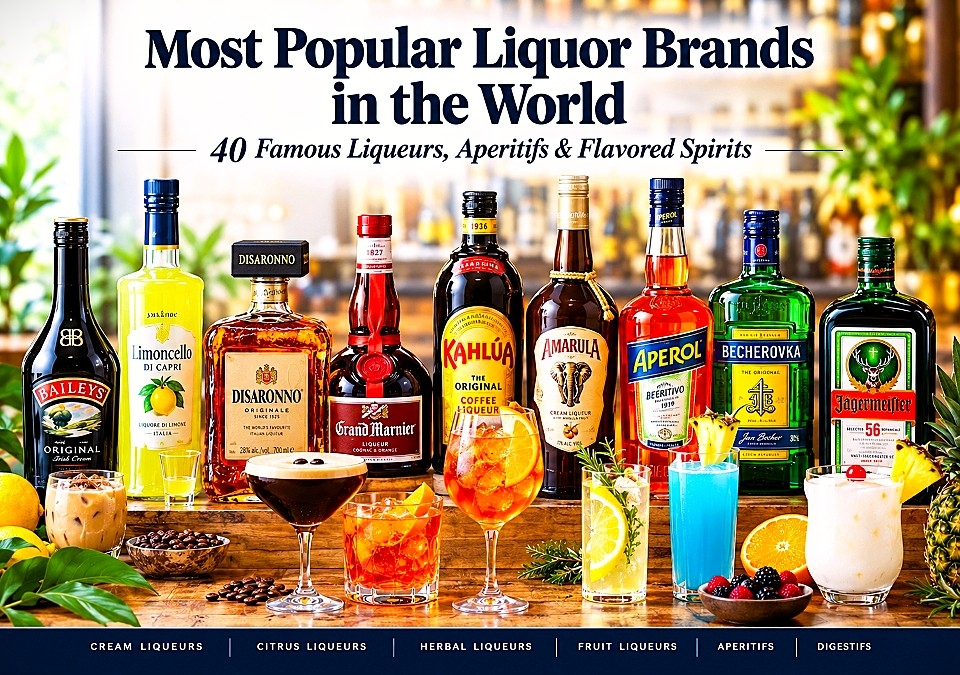
Most Popular Liquor Brands in the World: 40 Famous Liqueurs, Aperitifs & Flavored Spirits
Discover 40 of the most popular and recognizable liquor and liqueur brands in the world, including Baileys, Limoncello, Disaronno, Grand Marnier, Kahlúa, Amarula, Aperol, Becherovka, B&B, Bénédictine, Campari, Cointreau, Drambuie, Jägermeister, Fernet-Branca, Frangelico, Hpnotiq, Malibu, Triple Sec, Pernod, Ricard, Sheridan’s, RumChata, St-Germain and more. Learn what makes each brand distinctive, the main flavors, how these famous liqueurs are traditionally served, popular cocktails, food pairings, and how to choose the right bottle.
Walk into almost any well-stocked liquor store or cocktail bar in the world and you’ll encounter a fascinating collection of bottles that don’t fit neatly into just one category.
-
-
- Some are cream liqueurs.
- Some are orange liqueurs.
- Some are herbal digestifs.
- Some are Italian aperitivi.
-
Others are coffee, coconut, hazelnut, elderflower, anise or fruit liqueurs.
In everyday North American language, many of these products are simply called liquor. Technically, however, a large portion of the names in this article are liqueurs, aperitifs or flavored spirits, rather than base spirits such as whisky, rum, vodka or tequila.
That distinction is worth making because the list you are about to explore includes both individual brands and broader categories. Limoncello and Triple Sec, for example, are categories rather than one single universal brand name, while Ricard Pastis is a specific brand of pastis and B&B is a particular Bénédictine-and-brandy expression.
There is also no single official worldwide ranking that establishes which liquor or liqueur is definitively “number one.” This article is therefore an editorial guide to internationally recognized and culturally important brands, rather than a strict global sales ranking.
Baileys brings together Irish whiskey, cream, chocolate and vanilla. Kahlúa combines rum and Arabica coffee. Grand Marnier blends Cognac and bitter orange. Aperol brings citrus and herbal bitterness to the aperitivo. Jägermeister uses a closely guarded blend of herbs, roots, spices and fruit.
St-Germain is built around hand-picked elderflowers. Malibu takes white rum and coconut flavor in a distinctly tropical direction. (baileys.com) (kahlua.com) (grandmarnier.com) (jagermeister.com) (stgermainliqueur.com)
That diversity is exactly what makes the category so interesting.
Table of Contents
-
-
- What Is a Liqueur?
- Liquor vs. Liqueur: What’s the Difference?
- Why Liqueurs Are So Popular
- How Liqueurs Are Made
- 40 Most Popular Liquor & Liqueur Brands in the World
- Baileys
- Limoncello
- Disaronno
- Grand Marnier
- Kahlúa
- Amarula
- Aperol
- Becherovka
- B&B
- Bénédictine
- Campari
- Cointreau
- Drambuie
- Jägermeister
- Fernet-Branca
- Frangelico
- Hpnotiq
- Malibu
- Triple Sec
- Pernod
- Ricard
- Sheridan’s
- RumChata
- St-Germain
- Midori
- Sambuca
- Luxardo
- Galliano
- Chartreuse
- Licor 43
- Amaro Montenegro
- Averna
- Cynar
- Chambord
- Southern Comfort
- Curaçao
- Bols
- De Kuyper
- Pimm’s No. 1
- Marie Brizard
- Why These Brands Became Global Icons
- Best Liquor Brands for Beginners
- Best Liquor Brands for Cocktails
- Best Cream Liqueurs
- Best Citrus Liqueurs
- Best Herbal Liqueurs
- Best After-Dinner Liqueurs
- Best Liqueurs for Coffee
- Best Liqueurs for Dessert
- Famous Liqueur Cocktails
- How to Build a Home Liqueur Bar
- How to Store Liqueurs
- Frequently Asked Questions
- Final Thoughts
-
What Is a Liqueur?
A liqueur is a spirit that has been flavored and generally sweetened with ingredients such as fruit, herbs, spices, nuts, flowers, coffee, cream, roots or botanicals. That’s why liqueurs can taste dramatically different from neutral base spirits.
A vodka can provide alcohol without imposing a major flavor identity. A liqueur is designed to contribute flavor. That makes liqueurs incredibly important behind the cocktail bar.
A bartender can use a small amount of:
-
-
- Cointreau to bring orange.
- Frangelico to bring hazelnut.
- St-Germain to bring elderflower.
- Kahlúa to bring coffee.
- Campari to bring bitter herbal citrus.
- Bénédictine to bring complex botanical sweetness.
-
The liqueur becomes part of the architecture of the drink.
Liquor vs. Liqueur: What’s the Difference?
The terms are often confused. In everyday North American usage, liquor can refer to distilled alcoholic beverages generally. Liqueur is a more specific category of flavored and usually sweetened spirit.
That means:
-
-
- vodka = liquor/spirit
- whisky = liquor/spirit
- rum = liquor/spirit
- Cointreau = liqueur
- Baileys = liqueur
- Kahlúa = liqueur
- Aperol = aperitivo/liqueur
-
The terminology becomes particularly confusing with names such as Triple Sec and Limoncello.
Triple sec is a generic term for an orange-flavored spirit rather than one universally regulated worldwide brand category; Cointreau’s official explanation specifically distinguishes the generic triple-sec term from Cointreau as a particular orange liqueur. (cointreau.com)
Limoncello is similarly a category of lemon liqueur, with many different producers making their own versions. For this article, “liquor brands” is used in the broad consumer and SEO sense, while the technical category of each product is identified where useful.
Why Liqueurs Are So Popular
Liqueurs solve an important cocktail problem- flavor concentration. A small amount can transform an entire drink.
Consider:
-
-
- Coffee: Kahlúa.
- Orange: Cointreau.
- Cognac + orange: Grand Marnier.
- Elderflower: St-Germain.
- Hazelnut: Frangelico.
- Coconut: Malibu.
- Bitter orange and herbs: Aperol or Campari.
- Herbal complexity: Bénédictine or Jägermeister.
- Cream: Baileys, Amarula or RumChata.
-
That means a home bartender can create dozens of dramatically different drinks without owning dozens of base spirits.
How Liqueurs Are Made
Different liqueurs use different techniques. Ingredients can be infused, macerated, distilled, blended or combined with a finished spirit. Cream liqueurs require additional processing because dairy or plant-based ingredients need to remain stable.
St-Germain, for example, uses hand-picked elderflowers and a maceration process designed to capture their delicate flavor. The producer says that up to 1,000 elderflowers can contribute to each bottle. (stgermainliqueur.com)
Kahlúa combines rum with Arabica coffee and describes a production cycle in which coffee beans can take years to reach the desired maturity before roasting, blending and resting with the spirit. (kahlua.com)
Baileys takes another approach, bringing Irish whiskey and spirits together with Irish dairy cream and chocolate and vanilla flavors. (baileys.com)
The ingredients determine the personality.
40 Most Popular Liquor & Liqueur Brands in the World
1. Baileys
Country: Ireland
Style: Irish cream liqueur
Baileys is arguably the world’s best-known cream liqueur. The original recipe combines Irish whiskey and spirits, Irish dairy cream, chocolate and vanilla flavors. Baileys says the recipe was developed after two years of experimentation and dates to 1974. (baileys.com)
Original Baileys is typically enjoyed over ice, in coffee, in desserts or in cocktails. The official Canadian Baileys site currently promotes recipes including Espresso Martinis and coffee-based drinks.
Famous cocktails
-
-
- Baileys Espresso Martini
- Mudslide
- Baileys White Russian
- Irish Coffee variations
-
Best for
-
-
- Desserts
- Coffee
- Creamy cocktails
-
2. Limoncello
Country: Italy
Style: Lemon liqueur
Limoncello is not a single brand but one of Italy’s most famous liqueur categories. It is particularly associated with Sorrento, Amalfi and the island of Capri.
The Sorrento Lemon PGI consortium specifically identifies limoncello among the products associated with the region’s famous lemons. (limonedisorrentoigp.it)
Limoncello DICAPRI says its product is made with PGI-certified Sorrento lemons, alcohol, water and sugar. (limoncello.com)
Famous serves
-
-
- Limoncello Spritz
- Limoncello Tonic
- Limoncello Collins
-
Best for
-
-
- Summer
- Digestif
- Desserts
-
3. Disaronno
Country: Italy
Style: Almond-style Italian liqueur
Disaronno is one of Italy’s most internationally recognized liqueur brands.
The brand’s own history traces its story to Saronno and a Renaissance-era legend associated with a 1525 painting, while its modern corporate history began with ILLVA Saronno in 1947. Disaronno says it is now enjoyed in more than 160 countries. (disaronno.com)
Its flavor profile makes it especially useful in Sours, dessert drinks, coffee and after-dinner cocktails.
Famous cocktails
-
-
- Amaretto Sour
- Godfather
- French Connection
- Disaronno Coffee
-
Best for
-
-
- Beginners
- Desserts
- Sours
-
4. Grand Marnier
Country: France
Style: Cognac and bitter-orange liqueur
Grand Marnier is a classic example of how a liqueur can combine a base spirit with a powerful flavor ingredient.
Its flagship Cordon Rouge combines French Cognac with bitter orange, with the house dating its signature formula to 1880. Grand Marnier says the Cordon Rouge recipe has remained unchanged since its creation. (grandmarnier.com) (grandmarnier.com)
Famous cocktails
-
-
- Grand Margarita
- Grand Sidecar
- Cosmopolitan variations
- Grand Old Fashioned
-
Best for
-
-
- Citrus cocktails
- French-inspired drinks
- Desserts
-
5. Kahlúa
Country: Mexico
Style: Coffee liqueur
Kahlúa was born in Mexico in 1936 and is made with 100% Arabica coffee beans and rum, according to the brand. (kahlua.com)
Kahlúa is deeply connected with White Russians, Black Russians, Mudslides and Espresso Martinis.
The brand’s current Canadian product page highlights its role in coffee cocktails and desserts. (kahlua.com)
Best for Coffee
-
-
- Dessert
- Cream cocktails
-
6. Amarula
Country: South Africa
Style: Marula cream liqueur
Amarula brings an African identity to the cream-liqueur category. The brand’s original cream liqueur is made from marula fruit, with the marula spirit aged in French oak for two years. Amarula’s current product information lists the cream liqueur at 17% ABV. (amarula.com)
The brand currently offers additional expressions including Ethiopian Coffee, Raspberry, Chocolate & African Baobab, Vanilla Spice and plant-based options, with availability varying by market. (amarula.com)
Best for
-
-
- Cream cocktails
- Coffee
- Desserts
-
7. Aperol
Country: Italy
Style: Aperitivo
Aperol has become one of the world’s best-known orange-colored aperitivi. The brand says it was created in 1919 by brothers Luigi and Silvio Barbieri after seven years of experimentation. (aperol.com)
Aperol currently describes its profile as zesty orange, herbal, vanilla and bittersweet. It has an alcohol content of 11% ABV. (aperol.com)
Famous cocktail
-
-
- Aperol Spritz
-
Also useful in
-
-
- Aperol Soda
- Aperol Sour
- Paper Plane
-
Best for
-
-
- Aperitivo
- Summer
- Brunch
-
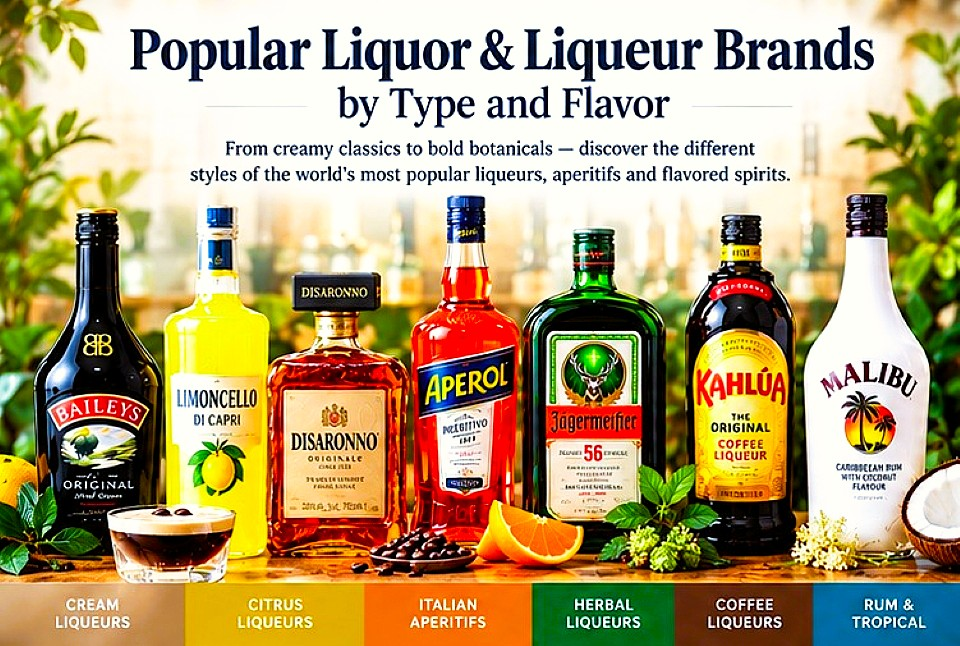
Popular liquor and liqueur brands by type and flavor including Baileys, Limoncello, Disaronno, Aperol, Jägermeister, Kahlúa and Malibu
8. Becherovka
Country: Czech Republic
Style: Herbal liqueur
Becherovka is one of the Czech Republic’s best-known spirits. The official brand history says it has been continuously produced since 1807 in Karlovy Vary and is based on a secret recipe using approximately 20 herbs and spices. (becherovka.com)
The iconic flat bottle has been associated with the brand since the 19th century.
Best for
-
-
- Herbal cocktails
- Digestifs
- Long drinks
-
9. B&B
Country: France
Style: Bénédictine and brandy liqueur
B&B stands for a blend of Bénédictine and French brandy.
The current Bénédictine site says the formula was revived in 1937 as a combination of 60% Bénédictine and 40% fine French brandy, followed by maturation in small French-oak casks. (benedictinedom.com)
Best for
-
-
- After dinner
- Coffee
- Brandy cocktails
-
The producer currently lists:
-
-
- B&B on the rocks
- B&B Coffee
- B&B Frappé.
-
10. Bénédictine
Country: France
Style: Herbal and spice liqueur
Bénédictine is one of France’s historic liqueurs. The current house describes D.O.M. as an intricate blend of 27 plants and spices produced at the Palais Bénédictine in Fécamp. (benedictinedom.com)
It is particularly important to cocktail history because of its ability to add herbal, spicy, honeyed and botanical notes.
Famous cocktails
-
-
- Singapore Sling
- Bobby Burns variations
- Vieux Carré
- B&B
-
Best for
-
-
- Classic cocktails
- Digestifs
- Fine dining
-
11. Campari
Country: Italy
Style: Bitter aperitivo
Campari is one of the defining names of Italian aperitivo culture. The official company history traces its origin to 1860, when Gaspare Campari created the distinctive bitter spirit. (campari.com)
Campari is defined by its bitterness, orange, herbal and spiced profile.
Famous cocktails
-
-
- Negroni
- Americano
- Boulevardier
- Garibaldi
-
Best for
-
-
- Aperitivo
- Bittersweet cocktails
-
12. Cointreau
Country: France
Style: Orange liqueur
Cointreau is one of the world’s most important orange liqueurs. The brand’s history begins in 1849, with Édouard Cointreau later developing the famous crystalline orange liqueur. (cointreau.com)
The brand says its original liqueur was created from a combination of dried and fresh sweet and bitter orange peels.
Famous cocktails
-
-
- Margarita
- Cosmopolitan
- Sidecar
- White Lady
-
Best for
-
-
- Cocktail-making
- Citrus drinks
-
13. Drambuie
Country: Scotland
Style: Scotch whisky liqueur
Drambuie combines aged Scotch whisky, spices, herbs and heather honey.
The official Drambuie history traces the brand’s story to 1745 and Prince Charles Edward Stuart, commonly known as Bonnie Prince Charlie. (drambuie.com)
Famous cocktail
-
-
- Rusty Nail
-
Best for
-
-
- Whisky cocktails
- Cold-weather drinks
- After dinner
-
14. Jägermeister
Country: Germany
Style: Herbal liqueur
Jägermeister is built around a secret recipe of 56 natural ingredients, including herbs, roots, blossoms and fruit, according to the brand. It is matured in oak barrels before bottling. (jagermeister.com)
The company says the recipe was developed by Curt Mast more than 80 years ago and remains closely guarded. (jagermeister.com)
Famous serves
-
-
- Jägerbomb
- Jäger Tonic
- Jäger Old Fashioned-style cocktails
-
Best for
-
-
- Herbal drinks
- Party cocktails
- Chilled shots
-
15. Fernet-Branca
Country: Italy
Style: Amaro/digestif
Fernet-Branca’s history begins in Milan in 1845, when Bernardino Branca created the original recipe. The producer says the formula contains 27 ingredients and remains secret. (fernetbranca.com)
Fernet-Branca is intensely bitter, herbal, spicy and mentholated.
Famous serves
-
-
- Fernet and Coke
- Hanky Panky
- Toronto
-
Best for
-
-
- Experienced palates
- Digestifs
- Bitter cocktails
-
16. Frangelico
Country: Italy
Style: Hazelnut liqueur
Frangelico is famous for its hazelnut, vanilla, cocoa and coffee-like character. It is particularly effective in dessert cocktails.
Famous serves
-
-
- Frangelico Coffee
- Nutty Irishman
- Frangelico Sour
-
Best for
-
-
- Desserts
- Coffee
- Chocolate
-
17. Hpnotiq
Origin: United States
Style: Fruit liqueur
Hpnotiq arrived in 2001 and became known for its distinctive blue color and unusual combination of tropical fruit juices, French vodka and a touch of Cognac. The current official site lists it at 17% ABV. (hpnotiq.com)
Famous uses
-
-
- Hpnotiq Martini
- Incredible Hulk
- Tropical mixed drinks
-
Best for
-
-
- Fruit cocktails
- Colorful party drinks
-
18. Malibu
Origin: Caribbean / global brand
Style: Coconut-flavored rum-based liqueur/spirit
Malibu is strongly associated with coconut, pineapple, summer and tropical cocktails.
The brand says its story began in 1978, when the product was known as Coco Rico, before Malibu launched in 1980. Malibu Original is made with white rum and coconut flavor and is currently listed at 21% ABV in Canada. (malibudrinks.com) (malibudrinks.com)
Famous cocktails
-
-
- Piña Colada
- Malibu Bay Breeze
- Malibu Daiquiri
-
Best for
-
-
- Summer
- Tropical cocktails
-
19. Triple Sec
Style: Orange liqueur category
Triple Sec is not one specific worldwide brand. It is a generic term used for orange-flavored liqueurs.
Cointreau’s official explanation notes that there is no single worldwide legal definition or universal production standard for triple sec, which means products can vary considerably. (cointreau.com)
Common uses
-
-
- Margarita
- Cosmopolitan
- Sidecar
- Mai Tai variations
-
Best for
-
-
- Home cocktail bars
-
20. Pernod
Country: France
Style: Aniseed liqueur
Pernod is a famous French aniseed liqueur. Pernod Ricard describes it as a spirit created around star anise, fennel and aromatic plants, with a relatively small amount of liquorice compared with pastis. (pernod-ricard.com)
Best for
-
-
- Anise cocktails
- Seafood
- French aperitifs
-
21. Ricard Pastis
Country: France
Style: Pastis
Ricard was created by Paul Ricard in 1932 as a “Pastis de Marseille.”
The current Pernod Ricard brand page says its recipe has remained unchanged and includes anise, liquorice and aromatic plants from Provence. (pernod-ricard.com) Ricard is traditionally diluted with water.
Best for
-
-
- French aperitif culture
- Mediterranean food
- Anise lovers
-
22. Sheridan’s
Origin: Ireland
Style: Layered coffee and cream liqueur
Sheridan’s is immediately recognizable because of its unusual split bottle. One side contains dark coffee liqueur while the other contains light vanilla cream liqueur. The two components pour together when served.
Best for
-
-
- Coffee
- Dessert
- After dinner
-
A chilled layered presentation makes Sheridan’s particularly suited to entertaining.
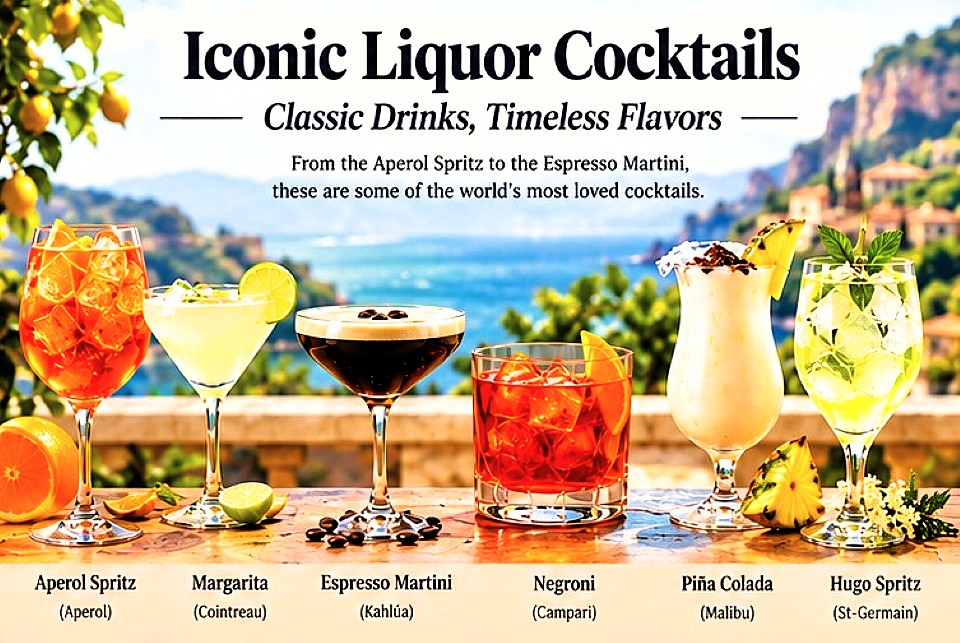
Iconic liquor cocktails including Aperol Spritz, Margarita, Espresso Martini, Negroni, Piña Colada and Hugo Spritz
23. RumChata
Country: United States
Style: Cream liqueur
RumChata takes inspiration from horchata, a traditional rice-and-cinnamon drink. The Canadian brand site identifies its inspiration as Mexican-style horchata and highlights white rice, Mexican cinnamon, milk, vanilla and sugar among the flavor foundations. (rumchata.ca)
Famous drinks
-
-
- RumChata White Russian
- RumChata Coffee
- RumChata Hot Chocolate
-
Best for
-
-
- Dessert
- Coffee
- Cream cocktails
-
24. St-Germain
Country: France
Style: Elderflower liqueur
St-Germain is one of the most influential modern liqueur brands.
The producer says founder Robert J. Cooper launched the brand in 2007, using fresh elderflowers hand-picked in late spring. Each bottle can contain the equivalent of up to 1,000 selected elderflowers. (stgermainliqueur.com)
The flavor includes elderflower, pear, citrus and honeysuckle. (stgermainliqueur.com)
Famous cocktails
-
-
- St-Germain Spritz
- Hugo Spritz
- St-Germain Royale
- St-Germain Margarita
-
Best for
-
-
- Modern cocktails
- Summer
- Brunch
-
25. Midori
Country: Japan
Style: Melon liqueur
Midori is famous for its bright green color and sweet melon flavor. It is especially useful in tropical and visually dramatic cocktails.
Famous cocktails
-
-
- Midori Sour
- Japanese Slipper
- Melon Ball
-
Best for
-
-
- Party cocktails
- Tropical drinks
-
26. Sambuca
Country: Italy
Style: Anise liqueur
Sambuca is one of Italy’s best-known anise spirits. It is usually sweet, licorice-like, anise-forward and high in alcohol.
Famous serves
-
-
- Sambuca neat
- Sambuca with coffee
- Sambuca cocktails
-
It is especially popular as an after-dinner drink.
27. Luxardo
Country: Italy
Style: Maraschino and fruit liqueurs
Luxardo is one of Italy’s most famous liqueur houses. Its Maraschino is particularly important in classic cocktails.
Famous cocktails
-
-
- Aviation
- Last Word
- Hemingway Daiquiri
- Casino
-
Best for
-
-
- Classic cocktails
- Fruit liqueur collections
- Cocktail enthusiasts
-
28. Galliano
Country: Italy
Style: Herbal and vanilla liqueur
Galliano is immediately recognizable for its tall bottle and golden color. Its profile combines vanilla, herbs, anise-like spice and botanical notes.
Famous cocktail
-
-
- Harvey Wallbanger
-
Best for
-
-
- Retro cocktails
- Tiki-style drinks
- Herbal cocktails
-
29. Chartreuse
Country: France
Style: Herbal liqueur
Chartreuse is one of the world’s most distinctive botanical liqueurs. The category includes Green Chartreuse and Yellow Chartreuse. It is famous for extraordinary herbal complexity.
Famous cocktails
-
-
- Last Word
- Bijou
- Chartreuse Swizzle
-
Best for
-
-
- Serious cocktail enthusiasts
- Herbal cocktails
-
30. Licor 43
Country: Spain
Style: Vanilla and botanical liqueur
Licor 43 is associated with vanilla, citrus, sweet spices and botanical aromas.
Famous cocktail
-
-
- Carajillo 43
-
Best for
-
-
- Coffee
- Dessert
- Spanish-style drinks
-
31. Amaro Montenegro
Country: Italy
Style: Amaro
Amaro Montenegro is a bittersweet Italian digestif with botanical complexity. It works well neat but can also add depth to Highballs, Spritzes, Negroni variations and after-dinner cocktails.
Best for
-
-
- Aperitivo
- Digestifs
- Modern Italian cocktails
-
32. Averna
Country: Italy
Style: Sicilian amaro
Averna is known for a rich, herbal, caramel-like and bittersweet profile.
Famous cocktails
-
-
- Black Manhattan
- Averna Sour
- Averna Highball
-
Best for
-
-
- After dinner
- Whisky cocktails
-
33. Cynar
Country: Italy
Style: Bitter amaro
Cynar is famous for its dark herbal character. It is often used when bartenders want bitterness, vegetal notes and depth.
Famous drinks
-
-
- Cynar Spritz
- Black Manhattan variations
- Cynar and Soda
-
Best for
-
-
- Adventurous cocktail drinkers
-
34. Chambord
Country: France
Style: Raspberry liqueur
Chambord is known for its rich raspberry character. It’s useful with Champagne, vodka, gin, lemon and desserts.
Famous cocktails
-
-
- French Martini
- Chambord Royale
-
Best for
-
-
- Fruit cocktails
- Brunch
- Desserts
-
35. Southern Comfort
Origin: United States
Style: Fruit-forward whiskey-based liqueur/spirit
Southern Comfort is a historic American flavored spirit known for its smooth combination of whiskey-related character with fruit and spice notes.
Famous drinks
-
-
- Comfort & Cola
- Alabama Slammer
- Scarlet O’Hara
-
Best for
-
-
- Easy mixed drinks
- Party cocktails
-
36. Curaçao
Style: Orange liqueur category
Curaçao is both a historic liqueur category and a foundation for many classic cocktails. It may be orange, blue, clear or aged, depending on the producer.
Famous cocktails
-
-
- Mai Tai
- Blue Lagoon
- Curaçao Sour
-
Best for
-
-
- Tiki
- Tropical cocktails
- Orange-forward drinks
-
37. Bols
Country: Netherlands
Style: Liqueur brand / multi-flavor liqueurs
Bols is one of the world’s oldest and most recognizable liqueur names. The company’s history traces its distilling tradition in Amsterdam back to 1575, and the brand describes itself as having more than 450 years of distilling, mixing and blending expertise.
Unlike a producer centered on one signature flavor, Bols has built a broad portfolio spanning orange, melon, cacao, cherry, amaretto, coffee, fruit and numerous other styles.
The company’s current range includes more than 30 liqueur flavors, from fruity and nutty expressions to brightly colored cocktail ingredients.
Bols is particularly important to cocktail culture because its liqueurs have long been used as flavor-building ingredients rather than simply after-dinner drinks. The company’s own history documents its role in early cocktail culture and its long-running involvement with bartending education and cocktail development.
Famous cocktail uses
-
-
- Blue Curaçao
- Dry Orange Curaçao
- Triple Sec
- Cacao liqueurs
- fruit liqueurs
-
Best for
-
-
- Cocktail bars
- Tropical cocktails
- Classic recipes
- Home-bar experimentation
-
38. De Kuyper
Country: Netherlands
Style: Fruit, citrus and flavored liqueurs
De Kuyper is another major Dutch liqueur house with a longstanding connection to international cocktail culture. The brand is particularly associated with a wide range of flavored cocktail ingredients, including orange, cherry, peach, blue curaçao, amaretto, melon and other fruit-driven styles.
Its importance for bartenders comes from versatility: a broad liqueur portfolio allows cocktails to be adjusted with fruit, citrus, sweetness and color without changing the main spirit.
Famous cocktail uses
-
-
- Peach cocktails
- Blue Curaçao drinks
- Cherry cocktails
- Tropical cocktails
- Sours
-
Best for
-
-
- Home bars
- Cocktail parties
- Fruit-forward drinks
-
39. Pimm’s No. 1
Country: United Kingdom
Style: Fruit-and-herb-based gin liqueur / aperitif
Pimm’s No. 1 occupies a distinctive position in the world of famous British drinks. It is best known for Pimm’s Cup and the elaborate summer serves built around it.
The classic serve combines Pimm’s with a carbonated mixer and fresh ingredients such as cucumber, orange, lemon, strawberry, mint and apple. Pimm’s is particularly associated with British summer entertaining, garden parties and Wimbledon-style hospitality.
Famous cocktail
-
-
- Pimm’s Cup
-
Best for
-
-
- Summer
- Garden parties
- Brunch
- Fruit cocktails
-
40. Marie Brizard
Country: France
Style: French liqueurs
Marie Brizard is one of France’s historic liqueur houses. The company says Maison Marie Brizard & Roger was founded in Bordeaux in 1755 by Marie Brizard, and it continues to produce a broad portfolio of liqueurs and cocktail ingredients.
Its current collection includes a wide variety of flavored liqueurs, while the official website also publishes a substantial cocktail library featuring drinks such as Cosmopolitan, Margarita, Aviation, Bramble, White Lady, B-52 and many others.
The current brand portfolio includes products such as Anisette, Limoncello, Elderflower, Curaçao, fruit liqueurs and other flavored spirits.
Famous cocktail uses
-
-
- Margarita
- Cosmopolitan
- Bramble
- Aviation
- White Lady
-
Best for
-
-
- Classic cocktails
- French liqueurs
- Fruit cocktails
- Professional bartending
-
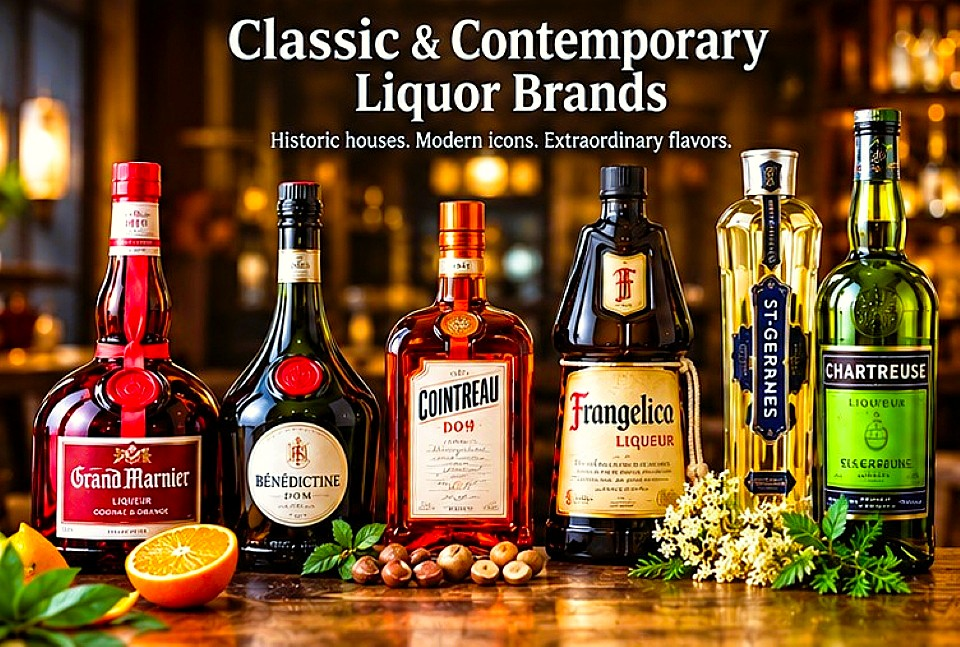
Classic and contemporary liquor brands including Grand Marnier, Bénédictine, Cointreau, Frangelico, St-Germain and Chartreuse
Why These Brands Became Global Icons
Look across this entire list and a pattern becomes obvious. The most recognizable liqueurs usually have a simple flavor identity.
-
-
- Baileys: cream + chocolate + vanilla
- Kahlúa: coffee + rum
- Frangelico: hazelnut
- St-Germain: elderflower
- Malibu: coconut
- Cointreau: orange
- Grand Marnier: orange + Cognac
- Aperol: orange + bittersweet herbs
- Campari: bitter orange + botanicals
- Jägermeister: herbs + spices
-
These are immediately understandable. That’s powerful from both a consumer and cocktail perspective.
You don’t need a sommelier to understand what a coffee liqueur does. You don’t need a spirits expert to imagine coconut in a tropical cocktail. And you don’t need to know every botanical in Bénédictine to understand that it can add sweetness and herbal complexity.
The world’s most successful liqueur brands have therefore managed to combine recognizable flavor, distinctive packaging, strong cultural identity and cocktail versatility.
Best Liquor Brands for Beginners
For someone building a home bar for the first time, extremely complex herbal liqueurs may not be the best starting point. A useful beginner selection would be:
Baileys
For:
-
-
- coffee
- dessert
- cream cocktails.
-
Cointreau
For:
-
-
- Margaritas
- Cosmopolitans
- Sidecars.
-
Kahlúa
For:
-
-
- Espresso Martinis
- White Russians
- coffee.
-
Grand Marnier
For:
-
-
- Margaritas
- French cocktails
- dessert.
-
Aperol
For:
-
-
- Spritzes
- aperitivo.
-
Disaronno
For:
-
-
- Amaretto Sours
- coffee
- dessert.
-
St-Germain
For:
-
-
- Spritzes
- Gin & Tonics
- Hugo cocktails.
-
Best Liquor Brands for Cocktails
If your primary objective is building cocktails, prioritize versatility.
Citrus
-
-
- Cointreau
- Grand Marnier
- Limoncello
-
Coffee
-
-
- Kahlúa
- Baileys
- Sheridan’s
- Licor 43
-
Herbal
-
-
- Bénédictine
- Campari
- Aperol
- Jägermeister
- Chartreuse
-
Fruit
-
-
- Chambord
- Hpnotiq
- Midori
-
Cream
-
-
- Baileys
- Amarula
- RumChata
-
Tropical
-
-
- Malibu
- Curaçao
-
Best Cream Liqueurs
Cream liqueurs are especially popular for coffee, dessert, holiday cocktails and fter-dinner drinks. The major names include Baileys, Amarula, RumChata and Sheridan’s.
Baileys Original is currently listed at 17% ABV, Amarula Cream at 17% ABV, while St-Germain, by comparison, is a non-cream liqueur at 20% ABV. (baileys.com) (amarula.com) (stgermainliqueur.com)
Cream liqueurs should be treated differently from shelf-stable high-proof spirits. Always check the individual producer’s storage recommendations.
Best Citrus Liqueurs
For anyone interested in classic cocktails, citrus liqueurs are essential.
-
-
- Cointreau: Bright orange.
- Grand Marnier: Orange with Cognac depth.
- Limoncello: Fresh lemon.
- Curaçao: Orange-driven and especially useful for tropical cocktails.
- Triple Sec: A broad category of orange liqueur.
-
With these four or five bottles, you can make dozens of classic drinks.
Best Herbal Liqueurs
For complexity:
-
-
- Bénédictine
- Jägermeister
- Becherovka
- Fernet-Branca
- Chartreuse
- Campari
- Averna
- Cynar
-
These can be used in:
-
-
- digestifs
- aperitifs
- highballs
- Negroni variations
- spirit-forward cocktails.
-
Best After-Dinner Liqueurs
For a post-meal drink, consider:
-
-
- Bénédictine
- B&B
- Baileys
- Amarula
- Frangelico
- Kahlúa
- Fernet-Branca
- Disaronno
- Sambuca
- Drambuie
-
Different styles suit different palates. Cream and coffee liqueurs are more dessert-like. Fernet and herbal digestifs are more bitter. Drambuie sits closer to a sweet whisky experience. B&B brings brandy and Bénédictine together.
Best Liqueurs for Coffee
Coffee is perhaps the single greatest common denominator among liqueurs.
Try:
-
-
- Kahlúa
- Baileys
- Frangelico
- B&B
- Amarula
- Sheridan’s
- Licor 43
- Disaronno
-
Classic combinations
-
-
- Kahlúa + espresso
- Baileys + coffee
- Frangelico + espresso
- B&B + coffee
- Amarula + coffee
-
Each produces a different balance of sweetness, cream, spice and roasted flavor.
Best Liqueurs for Dessert
Liqueurs can transform very simple desserts. Try:
Vanilla/cream
-
-
- Baileys
- RumChata
-
Coffee
-
-
- Kahlúa
- Sheridan’s
-
Hazelnut
-
-
- Frangelico
-
Orange
-
-
- Grand Marnier
- Cointreau
-
Lemon
-
-
- Limoncello
-
Raspberry
-
-
- Chambord
-
Marula fruit
-
-
- Amarula
-
These can be poured over ice cream, cake, fruit, coffee or incorporated into sauces and dessert cocktails.
Famous Liqueur Cocktails
The importance of these brands becomes especially clear when you look at cocktail history.
4. 1. Margarita: A classic combination of tequila + orange liqueur + lime. Cointreau and Triple Sec are particularly familiar in this family.
6. 2. Cosmopolitan: vodka + orange liqueur + cranberry + lime.
3. Sidecar: Cognac + orange liqueur + lemon.
4. White Russian: vodka + coffee liqueur + cream.
5. Espresso Martini: vodka + coffee liqueur + espresso.
6. Negroni: gin + Campari + sweet vermouth.
7. Aperol Spritz: Aperol + sparkling wine + soda. Aperol’s official recipe and brand materials identify the Spritz as its signature serve. (aperol.com)
8. Rusty Nail: Scotch + Drambuie.
9. French Martini: vodka + Chambord + pineapple.
10. Amaretto Sour: Disaronno/amaretto + lemon + sweetener.
11. Hugo Spritz: St-Germain + Prosecco + sparkling water + mint. St-Germain’s official FAQ identifies the Hugo as a modern classic based around elderflower liqueur, Prosecco, sparkling water and mint. (stgermainliqueur.com)
How to Build a Home Liqueur Bar
You don’t need 30 bottles. Start with six.
Bottle 1: Orange
Cointreau or another quality Triple Sec.
Bottle 2: Coffee
Kahlúa.
Bottle 3: Cream
Baileys.
Bottle 4: Herbal or bitter
Campari or Aperol.
Bottle 5: Nut
Disaronno or Frangelico.
Bottle 6: Floral
St-Germain.
That collection gives you enormous flexibility. You can make Margaritas, Cosmopolitans, White, Russians, Espresso Martinis, Spritzes, Sours, coffee drinks and dessert cocktails. Then expan according to your tastes.
How to Store Liqueurs
Most high-proof liqueurs don’t need refrigeration before opening, but storage depends on the product. Keep bottles upright, cool, dry and away from direct sunlight. Cream products deserve additional attention.
Baileys currently provides product-specific ingredient and storage information on its official Canadian site. Amarula says opened bottles should be refrigerated and consumed within six months.
St-Germain recommends consuming its natural elderflower liqueur within six months after opening and storing it away from bright light. (baileys.com) (amarula.com) (stgermainliqueur.com)
Always follow the specific bottle’s instructions.
How to Choose the Right Liquor or Liqueur
Instead of asking which bottle is universally “best,” ask what you’re making.
Margarita
Choose: Cointreau, Triple Sec or Grand Marnier.
Espresso Martini
Choose: Kahlúa.
White Russian
Choose: Kahlúa plus a cream component.
Spritz
Choose: Aperol or St-Germain.
Amaretto Sour
Choose: Disaronno or another amaretto.
Tropical cocktails
Choose: Malibu, Curaçao or Midori.
Coffee
Choose: Kahlúa, Baileys, Frangelico, Amarula or Licor 43.
Herbal cocktails
Choose: Bénédictine, Campari, Fernet-Branca, Chartreuse, Jägermeister
Whisky cocktails
Choose: Drambuie, B&B, Amaro or an appropriate herbal liqueur.
Why Packaging Matters
Several of these brands are recognizable before the bottle is even opened.
Think about:
-
-
- Jägermeister’s green glass
- Hpnotiq’s blue liquid
- Aperol’s orange
- Malibu’s white bottle
- Kahlúa’s dark coffee-colored liquid
- St-Germain’s elegant Art Deco-style bottle
- Sheridan’s split bottle
- Bénédictine’s distinctive decorated bottle
- Galliano’s extraordinarily tall bottle
-
The visual identity becomes part of the drinking experience. That matters particularly in bars and restaurants. A strong bottle can become a recognizable shelf marker, a cocktail ingredient, a gift and a cultural icon.
The Most Important Flavor Families
Rather than memorizing 40 individual names, divide the category into families.
Citrus
-
-
- Limoncello
- Cointreau
- Grand Marnier
- Triple Sec
- Curaçao
-
Coffee
-
-
- Kahlúa
- Sheridan’s
- Baileys
- Licor 43
-
Cream
-
-
- Baileys
- Amarula
- RumChata
-
Herbal
-
-
- Bénédictine
- Becherovka
- Jägermeister
- Fernet-Branca
- Chartreuse
-
Bitter Aperitivo
-
-
- Aperol
- Campari
- Averna
- Cynar
- Amaro Montenegro
- Nut
- Disaronno
- Frangelico
-
Floral
-
-
- St-Germain
-
Fruit
-
-
- Chambord
- Hpnotiq
- Midori
-
Tropical
-
-
- Malibu
- Curaçao
-
Anise
-
-
- Pernod
- Ricard
- Sambuca
-
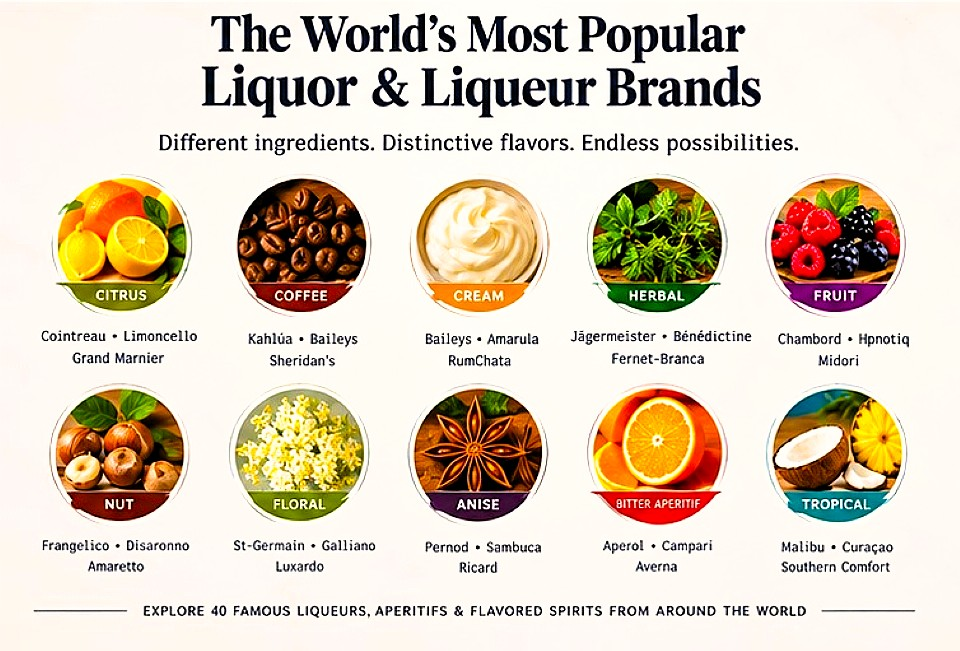
World’s popular liquor and liqueur flavor families including citrus, coffee, cream, herbal, fruit, nut, floral, anise and tropical
Frequently Asked Questions
What are the most popular liquor brands in the world?
There is no single authoritative worldwide ranking covering every liquor and liqueur category. Major internationally recognized names include Baileys, Kahlúa, Disaronno, Grand Marnier, Cointreau, Aperol, Campari, Jägermeister, Malibu, St-Germain and many others.
Is Baileys a liquor or liqueur?
Baileys is technically a cream liqueur.
What is Baileys made from?
Baileys Original combines Irish whiskey and spirits, Irish dairy cream, chocolate and vanilla flavors. (baileys.com)
What is the alcohol content of Baileys?
Baileys Original is currently listed at 17% ABV in Canada. (baileys.com)
What is Limoncello?
Limoncello is an Italian lemon liqueur made by extracting flavor from lemon peels and combining the resulting infusion with alcohol, water and sugar. Specific recipes vary by producer.
Where is Limoncello from?
It is strongly associated with southern Italy, particularly the Sorrento, Amalfi Coast and Capri areas. Italy’s Campania regional agriculture authority identifies Limoncello as a traditional product associated with Sorrento lemons. (agricoltura.regione.campania.it)
What is Disaronno?
Disaronno is a famous Italian liqueur associated with Saronno. Its official history traces the brand’s story to a Renaissance legend and says the modern brand is now available in more than 160 countries. (disaronno.com)
What is Grand Marnier?
Grand Marnier is a French liqueur combining Cognac with bitter orange. The flagship Cordon Rouge dates to 1880. (grandmarnier.com)
What is Kahlúa?
Kahlúa is a Mexican coffee liqueur made with Arabica coffee beans and rum. The brand dates to 1936. (kahlua.com)
What is Amarula?
Amarula is a South African cream liqueur made with marula fruit spirit. (amarula.com)
What is Aperol?
Aperol is an Italian aperitivo created in 1919, with a citrus and herbal bittersweet profile. It is currently listed at 11% ABV. (aperol.com)
What is Becherovka?
Becherovka is a Czech herbal liqueur produced in Karlovy Vary from a closely guarded recipe involving approximately 20 herbs and spices. (becherovka.com)
What is B&B liqueur?
B&B is a combination of Bénédictine and French brandy. The current producer describes its formula as 60% Bénédictine and 40% fine French brandy. (benedictinedom.com)
What is Bénédictine?
Bénédictine D.O.M. is a French herbal liqueur based on 27 plants and spices. (benedictinedom.com)
What is Campari?
Campari is an Italian bitter aperitivo whose history goes back to 1860. (campari.com)
What is Cointreau?
Cointreau is a French orange liqueur with a history beginning in 1849. Its current brand materials describe its recipe around sweet and bitter orange peels. (cointreau.com)
Is Cointreau the same as Triple Sec?
Not exactly. Triple Sec is a generic term for orange-flavored liqueurs, while Cointreau is a specific brand and product. Cointreau’s own official FAQ makes this distinction. (cointreau.com)
What is Drambuie?
Drambuie is a whisky liqueur made from aged Scotch whisky, spices, herbs and heather honey. (drambuie.com)
What is Jägermeister made from?
Jägermeister says its recipe contains 56 herbs, roots, blossoms and fruit. (jagermeister.com)
What is Fernet-Branca?
Fernet-Branca is an Italian amaro created in Milan in 1845 using a secret blend of botanicals. (fernetbranca.com)
What is Hpnotiq?
Hpnotiq is a blue-colored liqueur made with tropical fruit juices, French vodka and a touch of Cognac. The brand launched in 2001. (hpnotiq.com)
Is Malibu rum?
Malibu describes Malibu Original as a white-rum-based coconut-flavored liqueur, rather than calling the product simply coconut rum. (malibudrinks.com)
What is Pernod?
Pernod is a French aniseed liqueur made with star anise, fennel and other aromatic plants. (pernod-ricard.com)
What is Ricard?
Ricard is a French pastis created by Paul Ricard in 1932. (pernod-ricard.com)
What is RumChata?
RumChata is a cream liqueur inspired by Mexican-style horchata, with flavors associated with rice, cinnamon, vanilla and cream. (rumchata.ca)
What is St-Germain?
St-Germain is a French elderflower liqueur launched in 2007. It uses hand-picked elderflowers and has notes including pear, citrus and honeysuckle. (stgermainliqueur.com)
What is the most popular cream liqueur?
Baileys is one of the most internationally recognizable cream liqueur brands, but there is no single universal worldwide ranking covering every cream liqueur market.
What is the best orange liqueur?
Cointreau, Grand Marnier, Triple Sec and Curaçao each have different uses and flavor profiles. No single bottle is objectively best for every cocktail.
What is the best coffee liqueur?
Kahlúa is one of the world’s most recognizable coffee liqueur brands and is closely associated with White Russians, Black Russians and Espresso Martinis. (kahlua.com)
What is the best herbal liqueur?
The answer depends on whether you prefer bitter, sweet, spicy, anise-heavy or botanical flavors. Bénédictine, Jägermeister, Becherovka, Fernet-Branca and Chartreuse represent very different styles.
What is the best liqueur for an Espresso Martini?
Kahlúa is a classic choice, although Baileys, Frangelico and other coffee or cream liqueurs can create different variations.
What is the best liqueur for a Margarita?
Cointreau, Triple Sec and Grand Marnier are common choices.
What is the best liqueur for a Spritz?
Aperol, St-Germain, Campari and Limoncello can each produce very different Spritz styles.
What is the best liqueur for coffee?
Kahlúa, Baileys, Frangelico, Amarula, B&B, Sheridan’s and Licor 43 are all useful options.
What is the best liqueur for dessert?
Baileys, Grand Marnier, Limoncello, Frangelico, Amarula, Kahlúa and Chambord are particularly versatile.
Can you drink liqueurs neat?
Yes. Many liqueurs are designed to be enjoyed neat, chilled, over ice or mixed into cocktails.
Can you drink Baileys on ice?
Yes. The Baileys Canada site specifically suggests enjoying Original Irish Cream over ice. (baileys.com)
Can you drink St-Germain neat?
Yes, although the producer says St-Germain was designed especially for mixing and recommends it in cocktails such as the St-Germain Spritz. (stgermainliqueur.com)
Should liqueurs be refrigerated?
It depends on the specific product. Follow the producer’s storage instructions. Cream and natural-flower products can have more specific post-opening requirements. (amarula.com) (stgermainliqueur.com)
What is the difference between a liqueur and an aperitif?
A liqueur is primarily a category of flavored, generally sweetened spirit. An aperitif describes a beverage traditionally served before a meal; some aperitifs, such as Aperol and Campari, are also liqueur-like products.
What is an amaro?
Amaro is a broad Italian category of bittersweet herbal liqueurs traditionally associated with after-dinner drinking, although modern cocktail culture uses many amaros in aperitif and mixed drinks.
Is Campari an amaro?
Campari is generally categorized as a bitter aperitivo rather than simply being treated as a conventional amaro, although both belong to Italy’s wider bitter herbal liqueur culture.
Is Jägermeister a liqueur?
Yes. It is an herbal liqueur.
Is Baileys a spirit?
Baileys is a cream liqueur based on Irish whiskey and other spirits.
Is Limoncello a liquor?
In broad North American usage, yes, but technically it is a lemon liqueur.
Is Triple Sec a brand?
No. Triple Sec is a generic category/name used for orange liqueurs.
What is the most popular liqueur in the world?
There is no single current, universally accepted worldwide ranking covering all liqueur categories and markets.
Which liqueurs should every home bar have?
A practical core collection is orange liqueur, coffee liqueur, cream liqueur, bitter aperitivo, herbal liqueur and a floral or fruit liqueur.
Final Thoughts: The Most Popular Liquor Brands in the World
The world of liquor and liqueurs is enormous. And the most interesting thing about it is that these bottles aren’t competing for the same purpose. Every liqueur brings a different tool to the bar.
-
-
- Baileys brings cream.
- Kahlúa brings coffee.
- Grand Marnier brings orange and Cognac.
- Cointreau brings bright orange.
- Limoncello brings lemon.
- Frangelico brings hazelnut.
- St-Germain brings elderflower.
- Aperol brings bittersweet orange and herbs.
- Campari brings bitterness.
- Bénédictine brings botanicals and spice.
- Jägermeister brings an unmistakably herbal profile.
- Malibu brings coconut.
- Amarula brings marula and cream.
- RumChata brings a cinnamon-and-horchata-inspired character.
- Fernet-Branca brings intense bitterness and herbs.
-
That’s why building a liqueur collection is different from building a whisky collection. With whisky, you may compare:
-
-
- Scotch
- Bourbon
- Rye
- Irish whiskey
- Japanese whisky.
-
With liqueurs, you’re assembling a flavor palette.
-
-
- One bottle supplies citrus.
- Another supplies coffee.
- Another supplies herbs.
- Another supplies sweetness.
- Another supplies cream.
- Another supplies tropical fruit.
-
The result is an enormous cocktail vocabulary. With only Cointreau, Kahlúa, Baileys, Aperol, Campari and St-Germain, you can already make a remarkable range of drinks.
And once you add Disaronno, Grand Marnier, Frangelico, Limoncello, Chambord and Malibu the number of possibilities expands dramatically. That’s why the world’s most recognizable liqueur brands have become such important parts of cocktail culture.
They are easy to understand. They’re highly distinctive. And they are useful. The best brands also have stories.
-
-
- Baileys emerged from combining Irish whiskey and cream.
- Kahlúa began in Mexico in 1936.
- Aperol dates to 1919.
- Campari dates to 1860.
- Cointreau began in 1849.
- Jägermeister developed a secret botanical recipe in Germany.
- Bénédictine has a centuries-old identity associated with Fécamp.
-
St-Germain is comparatively young, launching in 2007 but quickly becoming one of the recognizable modern elderflower brands. (baileys.com) (kahlua.com) (aperol.com) (campari.com) (cointreau.com) (jagermeister.com) (stgermainliqueur.com)
Those histories have become part of the value of the bottle. And packaging reinforces that identity.
-
-
- Jägermeister’s angular green bottle.
- Hpnotiq’s electric blue color.
- Malibu’s famous white bottle.
- Galliano’s tall silhouette.
- Sheridan’s split bottle.
- St-Germain’s elegant presentation.
-
These aren’t incidental details. They help consumers recognize the products immediately. But the most important factor is still what’s inside.
Flavor. That’s what makes a liqueur useful. For a beginner, start with the classics.
-
-
- Cointreau for orange.
- Kahlúa for coffee.
- Baileys for cream.
- Aperol for bittersweet aperitivo.
- St-Germain for elderflower.
-
Then choose one direction that interests you.
-
-
- Love dessert? Add Frangelico, Amarula, RumChata or Disaronno.
- Love classic cocktails? Add Campari, Bénédictine, Luxardo, Chartreuse or Cointreau.
- Love tropical drinks? Add Malibu, Curaçao, Midori.
- Love bitter drinks? Explore Fernet-Branca, Averna, Cynar, Amaro Montenegro.
- Love anise? Try Pernod, Ricard or Sambuca.
-
This is a much better way to explore the category than buying bottles randomly. Build according to flavor. And don’t overlook food. Liqueurs can become part of a complete dining experience.
-
-
- Limoncello with lemon desserts.
- Grand Marnier with chocolate and orange desserts.
- Baileys with coffee.
- Frangelico with hazelnut desserts.
- Amarula with chocolate.
- Bénédictine with rich cheese and after-dinner service.
- Campari with Italian aperitivo.
- Aperol with light appetizers.
-
The possibilities are almost endless. The cocktail bar is where the category really comes alive, however.
-
-
- Take one classic: Margarita.
- Use: Cointreau.
- Now change the orange liqueur to: Grand Marnier.
- Make it with: Triple Sec.
-
It changes again. That’s why liqueurs matter. They allow small changes to create very different drinks.
The same thing happens with coffee.
-
-
- Use: Kahlúa.
- Then: Frangelico.
- Then: Baileys.
- Then: Amarula.
-
The underlying coffee remains. But the drink becomes entirely different. That’s the real strength of these bottles. They are modular flavor components. And that is why some of the world’s oldest liqueur houses remain highly relevant in modern cocktail culture.
At the same time, newer brands continue to create new categories. St-Germain is a good example. The brand launched in 2007 and deliberately positioned itself around cocktail culture and the distinctive flavor of fresh elderflower. (stgermainliqueur.com)
It shows that the liqueur category isn’t frozen in history. New flavor ideas can still become global cocktail staples. The same is true of modern uses for existing bottles.
-
-
- Aperol is no longer just an Italian aperitivo. It is now a global Spritz ingredient.
- Kahlúa is no longer simply a coffee liqueur. It’s a major part of contemporary Espresso Martini culture.
- Campari goes far beyond neat service.
- Bénédictine appears in sophisticated cocktails.
- Fernet-Branca has moved from digestif tradition into modern bartender culture.
-
The world of liqueurs is therefore both historic and constantly evolving. And that’s what makes it such an important part of the global spirits industry. So when you’re choosing your next bottle, think about the flavor you want to add to your bar.
-
-
- Want brightness? Cointreau.
- Want lemon? Limoncello.
- Want coffee? Kahlúa.
- Want cream? Baileys.
- Want bitterness? Campari.
- Want herbs? Bénédictine.
- Want tropical fruit? Malibu.
- Want elderflower? St-Germain.
- Want hazelnut? Frangelico.
- Want a bold herbal digestif? Fernet-Branca.
- Want a Scotch-based liqueur? Drambuie.
- Want a classic Italian almond-style liqueur? Disaronno.
-
There is no need to own everything. A thoughtfully chosen six-to-eight-bottle collection can cover a huge amount of cocktail territory. And once you understand the flavor families, you’ll know exactly where to go next.
That’s ultimately why the world’s most popular liquor and liqueur brands continue to matter. They aren’t simply famous names on shelves. They are building blocks of cocktail culture.
They connect:
-
-
- Italy
- France
- Ireland
- Scotland
- Germany
- Mexico
- South Africa
- the Czech Republic
- Japan
- Greece
-
and many other traditions through a single international language: the cocktail.
Whether you’re making an Aperol Spritz on a summer afternoon, an Espresso Martini after dinner, a Margarita for friends, a White Russian on a winter evening or a classic Negroni before a meal, the liqueur often provides the flavor that makes the drink memorable.
And that’s why these bottles deserve a permanent place in the story of the world’s great spirits.