
Blog
Most Popular Calvados Brands in the World: 30 Famous Normandy Calvados Bottles to Know

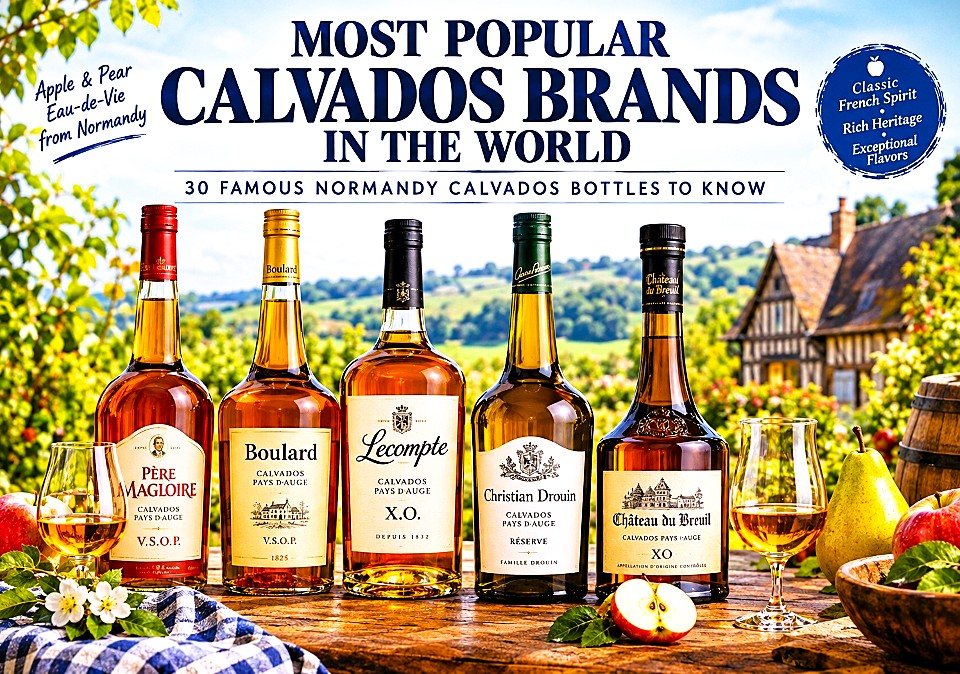
Calvados is one of France’s great regional spirits—and one of the most distinctive apple-based spirits in the world.
Made in Normandy and surrounding approved areas from cider apples and, depending on the appellation, perry pears, Calvados turns orchard fruit into an aromatic eau-de-vie that can range from fresh and floral to deeply mature, spicy, woody and dessert-like.
France’s INAO describes Calvados as an eau-de-vie made from cider apples and perry pears, with the distillate matured in oak for at least two years; it can be distilled either by double distillation in a pot still or continuously in a column still, depending on the appellation and producer.
The category is much larger and more diverse than many drinkers realize. There are major internationally exported houses, small family estates, organic farms, Domfrontais producers specializing in pear-rich spirits, and specialist houses known for old or vintage bottlings.
The official Calvados France tourism organization currently identifies Père Magloire, Calvados Boulard and Lecompte together as three leading Calvados brands. It also maintains a producer directory spanning the wider Calvados, Calvados Pays d’Auge and Calvados Domfrontais appellations.
This article therefore uses “most popular” in a broad editorial sense. It combines international recognition, export reach, historical importance, category significance, producer visibility and interest among Calvados enthusiasts. It is not an official worldwide sales ranking.
That distinction matters because a large international brand and a small estate producer can both be important for completely different reasons.
Let’s explore the world of Calvados.
Table of Contents
-
-
- What Is Calvados?
- Where Is Calvados Made?
- The Three Calvados Appellations
- Calvados vs. Calvados Pays d’Auge
- Calvados vs. Calvados Domfrontais
- How Calvados Is Made
- Apple Varieties Used for Calvados
- The Role of Pears
- How Calvados Is Aged
- What VS, VSOP and XO Mean
- Vintage Calvados
- How to Read a Calvados Label
- 30 Popular Calvados Brands and Producers
- Best Calvados for Beginners
- Best Calvados for Sipping
- Best Calvados for Cocktails
- Best Calvados for Gifts
- Calvados and Food Pairing
- How to Taste Calvados
- Calvados Cocktails
- Café Calva and Trou Normand
- Calvados Tourism
- Current Calvados Trends
- Frequently Asked Questions
- Final Thoughts
-
What Is Calvados?
Calvados is a French apple- and pear-based eau-de-vie from Normandy and approved surrounding areas.
Its starting point is not distilled spirit. It’s fruit.
The fruit is pressed into juice, fermented into cider or perry, and then distilled. The resulting clear eau-de-vie is aged in oak until it develops the amber color and complex flavors associated with mature Calvados.
INAO says Calvados is produced from cider apples and perry pears, while the official Calvados site describes the production process as moving from orchard to fruit selection, fermentation, distillation and oak maturation.
The result can taste surprisingly different depending on:
-
-
- fruit varieties
- terroir
- distillation method
- barrel type
- length of aging
- blending decisions.
-
A young Calvados can smell of:
-
-
- fresh apple
- pear
- white flowers
- citrus.
-
An older expression can develop:
-
-
- baked apple
- vanilla
- honey
- walnut
- spice
- caramel
- oak.
-
The official Calvados organization describes this evolution from fresh fruit aromas toward cooked fruit, wood, vanilla, honey, spice and nutty notes as maturation progresses.
Where Is Calvados Made?
Calvados is produced within a large geographical area of Normandy and nearby departments.
INAO currently describes an appellation area covering roughly 1,600 communes, extending across parts of Calvados, Orne, Manche, Eure, Seine-Maritime, Mayenne, Sarthe, Oise and Eure-et-Loir.
That sounds large—and it is. But not all Calvados tastes the same. The landscape ranges from the apple-rich Pays d’Auge to the pear-dominated Domfrontais. Those geographical distinctions are central to understanding the category.
The Three Calvados Appellations
The official Calvados organization describes three appellations:
1. Calvados: The broadest appellation. It permits either continuous column distillation or pot-still distillation.
2. Calvados Pays d’Auge: A more tightly defined appellation centered on the Pays d’Auge. It requires at least 70% apples, and distillation must be performed using a pot still with double distillation. The resulting eaux-de-vie must be aged in oak for at least two years.
3. Calvados Domfrontais: The distinctive pear-rich appellation. It requires at least 30% perry pears, uses column distillation, and requires at least three years of oak aging.
These aren’t simply marketing names. They describe different production traditions.
Calvados vs. Calvados Pays d’Auge
For many enthusiasts, Pays d’Auge represents one of the most prestigious and traditional branches of Calvados.
The appellation requires:
-
-
- at least 70% apples
- double distillation in pot stills.
-
INAO says Pays d’Auge Calvados develops fruit-derived aromas that evolve during aging toward cooked fruit, dried fruit, spice and wood.
Many famous houses are associated with Pays d’Auge, including:
-
-
- Boulard
- Lecompte
- Christian Drouin
- Domaine Dupont
- Roger Groult
- Château du Breuil
- Père Jules.
-
That makes Pays d’Auge one of the best places to start a serious Calvados tasting.
Calvados vs. Calvados Domfrontais
Domfrontais offers a dramatically different experience. The appellation requires at least 30% perry pears, while the best-known traditional producers may use much more.
INAO describes young Domfrontais as strongly fruit-driven, with pear prominence, while aging adds pastry, dried-fruit, toasted and spicy notes.
The Lemorton estate, for example, says its Calvados contains roughly 70% pears in the cider destined for distillation, well above the 30% minimum required by the appellation.
That’s why Domfrontais can be one of the most fascinating directions for an experienced Calvados drinker.
How Calvados Is Made
The process begins in the orchard. The official Calvados organization says there are approximately 3 million trees and 300 houses connected with Calvados production. Fruit is generally harvested from September through mid-December depending on variety.
The apples are divided into four broad families:
-
-
- bitter
- bittersweet
- sweet
- tart.
-
Different proportions create the balance of:
-
-
- sugar
- tannin
- acidity
- aromatic complexity.
-
The fruit is sorted, washed, crushed and pressed. The juice then ferments naturally.
The official production guide says the fermentation period must be at least 21 days for Calvados and Calvados Pays d’Auge, and 30 days for Calvados Domfrontais before distillation. Then comes the still.
The Role of Distillation
Distillation is one of the biggest reasons Calvados styles differ. The broad Calvados appellation permits:
-
-
- pot-still distillation
- continuous column distillation.
-
Calvados Pays d’Auge requires double distillation in a traditional pot still. Calvados Domfrontais requires column distillation. The still determines which volatile compounds survive and how the final eau-de-vie feels.
The official Calvados organization describes the fresh distillate as unexpectedly floral and fruity, with oak and time later giving it color, depth and maturity.
Apple Varieties Used for Calvados
One of the category’s great secrets is that these are cider apples, not ordinary dessert apples.
The official INAO information lists hundreds of recognized apple and pear varieties, with 230 cider-apple varieties and 121 perry-pear varieties recorded for Calvados production.
This matters because cider apples can contain significantly more tannin and acidity than standard eating apples. Those compounds become important during fermentation and maturation. That is part of why serious Calvados can taste far more complex than simple “apple brandy.”
The Role of Pears
Pears aren’t merely a secondary ingredient. In Domfrontais, they can dominate. The region has a long tradition of high-stem perry pear trees.
INAO says Calvados Domfrontais requires a minimum of 30% perry pears, while some estates use substantially more.
Domfrontais producers such as Lemorton, Pacory, Victor Gontier and Comte Louis de Lauriston are therefore particularly useful for discovering pear-driven Calvados.
How Calvados Is Aged
Freshly distilled Calvados is clear. Oak changes everything.
The official Calvados organization says Calvados can only be marketed after a minimum aging period depending on appellation, and that aging takes place in specified oak. During maturation, alcohol and liquid volume gradually decline through natural evaporation—the so-called “angel’s share.”
A young spirit may spend time in relatively smaller new-oak barrels before moving into older, larger casks. Other houses use large older foudres.
As maturation continues, fresh apple can evolve into:
-
-
- baked apple
- vanilla
- honey
- spice
- walnut
- caramel
- dried fruit.
-
What VS, VSOP and XO Mean
Calvados uses age categories similar to other French spirits, but the exact framework is specific to Calvados. The official Calvados label guide states:
-
-
- VS / Three Stars / Three Apples: minimum 2 years
- Réserve / Vieux: minimum 3 years
- VO / VSOP / Vieille Réserve: minimum 4 years
- Hors d’Âge / XO / Très Vieille Réserve / Napoléon / Extra: minimum 6 years.
-
One important detail:
For blends, an age statement refers to the youngest Calvados in the blend. So a Calvados labeled “20 years” can contain older eaux-de-vie as well.
Vintage Calvados
Vintage Calvados is different.
The official label guide explains that vintage bottlings are composed of eaux-de-vie distilled in the same year, with that year displayed on the label. It also recommends identifying the bottling year because Calvados does not continue aging in the bottle.
This makes vintage Calvados especially interesting to collectors. You can compare:
-
-
- 1995
- 2000
- 2005
- 2010
-
and see how different harvest years and maturation histories affect the spirit.
How to Read a Calvados Label
Look for:
-
-
- Appellation
- Producer
- Age
- Vintage
- Blend
- Distillation information
- Bottling strength
-
A label saying::
Calvados Pays d’Auge: immediately tells you that you are dealing with a more specific apple-focused appellation and double-distillation tradition.
A label saying:
Calvados Domfrontais: signals the pear-rich tradition. And a vintage year tells you the spirit’s distillation year rather than simply how old the bottle itself is.
30 Most Popular and Notable Calvados Brands in the World
1. Père Magloire
Origin: Normandy
Père Magloire is one of the historic names in Calvados. The official Calvados tourism organization says the brand has embodied Normandy heritage since 1821 and produces a broad range of Calvados for different drinking occasions.
The brand has long been one of the best-known names internationally and has strong historical importance.
Best for:
-
-
- Beginners
- Classic Normandy character
- Cocktails
- Gifts
-
2. Calvados Boulard
Origin: Pays d’Auge
Boulard is one of the most internationally visible Calvados houses. The official Calvados tourism organization describes Boulard as one of its three leading Calvados brands, while Boulard’s current site offers expressions ranging from Grand Solage and VSOP to XO, Auguste XO and Extra.
Its VSOP is made from Calvados Pays d’Auge aged at least four years and then blended and rested to develop harmony.
Best for:
-
-
- Classic cocktails
- Sipping
- Premium gifts
-
3. Lecompte
Origin: Normandy
Lecompte is another internationally recognized Calvados house and is grouped by the official Calvados tourism organization with Père Magloire and Boulard as three leading brands. The brand is especially associated with a premium, luxury-oriented positioning and Pays d’Auge Calvados.
Best for:
-
-
- Premium sipping
- Gifts
- Fine dining
-
4. Busnel
Origin: Cormeilles, Pays d’Auge
Distillerie Busnel was founded in 1820, and Calvados Tourism describes it as the first major Calvados house. Visitors can still see its working distillery in the Pays d’Auge.
Best for:
-
-
- Classic French brandy enthusiasts
- Pays d’Auge exploration
- Tourism
-
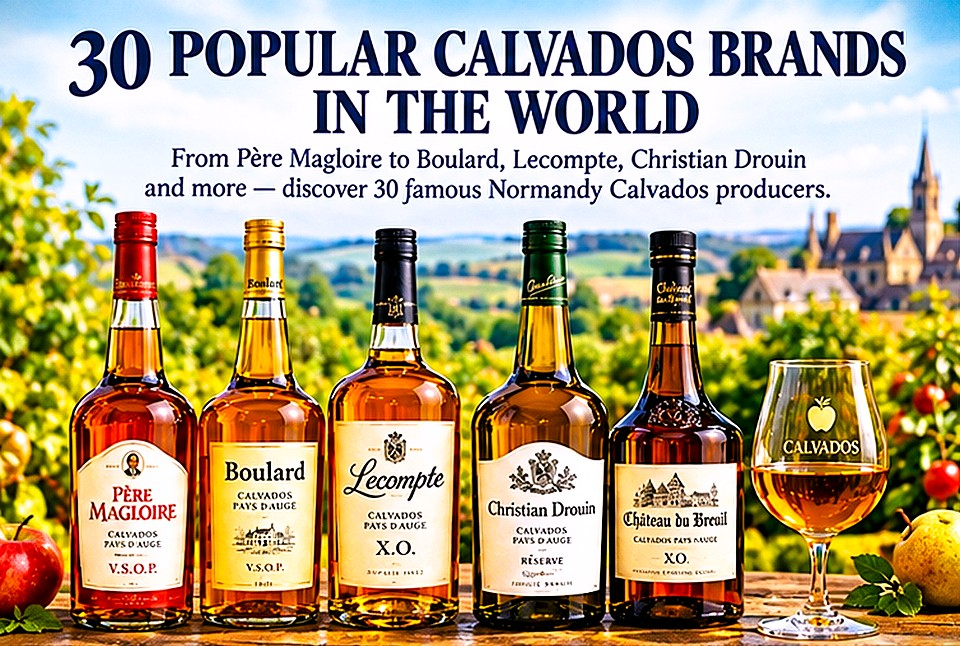
30 popular Calvados brands including Père Magloire, Boulard, Lecompte, Christian Drouin, Château du Breuil and other Normandy producers
5. Christian Drouin
Origin: Pays d’Auge
Christian Drouin has built an international reputation around traditional Pays d’Auge production and, particularly, vintage Calvados.
Calvados Tourism describes the house as a family-owned craft distillery specializing in vintage Calvados, while the producer says it exports to dozens of countries and has accumulated more than 230 gold medals in spirits competitions.
Best for:
-
-
- Vintage Calvados
- Collectors
- Premium sipping
- Cocktails
-
Its young Calvados Sélection is explicitly recommended for long drinks, cocktails and gourmet recipes.
6. Domaine Dupont
Origin: Pays d’Auge
The Dupont family has produced cider and Calvados since 1887. The estate covers about 30 hectares in the Pays d’Auge, where the family produces ciders, Calvados and related apple products.
Best for:
-
-
- Terroir-focused tasting
- Premium sipping
- Food pairing
-
7. Roger Groult
Origin: Pays d’Auge
Roger Groult is one of the best-known independent family distilleries in Pays d’Auge. The house says its family distillery was created in 1960, and that the family has preserved natural fermentation and double wood-fired distillation through five generations.
Its cellars contain around 400 barrels and foudres ranging from small casks to very large vessels.
Best for:
-
-
- Traditionalists
- Estate character
- Sipping
-
8. Domaine du Coquerel
Origin: Manche
Founded in 1937, Domaine du Coquerel remains a family-owned independent producer. The estate says it cultivates more than 40 AOC apple varieties, naturally ferments its cider, distills over three copper columns and ages Calvados in French oak, including ex-Cognac, Port, rum and wine casks.
Best for:
-
-
- Modern Calvados
- Cask finishes
- Cocktails
- Experimentation
-
Its current collection includes bourbon- and cacao-finished expressions alongside older Calvados.
9. Calvados Morin
Origin: Ivry-la-Bataille
Calvados Morin dates back to 1889. The family house specializes in blending and aging, with underground 19th-century cellars.
Its current range includes:
-
-
- 10 Year
- 15 Year
- 20 Year XO
- 25 Year Napoléon
- 35 Year Henri IV
- and vintage bottlings.
-
Best for:
-
-
- Mature Calvados
- Collectors
- Vintage exploration
-
10. Château du Breuil
Origin: Pays d’Auge
Château du Breuil is one of the most visually distinctive Calvados houses, operating from a historic château in Le Breuil-en-Auge. Calvados Tourism describes it as one of the prestigious Calvados distilleries and says it exports to more than 60 countries.
Best for:
-
-
- International availability
- Gifts
- Tours
- Pays d’Auge Calvados
-
11. Le Père Jules
Origin: St-Désir de Lisieux
The Père Jules family has been producing since 1919, according to Calvados Tourism. Its products are made from selected apple and pear varieties grown in traditional high-stem orchards within protected appellation areas.
Best for:
-
-
- Traditional Normandy
- Family-estate tasting
-
12. Didier Lemorton
Origin: Domfrontais
Lemorton is one of the most interesting names for people who want pear-driven Calvados Domfrontais. The family estate specializes in old vintage Domfrontais Calvados, with a high proportion of pears in the cider destined for distillation.
Best for:
-
-
- Vintage Domfrontais
- Pear-rich Calvados
- Collectors
-
13. Pacory — Ferme des Grimaux
Origin: Domfront
Pacory is a family farm in the heart of the Domfront region, where pears play an important role in local cider culture. The estate maintains high-stem orchards and produces Calvados Domfrontais, perry, cider and Pommeau.
Best for:
-
-
- Domfrontais exploration
- Farm-produced spirits
-
14. Domaine de la Galotière
Origin: Pays d’Auge
Domaine de la Galotière is a family estate dating to the 17th century, with organic farming since 1997. The estate produces Pays d’Auge Calvados from about 3 years to more than 20 years and grows around 50 apple varieties.
Best for:
-
-
- Organic Calvados
- Terroir exploration
- Mature bottles
-
15. Domaine de la Flaguerie
Origin: Bessin
Domaine de la Flaguerie is a family farm with roots dating to 1835. The estate manages more than 40 hectares organically and produces cider, Pommeau and Calvados from its orchards.
Best for:
-
-
- Organic spirits
- Farm-to-bottle Calvados
-
16. Domaine de la Duretière
Origin: Domfrontais / northern Mayenne
This organic family farm covers 17 hectares and lies within the Calvados Domfrontais, Calvados and Pommeau de Normandie appellations. The estate combines apple and ancestral pear varieties.
Best for:
-
-
- Domfrontais
- Organic producers
- Food pairing
-
17. Calvados Garnier
Origin: Normandy Bocage
Distillerie Garnier was founded in 1877 and remains a five-generation family business. The official Calvados directory describes its Calvados as notably fruity and authentic.
Best for:
-
-
- Traditional styles
- Regional tasting
-
18. Domaine des Hauts Vents
Origin: Roumois
The Caboulet family has maintained its cider-based tradition for three generations. The estate was established in the Calvados appellation area in 1936 and produces cider, perry, Pommeau and oak-aged Calvados.
Best for:
-
-
- Traditional estate tasting
- Normandy tourism
-
19. Théo Capelle
Origin: Cotentin
The Capelle family has championed Normandy products since 1981. Ludovic Capelle began distilling the family’s own Calvados after installing a still in 2008, and in 2015 created the Kapelwick aperitif Calvados brand with 3-, 5-, 7- and 9-year expressions.
Best for:
-
-
- Younger Calvados
- Modern aperitifs
- Regional producers
-
20. Victor Gontier
Origin: Domfrontais
Victor Gontier is a three-generation farm producer in the Domfrontais appellation. Its Calvados is made from cider apples and perry pears grown on the estate and is sold as vintage Calvados from a single distillation year.
Best for:
-
-
- Vintage Domfrontais
- Pear and apple character
-
21. Comte Louis de Lauriston
Origin: Domfront
This house has a remarkable history. The Domfront cellars were created to help end illicit Calvados production in the region, and today they hold historic stocks and vintage Calvados from multiple decades. The producer says its vintages are exported to more than 20 countries.
Best for:
-
-
- Vintage Calvados
- Domfrontais history
- Collectors
-
22. Ferme de Billy
Origin: Rots
Ferme de Billy is a family-oriented Normandy producer and an official member of the Calvados producer network. Its identity centers on local tradition, nature and agricultural authenticity.
Best for:
-
-
- Farm-based experiences
- Normandy tourism
-
23. Maison Hérout
Origin: Cotentin
Founded in 1946, Maison Hérout became a pioneer in organic cider production from the 1970s onward. The house is useful for readers interested in organic Normandy cider and Calvados traditions.
Best for:
-
-
- Organic production
- Cotentin styles
-
24. Domaine Duclos-Fougeray
Origin: Pays de Bray
Domaine Duclos-Fougeray is a ciderie-distillery located in a traditional Normandy farm building. It produces:
-
-
- cider
- Pommeau
- Calvados
- apple juice
- cider vinegar.
-
Best for: Farm-to-bottle exploration
25. Manoir d’Apreval
Origin: Pennedepie
This producer is particularly distinctive because its vineyards of cider apples sit near the sea. The estate grows 17 Pays d’Auge cider-apple varieties across about 20 hectares of organic orchards.
Best for:
-
-
- Organic Pays d’Auge
- Terroir
- Sea-influenced Normandy
-
26. Distillerie La Monnerie
Origin: Cerisy-Belle-Etoile
La Monnerie provides one of the more atmospheric Calvados experiences, with cellars containing century-old casks, according to Calvados Tourism.
Best for:
-
-
- Traditional cellars
- Long-aged spirits
- Tourism
-
27. Domaine de la Touche
Origin: Montabard
Domaine de la Touche produces Calvados using fruit from its own orchards, with traditional methods and hand harvesting. The producer describes its farming as avoiding pesticides.
Best for:
-
-
- Small-estate Calvados
- Traditional production
-
28. Ferme de Cutesson
Origin: Vimoutiers, Pays d’Auge
Ferme de Cutesson is a 65-hectare family farm that has been managed organically since 1996. The farm sells its products through local and specialized channels, making it a strong example of a small-scale Normandy producer.
Best for:
-
-
- Organic Calvados
- Local producer discovery
-
29. Ferme de la Vallée au Tanneur
Origin: Repentigny
This traditional organic farm combines Normandy cattle with high-stem apple orchards. That agricultural model reflects the classic pré-verger landscape in which livestock and orchard farming coexist.
Best for:
-
-
- Traditional Normandy landscapes
- Farm-based Calvados
-
30. Domaine des 5 Autels
Origin: Valambray
Domaine des 5 Autels is an official Normandy family estate whose identity combines Calvados production with environmental stewardship.
Best for:
-
-
- Independent estates
- Regional exploration
-
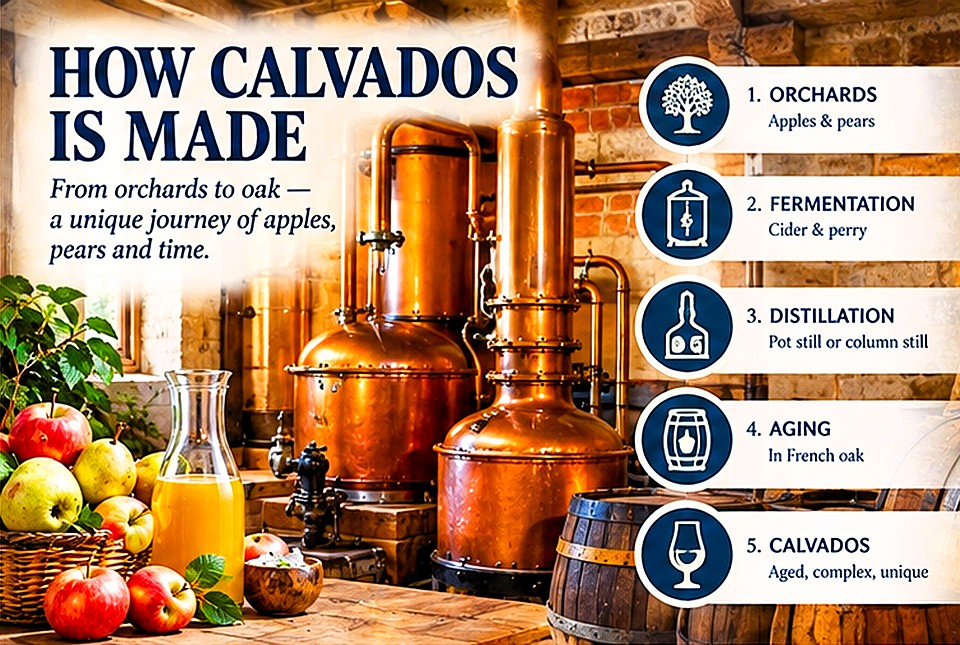
How Calvados is made from Normandy apples and pears through fermentation, distillation and oak aging
Best Calvados for Beginners
New to Calvados? You don’t need to start with a 20-year-old vintage. A young or medium-aged blend is often much easier to understand.
Good styles to explore include:
-
-
- Père Magloire
- Boulard Grand Solage
- Lecompte
- Busnel
- Christian Drouin Sélection
- Domaine Dupont
-
A younger Calvados usually emphasizes:
-
-
- fresh apple
- pear
- flowers
- brightness.
-
This makes it easier to recognize what the spirit itself tastes like before oak and age become dominant.
Best Calvados for Sipping
For sipping, explore:
-
-
- VSOP
- XO
- Hors d’Âge
- Vintage
-
The official Calvados organization recommends a tulip glass for mature Calvados because the shape concentrates aromas. It describes mature expressions as especially suited to quiet after-dinner drinking, often showing woody, caramelized and long-lasting flavors.
Producers worth exploring
-
-
- Christian Drouin
- Roger Groult
- Domaine Dupont
- Calvados Morin
- Comte Louis de Lauriston
- Lemorton
- Domaine de la Galotière
-
Best Calvados for Cocktails
Young Calvados is often the smartest choice for cocktails. The official Calvados organization says younger two-to-four-year-old expressions are particularly suited to convivial occasions and that fresh, fruity or floral aromas work well in cocktails.
It also maintains a dedicated cocktail section featuring drinks including:
-
-
- Corpse Reviver No. 1
- Calva Seoul
- Apple Mojito
- Appletini
- Calvados Tonic
- Calvaspresso
- Jack Rose
- Calva Limo.
-
That makes Calvados unusually versatile.
Best Calvados for Gifts
For gifts, presentation matters. Good choices include:
-
-
- Boulard XO
- Lecompte
- Christian Drouin
- Calvados Morin
- Château du Breuil
- Comte Louis de Lauriston
- Special vintage bottlings.
-
A gift recipient who enjoys whisky or Cognac may be especially interested in an older Calvados because it offers a completely different fruit-driven profile.
Calvados and Food Pairing
Calvados is an excellent food spirit. The official Calvados organization recommends different styles with different courses.
VS
Works particularly well chilled or “frozen” with smoked fish and caviar.
VSOP
Pairs well with foie gras and Normandy cheeses.
Mature Calvados
Works with:
-
-
- roast poultry
- veal
- pork with apples
- lamb
- duck
- scallops
- lobster
- prawns
- desserts.
-
The apple connection makes Calvados especially natural with:
-
-
- apple tart
- Tarte Tatin
- pear desserts
- chocolate cakes
- coffee.
-
The “Trou Normand”
One of Normandy’s most famous culinary customs is the Trou Normand. The official Calvados organization traces this practice back to the 18th century, describing it as a small serving of Calvados during a large meal, traditionally intended to refresh the palate and stimulate appetite.
It is sometimes accompanied by sorbet. It is one of the clearest examples of how deeply Calvados is integrated into French culinary culture.
Café Calva
Coffee and Calvados are another classic Norman pairing. The official Calvados site describes Café-Calva as a tradition more than a century old, with several traditional serving styles, including:
-
-
- café-goutte
- la rincette
- le canard.
-
The category has also moved into modern mixology through drinks such as Calvaspresso. That makes coffee one of the most natural ingredients to experiment with.
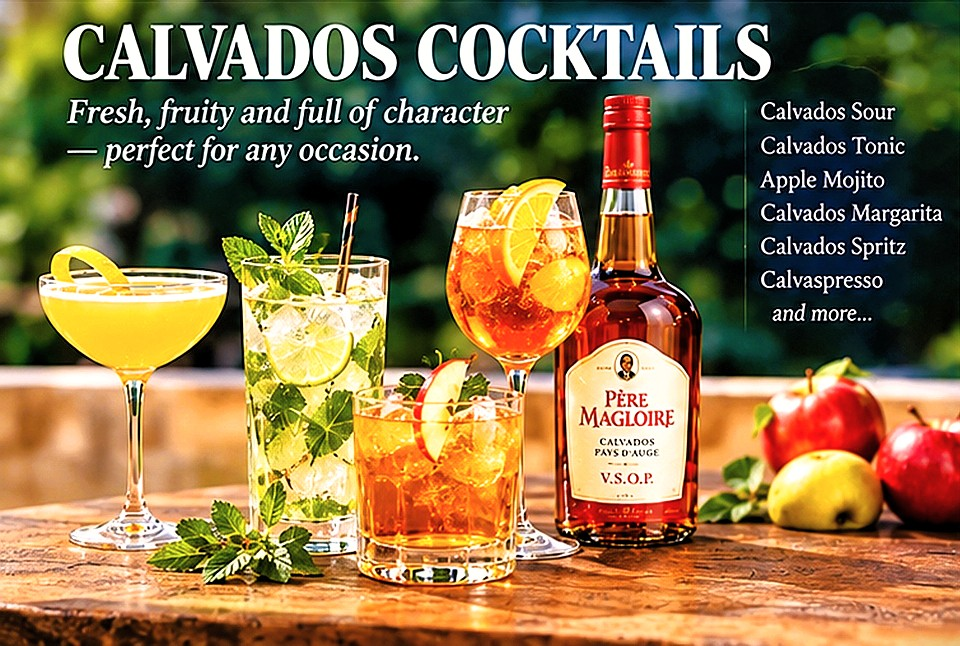
Calvados cocktails including Calvados Sour, Calvados Tonic, Apple Mojito, Calvados Spritz and Calvaspresso
How to Taste Calvados
Pour a small amount into a tulip glass. Observe the color. Then smell gently.
Look for:
-
-
- apple
- pear
- flowers
- vanilla
- oak
- spice
- dried fruit
-
Take a small sip. Pay attention to the transition.
Young Calvados
-
-
- Fresh.
- Fruity.
- Floral.
-
Mature Calvados
-
-
- Rounder.
- Spicier.
- More oaky.
- More complex.
-
Vintage Calvados
Potentially very individual, reflecting a particular distillation year and maturation history. The official label guide stresses that a vintage year identifies eaux-de-vie distilled in that year, and that the spirit no longer ages after bottling.
Calvados Cocktails Worth Trying
Calvados isn’t only a sipping spirit. Some of the most interesting modern drinks use it as a substitute for:
-
-
- whisky
- brandy
- rum
- gin.
-
Calvados Tonic
-
-
- 45 ml Calvados
- 100–120 ml tonic
- Lemon peel
-
Calvados Sour
-
-
- 50 ml Calvados
- 25 ml lemon juice
- 15 ml simple syrup
- 2 dashes bitters
-
Apple Mojito
-
-
- 45 ml Calvados
- Lime
- Mint
- Sugar
- Soda
-
Calvaspresso
Calvados combined with espresso creates a richer after-dinner drink. The official Calvados cocktail collection confirms that these modern formats are increasingly part of the category.
Why Calvados Works So Well in Cocktails
Calvados has a natural advantage. It already contains a fruit identity. That means it works with:
-
-
- lemon
- lime
- orange
- ginger
- apple
- pear
- coffee
- vanilla
- honey
- bitters.
-
A young Calvados can brighten a drink. A VSOP can add depth. An older XO can create a powerful spirit-forward cocktail. This is one reason bartenders continue to rediscover it.
Current Calvados Trends
The category is evolving rapidly. The official Calvados production site says classic age statements and vintage expressions remain dominant, while newer formats such as:
-
-
- single cask
- cask strength
- finish in Bourbon, whisky, Sherry or Sauternes casks are gaining ground.
-
Domaine du Coquerel is a particularly clear example, with current releases featuring bourbon, cacao and other cask-finished expressions.
Christian Drouin is also experimenting with new formats. Its Sélection is explicitly positioned for cocktails and long drinks, while ABC de Christian Drouin combines young Calvados with botanical and spice infusions inspired by vermouth production.
These developments point to a broader trend: Calvados is moving beyond the after-dinner snifter.
It is becoming:
-
-
- a cocktail spirit
- a food-pairing spirit
- a cask-finished spirit
- a collector’s spirit.
-
Calvados and Sustainability
Sustainability is also becoming increasingly important. Several estates emphasize:
-
-
- organic orchards
- high-stem trees
- biodiversity
- natural fermentation
- farm-to-bottle production.
-
Domaine de la Flaguerie manages its orchards organically, while Domaine de la Galotière has been organic since 1997. Domaine de la Duretière is also an organic family farm in the Domfrontais region.
Domaine du Coquerel currently highlights its orchard biodiversity and environmental footprint as part of its production model.
For consumers who care about provenance, these details can be as interesting as the liquid inside the bottle.
Calvados Tourism
Calvados isn’t just a spirit to drink. It is also a place to visit. The official Calvados tourism network lists distilleries across:
-
-
- Calvados
- Calvados Pays d’Auge
- Calvados Domfrontais.
-
Many estates offer:
-
-
- tours
- tastings
- cellar visits
- orchard walks and educational experiences.
-
Christian Drouin offers year-round visits and workshops, including cocktail workshops.
Château du Breuil offers multiple guided experiences in its historic château environment.
Calvados Morin offers access to its underground cellars, while Domaine de la Galotière combines its distillery with an organic family estate.
For a serious Calvados enthusiast, a Normandy tasting trip can be the ultimate way to understand the category.
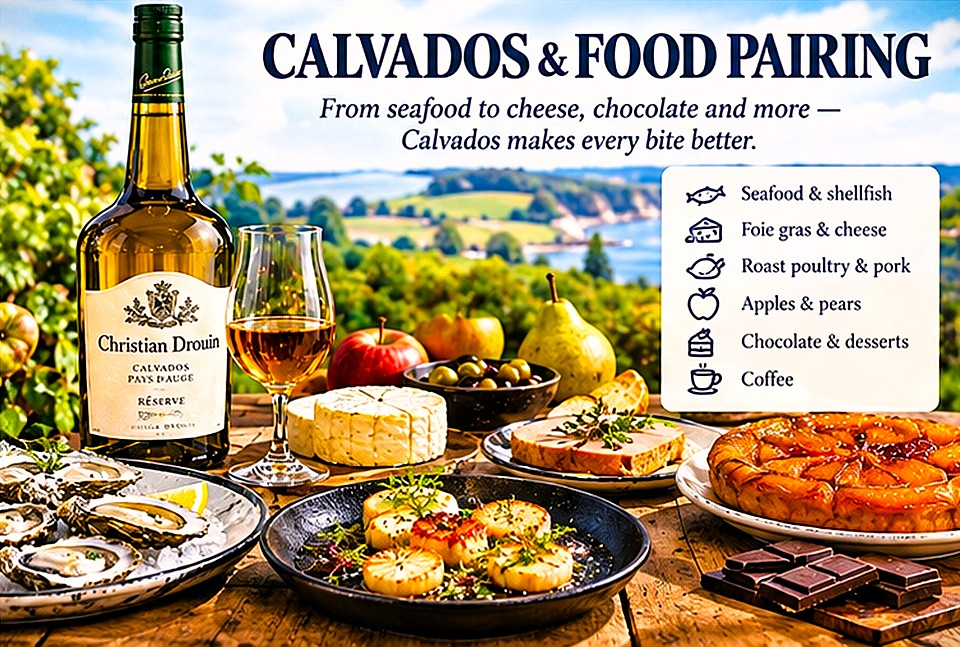
Calvados food pairings with seafood, foie gras, Normandy cheese, roast poultry, apples, chocolate desserts and coffee
Frequently Asked Questions
What is Calvados?
Calvados is a French apple- and pear-based eau-de-vie made from cider and perry that is aged in oak.
Is Calvados apple brandy?
Yes. Calvados is a specific French regional category of apple- and pear-based brandy/eau-de-vie.
Where is Calvados made?
It is produced in a defined geographical area covering much of Normandy and parts of nearby departments.
What are the three Calvados appellations?
They are:
-
-
- Calvados
- Calvados Pays d’Auge
- Calvados Domfrontais.
-
What is Calvados Pays d’Auge?
A protected appellation requiring at least 70% apples and double distillation in a pot still.
What is Calvados Domfrontais?
A pear-rich appellation requiring at least 30% perry pears and column distillation.
What is the best Calvados brand?
There is no universally accepted single best brand. Père Magloire, Boulard, Lecompte, Christian Drouin, Domaine Dupont, Roger Groult and others represent different traditions and styles.
What are the most famous Calvados brands?
Père Magloire, Boulard, Lecompte and Busnel are among the most internationally recognizable historic houses. Calvados Tourism currently describes Père Magloire, Boulard and Lecompte as three leading brands.
What is the best Calvados for beginners?
A young VS or VSOP from an established producer is usually the easiest introduction.
What is the best Calvados for sipping?
VSOP, XO, Hors d’Âge and vintage expressions are good places to explore.
What is the best Calvados for cocktails?
Young, fruit-forward Calvados is generally the most practical choice.
What does VS mean on Calvados?
VS means a minimum aging period of two years.
What does VSOP mean on Calvados?
VSOP indicates a minimum aging period of four years.
What does XO mean on Calvados?
XO indicates a minimum aging period of six years under the official Calvados classification.
What does Hors d’Âge mean?
It is one of the mature age designations indicating a minimum six-year aging period under the Calvados classification.
Does Calvados age in the bottle?
No. The official label guidance recommends noting the bottling year because Calvados stops aging once bottled.
What is vintage Calvados?
It is made from eaux-de-vie distilled in the same year, with the reference year appearing on the label.
Is older Calvados better?
Not necessarily. Older Calvados is more mature, but younger Calvados can be more vibrant and especially useful in cocktails.
How should Calvados be served?
Mature Calvados is often served neat in a tulip glass. Younger Calvados can also be served chilled, in long drinks or cocktails.
Can you drink Calvados on ice?
Yes, particularly younger Calvados or cocktail-oriented expressions.
Can you mix Calvados with tonic?
Yes. The official Calvados cocktail collection includes Calvados Tonic.
Can you mix Calvados with coffee?
Yes. Café Calva is a long-standing Normandy tradition, and Calvados is also used in modern coffee cocktails.
Can you make a cocktail with Calvados?
Absolutely. The official Calvados cocktail collection includes Corpse Reviver No. 1, Apple Mojito, Appletini, Calvados Tonic, Calvaspresso, Jack Rose and other drinks.
What food goes with Calvados?
Calvados pairs well with seafood, smoked fish, foie gras, Normandy cheese, roast poultry, pork, duck, apples, pears, chocolate desserts and coffee.
Does Calvados go with cheese?
Yes. VSOP is specifically recommended by the official Calvados site with foie gras and Normandy cheeses.
Does Calvados go with chocolate?
Yes. Mature Calvados and chocolate desserts are a recognized pairing.
What is a Trou Normand?
A traditional Normandy custom involving a small serving of Calvados during a substantial meal, sometimes with sorbet.
What is Café Calva?
Coffee served with Calvados, a traditional Normandy pairing that has also inspired modern cocktails.
What apple varieties are used for Calvados?
There are hundreds of recognized cider-apple varieties; INAO currently identifies 230 cider-apple varieties and 121 perry-pear varieties for Calvados production.
Are dessert apples used for Calvados?
Traditional Calvados relies on cider-specific varieties selected for attributes such as tannin, acidity and sugar rather than ordinary dessert apples.
Is pear used in Calvados?
Yes, and pear is especially important in Calvados Domfrontais.
Is Calvados the same as Cognac?
No. Cognac is a grape-based French spirit from the Cognac region; Calvados is based on cider and perry and comes from Normandy and the surrounding approved areas.
Is Calvados the same as Armagnac?
No. Both are French regional eaux-de-vie, but Armagnac is grape-based while Calvados is made from cider apples and pears.
Is Calvados a brandy?
Yes, in the broad sense it is a regional French fruit-based brandy/eau-de-vie.
Is Calvados stronger than whisky?
Not necessarily. Bottle strength varies by product.
Should Calvados be refrigerated?
Usually no. Store the bottle upright in a cool, dark place.
Does Calvados improve after opening?
It can remain stable for a long time when stored properly, although prolonged exposure to air can gradually affect its aroma.
What glass is best for Calvados?
A tulip-shaped glass is particularly suitable for mature Calvados because it concentrates aromas.
What Calvados is best for a gift?
Boulard, Lecompte, Christian Drouin, Château du Breuil, Calvados Morin or a vintage Comte Louis de Lauriston can all make distinctive gifts.
What Calvados is best for collectors?
Vintage, single-cask and older expressions are particularly interesting.
What Calvados is best for food pairing?
VSOP and mature expressions offer a broad range of food-pairing possibilities.
What Calvados is best for cocktails?
Young, fruit-forward bottles are generally more practical than rare vintage releases.
What is the difference between Calvados and Calvados Pays d’Auge?
Pays d’Auge requires at least 70% apples and double distillation in pot stills, while broader Calvados can use either pot or column distillation.
What is the difference between Calvados and Calvados Domfrontais?
Domfrontais requires at least 30% perry pears and column distillation, making it especially pear-driven.
Which Calvados is most pear-driven?
Calvados Domfrontais, particularly from producers that use high proportions of perry pears.
Which Calvados is most apple-driven?
Pays d’Auge is one of the most natural places to look because the appellation requires at least 70% apples.
Is Boulard a Calvados?
Yes. Boulard produces Calvados Pays d’Auge.
Is Christian Drouin a Calvados?
Christian Drouin is a Calvados producer specializing in Pays d’Auge and vintage expressions.
Is Domaine Dupont Calvados?
Yes. Domaine Dupont produces Calvados Pays d’Auge in Normandy.
Is Roger Groult Calvados?
Yes. Roger Groult produces Calvados Pays d’Auge.
Is Calvados Morin a Calvados producer?
Yes. It produces both Calvados and Calvados Pays d’Auge.
Is Château du Breuil Calvados?
Yes. Château du Breuil produces Calvados Pays d’Auge.
Final Thoughts: The Most Popular Calvados Brands in the World
Calvados is one of the world’s great examples of what happens when agriculture, place and distillation come together. It begins in an orchard. That is important.
Unlike grain spirits, where the starting material is harvested, dried and processed into a mash, Calvados begins with a living agricultural landscape.
-
-
- Apple trees.
- Pear trees.
- Meadows.
- Cider.
- Fermentation.
- Copper.
- Oak.
- Time.
-
The result is a spirit that carries the character of Normandy in a way few other spirits can match. And once you start exploring the category, the range is enormous. At the commercial end, there are recognizable houses such as:
-
-
- Père Magloire
- Boulard
- Lecompte
- Busnel.
-
These brands are internationally visible and provide an accessible entry point into Normandy’s best-known fruit spirit. Calvados Tourism currently groups Père Magloire, Boulard and Lecompte together as leading Calvados brands. Then there is the world of family estates.
-
-
- Christian Drouin
- Domaine Dupont
- Roger Groult
- Domaine du Coquerel
- Calvados Morin
- Château du Breuil
- Père Jules.
-
These houses reveal a more detailed side of Calvados:
-
-
- vintage bottlings
- small-batch production
- different distillation methods
- cask programs
- estate fruit
- regional identity.
-
Then the category gets even more specialized. Move into the Domfrontais and the picture changes.
-
-
- Lemorton
- Pacory
- Victor Gontier
- Comte Louis de Lauriston
- Domaine de la Duretière show how pears can reshape the spirit.
-
A pear-rich Calvados doesn’t simply taste like an apple brandy with some pear flavor added. It can have a different structure. More floral notes. A different kind of freshness. A distinctive pear-derived acidity and tannic texture. That is why Domfrontais deserves its own place in any serious tasting.
The official INAO rules make that difference very clear: at least 30% perry pears, column distillation and a minimum of three years of aging. Pays d’Auge goes in the opposite direction.
-
-
- More apples.
- Double distillation.
- Pot still.
- Dense fruit.
- Longer development in oak.
-
INAO requires at least 70% apples for the appellation and double distillation in pot stills. That is why a Pays d’Auge tasting next to a Domfrontais tasting can feel almost like comparing two neighboring but distinct spirits.
The broad Calvados appellation sits between them. There, producers may choose between continuous column distillation and pot-still distillation. And then there is age. Calvados can be:
-
-
- young
- fresh
- fruity
- floral
-
or:
-
-
- old
- spicy
- nutty
- caramelized
- woody
- deeply aromatic.
-
The official Calvados guidance says two-to-four-year-old Calvados is especially suited to convivial drinking and cocktails, while mature expressions can be excellent after dinner in a tulip glass.
That’s a very useful rule. Don’t assume an older bottle is automatically the right bottle. A good young Calvados might make a better:
-
-
- Calvados Tonic
- Apple Mojito
- Jack Rose
- Calvaspresso.
-
An older bottle may be better with:
-
-
- coffee
- chocolate
- Normandy cheese or simply nothing at all.
-
Just a glass. Just the spirit. And perhaps that is the most useful way to think about Calvados. Not as one thing. But as a spectrum.
-
-
- At one end: fresh apple
- At the other: oak and dried fruit.
- In the middle: pear, spice, vanilla, honey, flowers and caramel.
-
The best way to explore it is therefore to compare. Try a young Boulard.
-
-
- Then a Christian Drouin.
- Then a Roger Groult.
- Then a Domfrontais Lemorton.
- Then an older Calvados Morin or vintage Comte Louis de Lauriston.
-
Taste them side by side. Pay attention to:
-
-
- fruit
- sweetness
- acidity
- tannin
- oak
- spice
- finish.
-
You will quickly understand why Calvados has developed such a devoted following. There is also a strong culinary dimension. Calvados isn’t a spirit that needs to wait until dessert. It can accompany an entire meal.
The official Calvados organization recommends VS with smoked fish and caviar, VSOP with foie gras and Normandy cheeses, and a range of mature expressions with poultry, pork, seafood and desserts.
Then there is the legendary: Trou Normand and Café Calva. These aren’t gimmicks. They are evidence of how thoroughly the spirit has become part of Normandy’s food culture. That cultural connection also makes Calvados particularly interesting for travelers.
A distillery visit can take you through:
-
-
- orchards
- pressing
- fermentation
- copper stills
- cellars
- blending.
-
The official tourism network includes producers across all three appellations, many of which offer tastings and tours. For enthusiasts, that is far more rewarding than simply buying a bottle from a shelf.
-
-
- You can see the trees that produced the fruit.
- You can smell the cider.
- You can watch the stills.
- You can taste the new make.
-
Then you can compare it with something aged for years. That is the whole Calvados story in one place. And the category is not standing still. The official production site says the traditional world of age statements and vintages is being joined by:
-
-
- single casks
- cask-strength releases
- finishes in Bourbon, whisky, Sherry and Sauternes casks.
-
Domaine du Coquerel’s current portfolio illustrates this evolution with multiple cask-finished Calvados expressions.
Christian Drouin is similarly combining traditional Calvados expertise with new formats such as cocktail-friendly Sélection and the botanical ABC de Christian Drouin.
So the modern Calvados drinker has more choice than ever. You can choose:
-
-
- classic
- organic
- vintage
- single cask
- cask strength
- cask finished
- pear-driven
- apple-driven
- cocktail-friendly
- ultra-mature.
-
That is why the world’s Calvados scene is so interesting right now. It’s rooted in a centuries-old Norman orchard culture, but it is also flexible enough to adapt to modern bars, collectors and food culture. So start with one bottle.
-
-
- Try a VS.
- Then a VSOP.
- Then a Domfrontais.
- Then a vintage.
-
You don’t need to buy the oldest or most expensive bottle. You just need to taste thoughtfully. Because once you understand Calvados, you stop thinking of it simply as “apple brandy.” You start tasting the orchard.
-
-
- The cider.
- The still.
- The barrel.
- The region.
- And the years.
-