
Blog
Most Popular Cognac Brands in the World: 30 Famous Houses Every Cognac Lover Should Know

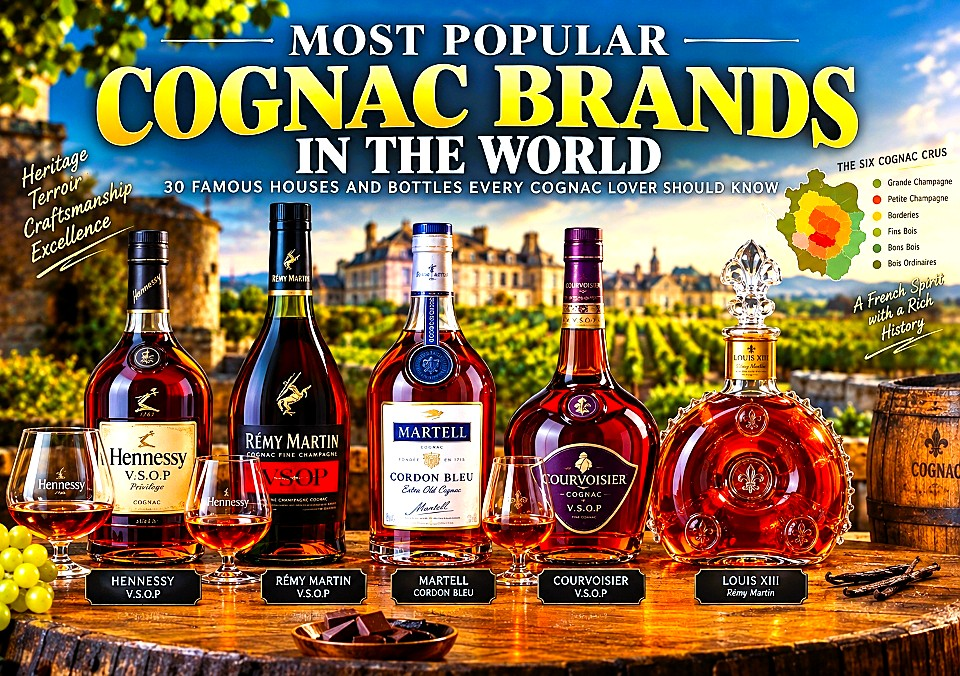
Discover the most popular Cognac brands in the world, from Hennessy, Rémy Martin, Martell and Courvoisier to Pierre Ferrand, D’Ussé, Camus, Hine, Frapin and Delamain. Learn which Cognac houses dominate global sales and the world’s best bars, how VS, VSOP, Napoleon, XO and XXO differ, what Grande Champagne and Petite Champagne mean, and how to choose the perfect Cognac for sipping, cocktails and gifting.
Cognac occupies a unique position in the world of spirits.
It is a French wine spirit, but it is also one of the world’s great luxury categories. It can be enjoyed neat, with water, over ice, in a Sidecar, in a Sazerac, alongside dessert, or as the centerpiece of an elaborate after-dinner tasting.
The category is also remarkably diverse.
At one end are widely available VS and VSOP Cognacs designed for cocktails and everyday drinking. At the other are XO, XXO, single-cru, vintage and prestige Cognacs intended for slow sipping and collecting.
And while four major houses dominate much of the public conversation—Hennessy, Rémy Martin, Martell and Courvoisier—the Cognac world extends far beyond them.
That distinction is especially important today.
Drinks International’s 2026 Brands Report: Cognac produced a significant upset in the world’s leading bars. After dominating the report every year since the research began in 2010, Hennessy was finally displaced from the top spot by Rémy Martin, which was the bestselling Cognac in just over 30% of surveyed bars, compared with 25% for Hennessy. Martell returned to the podium in third place, while Courvoisier took fourth.
That is not the same thing as saying Rémy Martin is the world’s biggest Cognac brand overall.
In fact, Drinks International’s 2025 report described Hennessy as responsible for almost half of global Cognac volume, illustrating just how different global sales volume and premium-bar popularity can be.
The distinction matters because a good “most popular Cognac brands” article should answer several questions:
-
-
- Which Cognac sells the most?
- Which Cognacs do leading bartenders prefer?
- Which houses have the greatest history?
- Which brands are best for cocktails?
- Which bottles are best for sipping?
- Which houses are worth exploring if you want something beyond the big four?
-
This guide brings those questions together.
Table of Contents
-
-
- What Is Cognac?
- Where Is Cognac Made?
- The Six Cognac Crus
- What Grapes Are Used for Cognac?
- How Cognac Is Made
- Double Distillation Explained
- Cognac Aging Categories
- VS vs. VSOP vs. XO vs. XXO
- How to Read a Cognac Label
- The 30 Most Popular Cognac Brands in the World
- Hennessy
- Rémy Martin
- Martell
- Courvoisier
- Pierre Ferrand
- D’Ussé
- Camus
- Hine
- Delamain
- Frapin
- Bache-Gabrielsen
- De Luze
- Cognac Ferrand
- Frapin
- Larsen
- Meukow
- Hardy
- Bisquit
- Louis Royer
- Otard
- A.E. Dor
- Prunier
- Monnet
- Godet
- Maison Normandin Mercier
- Château de Beaulon
- Briottet / Cognac-related houses
- François Voyer
- Bourgoin
- ABK6
- Best Cognac for Beginners
- Best Cognac for Cocktails
- Best Cognac for Sipping
- Best Cognac for Gifts
- Cognac and Food Pairing
- Current Cognac Trends
- Cognac and Sustainability
- Frequently Asked Questions
- Final Thoughts
-
What Is Cognac?
Cognac is a distilled wine spirit made in the Cognac appellation of southwestern France.
The official Cognac organization, the BNIC, describes Cognac as a unique wine spirit produced only within the geographically defined Cognac area under a protected designation. The region is located north of Bordeaux and extends through parts of Charente and Charente-Maritime, with limited areas of neighboring departments.
This geographic restriction is fundamental.
Just as Scotch must be made according to the Scotch whisky rules in Scotland, Cognac is tied to a protected French appellation and its production specifications.
Cognac is therefore not simply another word for brandy. All Cognac is brandy. But not all brandy is Cognac. That distinction is essential when shopping.
Where Is Cognac Made?
The Cognac production area is divided into six officially recognized crus or growing regions:
-
-
- Grande Champagne
- Petite Champagne
- Borderies
- Fins Bois
- Bons Bois
- Bois Ordinaires / Bois à Terroirs
-
The BNIC states that the Cognac geographical indication covers a precisely delimited production zone and that the six crus have distinct soil and geographic characteristics that influence the resulting eaux-de-vie.
These categories matter because Cognac is fundamentally an agricultural spirit. The grape and the land are the beginning of the story.
The Six Cognac Crus
Grande Champagne
Grande Champagne is one of the most prestigious Cognac crus. Its chalk-rich soils are particularly suited to producing eaux-de-vie known for finesse, floral character and longevity.
The word “Champagne” here refers to the chalky Cognac terroir, not the Champagne wine region.
That is an important distinction for newcomers.
-
-
- Petite Champagne: Petite Champagne also produces delicate, fin eaux-de-vie, generally with excellent aging potential.
- Borderies: Borderies is the smallest of the six major crus and is especially associated with floral and rounded styles.
- Fins Bois: Fins Bois is the largest Cognac cru by vineyard area. The BNIC describes its eaux-de-vie as generally round and soft, with fresh fruit characteristics.
- Bons Bois: Bons Bois tends to produce fruitier, more approachable styles.
- Bois Ordinaires / Bois à Terroirs: This coastal category can produce Cognacs with distinctive maritime or iodized characteristics.
-
The BNIC notes that the different crus contribute different sensory characteristics because of their soils, geography and proximity to the coast.
What Grapes Are Used for Cognac?
Cognac is primarily made from Ugni Blanc, a white grape variety known for its high acidity and relatively low sugar. The official Cognac organization says more than 98% of the Cognac vineyard is planted with Ugni Blanc, while the broader appellation also recognizes several other grape varieties.
High acidity is useful because the base wine needs to remain suitable for distillation. The objective isn’t to make a spectacular table wine. It is to create a wine that can be transformed through distillation and years of maturation into a complex spirit. This is one of Cognac’s most fascinating characteristics.
The finished bottle may contain aromas of:
-
-
- flowers
- fresh fruit
- dried fruit
- vanilla
- spice
- nuts
- cocoa
- tobacco
- leather
- oak,
-
even though its raw material began as an acidic white wine.
How Cognac Is Made
The broad process is:
vineyard → harvest → pressing → fermentation → wine → distillation → maturation → blending → bottling
The magic happens in the middle.
-
-
- Harvest: The grapes are harvested and turned into a low-alcohol wine.
- Fermentation: Yeast converts grape sugars into alcohol.
- Distillation: The wine undergoes the traditional Charentaise double-distillation process.
- Maturation: The resulting eaux-de-vie spend time in oak.
- Blending: Master blenders combine different eaux-de-vie to achieve the desired house style.
-
That final step is enormously important. A Cognac house is not simply aging one liquid in one barrel. A commercial VSOP or XO can contain eaux-de-vie of different ages and from different crus. The blender’s task is to create consistency and complexity.
Double Distillation Explained
Cognac uses a distinctive two-stage distillation process.
The BNIC explains that double distillation in Charentais stills helps preserve the freshness and fruitiness of the wine while concentrating the spirit’s aromas.
This is one reason Cognac has such a different personality from many other fruit-based spirits. Distillation isn’t just about raising alcohol. It is about selecting and concentrating desirable aromatic compounds.
Cognac Aging Categories
One of the most important things to understand is that Cognac age statements refer to the youngest eau-de-vie in the blend. The BNIC explicitly states this principle in its explanation of Cognac aging.
The commonly encountered categories are:
-
-
- VS: Minimum 2 years of aging.
- VSOP: Minimum 4 years. Napoleon: Minimum 6 years.
- XO: Minimum 10 years.
- XXO: Minimum 14 years.
-
The BNIC confirms the 2-, 4-, 10- and 14-year thresholds and separately identifies Napoleon at six years among the additional aging designations.
Importantly, these are minimums. A Cognac labeled XO can contain components considerably older than ten years.
VS vs. VSOP vs. XO vs. XXO
| Category | Minimum age | Typical character | Best use |
|---|---|---|---|
| VS | 2 years | Fresh, fruity, lively | Cocktails |
| VSOP | 4 years | Balanced, rounded, aromatic | Cocktails + sipping |
| Napoleon | 6 years | More developed, richer | Sipping + cocktails |
| XO | 10 years | Deep, complex, layered | Sipping |
| XXO | 14 years | Very mature, complex | Slow sipping |
These official age thresholds are based on the youngest component in the blend.
-
-
- For cocktails, VS and VSOP often make the most practical sense.
- For sipping, VSOP, XO and older expressions are where the category becomes particularly interesting.
-
The 30 Most Popular Cognac Brands in the World
It combines:
-
-
- global recognition
- historical significance
- leading-bar popularity
- international distribution
- premium reputation
- consumer awareness
- enthusiast influence.
-
For the biggest houses, current bar and industry data provide stronger evidence. For smaller houses, their inclusion reflects significance within the Cognac category rather than a claim that they outsell the major four.
1. Hennessy
Founded: 1765
Owner: LVMH
Hennessy is probably the most recognizable Cognac brand in the world. The house was founded by Irish officer Richard Hennessy in 1765, and its history includes the development of the X.O designation in 1870. Hennessy remains one of the defining names in global luxury Cognac.
For many consumers, “Cognac” and “Hennessy” are almost interchangeable. That level of brand recognition is extraordinarily rare.
Famous expressions
-
-
- Hennessy V.S
- Hennessy V.S.O.P
- Hennessy X.O
- Paradis
- Richard Hennessy
-
Best for:
-
-
- Cocktails
- Sipping
- Luxury gifting
-
Hennessy also has enormous influence in the international bar scene. Even after losing first place to Rémy Martin in Drinks International’s 2026 bar survey, Hennessy remained extremely strong, appearing most frequently as a second- or third-choice Cognac.
2. Rémy Martin
Founded: 1724
Owner: Rémy Cointreau
Rémy Martin is one of the four great historic Cognac houses. It has a particularly strong association with Grande Champagne and Petite Champagne, collectively forming the Fine Champagne designation.
Its history stretches back to 1724, making it one of Cognac’s oldest major houses.
Famous expressions
-
-
- Rémy Martin VSOP
- Rémy Martin 1738
- Rémy Martin XO
- Louis XIII
-
Why it’s important?
Rémy Martin became the bestselling Cognac in Drinks International’s 2026 survey of the world’s best bars, taking the position from Hennessy. It was the bestselling Cognac in just over 30% of surveyed bars.
Best for
-
-
- VSOP cocktails
- XO sipping
- Luxury gifting
-
3. Martell
Founded: 1715
Owner: Pernod Ricard
Martell is the oldest of the major Cognac houses commonly grouped among the “big four.” The BNIC’s historical overview dates Martell to 1715, Rémy Martin to 1724, Delamain to 1759, Hine to 1763 and Hennessy to 1765.
Martell is often associated with elegance and fruit-forward Cognac.
Famous expressions
-
-
- Martell VS
- Martell VSOP
- Martell Cordon Bleu
- Martell XO
-
Current bar position
Martell returned to the podium in Drinks International’s 2026 report and served as the house pour in 12% of surveyed bars.
Best for
-
-
- Sidecars
- Sipping
- Classic cocktails
-
4. Courvoisier
Founded: 19th century
Owner: Campari Group
Courvoisier has long been one of the world’s best-known Cognac houses. The company was founded in the 1800s, with the BNIC history page listing Courvoisier in 1843 among the significant houses established in that period.
Courvoisier is particularly famous for prestige expressions and historically strong international recognition.
Famous expressions
-
-
- Courvoisier VS
- Courvoisier VSOP
- Courvoisier XO
- L’Essence
-
Best for
-
-
- Sipping
- Sidecars
- Luxury occasions
-
Drinks International placed Courvoisier fourth in its 2026 leading-bar Cognac ranking, completing the return of the traditional “big four” to the top four positions.
5. Pierre Ferrand
Producer: Maison Ferrand
Pierre Ferrand occupies a distinctive position. The brand often appeals to consumers interested in Cognac with strong terroir expression and traditional-minded production. It has also been a major force in cocktail bars.
In the 2025 Drinks International Cognac report, Pierre Ferrand ranked third, ahead of several major houses, demonstrating its influence among top bartenders.
Best for
-
-
- Cocktails
- Sipping
- Cognac enthusiasts
-
Its premium positioning makes it an excellent bridge between cocktail Cognac and serious sipping Cognac.
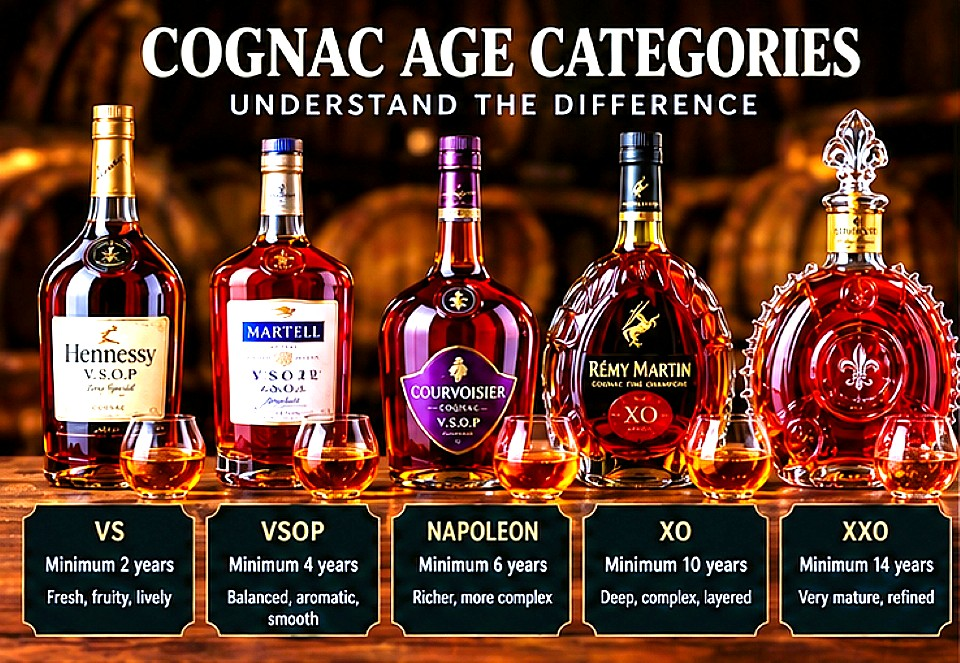
Cognac age categories explained including VS, VSOP, Napoleon, XO and XXO with popular Cognac bottles and tasting profiles
6. D’Ussé
Owner: Bacardi
D’Ussé is one of the newer major global Cognac brands. It has achieved particularly strong recognition in North America and in contemporary premium spirits culture.
The brand is often positioned around accessible premium Cognac and cocktail use.
Best for
-
-
- Old Fashioned variations
- Sidecars
- Sipping
-
D’Ussé was one of the debuting brands in the top Cognac rankings of Drinks International’s 2026 report.
7. Camus
Camus is one of the most important independent Cognac families. Founded in the 19th century, the house remains family controlled and is particularly associated with Borderies and expressions emphasizing aromatic character.
Famous expressions
-
-
- Camus VSOP
- Camus Borderies
- Camus XO
-
Camus has also performed strongly in spirits competitions. At the 2026 Cognac Masters, Camus La Grande Marque won a Master medal for its VSOP Borderies Single Estate, while its XO Borderies Single Estate earned Gold.
Best for
-
-
- Sipping
- Single-estate exploration
-
8. Hine
Hine is one of Cognac’s classic historic houses. The BNIC’s history records Hine in 1763 among the early major Cognac companies. Hine is widely appreciated among enthusiasts and sommeliers.
Famous expressions
-
-
- Hine Rare VSOP
- Hine Antique XO
- Hine Vintage Cognacs
-
Best for
-
-
- Sipping
- Food pairing
- Fine dining
-
9. Delamain
Delamain occupies an especially important niche among serious Cognac enthusiasts. The house dates to 1759, making it one of the historic Cognac names. Its reputation is strongly associated with mature, elegant Cognacs.
At the 2026 Cognac Masters, Delamain’s Pale & Dry XO received a Master, while its Single Vineyard Domaine La Rambaudie received both Taste Master and Master recognition.
Best for
-
-
- Experienced Cognac drinkers
- Fine dining
- Collectors
-
10. Frapin
Frapin is one of the major estate-focused Cognac houses. It is particularly respected because of its strong vineyard ownership and Grande Champagne identity.
Its current range includes:
-
-
- VSOP
- XO
- Château Fontpinot
- Vintage expressions
-
The 2026 Cognac Masters awarded Master recognition to Frapin Château Fontpinot XO and listed a 1997 vintage among its gold winners.
Best for
-
-
- Sipping
- Terroir-driven Cognac
-
11. Bache-Gabrielsen
Bache-Gabrielsen is a historic Cognac house with strong Scandinavian and international connections. The BNIC has featured the house among major Cognac producers and industry participants.
Best for
-
-
- VSOP
- XO
- Exploring independent houses
-
12. De Luze
De Luze is part of Maison Boinaud, one of the major family-owned Cognac groups. The brand has received increased attention in premium circles. Drinks International listed De Luze & Fils among the debutants in its 2026 Cognac Brands Report.
Best for
-
-
- Fine Champagne styles
- Sipping
-
13. Larsen
Larsen is a Cognac brand with particularly strong Scandinavian heritage. The house is associated with distinctive packaging and a portfolio spanning multiple age categories.
At the 2026 Cognac Masters, Larsen XO received Gold and Larsen Aqua Ignis won a Master in the No Age Statement premium category.
Best for
-
-
- Premium sipping
- Gifts
-
14. Meukow
Meukow is instantly recognizable thanks to its distinctive black panther branding. The house dates back to 1862, according to the BNIC historical overview.
Best for
-
-
- Sipping
- Cocktails
- Gift bottles
-
15. Hardy
Hardy was established in 1863, another of the houses founded during Cognac’s major 19th-century expansion. The brand is especially well known in French and international markets.
Best for
-
-
- Classic Cognac drinking
- Sipping
-
16. Bisquit
Bisquit was established in 1819, making it another historic Cognac house. It has long been associated with a richer, rounder style.
Best for
-
-
- VSOP
- Sipping
- Cocktails
-
17. Louis Royer
Louis Royer is another longstanding Cognac house with a broad international profile. The BNIC has featured Louis Royer among significant Cognac producers and prestige expressions.
Best for
-
-
- Cocktails
- Sipping
- Gift giving
-
18. Otard
Otard is one of Cognac’s historic houses, established in 1795 according to the BNIC’s historical timeline. It is based at Château de Cognac, contributing to its strong heritage identity.
Best for
-
-
- Traditional Cognac
- Sipping
-
19. A.E. Dor
A.E. Dor is particularly interesting to collectors because of its reputation for older and vintage Cognacs.
Best for
-
-
- Collectors
- Vintage Cognac
- Serious sipping
-
Its positioning makes it more relevant to enthusiast buyers than casual cocktail drinkers.
20. Prunier
Prunier is one of the enduring family Cognac names. Its range covers accessible and premium expressions.
Best for
-
-
- Exploration
- Sipping
- Classic cocktails
-
21. Monnet
Monnet is another historic Cognac producer with an increasingly modern luxury positioning.
Best for
-
-
- VSOP
- XO
- Contemporary sipping
-
22. Godet
Godet is a distinctive Cognac house with a strong identity rooted in the Atlantic character of the region. It offers several unusual expressions.
Best for
-
-
- Exploration
- Sipping
- Gift bottles
-
23. Normandin Mercier
Normandin Mercier is an independent Cognac house with long family history. The BNIC has highlighted its products in prestige Cognac programs, including an Old Fashioned-themed expression.
Best for
-
-
- Traditional Cognac enthusiasts
- Sipping
-
24. Château de Beaulon
Beaulon is particularly interesting for consumers who want a highly estate-focused experience. The estate is associated with both Cognac and broader wine-country heritage.
Best for
-
-
- Terroir exploration
- Collectors
-
25. François Voyer
François Voyer is an independent producer strongly associated with Grande Champagne. Its products have performed exceptionally well in competitions.
At the 2026 Cognac Masters, François Voyer Extra and François Voyer XO Gold were among the award-winning entries.
Best for
-
-
- Premium sipping
- Fine Champagne enthusiasts
-
26. Bourgoin
Bourgoin is a modern independent producer that appeals strongly to enthusiasts seeking terroir and transparency.
Best for
-
-
- Cognac enthusiasts
- Experimental tastings
- Single-producer exploration
-
27. ABK6
ABK6 is one of the modern brands that helped bring greater attention to independent and estate-driven Cognac. The BNIC included ABK6 among the Cognac houses participating in international sommelier initiatives.
Best for
-
-
- Modern Cognac drinkers
- Cocktails
-
28. Pierre de Segonzac
Pierre de Segonzac is associated with Grande Champagne and appeals to consumers looking for estate-centered Cognac.
Best for
-
-
- Sipping
- Terroir exploration
-
29. Maison Tessendier
Maison Tessendier represents the independent side of the Cognac industry. Its work includes Cognac and other aged spirits, with a strong emphasis on blending and independent production.
Best for
-
-
- Exploration
- Independent Cognac
-
30. Fussigny
Fussigny is another independent Cognac brand gaining recognition in the international premium category. Drinks International listed Fussigny among the debutants in its 2026 Cognac Brands Report.
Best for
-
-
- Modern Cognac enthusiasts
- Sipping
-
Best Cognac for Beginners
A beginner doesn’t need a 20-year-old bottle. In fact, starting with younger Cognac may teach you more about the spirit’s fundamental character.
Good starting point:
VSOP: Why?
Because VSOP typically balances:
-
-
- fruit
- oak
- floral notes
- spice
- alcohol warmth.
-
Good introductory houses include:
-
-
- Hennessy
- Rémy Martin
- Martell
- Courvoisier
- Pierre Ferrand
- Camus
-
The goal isn’t to find the most expensive bottle. It’s to find a Cognac whose character you enjoy.
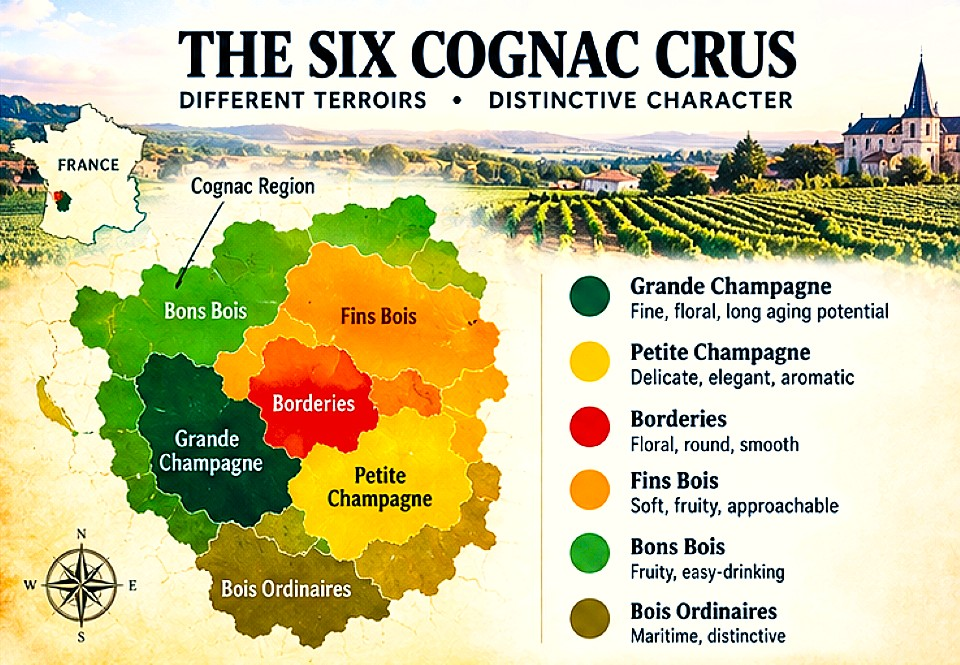
Map of the six Cognac crus including Grande Champagne, Petite Champagne, Borderies, Fins Bois, Bons Bois and Bois Ordinaires
Best Cognac for Cocktails
For cocktails, younger Cognac generally makes more sense. A VS or VSOP can provide plenty of flavor without making you pay for years of maturation that may be partially obscured by citrus, sugar or bitters.
Best for Sidecars
-
-
- Hennessy VS
- Rémy Martin VSOP
- Pierre Ferrand 1840
-
Best for Sazeracs
-
-
- Hennessy
- Rémy Martin
- Pierre Ferrand
-
Best for Vieux Carré
-
-
- Hennessy
- Martell
- Pierre Ferrand
-
Best for Brandy Alexander
A softer VSOP can be excellent.
Best Cognac for Sipping
Sipping Cognac is where age, terroir and blending become especially interesting.
Consider:
-
-
- Rémy Martin XO
- Hennessy XO
- Martell XO
- Courvoisier XO
- Delamain XO
- Frapin XO
- Camus XO
- François Voyer XO
-
Elaboration from Grande Champagne houses
For serious enthusiasts, age is only one variable. A young Cognac from an excellent terroir can be more interesting than an older blend that relies heavily on oak.
Best Cognac for Gifts
For gifts, presentation matters.
-
-
- Classic luxury: Hennessy XO
- Premium prestige: Rémy Martin XO
- Historic elegance: Martell Cordon Bleu
- Luxury visual impact: Courvoisier prestige expressions
- Collector appeal: Delamain, Frapin, François Voyer
-
A gift bottle should match the recipient. For a casual drinker, a recognizable house may be best. For an enthusiast, an independent Grande Champagne producer can make a much more interesting gift.
Cognac and Food Pairing
Cognac can work surprisingly well at the dinner table.
VSOP + appetizers
Fruitier, younger Cognacs can work with:
-
-
- Charcuterie
- Paté
- Soft cheese
-
XO + cheese
Older Cognacs pair beautifully with:
-
-
- Aged Gouda
- Comté
- Blue cheese
-
XO + dessert
-
-
- Dark chocolate
- Crème brûlée
- Chocolate tart
- Dried fruits
- Nut-based desserts
-
Cognac + cigar
This is a classic pairing, although the cigar can overwhelm delicate Cognac. If pairing, choose a more mature, full-bodied expression.
Cognac Cocktails
Cognac is one of the original cocktail spirits.
Some of the most famous Cognac cocktails include:
-
-
- Sidecar
- Sazerac
- French 75
- Vieux Carré
- Brandy Alexander
- Between the Sheets
- Horse’s Neck
- Champs-Élysées
- Summit
-
Cognac’s fruit, floral and spice characteristics make it especially versatile with:
-
-
- lemon
- orange
- sugar
- herbal liqueurs
- bitters
- sparkling wine.
-
Cognac vs. Brandy
This is one of the most common beginner questions. The simplest explanation:
Cognac is a type of brandy.
But Cognac is made according to specific geographical and production rules within the Cognac appellation. Brandy is a much broader category.
You can find brandies from:
-
-
- Spain
- California
- South Africa
- Armenia
- Georgia
- Peru
- Chile
- Australia
- and many other regions.
-
Cognac is specifically French and appellation protected!
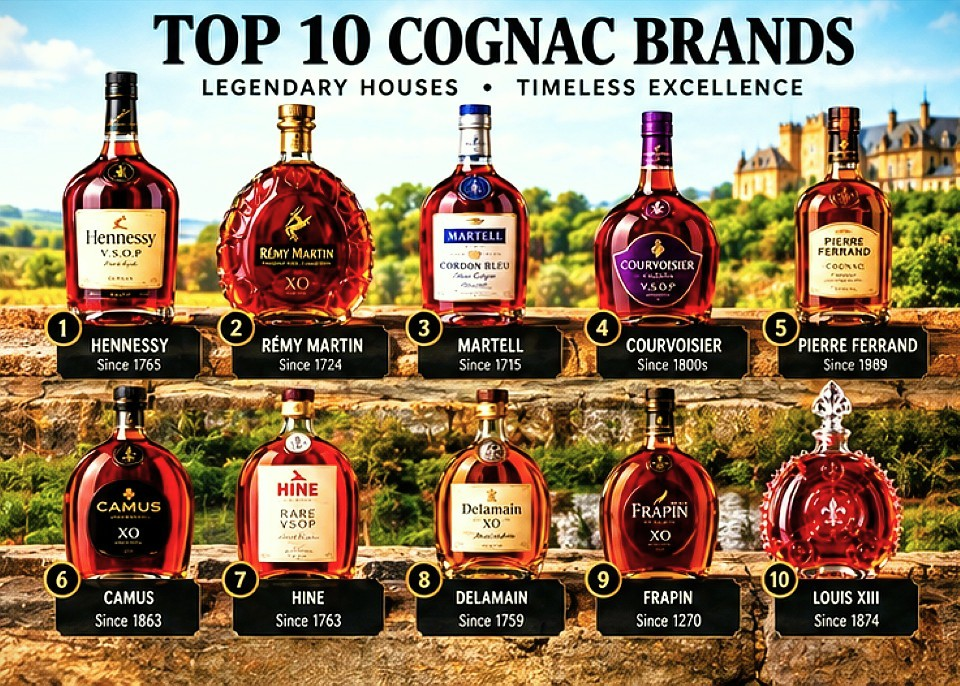
Top Cognac brands in the world including Hennessy, Rémy Martin, Martell, Courvoisier, Pierre Ferrand, Camus, Hine, Delamain and Frapin
Cognac vs. Armagnac
Cognac and Armagnac are both French grape brandies. But they come from different appellations and have different production traditions. This is a natural place to compare your Cognac article with other French spirits.
Cognac is generally more globally commercialized. Armagnac tends to have a stronger reputation among enthusiasts for small producers and distinctive terroir. For casual consumers, Cognac is usually easier to find.
For collectors, both categories are fascinating.
Current Cognac Trends
The Cognac industry is entering a difficult period. The category’s extraordinary growth in major export markets has slowed dramatically, and producers are adjusting to a new reality.
The Spirits Business reported in June 2026 that the category had gone through a serious contraction and that producers were restructuring operations amid lower shipment levels.
That doesn’t mean Cognac has lost relevance. Instead, it means the category is adapting. Several important trends stand out.
1. Premiumization is becoming more selective
Consumers aren’t automatically trading up. They want reasons to pay more.
2. Independent houses are gaining attention
Small producers can offer:
-
-
- single crus
- vintage Cognacs
- single estate bottlings
-
and more distinctive production stories.
3. Transparency matters
Enthusiasts increasingly want information on:
-
-
- origin
- cru
- age
- blend composition
- production
- maturation.
-
4. Cocktails remain critical
The BNIC says that globally nearly 80% of Cognac is consumed in cocktails, according to its 2026 industry figures. That is a remarkable number. It shows that Cognac is not solely an after-dinner sipping spirit. Cocktails are central to the category.
5. The bar trade matters
Rémy Martin’s rise to No. 1 in Drinks International’s 2026 Cognac Brands Report demonstrates how premium-bar engagement can change the competitive landscape.
Cognac and Sustainability
Climate change is increasingly important for every wine-derived spirit. Cognac producers depend on grape harvests.
Changes in:
-
-
- Temperature
- Rainfall
- Drought
- Disease pressure
- Harvest timing
-
The BNIC says the sector is researching disease-resistant grape varieties, sustainable viticulture and more energy-efficient distillation. This is especially significant because Cognac’s production cycle is long.
A change in vineyard practices today may affect bottles years—or decades—later.
Why XO Cognac Costs More
XO Cognac costs more mainly because older eaux-de-vie tie up inventory for longer.
Imagine producing an eau-de-vie and then waiting:
-
-
- 2 years
- 10 years
- 20+ years.
-
The producer has capital locked into inventory.
There are also:
-
-
- Barrel costs
- Evaporation
- Storage
- Blending expertise
- Limited availability
- Packaging
- Brand positioning
-
The BNIC reports that Cognac has approximately 2.2 billion bottle-equivalents of stock currently in oak barrels, illustrating the enormous scale of the inventory required by the industry.
The Angel’s Share
During maturation, some alcohol and water evaporate from the barrels. This is known as the angel’s share.
The BNIC estimates the annual loss at the equivalent of approximately 41 million bottles. That evaporation is one reason very old Cognac becomes increasingly expensive. The liquid is literally disappearing over time.
How to Taste Cognac
Start with a tulip-shaped glass. Pour a modest amount. Look at the color. Then smell gently. Don’t immediately swirl aggressively.
You may detect:
Young Cognac
-
-
- Grape
- Citrus
- Pear
- Floral notes
-
Mature Cognac
-
-
- Vanilla
- Dried fruit
- Spice
- Nuts
- Cocoa
- Tobacco
- Leather
-
Take a small sip. Allow it to move across the palate.
Then consider:
-
-
- sweetness
- acidity
- oak
- fruit
- spice
- alcohol
- finish.
-
Should Cognac Be Served Warm?
Not necessarily.
The old habit of warming the glass extensively can overemphasize alcohol. A high-quality Cognac often benefits from being served around cool room temperature. A little water can also reveal additional aromas.
And for younger Cognac, ice can be entirely appropriate—particularly in casual drinking or cocktails.
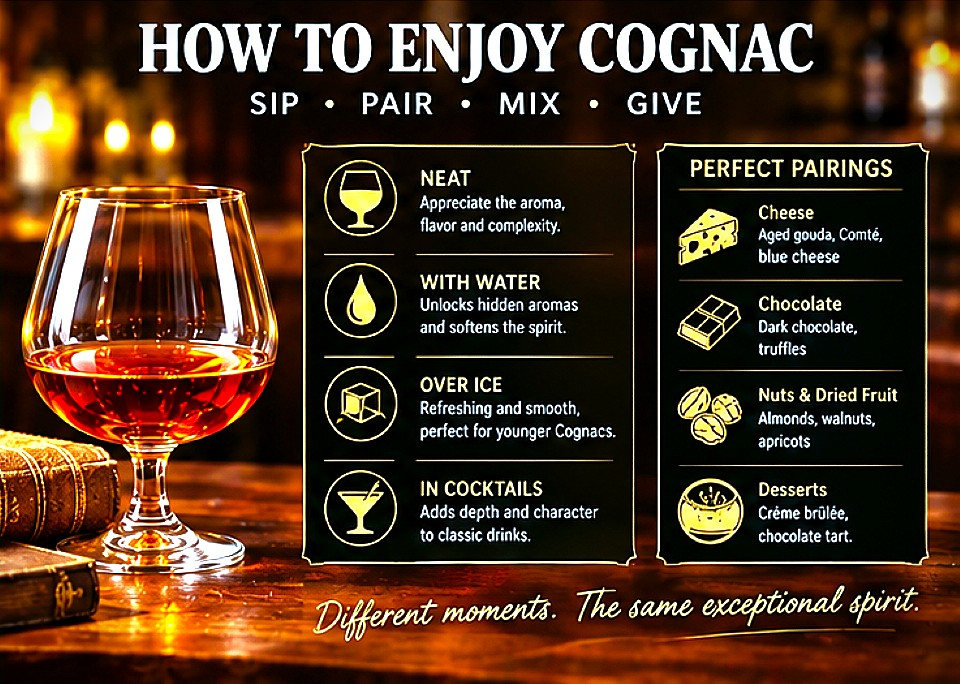
How to enjoy Cognac neat, with water, over ice or in cocktails paired with cheese, chocolate, nuts, dried fruit and desserts
Frequently Asked Questions
What is the most popular Cognac brand in the world?
There is no single current metric that answers every interpretation of “most popular.” Hennessy has historically dominated global Cognac volume, while Rémy Martin became the bestselling Cognac in Drinks International’s 2026 survey of the world’s best bars.
What is the biggest Cognac brand?
Hennessy is widely recognized as the global volume leader and has historically accounted for an enormous share of worldwide Cognac sales. Drinks International’s 2025 report described the brand as responsible for almost half of Cognac volumes.
What is the best Cognac brand?
There is no universally best Cognac. Hennessy, Rémy Martin, Martell and Courvoisier are the major global houses, while Delamain, Frapin, Camus, François Voyer and others appeal strongly to enthusiasts.
What are the four major Cognac houses?
The traditional global “big four” are:
-
-
- Hennessy
- Rémy Martin
- Martell
- Courvoisier
-
Drinks International’s 2026 report placed all four in the top four of its leading-bar Cognac ranking.
What is the oldest Cognac house?
The BNIC identifies Augier, founded in 1643, as the first Cognac house. Among the major houses still commonly encountered today, Martell dates to 1715, followed by Rémy Martin in 1724.
What does VS mean in Cognac?
VS means Very Special and indicates a Cognac whose youngest eau-de-vie has been aged for at least two years.
What does VSOP mean?
VSOP means Very Superior Old Pale and requires a minimum age of four years for the youngest eau-de-vie.
What does XO mean?
XO means Extra Old and requires the youngest eau-de-vie in the blend to have spent at least 10 years aging.
What does XXO mean?
XXO means Extra Extra Old and applies to Cognacs with a minimum age of 14 years for the youngest eau-de-vie.
What is a Napoleon Cognac?
Napoleon is a recognized aging designation indicating a minimum of six years for the youngest eau-de-vie.
Is older Cognac always better?
No. Older Cognac is generally more mature and often more expensive, but preference depends on the drinker’s taste.
What is the best Cognac for beginners?
A balanced VSOP is usually an excellent starting point.
What is the best Cognac for cocktails?
VS and VSOP Cognacs are usually practical choices because they deliver good flavor without requiring the premium cost of very old eaux-de-vie.
What Cognac is best for a Sidecar?
Hennessy, Rémy Martin, Martell and Pierre Ferrand all work well in a Sidecar.
What Cognac is best for a Sazerac?
Hennessy and Rémy Martin are classic choices, while Pierre Ferrand is also highly regarded in cocktail bars. Drinks International’s bar research has historically shown these brands performing strongly in Cognac cocktails.
What Cognac is best for sipping?
XO and mature Cognacs from houses such as Delamain, Frapin, Hennessy, Rémy Martin, Martell, Camus and Courvoisier are excellent starting points.
What is Fine Champagne Cognac?
Fine Champagne is not Champagne wine. It refers to Cognac blended entirely from eaux-de-vie originating in Grande Champagne and Petite Champagne, with at least 50% from Grande Champagne.
What are the Cognac crus?
Grande Champagne, Petite Champagne, Borderies, Fins Bois, Bons Bois and Bois Ordinaires/Bois à Terroirs.
Is Cognac made from grapes?
Yes. Cognac is a wine spirit, primarily made from Ugni Blanc grapes. The BNIC reports that more than 98% of the Cognac vineyard is planted with Ugni Blanc.
Is Cognac a whiskey?
No! Cognac is a grape-based French brandy, while whiskey is a grain-based distilled spirit.
Is Cognac brandy?
Yes! Cognac is a geographically protected type of brandy.
What is the difference between Cognac and brandy?
Cognac must comply with the Cognac appellation’s geographic and production rules; brandy is the broader category.
What is the difference between Cognac and Armagnac?
Both are French grape brandies, but they come from separate appellations and have different production traditions.
Should Cognac be chilled?
Usually it doesn’t need refrigeration. A cool room-temperature serving is a good starting point.
Can Cognac be served over ice?
Yes. Younger Cognacs are commonly served over ice, especially in casual settings.
Can you mix XO Cognac?
Yes, but many drinkers prefer to sip XO because cocktails can obscure some of its more delicate mature flavors.
Is VS Cognac good?
Yes. VS Cognac can be excellent in cocktails and younger, fruitier serves.
Is VSOP better than VS?
VSOP is older and often more developed, but “better” depends on how you plan to drink it.
Is XO worth the extra money?
It can be, especially for slow sipping. But XO is not necessarily the best value for cocktails.
What is the best Cognac for a gift?
Hennessy XO, Rémy Martin XO, Martell Cordon Bleu and premium independent-house expressions are strong options.
What Cognac is good with chocolate?
XO Cognac and other mature expressions often pair beautifully with dark chocolate.
What food goes well with Cognac?
Charcuterie, cheese, chocolate, dried fruit, nuts and rich desserts can all work well depending on the Cognac.
What makes Cognac expensive?
Age, inventory, evaporation, production costs, packaging, blending expertise, scarcity and brand positioning all contribute.
How is Cognac aged?
Cognac is matured in oak containers after distillation.
What is the angel’s share?
It is the portion of alcohol and water that evaporates naturally from Cognac barrels during maturation. The BNIC estimates an annual loss equivalent to roughly 41 million bottles.
How long can Cognac age?
It can remain in oak for many decades, although the relationship between wood and spirit changes over time.
Does Cognac improve forever in the bottle?
No. Once bottled, Cognac generally does not continue aging in the same way it does in oak.
What is the best Cognac for cocktails?
A flavorful VS or VSOP is usually the best balance of quality, flavor and value.
What is the best Cognac for a French 75?
A young, fresh VSOP or quality VS can work beautifully with sparkling wine and lemon.
What is the best Cognac for a Vieux Carré?
A balanced VSOP is an excellent choice.
What is the best Cognac for a Brandy Alexander?
A smooth VSOP with vanilla and fruit character works especially well.
Why is Cognac important in the cocktail world?
Its fruit, floral, oak and spice character makes it highly versatile with citrus, sugar, bitters, liqueurs and sparkling wine. The BNIC’s current industry data also indicate that cocktails account for nearly 80% of global Cognac consumption.
Final Thoughts: The World’s Most Popular Cognac Brands
Cognac is one of the world’s great spirits because it combines place, agriculture, craftsmanship, time and blending.
-
-
- The bottle begins in a vineyard.
- The grapes become wine.
- The wine becomes eau-de-vie.
- The eau-de-vie enters oak.
-
And years later—or sometimes decades later—it becomes Cognac. That journey is what makes the category so fascinating.
At the global level, Hennessy remains one of the most dominant names. Its history stretches back to 1765, and the house helped create and popularize some of the most important ideas in Cognac, including X.O.
But the current competitive picture is more interesting than simply putting Hennessy at No. 1.
In the world’s best bars, Rémy Martin took the top position in Drinks International’s 2026 Cognac Brands Report, displacing Hennessy after more than a decade of dominance.
-
-
- Martell returned to third.
- Courvoisier was fourth.
-
And that traditional four-house structure is once again visible at the top of premium bar culture. But the story doesn’t end there.
-
-
- Pierre Ferrand continues to punch above its global weight in cocktail culture.
- Camus is showing the importance of family ownership and single-estate styles.
- Delamain demonstrates why mature Cognac remains a collector’s category.
- Frapin highlights the importance of vineyard ownership and Grande Champagne.
- Hine remains one of the great historic names for fine dining.
-
François Voyer, Bache-Gabrielsen, De Luze, Larsen, ABK6, Bourgoin and other independent houses show just how much variety exists outside the global giants. That variety is perhaps Cognac’s greatest strength.
-
-
- You can buy a bottle for a cocktail.
- You can buy one for a dinner.
- You can buy one for a gift.
- You can buy one for collecting.
-
And you can buy one simply because you want to understand what a particular cru tastes like. The first step is learning the age categories.
-
-
- VS: young and lively.
- VSOP: balanced and versatile.
- Napoleon: increasingly mature.
- XO: deep and complex.
- XXO: highly mature and often aimed at serious sipping.
-
Those designations provide a useful starting framework, but they don’t tell the whole story. You also need to consider:
-
-
- Grande Champagne
- Petite Champagne
- Borderies
- Fins Bois
- Bons Bois
- Bois Ordinaires.
-
Then consider the producer. A Cognac from a global house can offer extraordinary consistency. A small estate producer may offer more distinct terroir. Neither approach is automatically better. They simply answer different questions. One of the most exciting developments in the category is the increased interest in exactly those differences.
Today’s enthusiast doesn’t necessarily ask: “What is the oldest Cognac I can afford?”
The better question is: “What kind of Cognac do I want to experience?”
-
-
- Do you want floral? Choose something associated with Borderies or a refined Champagne cru.
- Do you want fresh fruit? Try a younger expression.
- Do you want vanilla and oak? Choose a well-aged VSOP or XO.
- Do you want dried fruit, leather, spice and deep complexity? Look toward mature XO and XXO.
- Do you want cocktails? Choose VS or VSOP.
- Do you want a collector’s bottle? Explore mature, vintage or single-cru Cognacs.
-
The current industry environment makes this exploration particularly interesting. Cognac is facing a serious market correction after years of exceptionally strong growth, and producers are adjusting their strategies. At the same time, the category remains deeply international.
The BNIC reports that 96.8% of Cognac by value was consumed outside France in 2025, with exports reaching 139 countries, and annual sales worth approximately €2.22 billion.
That global orientation has always been part of Cognac’s identity. The BNIC’s own history describes Cognac as an internationally minded product shaped by centuries of trade. And cocktails are central to that global identity.
The BNIC says nearly 80% of Cognac is consumed in cocktails worldwide, a striking reminder that Cognac is not simply an after-dinner drink. That makes younger Cognacs particularly important.
A quality VS or VSOP can produce a superb:
-
-
- Sidecar
- Sazerac
- French 75
- Vieux Carré
- Brandy Alexander.
-
A mature XO can then be poured afterward.
That progression is one of the best ways to experience the category:
cocktail first → sipping second.
For someone new to Cognac, a good VSOP is probably the smartest place to begin. Try it neat.
-
-
- Then add a few drops of water.
- Then make a Sidecar.
- Then compare it with an XO.
-
You’ll immediately understand what time does to the spirit. Fresh fruit becomes dried fruit. Floral notes become deeper. Oak becomes more integrated. Spices become more complex. The finish becomes longer. And the spirit becomes more contemplative.
That is why Cognac remains one of the world’s greatest luxury spirits.
-
-
- Not because every bottle is expensive.
- Not because every XO is automatically superior.
- Not because one house is universally “the best.”
-
It is because the category offers an extraordinary combination of:
-
-
- history
- terroir
- distillation
- oak
- blending
- time
- human craftsmanship.
-
So whether you begin with Hennessy, Rémy Martin, Martell or Courvoisier—or discover Delamain, Frapin, Camus, Pierre Ferrand, François Voyer or another independent house—the important thing is to explore.
Taste younger and older Cognacs. Compare crus. Try cocktails. Pair Cognac with food. And pay attention to the details.
Once you do, the category stops being simply a luxury label on a bottle. It becomes a story about a vineyard, a region, a distillery, a cellar, a blender and years of waiting.
That’s the real attraction of Cognac.