
Blog
Most Popular Scotch Whisky Brands in the World: 30 Iconic Brands Every Whisky Lover Should Know

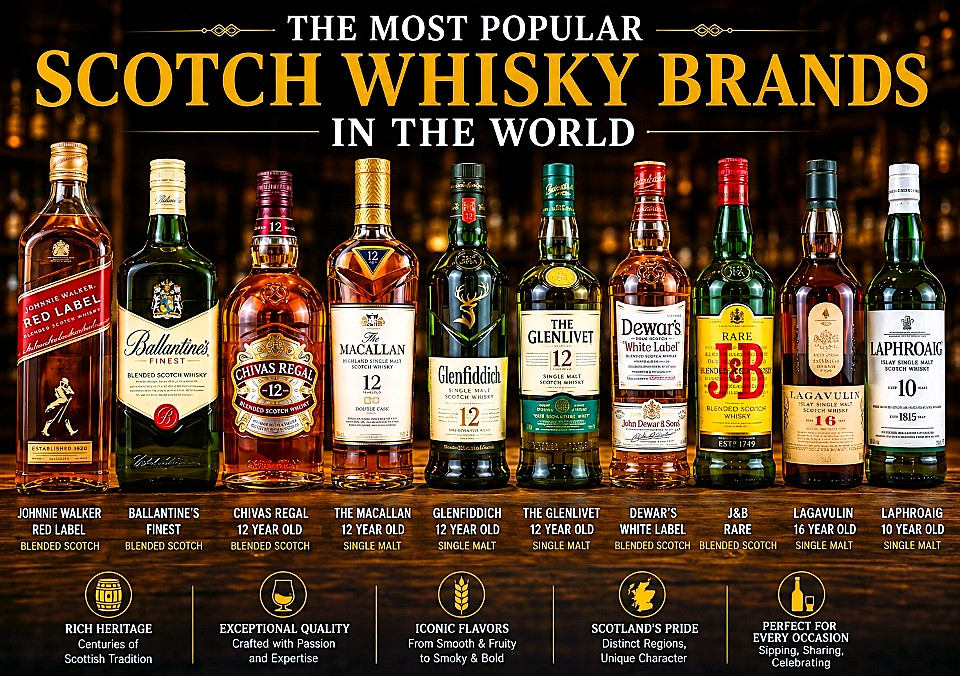
Discover the most popular Scotch whisky brands in the world, from Johnnie Walker and Ballantine’s to Chivas Regal, The Macallan, Glenfiddich, The Glenlivet, Dewar’s, Laphroaig and Lagavulin. Learn about blended Scotch, single malt, flavor profiles, famous expressions, cocktail uses, regional styles and how to choose the perfect Scotch whisky.
Scotch whisky is one of the world’s most famous spirits.
For centuries, Scottish distillers have developed a remarkable range of whiskies, from smooth and approachable blends to intensely smoky Islay single malts. Today, Scotch can be found in virtually every major spirits market, with familiar brands such as Johnnie Walker, Ballantine’s, Chivas Regal, Dewar’s and J&B sitting alongside prestigious single-malt names such as The Macallan, Glenfiddich, The Glenlivet, Lagavulin and Ardbeg.
But which Scotch whisky brands are actually the most popular?
The answer depends on how popularity is measured.
Global case sales are one useful measurement. Bar popularity is another. A whisky can sell millions of cases because it has enormous international distribution, while a luxury single malt can have a relatively small production but enormous recognition among enthusiasts and premium bars.
The latest 2026 global sales data make the distinction particularly clear. Johnnie Walker remained by far the world’s bestselling Scotch brand in 2025, selling 20.3 million nine-liter cases, followed by Ballantine’s at 9.1 million and Chivas Regal at 4.7 million. However, combined Scotch volumes among the major millionaire brands declined from 69.5 million to 67.4 million cases.
At the premium cocktail-bar level, the rankings look somewhat different. Drinks International’s 2026 Brands Report placed Johnnie Walker first and The Macallan second among Scotch brands in the world’s best bars, while The Macallan also topped the report’s trending list. The report found that more than 60% of bestselling Scotch entries were single malts, and around two-thirds of those single malts were peated.
That contrast is important.
The biggest Scotch brand is not necessarily the most prestigious.
And the most expensive Scotch isn’t necessarily the whisky most people want to drink.
This guide therefore combines global sales, international recognition, premium reputation, cocktail-bar popularity and historical importance to create a practical list of 30 Scotch whisky brands every whisky lover should know.
Table of Contents
- What Is Scotch Whisky?
- Whisky vs. Whiskey
- The Five Categories of Scotch Whisky
- Blended Scotch vs. Single Malt
- The 30 Most Popular Scotch Whisky Brands
- Most Popular Blended Scotch Brands
- Most Popular Single Malt Scotch Brands
- Most Popular Smoky Scotch Brands
- Best Scotch for Beginners
- Best Scotch for Sipping
- Best Scotch for Cocktails
- Best Scotch by Region
- How to Choose a Scotch Whisky
- Current Scotch Whisky Trends
- Frequently Asked Questions
- Final Thoughts
What Is Scotch Whisky?
Scotch whisky is whisky produced in Scotland under legally defined rules.
The Scotch Whisky Association states that Scotch is made from cereals, water and yeast, must be distilled and matured in Scotland for at least three years, and must be bottled at a minimum strength of 40% ABV.
Scotch whisky can be made from malted barley and other cereals depending on the category.
The most important categories include:
- Single Malt Scotch Whisky
- Single Grain Scotch Whisky
- Blended Scotch Whisky
- Blended Malt Scotch Whisky
- Blended Grain Scotch Whisky
These categories are defined by Scottish regulations and should not be treated simply as marketing terms.
Whisky vs. Whiskey
You will notice that Scotch is spelled:
whisky
rather than:
whiskey.
The spelling is associated with the country’s production tradition.
Generally:
Scotland = whisky
Canada = whisky
Japan = whisky
while:
Ireland = whiskey
United States = whiskey
There are exceptions, but this is a useful general rule. The Scotch Whisky Association also notes that the spelling distinction is traditionally associated with Scotch and Irish production, although the actual production and maturation requirements are determined by law.
The Five Categories of Scotch Whisky
Understanding the categories makes choosing Scotch much easier.
Single Malt Scotch Whisky
Single malt must be produced at a single distillery using malted barley and distilled in copper pot stills.
It does not mean that the whisky comes from a single barrel.
It means:
one distillery + malted barley.
Single Grain Scotch Whisky
Single grain comes from a single distillery but can use other cereals in addition to malted barley.
It is often used in blends but can also be bottled independently.
Blended Scotch Whisky
Blended Scotch combines:
one or more single malt whiskies + one or more single grain whiskies.
This is the category behind many of the world’s largest Scotch brands.
Blended Malt Scotch Whisky
Blended malt is made from two or more single malt whiskies from different distilleries.
Blended Grain Scotch Whisky
Blended grain combines two or more single grain whiskies from different distilleries.
Blended Scotch vs. Single Malt
This is one of the most common questions among new Scotch drinkers.
Blended Scotch
Typically emphasizes:
- Consistency
- Accessibility
- Balance
- Large-scale production
Examples include:
- Johnnie Walker
- Ballantine’s
- Chivas Regal
- Dewar’s
- J&B
- Buchanan’s
Single Malt
Typically emphasizes:
- Distillery character
- Regional identity
- Cask influence
- Malt character
- Individuality
Examples include:
- The Macallan
- Glenfiddich
- The Glenlivet
- Lagavulin
- Laphroaig
- Ardbeg
Neither category is inherently better.
A superb blend can be more enjoyable than a mediocre single malt.
The 30 Most Popular Scotch Whisky Brands in the World
1. Johnnie Walker
Category: Blended Scotch
Producer: Diageo
Johnnie Walker is unquestionably the giant of Scotch whisky.
The brand has become a global symbol of Scotch through its distinctive square bottle, Striding Man logo and broad portfolio.
Its current range includes:
- Red Label
- Black Label
- Double Black
- Green Label
- Gold Label Reserve
- Aged and limited releases
In global volume terms, no other Scotch brand comes close. Johnnie Walker sold 20.3 million nine-liter cases in 2025, retaining its position as the world’s largest Scotch whisky brand despite a 6% decline.
It also remained the bestselling Scotch brand in Drinks International’s 2026 survey of leading bars, where 23% of participating bars named it their house pour.
Flavor profile
Depending on the expression:
- Smoke
- Vanilla
- Oak
- Dried fruit
- Spice
- Malt
Best for
Highballs, whisky cocktails, casual sipping and entertaining.
Why try it?
Johnnie Walker is the essential starting point for understanding the global Scotch category.
2. Ballantine’s
Category: Blended Scotch
Producer: Pernod Ricard
Ballantine’s is the world’s second-largest Scotch brand by the latest global case sales.
It sold approximately 9.1 million cases in 2025, remaining comfortably ahead of the rest of the field.
The brand has built its success around approachable blended Scotch and extensive international distribution.
Flavor profile
Typical characteristics include:
- Honey
- Vanilla
- Apple
- Light spice
- Malt
Best for
- Highballs
- Whisky and soda
- Whisky cocktails
- Casual sipping
Why try it?
Ballantine’s demonstrates why blended Scotch remains the foundation of global Scotch consumption.
3. Chivas Regal
Category: Blended Scotch
Producer: Pernod Ricard
Chivas Regal is one of the world’s best-known premium blended Scotch brands.
It sold approximately 4.7 million cases in 2025.
Chivas is generally associated with a richer, smoother style than entry-level blends.
Typical notes
- Honey
- Apple
- Vanilla
- Dried fruit
- Oak
- Spice
Popular expressions
- Chivas 12
- Chivas 18
- Chivas XV
- Chivas 25
Best for
Sipping, highballs and premium whisky cocktails.
4. The Macallan
Category: Single Malt Scotch
Region: Speyside
The Macallan occupies an entirely different position from mass-market blends.
It is one of the world’s most famous luxury Scotch brands.
Drinks International’s 2026 report ranked The Macallan second among bestselling Scotch brands in the world’s best bars and also placed it at the top of its trending list.
The Macallan is particularly famous for its use of carefully selected oak casks and its emphasis on maturation.
Flavor profile
Depending on the expression:
- Dried fruit
- Orange
- Raisin
- Vanilla
- Oak
- Spice
- Chocolate
Best for
Sipping neat.
Why try it?
The Macallan is one of the best-known examples of luxury single malt Scotch.
5. Glenfiddich
Category: Single Malt Scotch
Region: Speyside
Glenfiddich is one of the world’s most widely recognized single malt Scotch brands.
Its approachable character has made it a common introduction to single malt whisky.
Typical notes
- Pear
- Apple
- Honey
- Vanilla
- Malt
- Oak
Popular expression
Glenfiddich 12 Year Old
is an excellent starting point for newcomers.
Best for
- Beginners
- Neat sipping
- Whisky on the rocks
- Highballs
6. The Glenlivet
Category: Single Malt Scotch
Region: Speyside
The Glenlivet is another foundational Speyside whisky.
Its generally smooth and fruit-forward character makes it particularly accessible.
Typical flavors
- Pear
- Apple
- Citrus
- Vanilla
- Almond
- Floral notes
Best for
New Scotch drinkers and relaxed sipping.
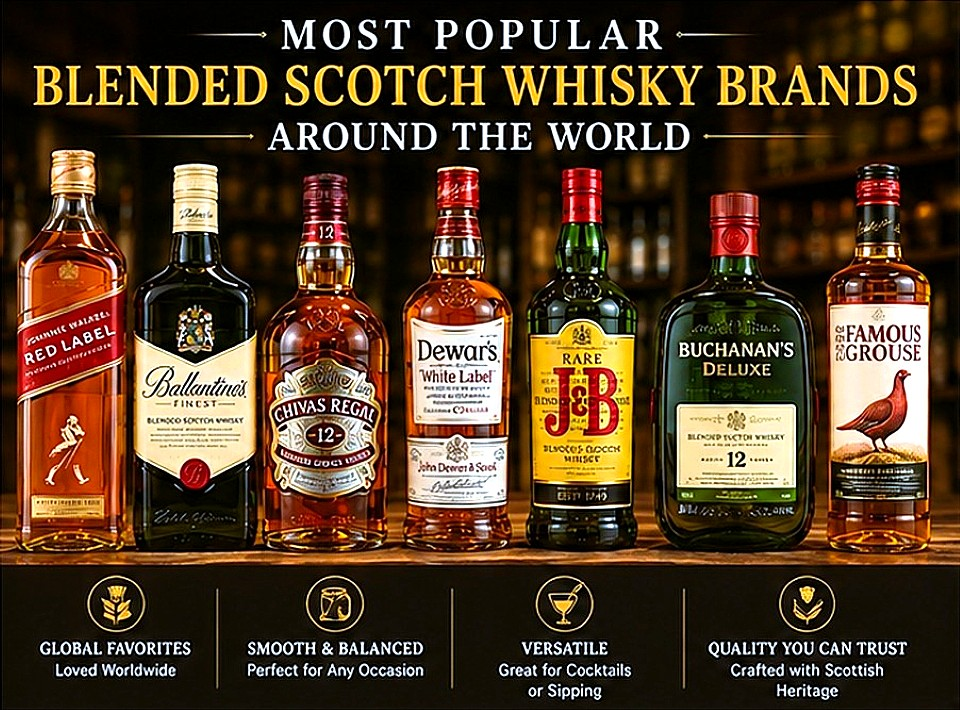
Most popular blended Scotch whisky brands including Johnnie Walker, Ballantine’s, Chivas Regal, Dewar’s, Buchanan’s and The Famous Grouse
7. Dewar’s
Category: Blended Scotch
Dewar’s is one of the world’s largest blended Scotch brands.
Its popularity comes from a combination of approachability, distribution and cocktail versatility.
Best for
- Highballs
- Whisky and soda
- Whisky cocktails
- Casual drinking
Dewar’s was among the brands contributing to the broader decline in Scotch volume in 2025, but it remains one of the category’s most globally recognizable labels.
8. J&B
Category: Blended Scotch
J&B is another major global Scotch brand.
The latest 2026 data put its 2025 sales at around 2.3 million cases, keeping it among the world’s million-case Scotch brands.
Its lighter, approachable style makes it particularly suitable for mixed drinks.
Best for
- Highballs
- Whisky & cola
- Cocktails
9. Buchanan’s
Category: Blended Scotch
Buchanan’s was one of the strongest performers among major Scotch brands in 2025.
Its sales increased 8.9% to approximately 2.3 million cases, making it one of the brighter spots in a difficult year for the broader Scotch category.
Best for
- Highballs
- Whisky and soda
- Sipping
10. The Famous Grouse
Category: Blended Scotch
The Famous Grouse is one of Scotland’s most recognizable everyday Scotch brands.
Its approachable style makes it particularly useful for:
- Highballs
- Whisky & cola
- Casual sipping
- Cocktails
Why try it?
It’s a good example of accessible blended Scotch.
11. Grant’s
Category: Blended Scotch
Grant’s has long been a major international Scotch label.
It is particularly useful when you want an economical bottle for mixing or entertaining.
Best for
- Highballs
- Whisky & cola
- Large gatherings
- Cocktails
12. Label 5
Category: Blended Scotch
Label 5 remains a significant global blended Scotch brand.
The latest Brand Champions data place it among the major million-case Scotch brands, despite a slight decline in 2025.
Best for
Mixing and casual drinking.
13. Black & White
Category: Blended Scotch
Black & White is an old Scottish brand with particularly strong regional popularity.
It was one of the positive stories in the latest global Scotch rankings, rising 13% to 3.4 million cases in 2025. Drinks International notes its strong position in France and Brazil.
Why try it?
It demonstrates how regional loyalty can keep historic Scotch brands highly relevant.
14. Teacher’s
Category: Blended Scotch
Teacher’s is another established blended Scotch brand.
Its 2025 volume increased 14.3% to about 1.6 million cases, making it one of the notable growth stories lower down the global ranking.
Best for
Casual sipping and mixed drinks.
15. Old Parr
Category: Blended Scotch
Old Parr is another longstanding Scotch brand with strong markets outside Scotland.
Its volume also increased 14.3% in 2025, reaching approximately 1.6 million cases.
16. Monkey Shoulder
Category: Blended Malt Scotch
Monkey Shoulder represents a more modern approach to Scotch.
Rather than being positioned primarily as a traditional sipping whisky, it has developed a strong identity around cocktails.
Best for
- Whisky Sour
- Highballs
- Old Fashioned variations
- Penicillin-style cocktails
Why try it?
It shows that Scotch can be a serious cocktail spirit.
17. Johnnie Walker Black Label
Although it belongs to the broader Johnnie Walker family, Black Label deserves special attention.
It is generally richer and more complex than Red Label and has become one of the world’s best-known premium blended Scotches.
Typical flavors
- Dried fruit
- Smoke
- Vanilla
- Oak
- Spice
Best for
Sipping and classic Scotch cocktails.
18. The Balvenie
Category: Single Malt Scotch
Region: Speyside
The Balvenie is particularly respected among single-malt enthusiasts.
The brand is known for craftsmanship and a wide range of cask-finished expressions.
Flavor profile
Depending on the expression:
- Honey
- Vanilla
- Dried fruit
- Spice
- Oak
- Orange
Best for
Sipping neat.
19. Glenmorangie
Category: Single Malt Scotch
Region: Highlands
Glenmorangie is one of the world’s best-known Highland single malts.
It is particularly associated with elegant, lighter styles and extensive cask experimentation.
Typical notes
- Orange
- Peach
- Vanilla
- Honey
- Almond
- Floral character
Best for
Beginners and experienced whisky drinkers alike.
20. Talisker
Category: Single Malt Scotch
Region: Isle of Skye
Talisker provides a fascinating bridge between coastal whisky and peat.
Expect:
- Pepper
- Smoke
- Salt
- Citrus
- Oak
Best for
Drinkers who want smoky whisky without starting with the most intense Islay styles.
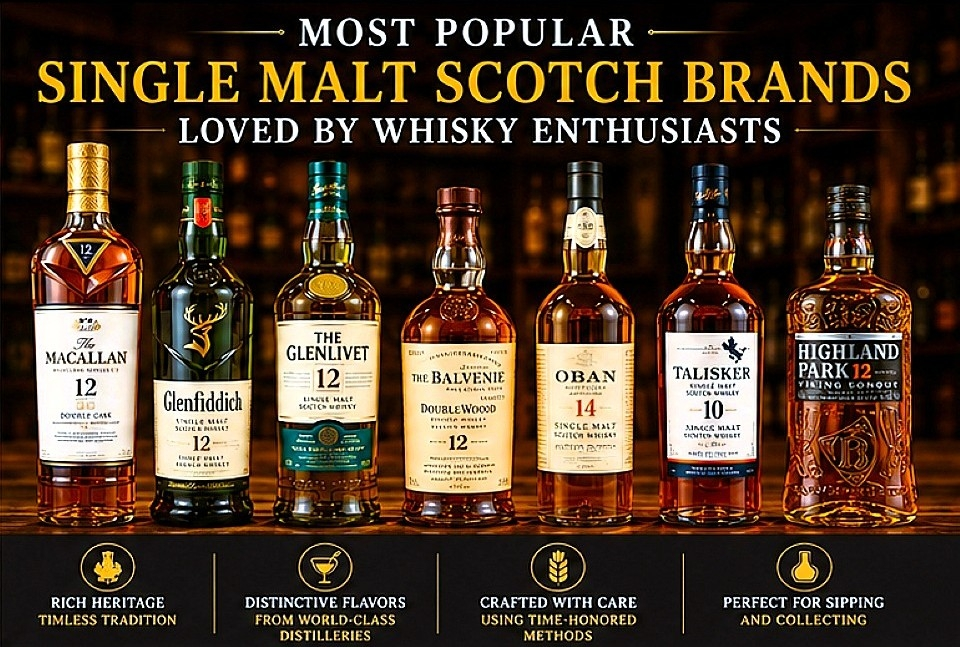
Most popular single malt Scotch brands including The Macallan, Glenfiddich, The Glenlivet, The Balvenie, Oban, Talisker and Highland Park
21. Lagavulin
Category: Single Malt Scotch
Region: Islay
Lagavulin represents the heavily peated side of Scotch.
It is famous for its intense smoke, maritime character and rich finish.
Flavor profile
- Peat
- Smoke
- Sea salt
- Dark fruit
- Oak
- Vanilla
Best for
Experienced whisky drinkers.
Cocktail use
It can be used carefully in smoky variations of:
- Old Fashioned
- Manhattan
- Penicillin
22. Laphroaig
Category: Single Malt Scotch
Region: Islay
Laphroaig is among the most recognizable smoky whiskies in the world.
It is famous for a particularly distinctive combination of:
- Peat smoke
- Seaweed
- Medicinal notes
- Char
- Vanilla
- Oak
Best for
Peat enthusiasts. This is not usually the first Scotch to give someone who dislikes smoky spirits.
23. Ardbeg
Category: Single Malt Scotch
Region: Islay
Ardbeg is another legendary peated whisky.
Its smoke is often accompanied by citrus, pepper and vanilla.
Typical notes
- Lemon
- Smoke
- Pepper
- Char
- Vanilla
- Earth
Best for
Experienced Scotch drinkers looking for intensity.
24. Bowmore
Category: Single Malt Scotch
Region: Islay
Bowmore is one of the historic Islay distilleries.
Its style can combine peat smoke with:
- Lemon
- Honey
- Vanilla
- Sea salt
- Tropical fruit
Best for
People exploring peated Scotch.
25. Aberlour
Category: Single Malt Scotch
Region: Speyside
Aberlour is known for rich, fruit-driven Scotch with substantial cask influence.
Flavor profile
- Raisin
- Apple
- Orange
- Chocolate
- Spice
- Oak
Best for
Sipping after dinner.
26. Glen Scotia
Category: Single Malt Scotch
Region: Campbeltown
Campbeltown is one of Scotland’s historic whisky regions, and Glen Scotia is one of its best-known surviving distilleries.
Flavor profile
- Salt
- Vanilla
- Citrus
- Oak
- Fruit
Why try it?
It offers something different from the better-known Speyside and Islay styles.
27. The Dalmore
Category: Single Malt Scotch
Region: Highlands
The Dalmore is strongly associated with premium and luxury single malt.
Its expressions often use a variety of cask types to create a rich profile.
Typical notes
- Orange
- Chocolate
- Raisin
- Vanilla
- Spice
- Oak
Best for
Luxury sipping and gifting.
28. Oban
Category: Single Malt Scotch
Region: Highlands
Oban is known for balancing coastal character with fruit and malt.
Expect:
- Citrus
- Smoke
- Salt
- Honey
- Oak
Best for
Drinkers who want moderate peat and coastal character.
29. Glenfarclas
Category: Single Malt Scotch
Region: Speyside
Glenfarclas is particularly respected for rich sherry-cask-influenced whisky.
Typical notes
- Dried fruit
- Raisin
- Orange
- Spice
- Nuts
- Oak
Best for
Rich, dessert-like sipping.
30. Highland Park
Category: Single Malt Scotch
Region: Orkney
Highland Park is famous for combining gentle peat with fruit, honey and spice.
Flavor profile
- Heather smoke
- Honey
- Orange
- Dried fruit
- Spice
- Oak
Best for
Drinkers who want a balanced smoky whisky.
Most Popular Blended Scotch Brands
If you are new to Scotch, blended whisky is the easiest place to start.
The major names include:
Johnnie Walker
The global leader.
Ballantine’s
The second-largest by volume.
Chivas Regal
A major premium blend.
Dewar’s
Approachable and versatile.
J&B
Lighter and mixable.
Buchanan’s
Strong international following.
The Famous Grouse
Classic everyday Scotch.
Grant’s
Widely distributed and accessible.
These brands are important because blended Scotch remains the dominant part of the global category. The Scotch Whisky Association says almost nine out of ten bottles of Scotch enjoyed around the world are blended Scotch whiskies, underscoring just how important blends remain.
Most Popular Single Malt Scotch Brands
For enthusiasts, single malt is often the most fascinating part of the category.
Start with:
The Macallan
Glenfiddich
The Glenlivet
Glenmorangie
The Balvenie
Lagavulin
Laphroaig
Ardbeg
Highland Park
Oban
Drinks International’s 2026 Scotch report found that single malts represented more than 60% of its bestselling Scotch list, with roughly two-thirds of those single malts being peated.
That is a strong indication of the continuing attraction of distinctive single-malt Scotch among premium-bar drinkers.
Most Popular Smoky Scotch Brands
If you like smoky whisky, start here.
Mild to moderate
Highland Park
Talisker
Bowmore
More intense
Lagavulin
Laphroaig
Ardbeg
The smoke comes primarily from the use of peat during malted-barley production.
The result can range from gentle campfire smoke to intensely medicinal and maritime flavors.
Best Scotch Whisky for Beginners
A beginner should generally start with a Scotch that isn’t overwhelmingly smoky.
Best starting choices
Glenfiddich 12
The Glenlivet 12
Johnnie Walker Black Label
Glenmorangie Original
Chivas Regal 12
Monkey Shoulder
These offer different perspectives while remaining relatively approachable.
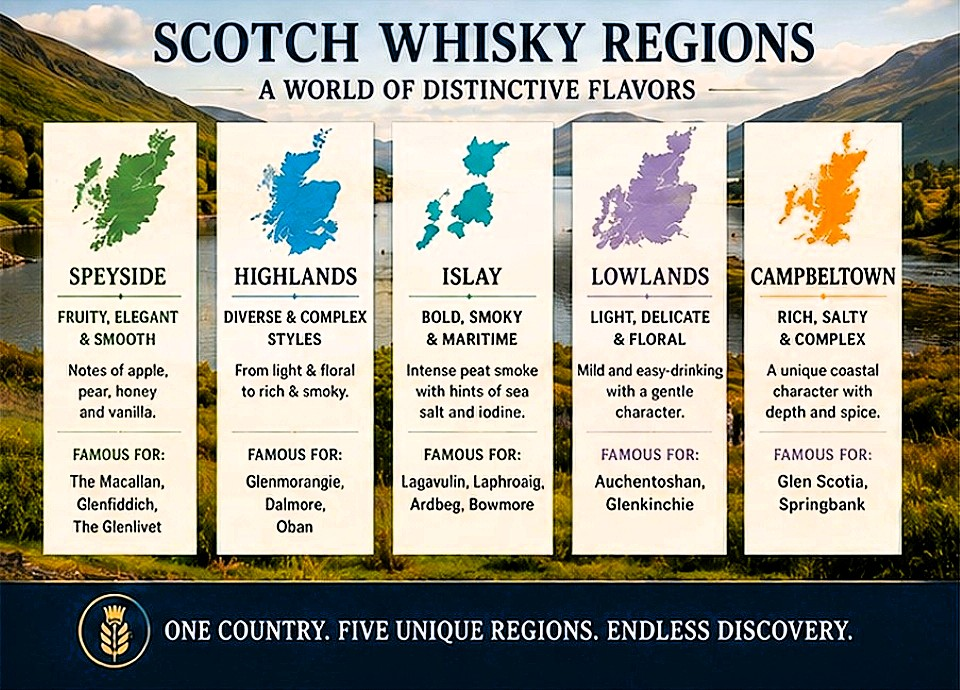
Scotch whisky regions including Speyside, Highlands, Islay, Lowlands and Campbeltown with their distinctive whisky styles
Best Scotch Whisky for Sipping
For neat drinking, look for complexity.
Rich
The Macallan
The Dalmore
Glenfarclas
Fruity
Glenfiddich
The Glenlivet
Glenmorangie
Smoky
Lagavulin
Laphroaig
Ardbeg
Balanced
Highland Park
Oban
The key is to find the style that matches your palate.
Best Scotch for Cocktails
Scotch is sometimes overlooked as a cocktail ingredient.
It shouldn’t be.
Classic and modern drinks can showcase Scotch beautifully.
Whisky Sour
Try:
Monkey Shoulder
Johnnie Walker Black Label
Dewar’s
Old Fashioned
Try:
Johnnie Walker Black Label
Chivas Regal
Monkey Shoulder
Blood and Sand
Try:
Blended Scotch
Penicillin
A blend provides the base, while a smoky Islay Scotch can be floated on top.
Good choices include:
Johnnie Walker
with a small amount of:
Lagavulin or Ardbeg
Rob Roy
This Scotch version of the Manhattan works particularly well with richer blended Scotch.
Best Scotch Whisky by Region
Scotland’s whisky regions offer distinct styles.
Speyside
Generally associated with:
- Fruit
- Honey
- Orchard character
- Elegant malt
- Sherry influence
Popular names:
Glenfiddich
The Glenlivet
The Macallan
The Balvenie
Aberlour
Glenfarclas
Highlands
The Highlands are extraordinarily diverse.
Popular names:
Glenmorangie
Oban
The Dalmore
Highland Park is geographically associated with Orkney but often discussed alongside broader Highland whisky traditions.
Highland whiskies can range from light and floral to rich and smoky.
Islay
Known for:
peat smoke
sea salt
medicinal character
maritime flavors
Major names include:
Lagavulin
Laphroaig
Ardbeg
Bowmore
Campbeltown
Campbeltown was historically one of Scotland’s major whisky centers.
Today, it is smaller but highly respected.
Glen Scotia is a key name.
Lowlands
Lowland whisky is often associated with lighter and more delicate styles.
It can be a good place to start for people who find heavily peated Scotch too intense.
How to Choose the Right Scotch Whisky
Ask yourself six questions.
1. Do you like smoke?
Yes: Try Islay.
No: Start with Speyside or Lowlands.
2. Do you prefer sweet or dry?
For sweeter profiles, look for:
- Sherry-cask maturation
- Dried fruit
- Vanilla
- Raisin
For drier, sharper profiles, look for:
- Coastal whisky
- Lighter cask influence
- Peated expressions
3. Are you drinking it neat?
Choose a whisky with complexity and finish.
4. Are you making cocktails?
Choose an affordable, versatile blend.
5. Are you buying a gift?
Choose a recognizable premium brand.
6. What’s your budget?
Scotch exists at almost every price point.
Does Age Statement Matter?
Age matters, but older does not automatically mean better.
A 25-year-old Scotch can be extraordinary.
But a well-made 12-year-old whisky can also be excellent.
Age indicates the time the spirit spent maturing in wood.
It does not tell you:
- Whether you’ll like the flavor
- How good the casks were
- How the spirit was blended
- How well the maturation worked
A great whisky balances:
spirit + oak + time.
How Casks Affect Scotch Whisky
Cask maturation is one of the biggest influences on Scotch flavor.
Common cask types include:
- Ex-bourbon
- Sherry
- Port
- Wine
- Rum
- Other fortified-wine casks
Bourbon casks
Often emphasize:
- Vanilla
- Coconut
- Caramel
- Oak
Sherry casks
Often emphasize:
- Raisin
- Dried fruit
- Nut
- Spice
- Chocolate
This is why two whiskies made from similar ingredients can taste completely different.
Current Scotch Whisky Trends
The Scotch market is currently going through a challenging period.
The latest Millionaires’ Club data show combined global volumes for the major Scotch millionaire brands falling from 69.5 million cases to 67.4 million cases in 2025. Johnnie Walker, Ballantine’s and Chivas all declined.
However, several brands performed positively.
Black & White grew 13%, while Teacher’s and Old Parr both rose 14.3%. The Glenlivet also grew, suggesting that premium single malts can still find momentum despite wider category pressure.
This creates an interesting split.
Mass-market Scotch
Under pressure from:
- Changing consumer habits
- Economic pressure
- Competition from other spirits
- Ready-to-drink beverages
Premium Scotch
Still supported by:
- Enthusiasts
- Collectors
- Cocktail bars
- Luxury gifting
- Whisky tourism
- Limited releases
Drinks International’s 2026 bar report reinforces the strength of premium single malt. The Macallan was the second bestselling Scotch in participating bars and the most-trending Scotch brand.
Scotch Whisky and Cocktails
Cocktail culture is increasingly important to Scotch.
Although Scotch is traditionally associated with neat sipping, bartenders continue to use it in:
- Penicillin
- Blood and Sand
- Rob Roy
- Scotch Sour
- Old Fashioned variations
- Highballs
The 2026 Drinks International report specifically notes that single malts and peated Scotch make up a substantial share of bestselling Scotch choices in influential bars.
That matters because premium cocktail menus can introduce Scotch to people who might otherwise never order it neat.
How Much Should You Spend on Scotch?
You don’t have to spend hundreds of dollars.
Entry level
Ideal for:
- Cocktails
- Highballs
- Learning Scotch
Mid-range
Usually the sweet spot for:
- Better single malts
- Premium blends
- More distinctive expressions
Luxury
Suitable for:
- Collecting
- Special occasions
- Gifts
- Serious tasting
Remember:
Price does not equal personal enjoyment.
A $60 whisky you love is more valuable to you than a $500 whisky you don’t.
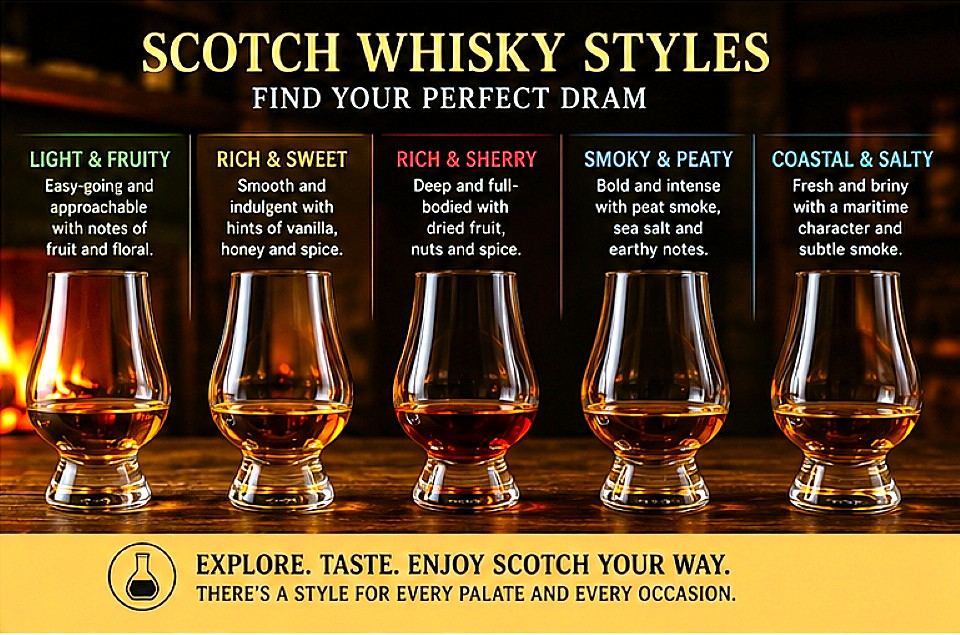
Scotch whisky styles ranging from light and fruity to rich, sherry, smoky, peaty and coastal flavors
Building a 10-Bottle Scotch Collection
You can explore nearly the entire Scotch spectrum with ten bottles.
1. Johnnie Walker Black Label
Blended Scotch.
2. Chivas Regal 12
Premium blend.
3. Glenfiddich 12
Approachable Speyside.
4. The Glenlivet 12
Another classic Speyside.
5. Glenmorangie Original
Light Highland style.
6. The Macallan
Rich premium single malt.
7. Highland Park
Balanced smoke.
8. Talisker
Coastal character.
9. Lagavulin
Intense peat.
10. Ardbeg
Powerful smoky Islay.
That collection would give you an excellent tour of Scotch styles.
Frequently Asked Questions About Scotch Whisky
What is the most popular Scotch whisky brand in the world?
Johnnie Walker is the world’s largest Scotch brand by global case volume. It sold approximately 20.3 million nine-liter cases in 2025.
What is the second most popular Scotch brand?
Ballantine’s ranked second by global volume, with approximately 9.1 million cases in 2025.
What is the third biggest Scotch brand?
Chivas Regal, with approximately 4.7 million cases in 2025.
What is the most popular single malt Scotch?
There is no single global sales ranking for every single malt, but The Macallan is among the world’s most prominent premium single malts and ranked second among Scotch brands in Drinks International’s 2026 leading-bar survey.
What is the best Scotch whisky?
There is no universally accepted best Scotch. The ideal whisky depends on whether you prefer smoke, sweetness, fruit, spice, oak or maritime flavors.
What is the best Scotch for beginners?
Glenfiddich 12, The Glenlivet 12, Glenmorangie Original, Chivas Regal 12 and Johnnie Walker Black Label are good starting points.
What is the best smoky Scotch?
Lagavulin, Laphroaig and Ardbeg are among the most recognizable intensely peated Scotches.
What is the best Scotch for cocktails?
Monkey Shoulder, Johnnie Walker Black Label, Dewar’s and other versatile blends work particularly well.
What is the difference between single malt and blended Scotch?
Single malt is produced at one distillery from malted barley, while blended Scotch combines one or more single malts with one or more single grain whiskies.
Is single malt better than blended Scotch?
No. They are different styles. Blended Scotch emphasizes consistency and balance, while single malt often emphasizes individual distillery character.
What is Scotch whisky made from?
Scotch is made from cereals, water and yeast and must meet specific Scottish production and maturation requirements.
How long must Scotch whisky be aged?
Scotch whisky must be matured in Scotland for at least three years under the applicable regulations.
What region makes the best Scotch?
There is no best region. Speyside is famous for elegant fruit-driven whisky, Islay for peat and smoke, and the Highlands offer enormous stylistic diversity.
Is Johnnie Walker a single malt?
No. Johnnie Walker is a blended Scotch whisky.
Is The Macallan a single malt?
Yes. The Macallan is a single malt Scotch brand from Speyside.
Is Scotch good in cocktails?
Absolutely. Scotch is used in classic and contemporary drinks including the Rob Roy, Blood and Sand, Penicillin and Scotch Sour.
Why is Islay whisky smoky?
Many Islay whiskies use peat smoke during the malting process. The resulting phenolic compounds contribute smoky and medicinal flavors.
Is older Scotch better?
Not necessarily. Age is one factor in whisky, but cask quality, spirit character and maturation conditions also matter.
What Scotch should I buy as a gift?
A recognizable premium bottle such as The Macallan, Glenfiddich, The Glenlivet, Johnnie Walker Black Label or Chivas Regal is a safe starting point, depending on the recipient’s taste.
Should Scotch be chilled?
Generally, Scotch is best appreciated without heavy chilling because very low temperatures can suppress aroma. Some drinkers prefer a small amount of water or one ice cube.
Final Thoughts: The World’s Most Popular Scotch Whisky Brands
Scotch whisky is much more than one style of spirit.
It encompasses:
blended Scotch
single malt
single grain
blended malt
blended grain
and an enormous range of regional and distillery personalities.
At the global-volume level, Johnnie Walker remains the undisputed king. Its 20.3 million cases in 2025 put it more than twice the size of Ballantine’s, the second-largest Scotch brand.
Chivas Regal remains a major premium blend.
The Macallan demonstrates the power of luxury single malt.
Glenfiddich and The Glenlivet continue to introduce generations of drinkers to Speyside whisky.
Glenmorangie offers a highly approachable Highland style.
And for smoky whisky lovers, Lagavulin, Laphroaig and Ardbeg demonstrate just how dramatic Scotch can become.
The latest data also reveal something important about the future of Scotch.
The category’s biggest global-volume brands experienced pressure in 2025, with combined millionaire-brand volumes declining to 67.4 million cases.
But premium Scotch remains highly relevant.
Drinks International’s 2026 research found The Macallan performing exceptionally well in the world’s best bars, while single malts represented more than 60% of the bestselling Scotch entries in that survey.
That tells us that Scotch has two very different personalities.
One is global, accessible and highly scalable.
The other is premium, distinctive and deeply connected to whisky enthusiasts and bartenders.
Both matter.
For a beginner, start with something approachable.
Try Glenfiddich 12.
Then explore The Glenlivet.
Move into a richer whisky such as The Macallan.
Then try something smoky such as Highland Park.
Eventually, explore Talisker, Lagavulin, Laphroaig and Ardbeg.
Taste them side by side.
Notice how smoke changes.
Notice how oak changes.
Notice how sweetness changes.
Notice how the finish changes.
Then experiment with cocktails.
Use a blended Scotch in a Rob Roy.
Try a smoky whisky in a Penicillin.
Use a lighter Scotch in a Highball.
The more styles you taste, the more you’ll understand what you actually enjoy.
And that’s the most important lesson of all.
There is no universally perfect Scotch whisky.
There is only the whisky that is perfect for your palate, your occasion and your budget.
Whether you’re opening a bottle of Johnnie Walker at a party, pouring a Glenfiddich after dinner, exploring The Macallan, discovering Speyside for the first time or enjoying a smoky Islay dram beside a winter fireplace, Scotch has something to offer.
The world of Scotch is enormous.
And that is precisely why it remains so fascinating.