Blog
Most Popular Irish Whiskey Brands in the World: 30 Famous Bottles Every Whiskey Lover Should Know


Discover the most popular Irish whiskey brands in the world, from Jameson and Bushmills to Tullamore D.E.W., Redbreast, Powers, Teeling, Green Spot and Midleton Very Rare. Explore bestselling Irish whiskey brands, single malt, single pot still and blended whiskey, tasting profiles, cocktail recommendations and tips for choosing the perfect bottle.
Irish whiskey has experienced one of the most remarkable revivals in the modern spirits industry.
For much of the 20th century, the category was concentrated around a relatively small number of producers and globally recognized labels. Today, Ireland has a much more diverse whiskey landscape, with historic distilleries operating alongside independent producers, Dublin craft distilleries, premium single malts, single pot still whiskeys and innovative cask-finished releases.
At the center of the category is Jameson, the world’s best-known Irish whiskey brand and by far the largest Irish whiskey by global volume.
The latest available 2026 Brand Champions data show Jameson sold 11.1 million nine-liter cases in 2025, rising 2.2% and earning the title of 2026 World Whisky Brand Champion. (thespiritsbusiness.com)
But Jameson is only the beginning.
Bushmills, Tullamore D.E.W., Redbreast, Powers, Teeling, Green Spot, Midleton Very Rare, Roe & Co, Dingle, Waterford, The Busker and other producers have helped transform Irish whiskey into an increasingly diverse premium category.
Drinks International’s reporting also shows how the category has expanded beyond the traditional giants. In its Irish whiskey bar survey, Jameson led comfortably, while Teeling and Redbreast followed, and Tullamore D.E.W., Bushmills and Roe & Co also performed strongly. The survey covered 100 leading bars in 33 countries.
That difference between global sales and premium-bar popularity matters.
The biggest Irish whiskey brand isn’t necessarily the most interesting bottle for a whiskey enthusiast.
A mass-market blend may be ideal for a highball, while a 12-year-old single pot still whiskey may be better suited to slow sipping.
So this guide isn’t simply a rigid ranking from 1 to 30.
Instead, it combines global brand popularity, bartender recognition, heritage, premium reputation, style and consumer relevance to create a practical list of Irish whiskey brands worth knowing.
Table of Contents
- What Is Irish Whiskey?
- What Makes Irish Whiskey Different?
- The Main Types of Irish Whiskey
- The 30 Most Popular Irish Whiskey Brands
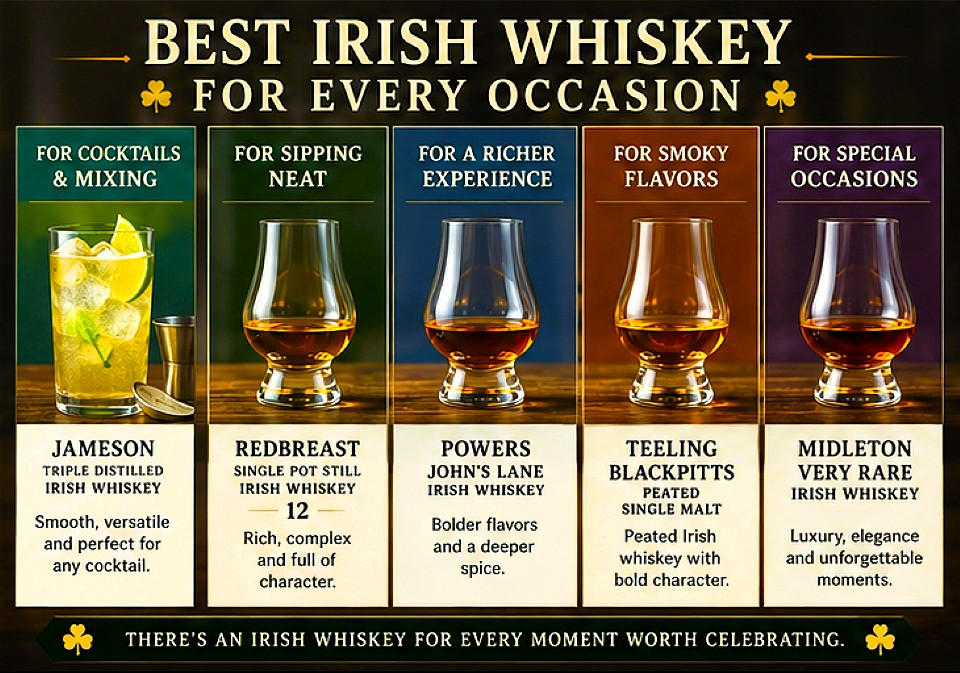
- Best Irish Whiskey Brands for Beginners
- Best Irish Whiskey for Sipping
- Best Irish Whiskey for Cocktails
- Irish Whiskey by Style
- Irish Whiskey by Region
- Premium and Luxury Irish Whiskey
- How to Choose Irish Whiskey
- Current Irish Whiskey Trends
- Frequently Asked Questions
- Final Thoughts
What Is Irish Whiskey?
Irish whiskey is a protected geographical indication associated with whiskey produced on the island of Ireland under specific technical requirements.
The Irish Department of Agriculture, Food and the Marine explains that Irish Whiskey is a protected GI and that its production must comply with an official technical file. The technical specification covers production, distillation, maturation and the categories of Irish whiskey.
Under the Irish Whiskey Technical File, Irish whiskey is divided into four principal classifications:
- Pot Still Irish Whiskey
- Malt Irish Whiskey
- Grain Irish Whiskey
- Blended Irish Whiskey
The Irish Whiskey Act also establishes important production requirements, including maturation in wooden casks for at least three years.
That legal framework is important because it distinguishes genuine Irish whiskey from spirits merely using Irish-inspired branding.
What Makes Irish Whiskey Different?
Irish whiskey has several characteristics that have helped make it globally successful.
Triple distillation
Irish whiskey has a strong association with triple distillation.
However, triple distillation is not universal across every Irish whiskey producer or category.
Some distillers use double distillation, and others employ different still arrangements.
Still, the tradition has helped establish the idea that Irish whiskey is often:
- Smooth
- Approachable
- Light
- Fruity
- Balanced
Pot still tradition
One of the most distinctive Irish styles is single pot still whiskey, made using a mixture of malted and unmalted barley.
That style can deliver a more complex and textured character than many standard blends.
Typical notes include:
- Green apple
- Pear
- Orchard fruit
- Spice
- Nuts
- Cream
- Honey
Cask maturation
Oak is central to Irish whiskey.
Common cask types include:
- Ex-bourbon
- Sherry
- Port
- Madeira
- Wine
- Rum
- Other fortified-wine casks
This creates enormous opportunities for experimentation.
The Main Types of Irish Whiskey
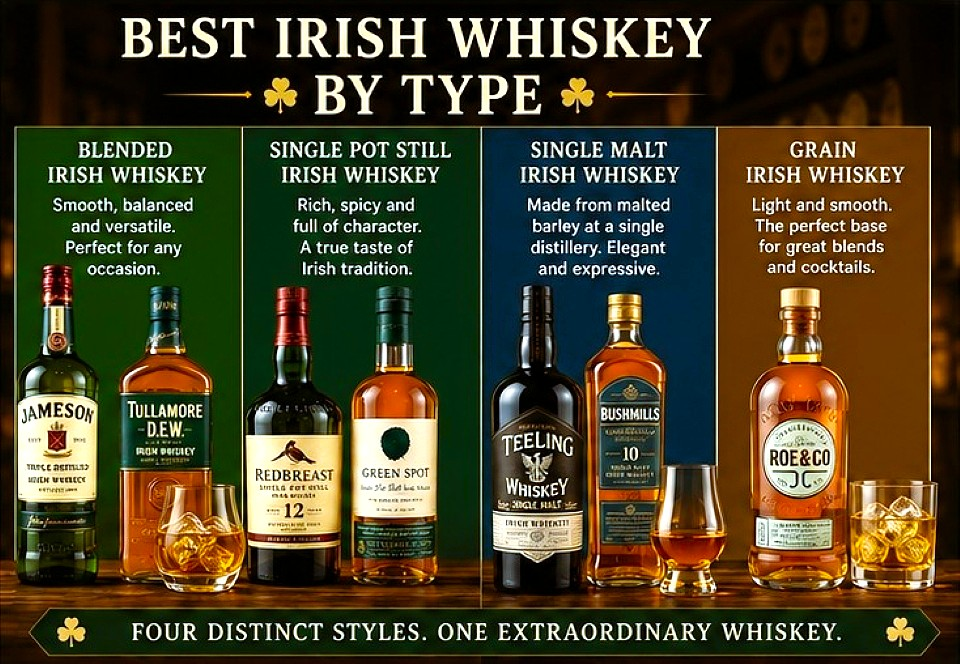
Blended Irish Whiskey
Blended Irish whiskey combines two or more different whiskey types.
It is typically designed for consistency and accessibility.
Major brands include:
Jameson
Tullamore D.E.W.
Bushmills Original
Powers Gold Label
Roe & Co
Single Malt Irish Whiskey
Single malt is made from malted barley at a single distillery.
Examples include:
Bushmills Single Malt
Teeling Single Malt
Dingle Single Malt
Waterford Single Malt
Single Pot Still Irish Whiskey
This is one of Ireland’s most distinctive styles.
It uses both malted and unmalted barley and is distilled in pot stills.
Major examples include:
Redbreast
Green Spot
Powers John’s Lane
Midleton Very Rare
Grain Irish Whiskey
Grain whiskey is generally produced in column stills and can form an important component of blended Irish whiskey.
It tends to be lighter and softer.
The 30 Most Popular Irish Whiskey Brands in the World
1. Jameson
Category: Blended Irish Whiskey
Producer: Irish Distillers
Home: Midleton, County Cork
Jameson is the undisputed global leader of Irish whiskey.
The brand sold 11.1 million nine-liter cases in 2025, an increase of 2.2%, making it the world’s largest Irish whiskey brand by a considerable margin. It was also named the 2026 World Whisky Brand Champion.
Jameson’s popularity comes from its remarkably versatile profile.
It works equally well:
- Neat
- On the rocks
- With ginger ale
- In Irish Coffee
- In whiskey cocktails
- In simple highballs
Typical flavor profile
- Vanilla
- Orchard fruit
- Honey
- Cereal
- Light spice
Best expression for beginners
Jameson Original
Best for cocktails
Jameson Original
Why try it?
Jameson is the essential reference point for modern Irish whiskey.
2. Bushmills
Category: Blended and Single Malt Irish Whiskey
Location: County Antrim, Northern Ireland
Bushmills has one of the strongest historical identities in Irish whiskey.
The distillery describes itself as the world’s oldest licensed whiskey distillery, and the brand now offers a broad range stretching from accessible blends to highly aged single malts.
The company has also been expanding aggressively.
Its new Causeway Distillery opened in 2024 and more than doubled production capacity, while Bushmills announced a planned £62.9 million investment in 26 additional warehouses in 2026.
The brand’s portfolio includes:
- Bushmills Original
- Black Bush
- Bushmills 10 Year Old
- Bushmills 12 Year Old
- Bushmills 16 Year Old
- Bushmills 21 Year Old
- Causeway Collection
- Prestige releases
Black Bush received a redesigned bottle in 2026, while retaining its traditional liquid, which contains a relatively high proportion of triple-distilled single malt matured in oloroso Sherry casks.
Best for
Black Bush for richer blended whiskey.
Bushmills 10 for accessible single malt.
Why try it?
Bushmills gives you a complete tour of Irish whiskey from affordable blends to luxury single malts.
3. Tullamore D.E.W.
Category: Blended Irish Whiskey
Home: County Offaly
Tullamore D.E.W. is one of Ireland’s most internationally recognizable whiskey brands.
Its standard blend is known for being approachable and easy to mix.
Typical notes
- Honey
- Apple
- Vanilla
- Citrus
- Light spice
Best for
- Whiskey Ginger
- Highballs
- Irish Coffee
- Neat sipping
The brand has also been experimenting beyond conventional whiskey. In 2025 it launched Tullamore D.E.W. Café Honey, a 35% ABV whiskey liqueur combining Irish whiskey, locally roasted coffee and honey. It was designed for drinking over ice or adding a twist to Irish Coffee.
Why try it?
Tullamore D.E.W. combines traditional Irish whiskey with modern innovation.
4. Redbreast
Category: Single Pot Still Irish Whiskey
Producer: Irish Distillers
Redbreast is one of the most respected names in Irish whiskey.
Unlike Jameson’s standard blended profile, Redbreast focuses on the distinctive single pot still tradition.
It can deliver significantly more texture and spice.
Typical notes
- Green apple
- Pear
- Dried fruit
- Nuts
- Vanilla
- Baking spice
Popular expressions
- Redbreast 12
- Redbreast 15
- Redbreast 18
- Redbreast 21
- Redbreast PX Edition
Drinks International’s Irish whiskey bar research placed Redbreast third overall and identified it as a strong bartender favorite.
Best for
Sipping neat.
Why try it?
Redbreast is one of the best introductions to authentic single pot still Irish whiskey.
5. Powers
Category: Irish Whiskey
Producer: Irish Distillers
Powers is one of Ireland’s historic whiskey names.
Its portfolio includes:
- Powers Gold Label
- Powers John’s Lane
- Powers Three Swallow
- Powers Irish Rye
The brand is particularly important to Irish whiskey enthusiasts because of its connection to the country’s pot still tradition.
Powers Gold Label
Approachable, spicy and versatile.
Powers John’s Lane
Richer and more complex.
Best for
Sipping and serious Irish whiskey exploration.
6. Green Spot
Category: Single Pot Still Irish Whiskey
Producer: Irish Distillers
Green Spot is one of Ireland’s best-known single pot still brands.
It is particularly associated with fruit-forward whiskey and elegant spice.
Typical notes
- Apple
- Pear
- Citrus
- Vanilla
- Honey
- Spice
Best for
Neat sipping.
Why try it?
Green Spot provides an excellent comparison with Redbreast.
Both showcase pot still whiskey but express it differently.
Best Irish whiskey by type including blended, single pot still, single malt and grain whiskey with Jameson, Redbreast, Teeling and Roe & Co
7. Midleton Very Rare
Category: Premium Irish Whiskey
Producer: Irish Distillers
Midleton Very Rare represents one of the highest-profile luxury whiskey lines in Ireland.
The annual vintage-style releases have become collector favorites.
The portfolio is associated with:
- Carefully selected casks
- Limited production
- Long maturation
- Rich texture
- Complex blending
The 2025 Midleton Very Rare Vintage Release won a Master medal in the Irish Whiskey Masters, as did its Silent Distillery Chapter Six release.
Best for
Special occasions and collectors.
Why try it?
This is Irish whiskey at the luxury end of the spectrum.
8. Teeling
Category: Irish Whiskey
Location: Dublin
Teeling is one of the brands that helped redefine modern Irish whiskey.
Its Dublin distillery opened in 2015, restoring whiskey production to the city center after a long absence.
Drinks International’s Irish whiskey survey placed Teeling second behind Jameson among the participating bars.
Portfolio highlights
- Teeling Small Batch
- Teeling Single Grain
- Teeling Single Malt
- Teeling Blackpitts
- Various limited editions
Best for
Modern Irish whiskey enthusiasts.
Teeling is particularly interesting because its portfolio demonstrates the renewed spirit of experimentation in Irish whiskey.
9. Roe & Co
Category: Blended Irish Whiskey
Location: Dublin
Roe & Co is a modern Irish whiskey brand developed around Dublin’s historic whiskey heritage.
It is generally positioned as a premium blend designed especially for contemporary cocktails.
Typical profile
- Vanilla
- Orchard fruit
- Spice
- Oak
- Caramel
Best for
- Old Fashioned
- Whiskey Sour
- Highballs
- Neat drinking
Roe & Co has maintained a consistent presence in international cocktail-bar rankings, even though it has not reached the volume of Jameson, Tullamore D.E.W. or Bushmills.
10. Dingle
Category: Irish Single Malt and Pot Still Whiskey
Location: County Kerry
Dingle is one of the most interesting independent Irish whiskey producers.
The distillery has become known for small-scale production and premium releases.
Its whiskey portfolio includes:
- Single Malt
- Single Pot Still
- Limited cask finishes
The 2025 Irish Whiskey Masters awarded Dingle Single Malt a Gold medal.
Best for
Whiskey enthusiasts looking beyond the major brands.
11. Waterford
Category: Single Malt Irish Whiskey
Waterford has taken one of the most terroir-focused approaches to Irish whiskey.
Instead of treating all grain as interchangeable, the brand emphasizes:
- Farm origin
- Barley variety
- Soil
- Provenance
- Separate distillation
Best for
Whiskey enthusiasts interested in terroir and agricultural provenance.
Why try it?
Waterford shows how Irish whiskey can move toward a wine-like concept of place.
12. Writers’ Tears
Category: Irish Whiskey
Producer: Walsh Whiskey
Writers’ Tears has become one of Ireland’s recognizable independent whiskey brands.
The portfolio includes:
- Copper Pot
- Double Oak
- Red Head
- Japanese Harmony
- Limited editions
Best for
Sipping and gifting.
13. The Busker
Category: Irish Whiskey
Producer: Royal Oak Distillery
The Busker is a relatively young brand compared with Jameson or Bushmills.
Introduced in 2020, it has grown quickly and is exploring multiple whiskey styles.
The brand reported approximately 70,000 casks maturing in Royal Oak warehouses and an eventual production target of 450,000 cases.
Best for
Drinkers interested in the new generation of Irish whiskey.
14. Bushmills Black Bush
Black Bush deserves separate attention from the wider Bushmills brand.
It combines grain whiskey with a substantial proportion of single malt matured in oloroso Sherry casks.
The result is richer and fruitier than the standard Bushmills blend.
Typical notes
- Raisin
- Dried fruit
- Nuts
- Vanilla
- Oak
- Spice
Best for
After-dinner drinking and cocktails.
15. Knappogue Castle
Category: Irish Single Malt
Knappogue Castle is a historic independent Irish whiskey brand with a strong reputation for single malt.
Its older expressions often attract serious whiskey enthusiasts.
The brand’s 12 Year Old Single Malt received Gold in the 2025 Irish Whiskey Masters.
Best for
Single-malt enthusiasts.
16. Kilbeggan
Category: Blended Irish Whiskey
Kilbeggan is one of Ireland’s historic distillery names.
Its approachable style works especially well for:
- Whiskey & ginger
- Highballs
- Irish Coffee
- Casual sipping
Why try it?
It provides a connection with Ireland’s independent distilling history.
17. The Sexton
Category: Single Malt Irish Whiskey
The Sexton has gained international recognition for its distinctive bottle and approachable single malt.
It is particularly popular as a gateway from blended whiskey into single malt.
Flavor profile
- Dried fruit
- Honey
- Oak
- Orange
- Spice
18. Bushmills 10 Year Old
This single malt is one of the easiest ways to explore Bushmills beyond the blend.
Typical notes
- Vanilla
- Honey
- Orchard fruit
- Citrus
- Light oak
Best for
Beginners moving into single malt Irish whiskey.
19. Bushmills 21 Year Old
The 21 Year Old moves firmly into premium territory.
Long maturation creates additional layers of:
- Dried fruit
- Oak
- Chocolate
- Nuts
- Spice
Best for
Special occasions and collectors.
20. Teeling Blackpitts
Category: Peated Irish Single Malt
Teeling Blackpitts is especially important because it challenges the idea that Irish whiskey must always be light and non-peated.
It uses peated malt to create a smoky profile.
Typical notes
- Smoke
- Char
- Dried fruit
- Spice
- Oak
Best for
Scotch drinkers who want to explore Irish whiskey.
21. Midleton Barry Crockett Legacy
Named for legendary Irish Distillers master distiller Barry Crockett, this premium single pot still whiskey is designed around carefully selected casks.
Flavor profile
- Fruit
- Vanilla
- Spice
- Toasted oak
- Honey
Best for
Serious enthusiasts.
Irish whiskey regions including County Cork, County Antrim, Dublin, County Kerry and County Waterford with famous distilleries and brands
22. Jameson Black Barrel
Black Barrel is a richer expression within the Jameson family.
It is matured in a combination of barrels including double-charred bourbon barrels and sherry-seasoned casks.
Typical notes
- Caramel
- Vanilla
- Dried fruit
- Toasted oak
- Spice
Best for
Old Fashioneds and richer sipping.
23. Jameson 18
Jameson 18 represents the premium end of the mainstream Jameson range.
Longer maturation gives it additional layers of:
- Dried fruit
- Oak
- Vanilla
- Spice
- Chocolate
The 18 Year Old received Gold recognition in the 2025 Irish Whiskey Masters.
Best for
Special occasions.
24. Redbreast 12
One of the world’s best-known examples of single pot still Irish whiskey.
Redbreast 12 is an excellent choice for anyone upgrading from entry-level Irish whiskey.
Flavor profile
- Orchard fruit
- Vanilla
- Nuts
- Spice
- Sherry
- Oak
Best for
Neat sipping.
25. Redbreast 21
Redbreast 21 takes the same basic pot still tradition into a much more mature and complex expression.
Expect:
- Tropical fruit
- Dried fruit
- Vanilla
- Oak
- Spice
- Nuts
Best for
Serious whiskey lovers and collectors.
26. Powers John’s Lane
This is one of the essential bottles for understanding traditional Irish pot still whiskey.
The whiskey is rich, oily and spicy.
Typical notes
- Baking spice
- Fruit
- Pot still richness
- Vanilla
- Oak
- Dried fruit
Best for
Drinking neat.
27. Green Spot Château Léoville Barton
This expression demonstrates the potential of cask finishing in Irish whiskey.
The base Green Spot style is combined with maturation or finishing in Bordeaux wine casks.
Flavor profile
- Red fruit
- Apple
- Spice
- Vanilla
- Oak
Best for
Adventurous whiskey drinkers.
28. Teeling Single Malt
Teeling Single Malt highlights the brand’s experimental side.
A wide range of cask finishes contributes layers of fruit and spice.
Best for
Enthusiasts who enjoy cask experimentation.
29. Yellow Spot
Yellow Spot is another important single pot still Irish whiskey.
It is typically richer and more mature than Green Spot.
Typical notes
- Apricot
- Honey
- Oak
- Vanilla
- Spice
Best for
Neat sipping.
30. Midleton Very Rare Silent Distillery
The Silent Distillery collection represents the rarest end of Irish whiskey.
These releases focus on extremely old and limited whiskey.
The 2025 Silent Distillery Chapter Six received a Master medal in The Irish Whiskey Masters.
Best for
Collectors and major celebrations.
Best Irish Whiskey Brands for Beginners
If you’re new to Irish whiskey, don’t start with the rarest bottle.
Start with an approachable classic.
Best beginner choices:
Jameson Original
Smooth, versatile and easy to mix.
Tullamore D.E.W.
Soft and approachable.
Bushmills Original
A straightforward introduction to Bushmills.
Bushmills 10
A good entry into single malt.
Jameson Black Barrel
For someone ready for a richer style.
Redbreast 12
For a beginner who wants to jump directly into premium whiskey.
Best Irish Whiskey for Sipping
When drinking whiskey neat, look for complexity.
Best approachable premium
Redbreast 12
Best rich pot still
Powers John’s Lane
Best single malt
Bushmills 16 or 21
Best luxury
Midleton Very Rare
Best experimental
Waterford
Best modern independent
Dingle
Best Irish Whiskey for Cocktails
Irish whiskey works exceptionally well in classic drinks.
Irish Coffee
Try:
Jameson
Tullamore D.E.W.
Bushmills
Whiskey Sour
Try:
Jameson
Tullamore D.E.W.
Roe & Co
Old Fashioned
Try:
Jameson Black Barrel
Powers John’s Lane
Redbreast
Highball
Try:
Jameson
Bushmills
Tullamore D.E.W.
Manhattan variation
Try:
Powers
Redbreast
Teeling
Best Irish whiskey for cocktails, neat sipping, richer flavors, smoky whiskey and special occasions including Jameson, Redbreast, Powers, Teeling and Midleton Very Rare
Irish Whiskey by Style
Blended
Best-known brands:
- Jameson
- Tullamore D.E.W.
- Bushmills
- Powers
- Roe & Co
General character
Usually:
- Smooth
- Balanced
- Approachable
- Versatile
Single Pot Still
Major names:
- Redbreast
- Green Spot
- Yellow Spot
- Powers John’s Lane
- Midleton Very Rare
General character
Often:
- Rich
- Fruity
- Spicy
- Creamy
- Textured
Single Malt
Major names:
- Bushmills
- Teeling
- Dingle
- Waterford
- The Sexton
- Knappogue Castle
General character
Can range from:
- Light
- Floral
- Fruity
to:
- Rich
- Oaky
- Sherry-driven
Is Irish Whiskey Always Smooth?
No.
This is one of the biggest misconceptions.
Irish whiskey is often described as smooth, but that does not mean it is always light.
You can find Irish whiskey that is:
- Rich
- Spicy
- Heavy
- Oaky
- Sherry-driven
- Wine-finished
- Peated
- High-proof
Teeling Blackpitts is a particularly good example because it introduces significant peat smoke into Irish single malt. Teeling’s wider portfolio is part of the innovation that has helped diversify the category.
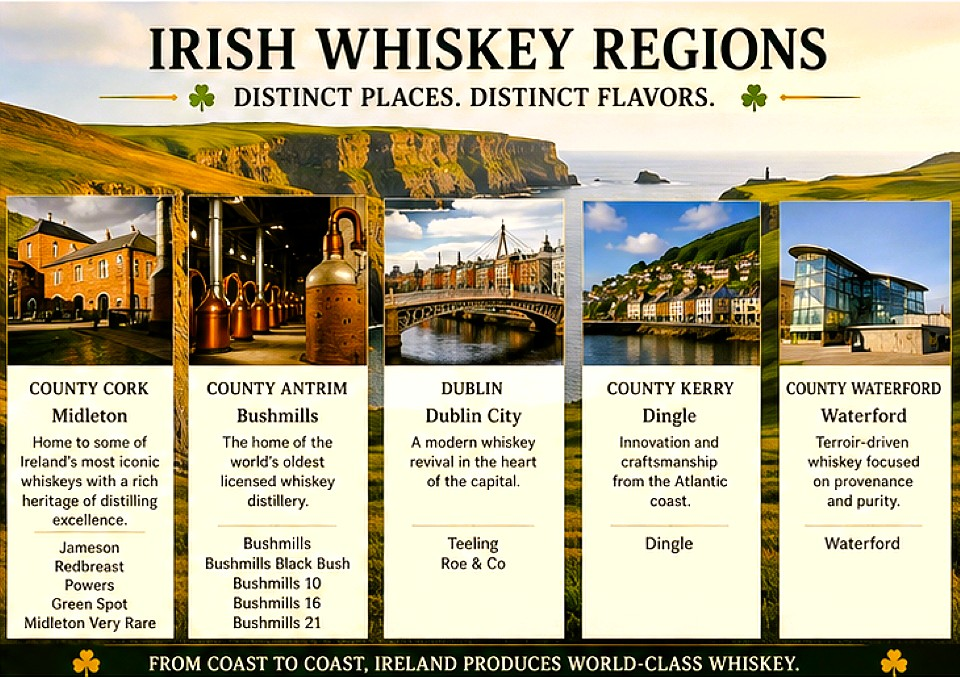
Irish Whiskey Regions and Distilleries
Irish whiskey is increasingly decentralized.
Historic names remain important, but new distilleries are appearing throughout the island.
Important locations include:
County Cork
Midleton
Home of:
- Jameson
- Redbreast
- Powers
- Green Spot
- Midleton Very Rare
County Antrim
Bushmills
Home of one of the world’s best-known Irish whiskey distilleries.
Dublin
Teeling
One of the brands central to Dublin’s modern whiskey revival.
Drinks International notes that Teeling’s 2015 distillery represented a new chapter for whiskey production in Dublin after a long absence.
County Kerry
Dingle
An important independent producer.
County Offaly
Tullamore D.E.W.
Why Irish Whiskey Is Growing More Diverse
The Irish whiskey category has moved from a relatively concentrated market toward a much more diverse industry.
Drinks International’s January 2026 overview quoted Teeling’s management describing how, when the company launched, Irish whiskey was heavily dominated by Jameson with Bushmills and Tullamore D.E.W. also important, while the new generation saw increasing room for experimentation.
That transformation has encouraged:
- New distilleries
- Independent bottlers
- New cask finishes
- Small-batch production
- Single-farm concepts
- Experimental grain bills
- Peated whiskey
- Premium releases
This means Irish whiskey enthusiasts now have far more options than previous generations.
Current Irish Whiskey Market Trends
The latest global data show that Irish whiskey is holding up comparatively well.
Jameson grew 2.2% in 2025 to 11.1 million cases, while the broader world-whisky category faced a difficult year. The Spirits Business reported that Irish whiskey was the standout major success story in the latest world-whisky ranking.
But volume isn’t the whole story.
Premiumization
Premium Irish whiskey is expanding through:
- Older age statements
- Limited releases
- Cask finishes
- Single cask bottlings
- Luxury packaging
New distilleries
Ireland’s distillery population has grown substantially compared with the era when production was dominated by only a few major operators.
Dublin revival
Teeling’s city-center distillery became a symbolic part of the modern Dublin whiskey revival.
Cask experimentation
Irish producers increasingly use:
- Sherry
- Port
- Madeira
- Wine
- Rum
- Other specialty casks
The 2025 Irish Whiskey Masters included Gold and Master awards across a broad range of experimental and traditional expressions, demonstrating how much the category has diversified.
Bushmills Is Entering a New Chapter
Bushmills deserves particular attention because the brand is expanding capacity at a substantial scale.
The Causeway Distillery opened in 2024 and more than doubled production capacity, while the company announced a further £62.9 million plan for additional maturation warehouses.
That investment is significant because Irish whiskey requires maturation time.
The whiskey being distilled today will become the premium portfolio of the future years down the road.
That means Bushmills is investing not just in today’s sales, but in tomorrow’s aged whiskey supply.
Jameson Remains the Category’s Global Anchor
No discussion of Irish whiskey can ignore Jameson.
With 11.1 million cases sold in 2025, the brand is larger than the rest of the Irish category by a huge margin.
Its success has also helped introduce consumers around the world to Irish whiskey.
Once someone tries Jameson, it becomes easier to move toward:
Black Barrel → Redbreast → Powers → Bushmills → Teeling → Midleton
That creates a natural consumer progression from accessible blends to premium pot still and single malt expressions.
How to Choose the Right Irish Whiskey
Use this simple formula:
Style + age + flavor + occasion + budget
For cocktails
Choose:
Jameson / Tullamore D.E.W. / Powers
For neat drinking
Choose:
Redbreast / Green Spot / Bushmills
For smoky whiskey
Choose:
Teeling Blackpitts
For luxury
Choose:
Midleton Very Rare
For experimentation
Choose:
Waterford / Teeling / Dingle
How Much Should You Spend?
You can find excellent Irish whiskey at many price levels.
Entry level
Perfect for:
- Cocktails
- Highballs
- Irish Coffee
Mid-range
Ideal for:
- Sipping
- Gifts
- Exploring new styles
Premium
Best for:
- Whiskey enthusiasts
- Special dinners
- Celebrations
Luxury
Designed for:
- Collectors
- Milestone occasions
- Rare whiskey experiences
As with wine, price does not automatically equal pleasure.
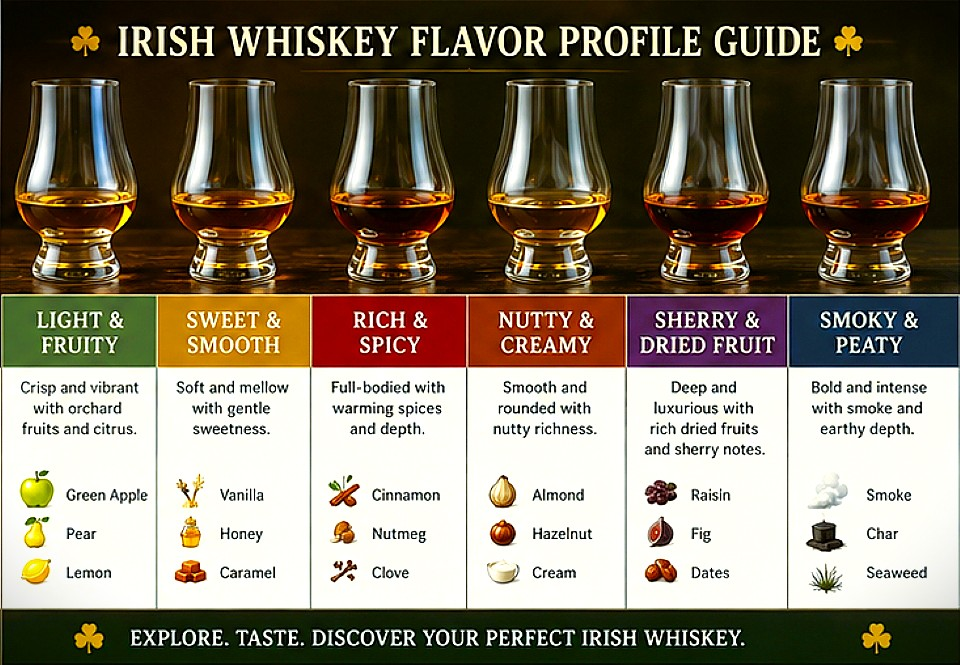
Irish whiskey flavor profiles ranging from light and fruity to sweet, rich and spicy, nutty and creamy, sherry and smoky
Building a 10-Bottle Irish Whiskey Collection
You don’t need 30 bottles.
Start with these:
- Jameson Original — classic blend
- Tullamore D.E.W. — approachable blend
- Bushmills Original — historic Irish style
- Jameson Black Barrel — richer blend
- Bushmills 10 — single malt
- Redbreast 12 — single pot still
- Green Spot — pot still
- Powers John’s Lane — richer pot still
- Teeling Blackpitts — peated Irish whiskey
- Midleton Very Rare — luxury Irish whiskey
That collection covers almost the entire modern Irish whiskey spectrum.
Frequently Asked Questions
What is the most popular Irish whiskey brand in the world?
Jameson is the world’s largest Irish whiskey brand by global volume, with 11.1 million nine-liter cases sold in 2025. It was also named the 2026 World Whisky Brand Champion.
What is the second most popular Irish whiskey?
The answer depends on the measurement. Bushmills and Tullamore D.E.W. are two of the category’s largest and most internationally recognized brands, while bar-focused surveys produce a somewhat different ranking. Drinks International’s survey placed Teeling second and Redbreast third among its participating bars.
What is the best Irish whiskey?
There is no universal winner. Redbreast, Green Spot, Powers John’s Lane, Bushmills, Teeling and Midleton Very Rare all represent different styles.
What is the best Irish whiskey for beginners?
Jameson Original, Tullamore D.E.W., Bushmills Original and Bushmills 10 are excellent starting points.
What is the best Irish whiskey for sipping?
Redbreast 12, Green Spot, Powers John’s Lane, Bushmills 16 and Teeling Single Malt are excellent choices.
What is the best Irish whiskey for cocktails?
Jameson, Tullamore D.E.W., Powers and Roe & Co are particularly versatile.
What is the best Irish whiskey for an Irish Coffee?
Jameson and Tullamore D.E.W. are classic choices.
Is Jameson single malt?
No. Standard Jameson is a blended Irish whiskey.
What is single pot still Irish whiskey?
It is a distinctive Irish whiskey category made using pot still distillation and a mash incorporating malted and unmalted barley. The Irish Whiskey Technical File recognizes Pot Still Irish Whiskey as one of the principal classifications.
What is the difference between Irish whiskey and Scotch whisky?
They come from different production traditions and have different protected geographical specifications. Irish whiskey is generally associated with a smooth, fruit-driven character, while Scotch encompasses a particularly broad range including heavily peated styles.
Is Irish whiskey always triple distilled?
No. Triple distillation is traditional for many Irish whiskeys, but it is not a universal requirement for every Irish whiskey.
What is the oldest Irish whiskey distillery?
Bushmills identifies itself as the world’s oldest licensed whiskey distillery, with a long history dating to the early 17th century.
What is the best premium Irish whiskey?
Midleton Very Rare, Redbreast 21, Bushmills 21, Powers John’s Lane and premium Teeling releases are all strong candidates depending on style and budget.
What is the smoothest Irish whiskey?
Smoothness is subjective, but Jameson, Tullamore D.E.W., Bushmills and some Japanese-influenced or premium Irish expressions are often perceived as approachable.
Is Irish whiskey good in cocktails?
Absolutely. Irish whiskey works beautifully in Irish Coffee, Whiskey Sours, Old Fashioned variations and highballs.
What Irish whiskey is closest to bourbon?
There is no exact equivalent, but sweeter Irish whiskeys matured in ex-bourbon barrels can show vanilla, caramel and oak notes familiar to bourbon drinkers.
What Irish whiskey is closest to Scotch?
Peated expressions such as Teeling Blackpitts can provide a smoky bridge, while Bushmills and Waterford single malts offer another point of comparison.
What is the best Irish whiskey gift?
For broad recognition, Jameson Black Barrel or Bushmills are good choices. For enthusiasts, Redbreast or Teeling can be more interesting. For luxury gifting, Midleton Very Rare is a standout.
Final Thoughts: The World’s Most Popular Irish Whiskey Brands
Irish whiskey has evolved from a relatively concentrated category into one of the world’s most exciting whiskey industries.
At the center is Jameson, which remains the overwhelming global volume leader.
Its 11.1 million cases in 2025 demonstrate the enormous international demand for Irish whiskey.
But the real story is what happens beyond Jameson.
Bushmills represents centuries of Northern Irish whiskey heritage while investing heavily in future production.
Tullamore D.E.W. continues to combine accessibility with experimentation.
Redbreast and Green Spot preserve and showcase Ireland’s distinctive single pot still tradition.
Powers offers another important expression of Irish whiskey heritage.
Teeling represents Dublin’s modern whiskey revival.
Dingle and Waterford demonstrate how independent producers can introduce new ideas around provenance and production.
Midleton Very Rare showcases the luxury end of the category.
And newer brands such as The Busker demonstrate that Irish whiskey’s future isn’t limited to the historic giants.
The latest industry reports make the transformation clear.
Drinks International notes that Teeling entered the market at a time when Irish whiskey was still heavily dominated by a small number of multinational producers, but that consumer curiosity and a demand for innovation created space for new distillers and new styles.
That’s exactly what you can see on today’s shelves.
You can start with:
Jameson
and move toward:
Redbreast
then:
Green Spot
then:
Powers John’s Lane
then:
Bushmills single malt
then:
Teeling Blackpitts
and eventually:
Midleton Very Rare
Each bottle teaches you something different.
That’s the real appeal of Irish whiskey.
It isn’t simply about finding one bottle that tastes good.
It’s about understanding the styles.
Blended whiskey teaches you balance and versatility.
Single pot still whiskey demonstrates Ireland’s distinctive grain-and-still tradition.
Single malt shows the influence of barley, distillery character and cask maturation.
Peated whiskey proves that Irish whiskey can be smoky.
Premium cask finishes show how dramatically secondary maturation can transform a spirit.
And luxury releases reveal just how deep the category can become.
For beginners, choose Jameson, Tullamore D.E.W. or Bushmills.
For cocktails, look toward Jameson, Powers, Tullamore D.E.W. and Roe & Co.
For sipping, explore Redbreast, Green Spot, Bushmills and Teeling.
For collectors, look toward Midleton Very Rare and limited single-cask releases.
Most importantly, don’t assume that “Irish whiskey” describes one flavor.
It doesn’t.
Irish whiskey can be:
smooth
fruity
creamy
spicy
rich
oaky
sherried
tropical
smoky
And with new distilleries, expanding maturation capacity and continued premium innovation, the category is likely to become even more diverse.
So the next time you’re choosing a bottle, don’t simply ask:
“What is the best Irish whiskey?”
Ask:
“What style of Irish whiskey do I want to experience?”
That question will lead you to much better bottles—and a much more enjoyable whiskey journey.