
Blog
Most Popular Japanese Whisky Brands in the World: 30 Famous Bottles Every Whisky Lover Should Know

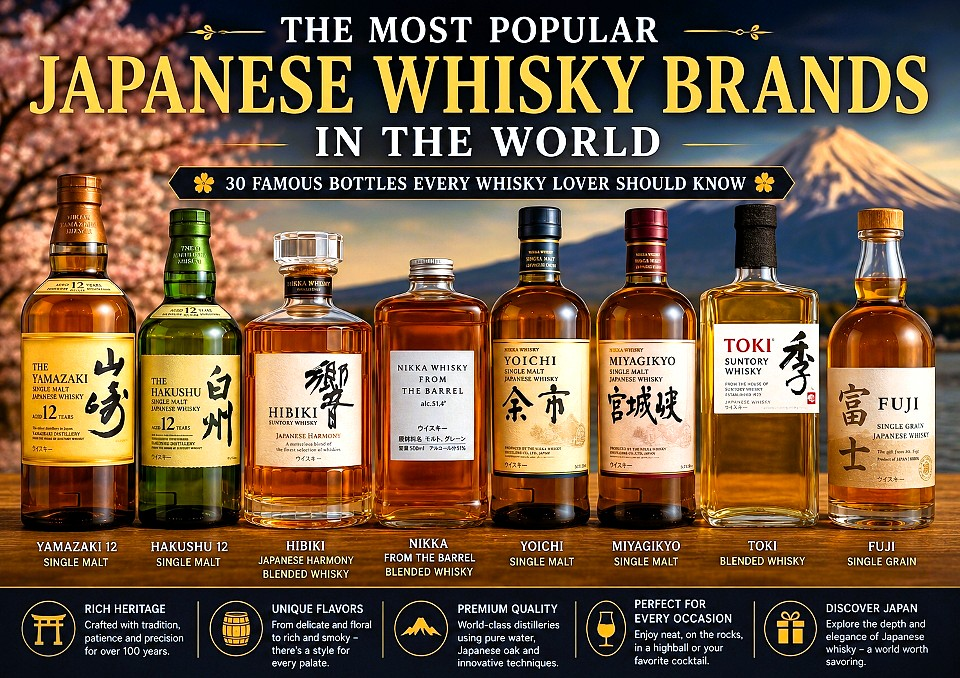
Discover the most popular Japanese whisky brands in the world, from Yamazaki, Hibiki and Hakushu to Nikka From the Barrel, Yoichi, Miyagikyo, Toki, Fuji and Ichiro’s Malt. Explore Japanese whisky history, famous distilleries, single malts, blended whiskies, tasting profiles, highballs, premium bottles and tips for choosing the perfect Japanese whisky.
Japanese whisky has become one of the most fascinating categories in the global spirits industry.
What began as an ambitious attempt to adapt Scotch-style whisky making to Japan has developed into a highly respected whisky tradition with its own production philosophy, distinctive distilleries, blending techniques and increasingly recognizable flavor profiles.
Today, names such as Yamazaki, Hibiki, Hakushu and Nikka are known by whisky drinkers around the world.
Premium Japanese whisky has also become increasingly difficult to ignore in international bars. Drinks International’s 2026 Brands Report says Nikka From the Barrel remained the bestselling world whisky in the world’s best bars, while 73% of surveyed bars said their bestselling world whisky came from Japan. Japan accounted for half of the report’s top-10 world-whisky lineup.
That is remarkable.
But there is a major difference between Japanese whisky popularity, Japanese whisky sales in Japan, premium-bar popularity, and collector prestige.
Not every Japanese whisky brand is positioned in the same market.
Some brands are enormous domestic sellers.
Others are premium single malts aimed at enthusiasts.
Some are blended whiskies designed specifically for highballs.
And some are rare, collectible bottles that can command extraordinary prices.
The category is also becoming more regulated and more competitive. A 2026 report from The Spirits Business described Japan as entering a new era of whisky production, with new distilleries multiplying and the country’s four major players—Suntory, Kirin, Asahi and Mars—facing a growing group of producers.
At the same time, Japanese whisky is developing a clearer definition.
The major producers increasingly emphasize whether a product meets the standards for labeling as Japanese Whisky, while consumers become more interested in provenance, distillery identity and authenticity. Official Suntory product pages, for example, explicitly state when individual expressions meet the Japan Spirits & Liqueurs Makers Association’s Japanese Whisky labeling standards.
This guide explores 30 of the most popular, famous and influential Japanese whisky brands and expressions, combining global recognition, bar popularity, historical importance, premium reputation and the breadth of Japan’s modern whisky scene.
Table of Contents
- What Is Japanese Whisky?
- A Brief History of Japanese Whisky
- What Makes Japanese Whisky Different?
- Japanese Whisky vs. Scotch
- The 30 Most Popular Japanese Whisky Brands
- Suntory
- Yamazaki
- Hakushu
- Hibiki
- Toki
- Nikka
- Nikka From the Barrel
- Yoichi
- Miyagikyo
- Taketsuru
- Nikka Days
- Black Nikka
- Fuji
- Mars Whisky
- Komagatake
- Tsunuki
- Iwai
- Ichiro’s Malt
- Akashi
- Yamazakura
- Togouchi
- Hatozaki
- Kurayoshi
- Matsui
- Chichibu
- Other Japanese Whisky Names Worth Knowing
- Best Japanese Whisky for Beginners
- Best Japanese Whisky for Sipping
- Best Japanese Whisky for Highballs
- Best Japanese Whisky for Cocktails
- Best Japanese Whisky by Style
- Japanese Whisky by Distillery
- How to Choose Japanese Whisky
- Current Japanese Whisky Trends
- Frequently Asked Questions
- Final Thoughts
What Is Japanese Whisky?
Japanese whisky developed heavily from Scotch whisky traditions, but over time Japan created its own production culture.
The historical foundation dates to the early 20th century.
Suntory began construction of the Yamazaki Distillery in 1923, which the company identifies as Japan’s first and oldest malt whisky distillery. The first distillation took place the following year.
Nikka followed with its own distilleries and developed a parallel tradition of malt and grain whisky production.
Today, Japanese whisky can include:
- Single malt
- Single grain
- Blended whisky
- Pure malt / blended malt styles
- Highly premium limited releases
The category increasingly emphasizes Japanese production and authenticity.
This matters because the term Japanese Whisky has historically been used in a broader marketplace than the strictest modern definition.
For today’s buyer, it is worth examining the label and producer information carefully rather than assuming every bottle carrying a Japanese-sounding brand is identical in origin or production.
Official Suntory releases such as Yamazaki and Hibiki explicitly identify their products as meeting the labeling standards set out by the Japan Spirits & Liqueurs Makers Association.
A Brief History of Japanese Whisky
Japan’s whisky story begins with the country’s determination to master a spirit that originated in Europe.
Suntory’s founder, Shinjiro Torii, began construction of Yamazaki in 1923. The company says he wanted to create a whisky suited to Japanese tastes while learning from traditional Scotch techniques.
Yamazaki became the foundation of Japanese malt whisky.
Then came Nikka.
Nikka’s founder, Masataka Taketsuru, had studied Scotch whisky production in Scotland before returning to Japan. His experience played a major role in establishing Japanese whisky production on a technical footing.
Nikka eventually established the Yoichi Distillery in Hokkaido and Miyagikyo Distillery in Sendai, creating two dramatically different production environments. Nikka continues to operate both distilleries today.
This diversity of distilleries became one of Japanese whisky’s great strengths.
Instead of making only one standardized style, Japanese producers developed different combinations of:
- Still shapes
- Fermentation methods
- Water sources
- Cask types
- Climate
- Blending approaches
That philosophy remains important today.
What Makes Japanese Whisky Different?
Several characteristics make Japanese whisky particularly interesting.
Precision
Japanese whisky producers are famous for attention to detail.
Small differences in:
- distillation
- blending
- cask selection
- maturation
- water
can be used deliberately to shape the final whisky.
Water
Water is central to Japanese whisky.
Suntory’s history of Yamazaki emphasizes the site’s exceptional water quality and its importance in selecting the location for Japan’s first malt distillery.
Kirin’s Fuji whisky also emphasizes water from Mount Fuji, describing its groundwater as having been naturally filtered through the earth for decades before reaching the distillery.
Mizunara oak
One of Japanese whisky’s most distinctive signatures is Mizunara, Japanese oak.
Mizunara can impart:
- Sandalwood
- Incense
- Coconut
- Spice
- Floral aromas
Suntory’s premium Yamazaki and Hibiki releases often highlight Mizunara maturation or finishing.
Blending
Japanese whisky producers have developed an extraordinarily sophisticated blending culture.
Hibiki is perhaps the clearest example.
Suntory describes Hibiki as a whisky built around the concept of harmony, blending components from different distilleries and cask types.
Japanese Whisky vs. Scotch
Japanese whisky often draws on Scotch production traditions, but the two categories should not be treated as identical.
Scotch
Often emphasizes:
- Regional identity
- Peat
- Sherry casks
- Distillery tradition
- Long-established appellation culture
Japanese whisky
Often emphasizes:
- Blending
- Precision
- Water
- Mizunara oak
- Harmony
- Distillery diversity
Of course, there is considerable overlap.
Some Japanese whiskies are heavily influenced by Scotch techniques, while some Japanese whiskies are smoky, heavily peated or matured in sherry casks.
The real difference is not simply flavor.
It is production philosophy and cultural context.
The 30 Most Popular Japanese Whisky Brands
1. Suntory Whisky
Country: Japan
Producer: Suntory Global Spirits
Suntory is arguably the single most important name in Japanese whisky.
The company’s portfolio includes:
- Yamazaki
- Hakushu
- Hibiki
- Toki
- Kakubin
Its history goes back to Yamazaki’s construction in 1923, which Suntory identifies as the beginning of Japanese malt whisky production.
Suntory has also become one of the dominant forces in international premium whisky.
Why it matters
Suntory combines:
heritage + distillery diversity + blending expertise + global distribution.
Best known for
- Yamazaki
- Hakushu
- Hibiki
- Toki
2. Yamazaki
Category: Single Malt
Distillery: Yamazaki
Yamazaki is Japan’s flagship single malt.
Suntory identifies Yamazaki as the flagship single malt from Japan’s first and oldest malt whisky distillery, established in 1923.
Its portfolio includes:
- Yamazaki Distiller’s Reserve
- Yamazaki 12
- Yamazaki 18
- Yamazaki 25
- ultra-rare limited releases
Flavor profile
The 12 Year Old features official tasting notes including:
- Peach
- Pineapple
- Grapefruit
- Candied orange
- Vanilla
- Coconut
- Cranberry
- Sweet ginger
- Cinnamon
It also includes components matured in American, Spanish and Mizunara oak.
Yamazaki 18 moves into a much richer profile with:
- Raisin
- Apricot
- Blackberry
- Strawberry jam
- Dark chocolate
- Mizunara
and was named Supreme Champion Spirit at the 2025 International Spirits Challenge.
Best for
Serious sipping and collectors.
3. Hakushu
Category: Single Malt
Location: Yamanashi
Hakushu offers a distinctly different perspective from Yamazaki.
Suntory describes Hakushu as a gently smoky single malt from its mountain forest distillery near Mount Kaikomagatake.
The Distiller’s Reserve’s official notes include:
- Peppermint
- Melon
- Cucumber
- Yuzu
- Grapefruit
- Lemon thyme
- Subtle smoke
Why try it?
Hakushu is one of the best Japanese whiskies for drinkers who love fresh, herbal and lightly smoky styles.
4. Hibiki
Category: Blended Japanese Whisky
Hibiki is perhaps the most elegant expression of Japanese blending culture.
Suntory describes it as an expression of harmony that draws on the company’s different whisky components and cask types.
Hibiki Japanese Harmony
Official tasting notes include:
- Rose
- Lychee
- Rosemary
- Sandalwood
- Honey
- Candied orange
- White chocolate
- Mizunara
Hibiki 21
The 21 Year Old is more mature and luxurious, with official notes including:
- Cooked fruit
- Blackberry
- Ripe banana
- Caramel
- Sandalwood
- Honeycomb
- Dried apricot
- Mizunara
Hibiki 30
This is a collector-level expression, with deep notes of:
- Leather
- Raisin
- Prune
- Chestnut
- Brown sugar
- Fig
- Apricot
- Cedar
- Mizunara
Best for
Elegant sipping, luxury gifts and special occasions.
5. Toki
Category: Blended Japanese Whisky
Toki has become one of the most accessible modern Japanese whiskies.
Suntory describes Toki as a blend of malt and grain whisky from its three iconic Japanese distilleries.
The blend is specifically designed to work beautifully in highballs.
Best for
- Highballs
- Whisky & soda
- Cocktails
- Casual sipping
Why try it?
Toki is one of the best ways to discover Japanese whisky without jumping straight into collector pricing.
6. Nikka
Country: Japan
Producer: Asahi
Nikka is the other enormous pillar of Japanese whisky.
Its core portfolio includes:
- Yoichi
- Miyagikyo
- Taketsuru
- From the Barrel
- Nikka Days
- Super Nikka
- The Nikka
Nikka currently operates the Yoichi and Miyagikyo distilleries.
Why it matters
Nikka represents a different side of Japanese whisky from Suntory.
It is particularly associated with:
malt character + pot still tradition + robust blending.
7. Nikka From the Barrel
Category: Blended Whisky
ABV: 51.4%
Nikka From the Barrel is arguably Japan’s most internationally famous modern cocktail-bar whisky.
Drinks International’s 2026 report says it remained the bestselling world whisky in the world’s best bars, with one in three bars choosing it as the house pour.
Nikka says the whisky is bottled at 51.4% ABV and combines more than 100 malt and grain whiskies, centered on Japanese malt whiskies and Coffey grain whisky. It then undergoes a secondary “marriage” period in casks.
Flavor profile
Official notes include:
- Rich oak
- Vanilla
- Chocolate
- Orange peel
- Grain
- Thick sweetness
- Oak
- Woody bitterness
Best for
- Neat sipping
- Highballs
- Cocktails
This is one of the best examples of a Japanese whisky that works equally well for bartenders and enthusiasts.
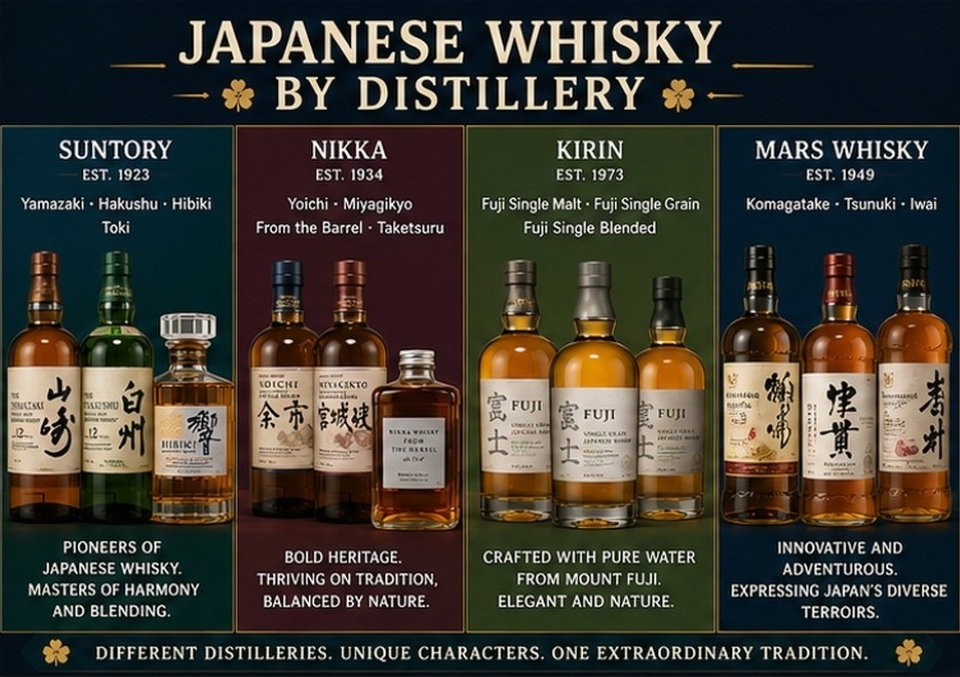
Japanese whisky by distillery featuring Suntory, Nikka, Kirin and Mars with Yamazaki, Hakushu, Hibiki, Yoichi, Miyagikyo and Fuji
8. Yoichi
Category: Single Malt
Location: Hokkaido
Yoichi is Nikka’s northern single malt distillery.
Its colder climate and traditional production style contribute to a more robust personality.
Yoichi is generally associated with:
- Smoke
- Malt
- Oak
- Fruit
- Salinity
Best for
Whisky enthusiasts who like richer and smokier styles.
9. Miyagikyo
Category: Single Malt
Location: Sendai
Miyagikyo is the softer counterpart to Yoichi.
It is associated with:
- Fruit
- Floral aromas
- Soft oak
- Delicate sweetness
Best for
Drinkers who prefer elegant and lighter single malts.
Nikka’s portfolio continues to feature Miyagikyo as one of its principal distillery brands.
10. Taketsuru
Category: Pure Malt / Blended Malt
Taketsuru is named after Nikka founder Masataka Taketsuru.
It combines malt whiskies from Nikka’s distilleries and is designed to express balance between different malt styles.
Typical character
- Fruit
- Malt
- Oak
- Gentle smoke
- Spice
Best for
Blended-malt enthusiasts.
11. Nikka Days
Nikka Days offers a lighter, more approachable side of the company’s portfolio.
It is especially useful in cocktails.
Drinks International’s 2025 world-whisky report described Nikka Days as a more budget-friendly option for mixing.
Best for
- Highballs
- Whisky Sours
- Light cocktails
12. Black Nikka
Country: Japan
Producer: Nikka
Black Nikka is one of Nikka’s major domestic-market brands and has substantial sales within Japan.
The latest Brand Champions reporting put Black Nikka at about 4.0 million nine-liter cases in 2024, illustrating its much larger scale compared with many premium Japanese whiskies.
Best for
Casual Japanese whisky drinking and highballs.
13. Fuji
Producer: Kirin
Distillery: Fuji Gotemba
Fuji is one of Japan’s most interesting modern whisky brands.
Kirin’s current product portfolio includes:
- Single Grain Japanese Whisky Fuji
- Single Malt Japanese Whisky Fuji
- Single Blended Japanese Whisky Fuji
Kirin describes Fuji as fruit-forward and elegant, with water sourced from the foothills of Mount Fuji and a cool, misty climate at the distillery.
Single Grain Fuji
Official notes include:
- Raspberry
- Orange marmalade
- Pound cake
- White grape
- Orange peel
- Wood
- Spice
Best for
Drinkers who enjoy fruity, silky Japanese whisky.
14. Mars Whisky
Producer: Hombo Shuzo
Mars is one of Japan’s most exciting whisky producers.
The company operates multiple facilities and has developed an increasingly broad range.
Major names include:
- Komagatake
- Tsunuki
- Iwai
- Mars Maltage
- Cosmo
- Japanese blended releases
Why try it?
Mars represents the expanding diversity of Japanese whisky beyond the Suntory-Nikka duopoly.
The Spirits Business identifies Mars as one of Japan’s four major whisky players alongside Suntory, Kirin and Asahi.
15. Komagatake
Category: Single Malt
Producer: Mars Whisky
Komagatake is a premium single malt produced at the Mars Shinshu Distillery.
The high-altitude location contributes to a distinctive maturation environment.
Flavor profile
Depending on the release:
- Citrus
- Apple
- Vanilla
- Malt
- Oak
- Spice
Best for
Single-malt enthusiasts exploring beyond Suntory and Nikka.
16. Tsunuki
Category: Single Malt
Producer: Mars Whisky
Tsunuki provides another perspective from Mars.
Its warmer climate contributes to a different maturation profile from Komagatake.
Typical notes
- Fruit
- Vanilla
- Oak
- Spice
- Malt
Best for
Exploring Japanese regional character.
17. Iwai
Producer: Mars Whisky
Iwai is a popular and approachable Mars expression named after Kiichiro Iwai, an important figure in Japanese whisky history.
Best for
- Highballs
- Cocktails
- Casual sipping
18. Ichiro’s Malt
Producer: Venture Whisky
Ichiro’s Malt is one of the best-known independent Japanese whisky names.
It became famous through bottlings connected with the old Hanyu distillery and later expanded into whisky from Chichibu.
Best for
Collectors and enthusiasts seeking limited or distinctive releases.
Ichiro’s is particularly important because it demonstrates the emergence of independent Japanese whisky outside the country’s largest corporate producers.
Drinks International has also identified Ichiro’s among the notable names appearing in world-whisky bar rankings.
19. Chichibu
Location: Saitama
Producer: Venture Whisky
Chichibu is one of Japan’s most famous modern independent distilleries.
Founded by Ichiro Akuto, it has developed an extraordinary reputation among collectors.
Typical characteristics
- Malt
- Fruit
- Spice
- Oak
- Tropical notes
Best for
Collectors and serious enthusiasts.
20. Akashi
Producer: Eigashima Shuzo
Akashi is associated with the White Oak Distillery.
The brand offers blends and single malts and has become increasingly known internationally.
Best for
Exploring smaller Japanese producers.
21. Yamazakura
Yamazakura is another Japanese whisky name worth exploring.
The brand is associated with Sasanokawa Shuzo in Fukushima.
Typical character
- Light
- Sweet
- Fruity
- Floral
- Oak
It has appeared in previous Drinks International world-whisky rankings alongside major Japanese brands.
22. Togouchi
Producer: Sakurao Brewery & Distillery
Togouchi is a well-known Japanese whisky brand with a particularly distinctive maturation story.
The brand has helped introduce many international drinkers to Japanese whisky outside the two biggest players.
Best for
Japanese whisky beginners and collectors looking for alternatives.
23. Hatozaki
Producer: Kaikyō Distillery
Hatozaki offers blended Japanese whisky styles designed around balance and approachability.
Best for
- Highballs
- Cocktails
- Casual sipping
It is a useful introduction to the broader wave of newer Japanese producers.
24. Kurayoshi
Producer: Matsui Shuzo
Kurayoshi is associated with the Matsui Shuzo whisky portfolio.
The brand offers a range of blended and aged expressions.
Typical profile
- Vanilla
- Fruit
- Spice
- Oak
Best for
Drinkers looking beyond the biggest Japanese names.
25. Matsui
Producer: Matsui Shuzo
Matsui has become increasingly visible in international spirits markets.
The portfolio includes:
- Tottori
- Kurayoshi
- Mizunara cask expressions
- Sakura cask expressions
The brand emphasizes cask influence and Japanese presentation.
26. Kakubin
Producer: Suntory
Kakubin is one of Suntory’s most famous domestic Japanese whisky brands.
The latest Brand Champions data show Kakubin sold approximately 4.0 million nine-liter cases in 2025, keeping it among the world’s largest Japanese whisky brands by volume.
The brand is strongly associated with Japan’s highball culture.
Best for
Highballs and casual drinking.
27. Torys
Producer: Suntory
Torys is another major domestic Japanese whisky brand.
The latest Brand Champions ranking reported 2.5 million cases in 2025, up 3.6%. The Spirits Business notes that its lower 37% ABV means it cannot technically be marketed as whisky in the EU.
Why include it?
Because popularity in Japan cannot be measured solely by premium exports.
Torys demonstrates the enormous scale of the Japanese domestic whisky market.
28. The Nikka
Producer: Nikka
The Nikka is a more premium expression within Nikka’s portfolio.
It is designed to combine multiple malt and grain components into a richer overall profile.
Best for
Premium sipping and elegant cocktails.
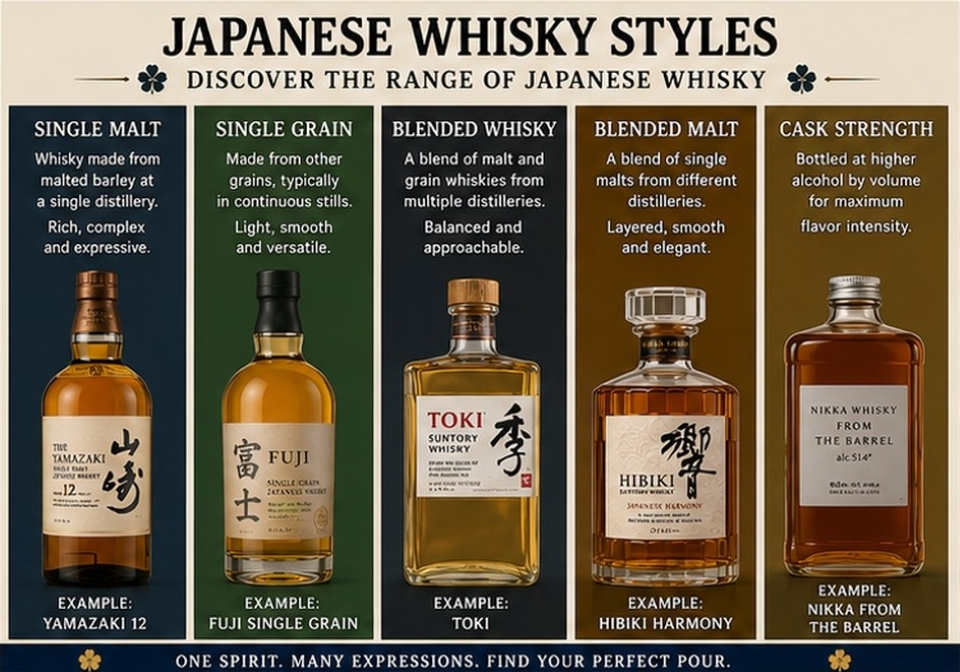
Japanese whisky styles including single malt, single grain, blended whisky, blended malt and cask strength expressions
29. Mars Cosmo
Producer: Mars Whisky
Cosmo is associated with Mars Whisky’s blending program and provides an approachable introduction to the company’s broader range.
Best for
- Sipping
- Highballs
- Japanese whisky exploration
30. Mars Iwai Tradition
Iwai Tradition is another popular Mars expression that offers a more accessible route into Japanese whisky.
Best for
- Highballs
- Cocktails
- Everyday sipping
For readers who want to explore beyond Suntory and Nikka without jumping immediately into ultra-premium pricing, Mars is an excellent place to continue.
Best Japanese Whisky Brands for Beginners
Don’t begin with a rare 18- or 25-year-old bottle.
Instead, choose something approachable.
Best starting points
Suntory Toki
Excellent in a highball.
Nikka Days
Light and easy to mix.
Nikka From the Barrel
More intense, but fascinating.
Hibiki Japanese Harmony
Elegant and balanced.
Fuji
Fruity and approachable.
A more sophisticated introduction to single malt.
Best Japanese Whisky for Sipping
For neat drinking, consider:
Yamazaki 12
Hibiki Japanese Harmony
Hibiki 21
Hakushu
Yoichi
Miyagikyo
Chichibu
Nikka From the Barrel
The choice depends on whether you prefer:
fruit → Yamazaki
harmony → Hibiki
fresh herbs and smoke → Hakushu
robust malt → Yoichi
soft fruit → Miyagikyo
Best Japanese Whisky for Highballs
The Japanese Highball is one of the most important modern whisky serves.
Good choices include:
Suntory Toki
Kakubin
Nikka Days
Nikka From the Barrel
Fuji
Suntory explicitly positions Toki as a versatile whisky for mixing and describes it as “made in Japan, mixed everywhere.”
The Nikka website also features From the Barrel being enjoyed neat or as a highball in its bartender content.
Best Japanese Whisky for Cocktails
Whisky Sour
Try:
- Nikka Days
- Toki
- Fuji
- The Nikka
Old Fashioned
Try:
- Nikka From the Barrel
- Yamazaki
- Hibiki
Japanese Highball
Try:
- Toki
- Kakubin
- Nikka Days
Manhattan variation
Try:
- Nikka From the Barrel
- Yamazaki
- Mars
Premium whisky is especially useful in cocktails with limited ingredients.
Best Japanese Whisky by Style
Fruity and floral
Look for:
Yamazaki
Miyagikyo
Fuji
Smoky
Look for:
Hakushu
Yoichi
Rich and spicy
Look for:
Nikka From the Barrel
Yamazaki 18
Elegant and balanced
Look for:
Hibiki
Miyagikyo
Powerful
Look for:
Nikka From the Barrel
Yoichi
Japanese Whisky by Distillery
One of the best ways to explore Japan’s whisky is by distillery.
Suntory
Yamazaki
Rich and fruit-driven.
Hakushu
Herbal and lightly smoky.
Chita
Grain whisky.
Together, these distilleries give Suntory enormous blending flexibility.
Toki is built from malt and grain whiskies from Suntory’s three iconic distilleries.
Nikka
Yoichi
Robust and smoky.
Miyagikyo
Soft and aromatic.
Nishinomiya / Coffey Grain heritage
Important to Nikka’s grain whisky tradition.
This ability to create diverse components is one reason Nikka can produce such a wide portfolio.
Kirin
Fuji Gotemba
Kirin’s flagship whisky operation.
Its single malt, single grain and blended Fuji expressions provide different perspectives on the distillery’s style.
Mars
Komagatake
High-altitude single malt.
Tsunuki
Distinct climate and maturation profile.
Iwai
Accessible blended style.
Mars is one of the key Japanese whisky producers to watch as the category expands.
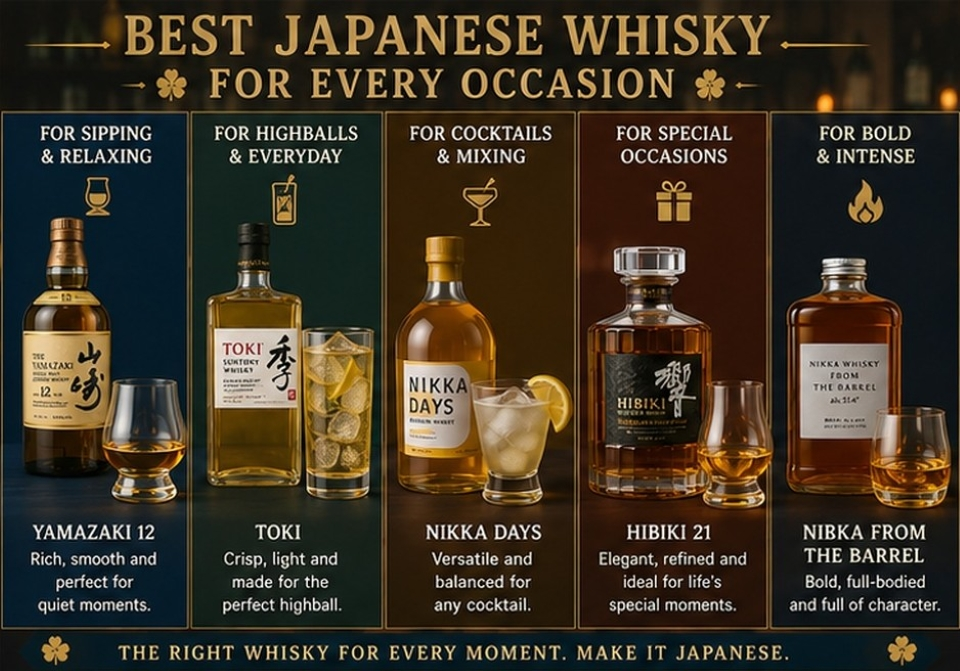
Best Japanese whisky for sipping, highballs, cocktails, special occasions and bold flavors featuring Yamazaki, Toki, Nikka Days, Hibiki and Nikka From the Barrel
How to Choose Japanese Whisky
Use this simple formula:
Style + distillery + age + cask + occasion + budget
Prefer fruit?
Try:
Yamazaki
Prefer smoke?
Try:
Hakushu or Yoichi
Prefer elegance?
Try:
Hibiki
Prefer intensity?
Try:
Nikka From the Barrel
Prefer highballs?
Try:
Toki or Kakubin
Prefer something unusual?
Try:
Ichiro’s Malt or Chichibu
Does Japanese Whisky Have Age Statements?
Some do.
Examples include:
Yamazaki 12
Yamazaki 18
Hibiki 21
Hakushu 12
Age statements can be an important part of premium Japanese whisky.
However, there are also excellent NAS (no-age-statement) whiskies such as:
Hibiki Japanese Harmony
Toki
Nikka From the Barrel
NAS does not automatically mean lower quality.
A blend may intentionally combine whiskies of different ages to achieve a particular flavor profile.
Why Mizunara Oak Matters
Mizunara is one of Japanese whisky’s most fascinating elements.
It is a Japanese oak that can be difficult to work with because of its porous wood.
But when used successfully, it can contribute highly distinctive flavors.
Typical associations include:
- Sandalwood
- Incense
- Coconut
- Spice
- Floral character
Suntory highlights Mizunara influence in Yamazaki 12, Yamazaki 18 and numerous Hibiki expressions.
For serious whisky enthusiasts, Mizunara maturation is one of the characteristics most closely associated with premium Japanese whisky.
Japanese Highball Culture
The highball deserves special attention.
Rather than treating whisky as something that must always be served neat, Japanese bar culture has developed an extremely refined approach to:
whisky + chilled soda + ice
The result is:
- Refreshing
- Aromatic
- Lower intensity
- Food-friendly
Toki was designed partly around this cultural tradition.
Nikka’s own bartender content also describes highballs as an increasingly important way to enjoy From the Barrel and Japanese whisky more generally.
A highball can therefore be an excellent first introduction to Japanese whisky.
Current Japanese Whisky Trends
Japanese whisky is moving into a new era.
The Spirits Business reported in 2026 that new Japanese distilleries are multiplying and that the category is becoming more competitive and regulated.
Four major players currently dominate much of the country’s production landscape:
Suntory
Kirin
Asahi/Nikka
Mars
But many smaller distilleries are emerging.
The New Generation of Japanese Distilleries
This is one of the most exciting developments.
The growth of new distilleries means Japan is creating:
- New single malts
- New regional identities
- New cask programs
- New grain recipes
- New maturation environments
The Spirits Business reported on new projects including Komoro Distillers and additional investment in Japanese distilling infrastructure. It also noted that Kavalan remains the largest malt distillery in Asia by capacity while Japanese producers continue to expand.
This suggests that Japanese whisky is moving from a two-brand story into a genuinely broad national whisky industry.
Authenticity and Japanese Whisky Standards
This is particularly important when buying Japanese whisky.
The Japan Spirits & Liqueurs Makers Association introduced standards intended to clarify which products can be labeled Japanese Whisky.
Major producers increasingly identify qualifying products explicitly.
For example:
- Yamazaki
- Hakushu
- Hibiki
- Toki
- Haku is not whisky, so it is unrelated to this standard
- Fuji
Official Suntory and Kirin pages identify qualifying expressions as meeting the relevant Japanese Whisky labeling standards.
As the market expands, checking the production details is becoming more important.
Is Japanese Whisky Worth the Price?
Sometimes.
Some Japanese whiskies command very high prices because of:
- Scarcity
- Age
- Reputation
- Limited production
- Collector demand
- Mizunara maturation
- Awards
- Distillery history
But not every expensive Japanese whisky is automatically better than a less expensive bottle.
For everyday drinking:
Toki
Nikka Days
Fuji
can be perfectly satisfying.
For premium sipping:
Yamazaki 12
Hibiki
Hakushu
may be more appropriate.
For collectors:
Yamazaki 18/25
Hibiki 21/30
Chichibu
and limited releases become much more relevant.
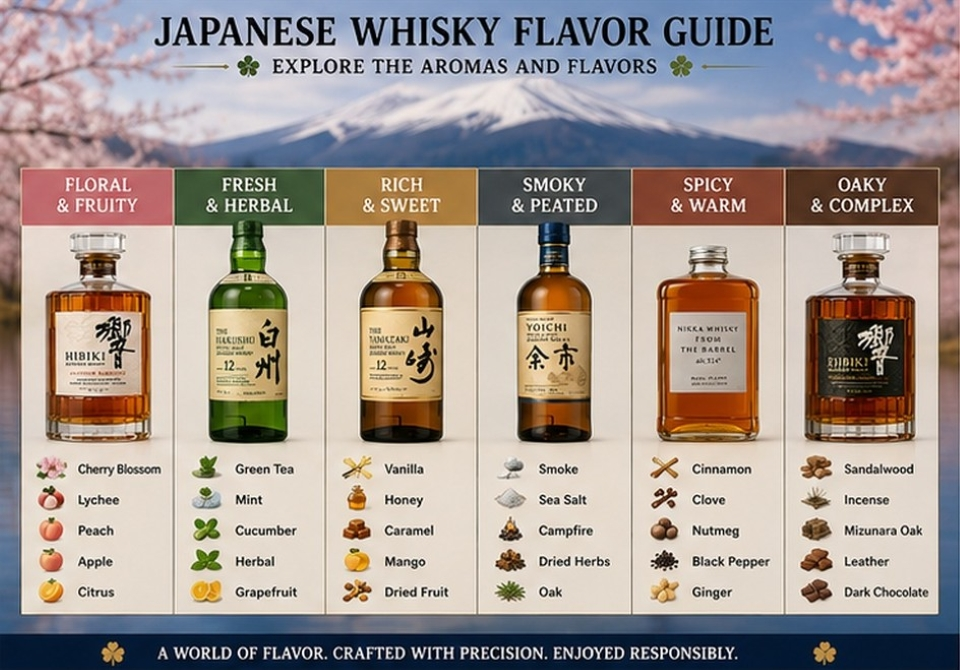
Japanese whisky flavor guide covering floral and fruity, fresh and herbal, rich and sweet, smoky and peaty, spicy and warm, and oaky flavors
Building a Japanese Whisky Collection
A ten-bottle collection could give you a remarkable overview.
1. Suntory Toki
For highballs.
2. Nikka Days
For accessible mixing.
3. Nikka From the Barrel
For intensity.
4. Yamazaki
For single malt.
5. Hakushu
For smoke and herbs.
6. Hibiki Japanese Harmony
For blending.
7. Yoichi
For robust malt.
8. Miyagikyo
For delicate fruit.
9. Fuji
For Japanese grain and malt diversity.
10. Ichiro’s Malt
For independent Japanese whisky.
That collection would cover an enormous range of styles.
Frequently Asked Questions
What is the most popular Japanese whisky brand in the world?
There is no single answer across every measure. Suntory and Nikka dominate global recognition, while Nikka From the Barrel was the bestselling world whisky in Drinks International’s 2026 leading-bar survey.
What is the best Japanese whisky?
There is no universal answer. Yamazaki, Hibiki, Hakushu, Nikka From the Barrel, Yoichi, Miyagikyo and Fuji all appeal to different palates.
What is the most famous Japanese whisky?
Yamazaki and Hibiki are arguably the two most internationally recognized names.
Is Yamazaki a Japanese whisky?
Yes. Suntory identifies Yamazaki as its flagship Japanese single malt and its products meet the Japanese Whisky labeling standards.
Is Hibiki a single malt?
No. Hibiki is a blended Japanese whisky.
Is Hakushu smoky?
Yes, particularly compared with many other Japanese whiskies. Suntory describes Hakushu Distiller’s Reserve as gently smoky with herbal notes.
What is the best Japanese whisky for beginners?
Toki, Nikka Days, Fuji and Hibiki Japanese Harmony are excellent starting points.
What is the best Japanese whisky for a highball?
Suntory Toki is one of the best-known choices, while Kakubin and Nikka Days are also excellent options.
What is the best Japanese whisky for sipping neat?
Yamazaki, Hibiki, Hakushu, Yoichi, Miyagikyo and Nikka From the Barrel are excellent places to start.
What is the best Japanese whisky for cocktails?
Nikka From the Barrel, Toki, Nikka Days and Fuji work particularly well.
What is Mizunara oak?
Mizunara is Japanese oak used in some whisky maturation. It can contribute distinctive sandalwood, incense, coconut and spice notes.
Is Japanese whisky better than Scotch?
Not universally. They’re different whisky traditions. Japanese whisky has become highly respected for precision and blending, while Scotch offers an enormous range of historical regional styles.
Why is Japanese whisky so expensive?
Some bottles are expensive because of scarcity, age, limited production, collector demand and the reputation of the distillery or expression.
Are all Japanese whisky brands made entirely in Japan?
Not necessarily. This is why checking the label and production information is important. The modern Japanese Whisky standards are intended to provide greater clarity about qualifying products, and major producers explicitly identify products that meet the standards.
What is Nikka From the Barrel?
It is a Japanese blended whisky bottled at 51.4% ABV. Nikka says it combines more than 100 malt and grain whiskies and undergoes a secondary marriage period in casks.
What is the difference between Yamazaki and Hakushu?
Yamazaki is generally richer and fruitier, while Hakushu is known for a fresher, herbal and gently smoky profile. Suntory’s official tasting notes support those broad distinctions.
What is the difference between Yamazaki and Hibiki?
Yamazaki is a single malt, while Hibiki is a blend designed around harmony between different whisky components.
What is the difference between Yoichi and Miyagikyo?
Yoichi generally offers a more robust and smoky character, while Miyagikyo is softer and more fruit-driven.
Is Japanese whisky good in cocktails?
Absolutely. Toki and Nikka are particularly well suited to highballs and mixed drinks, while premium expressions can work beautifully in Old Fashioned and spirit-forward cocktails.
Final Thoughts: The World’s Most Popular Japanese Whisky Brands
Japanese whisky has gone from a niche curiosity to one of the world’s most respected whisky traditions.
The category’s story starts with Yamazaki, where Suntory began construction of Japan’s first malt whisky distillery in 1923.
It continues through Hibiki’s art of blending, Hakushu’s fresh and gently smoky style, Nikka’s Yoichi and Miyagikyo distilleries, and the distinctive intensity of Nikka From the Barrel.
Then the story gets bigger.
Fuji brings Kirin’s interpretation of Japanese whisky.
Mars adds Komagatake, Tsunuki and Iwai.
Ichiro’s Malt and Chichibu represent the independent side.
And a growing generation of new distilleries is creating the next chapter.
The latest data show just how important Japan has become in the global whisky world.
Drinks International’s 2026 report says 73% of surveyed bars named Japan as the origin of their bestselling world whisky, while Nikka From the Barrel remained the category leader.
Meanwhile, The Spirits Business reports that Japan’s whisky industry is entering a more competitive and regulated period as new distilleries multiply.
That may be the most exciting development of all.
The old Japanese whisky story was largely:
Suntory vs. Nikka.
The new story is much bigger:
Suntory + Nikka + Kirin + Mars + Chichibu + new independent distilleries + regional producers.
For beginners, the simplest way to explore is to start with a blend.
Try:
Toki
Then compare it with:
Nikka Days
Then move to:
Hibiki Japanese Harmony
From there, explore single malt.
Try:
Yamazaki
Then:
Hakushu
Then:
Yoichi
Then:
Miyagikyo
And when you’re ready for something powerful, try:
Nikka From the Barrel.
That tasting journey gives you an introduction to the main personalities of Japanese whisky.
You will discover that Japanese whisky isn’t one flavor.
It can be:
fruity
floral
herbal
smoky
spicy
rich
silky
oaky
delicate
or incredibly complex.
Mizunara can bring incense and sandalwood.
Bourbon casks can bring vanilla and caramel.
Sherry casks can bring dried fruit and spice.
Peated malt can bring smoke.
Japanese blending can bring all of those components together into something remarkably harmonious.
And perhaps that is the defining quality of the category.
Harmony.
Not necessarily the loudest whisky.
Not necessarily the oldest.
Not necessarily the most expensive.
But a whisky where every component seems to belong.
That’s why brands such as Yamazaki, Hibiki, Hakushu, Nikka, Fuji and Ichiro’s Malt continue to attract global attention.
And as Japan’s new generation of distilleries matures, the country’s whisky story is likely to become even more interesting.
So don’t look for one bottle that represents all Japanese whisky.
Explore several.
Try a blend.
Try a single malt.
Try a smoky whisky.
Try a highball.
Try Mizunara-influenced whisky.
Try something from Suntory.
Then Fuji.
Then Mars.
Then Chichibu.
The more you explore, the more you realize that Japanese whisky is not simply an imitation of Scotch.
It has developed into a remarkable whisky culture of its own.
And there are still many bottles left to discover.