Blog
Most Popular Armagnac Brands in the World: 30 Famous Houses and Bottles Every Armagnac Lover Should Know

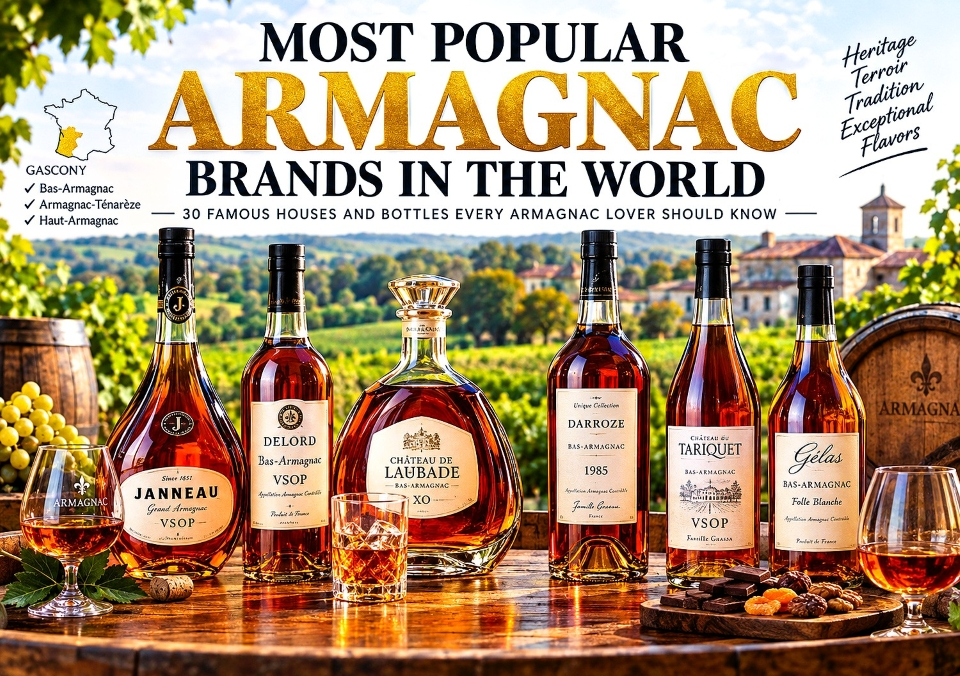
Discover 30 of the most popular and respected Armagnac brands in the world, from Janneau, Delord, Château de Laubade, Dartigalongue and Darroze to Tariquet, Castarède, Gélas, Samalens, Domaine d’Espérance and Domaine Laballe. Learn what makes Armagnac different from Cognac, understand Bas-Armagnac, Armagnac-Ténarèze and Haut-Armagnac, compare VS, VSOP, XO and Hors d’Âge, explore vintage Armagnac, and discover the best bottles for sipping, cocktails, food pairing and gifting.
Armagnac is one of France’s great historic spirits—and one of the most fascinating. It comes from Gascony in southwestern France, a region known for vineyards, rolling countryside, traditional food and a long connection to artisanal distilling.
Compared with Cognac, Armagnac is often less familiar to casual spirits drinkers. That is precisely what makes it interesting. The category offers remarkable variety.
You can find:
-
-
- young, fruity VS Armagnac
- complex VSOP
- rich XO
- Hors d’Âge bottlings
- single-vintage Armagnac
- single-estate expressions
- single-cask releases
- Blanche Armagnac, the clear, unaged style.
-
Armagnac also has a distinctive production identity. It is produced in three official production areas:
-
-
- Bas-Armagnac
- Armagnac-Ténarèze
- Haut-Armagnac
-
The appellation permits a broad range of grape varieties, with Ugni Blanc, Baco, Folle Blanche and Colombard among the varieties most widely used. The official Armagnac organization describes the region as having more than 700 years of history and identifies Armagnac as the oldest French brandy appellation.
The way Armagnac is distilled is also distinctive.
Unlike Cognac, where double distillation in pot stills is the standard, Armagnac is famous for its traditional continuous column still, the alambic armagnacais. Double distillation is also permitted and remains an important technique for certain producers, including Janneau.
The result is often a spirit with particularly expressive aromas.
Official Armagnac tasting guidance describes younger VS expressions with notes of pear, plum and grape, while mature VSOP and XO styles can develop cooked or candied fruit, dried fruit, nuts, spice, vanilla, oak and rancio.
And age matters differently in Armagnac than many new drinkers expect. The age on the label refers to the youngest eau-de-vie in the blend.
An Armagnac labeled 15 years old therefore means the youngest component is 15 years old, although older eaux-de-vie may also be included.
Table of Contents
-
-
- What Is Armagnac?
- Where Is Armagnac Made?
- The Three Armagnac Production Areas
- What Grapes Are Used for Armagnac?
- How Armagnac Is Made
- Continuous Distillation vs. Double Distillation
- Armagnac Aging Categories
- VS vs. VSOP vs. XO vs. Hors d’Âge
- Vintage Armagnac
- Blanche Armagnac
- How to Read an Armagnac Label
- 30 Most Popular Armagnac Brands in the World
- Janneau
- Delord
- Dartigalongue
- Darroze
- Château de Laubade
- Tariquet
- Gélas
- Domaine d’Espérance
- Castarède
- Samalens
- Maison Dartigalongue
- Larressingle
- Marquis de Montesquiou
- Comte de Lauvia
- Baron de Sigognac
- Domaine Laballe
- Domaine de Papillon
- Domaine de Magnaut
- Domaine de Luquet
- Domaine de Paguy
- Château de Briat
- Domaine de Charron
- Domaine de Maouhum
- Château de Sandemagnan
- Domaine du Péto
- Sempé
- Clé des Ducs
- Darroze Les Grands Assemblages
- Best Armagnac for Beginners
- Best Armagnac for Sipping
- Best Armagnac for Cocktails
- Best Vintage Armagnac
- Best Armagnac for Gifts
- Armagnac and Food Pairing
- Current Armagnac Trends
- How to Taste Armagnac
- Armagnac vs. Cognac
- Armagnac vs. Brandy
- Frequently Asked Questions
- Final Thoughts
-
What Is Armagnac?
Armagnac is a French grape brandy made in Gascony. The official Armagnac organization traces the spirit’s roots back more than 700 years, with historical references to aygue ardente—“burning water”—and explains that Armagnac received AOC recognition in 1936.
It is produced within a legally defined appellation. That means Armagnac is not simply any brandy produced in southwest France. The geographic origin and production methods are part of the identity.
Armagnac begins with wine grapes. The grapes are harvested. They are fermented into wine. The wine is then distilled. The resulting eau-de-vie spends time in oak.
Finally, it is bottled either as a blend or, in many cases, as a vintage, single-estate or distinctive producer expression. That agricultural foundation gives Armagnac a flavor profile quite different from neutral spirits.
-
-
- It can show:
- fresh fruit
- cooked fruit
- flowers
- spice
- vanilla
- nuts
- cocoa
- oak
- rancio in mature examples.
-
Where Is Armagnac Made?
Armagnac is made in Gascony, in southwestern France. The production area is divided into three official zones:
-
-
- Bas-Armagnac
- Armagnac-Ténarèze
- Haut-Armagnac.
-
This is one of the biggest differences between Armagnac and Cognac. Cognac is divided into six crus. Armagnac is organized into three production areas.
The three areas can create different styles because of variations in soils, climate, grape varieties and production traditions.
The Three Armagnac Production Areas
Bas-Armagnac
Bas-Armagnac is often associated with elegant, aromatic and fruit-driven Armagnacs.
It is particularly well represented by famous producers such as:
-
-
- Delord
- Dartigalongue
- Darroze
- Château de Laubade
- Janneau’s Bas-Armagnac expressions.
-
Armagnac-Ténarèze
Ténarèze tends toward powerful, structured eaux-de-vie that can develop beautifully with age. Domaine d’Espérance, Gélas and several other traditional producers are associated with Ténarèze production.
Haut-Armagnac
Haut-Armagnac occupies the eastern and southeastern part of the appellation. Its vineyards are much more limited than Bas-Armagnac and Ténarèze, making the area particularly interesting for enthusiasts seeking less common terroirs.
The official Armagnac site emphasizes the three production zones as one of the defining geographic characteristics of the appellation.
What Grapes Are Used for Armagnac?
The official appellation allows 10 grape varieties, although only four are widely and regularly used:
-
-
- Ugni Blanc
- Baco
- Folle Blanche
- Colombard.
-
Each can influence the resulting spirit differently.
Ugni Blanc
Widely used for its acidity and reliability.
Baco
A traditional French hybrid that has become strongly associated with Armagnac. It can contribute depth and richness.
Folle Blanche
Historically important and prized for its elegance and aromatic character.
Colombard
Often contributes freshness and aromatic lift. Some producers specialize in single-grape Armagnacs, making varietal identity an important part of the category.
The official Armagnac organization specifically highlights producers such as Gélas for their expertise with mono-varietal eaux-de-vie.
How Armagnac Is Made
The basic journey is: grapes → wine → distillation → oak → maturation → blending or bottling, but each stage matters.
-
-
- Harvest: The grapes are harvested at the appropriate stage of maturity.
- Fermentation: They are fermented into wine.
- Distillation: This is where Armagnac becomes particularly distinctive.
- Maturation: The clear eau-de-vie goes into oak barrels.
- Blending: Some Armagnacs are assembled from multiple eaux-de-vie.
- Bottling: Once the producer decides the spirit has reached its desired maturity, it is bottled.
-
The official Armagnac site notes that after bottling, Armagnac no longer ages in the same way it does in oak; it is ready to drink when sold.
Continuous Distillation vs. Double Distillation
This is one of Armagnac’s defining technical characteristics. Traditional Armagnac is famous for its continuous column still, often called the alambic armagnacais. The official Armagnac site describes continuous column distillation as the most common method.
The spirit can retain a remarkable amount of the original wine’s aromatic identity. Double distillation is also permitted.
Janneau is a particularly interesting example because the house uses both continuous and double-distilled eaux-de-vie in some of its blends. Janneau reintroduced double distillation in the region in the 1970s and has continued to blend eaux-de-vie from both methods.
That gives the house a distinctive production signature.
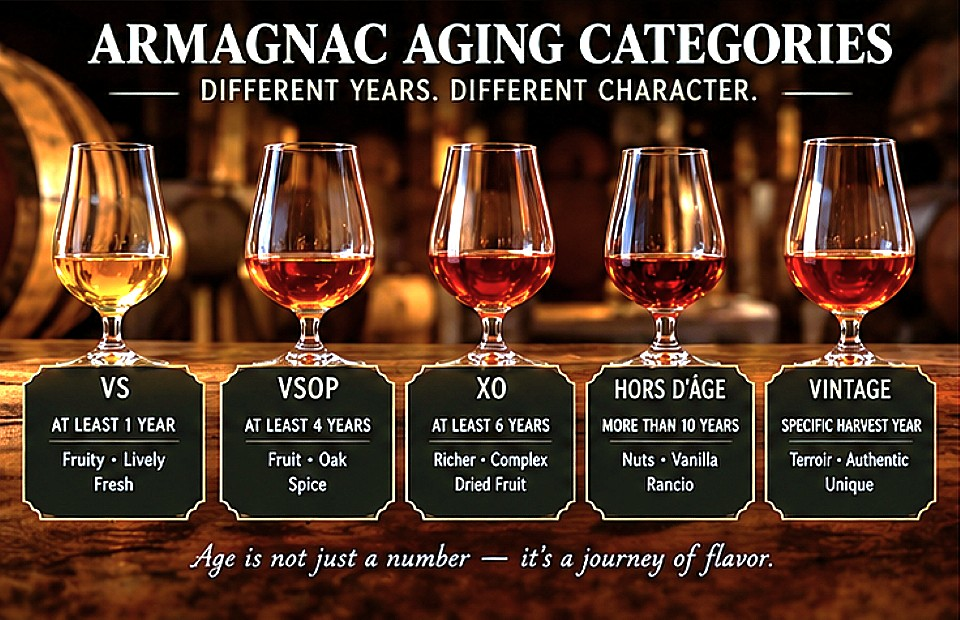
Armagnac Aging Categories
Armagnac’s age system is one of the easiest ways to understand the category:
-
-
- VS / Three Stars: The youngest eau-de-vie is aged for at least one year in wood.
- VSOP: The youngest eau-de-vie is aged for at least four years.
- XO / Napoléon: The youngest eau-de-vie is aged for at least six years under the commercial denomination system.
- Hors d’Âge: The youngest eau-de-vie is more than 10 years old.
- Vintage: The vintage year refers specifically to the harvest year, and the official Armagnac organization identifies vintage Armagnac as requiring at least 10 years of wood aging for the commercial vintage designation described on its educational pages.
-
VS vs. VSOP vs. XO vs. Hors d’Âge
| Category | Minimum age of youngest eau-de-vie | Typical character | Best use |
|---|---|---|---|
| VS | 1 year | Fruity, lively, warming | Cocktails |
| VSOP | 4 years | Fruit, oak, spice | Cocktails + sipping |
| XO / Napoléon | 6 years | Richer, more complex | Sipping + premium cocktails |
| Hors d’Âge | 10+ years | Dried fruit, nuts, vanilla, rancio | Sipping |
| Vintage | Vintage-specific | Terroir + year-specific character | Sipping / collecting |
The Armagnac organization specifically recommends VS for cocktails, VSOP for cocktails or food pairing, and XO primarily for food pairing or digestif drinking.
Vintage Armagnac
Vintage Armagnac is one of the category’s greatest attractions. Unlike a conventional blend, the vintage label identifies a specific harvest year.
For example:
-
-
- 1998
- 2003
- 2010
- 1985
-
The year isn’t simply decorative. It tells you that the spirit comes from grapes harvested in that particular year, assuming the vintage designation requirements are met. That makes vintage Armagnac particularly interesting for collectors.
A bottle from:
-
-
- your birth year
- a wedding year
- a historic anniversary
- a memorable family year
-
Blanche Armagnac
Blanche Armagnac is the clear, unaged style. It doesn’t spend the same maturation period in oak, so the finished spirit retains a much more direct expression of the distilled grape wine.
Typical flavors
-
-
- Fresh grape
- Floral notes
- Pear
- Herbs
- Spice
-
Best use
-
-
- Cocktails
- Chilled sipping
- Modern mixology
-
The official Armagnac educational portal identifies Blanche Armagnac as a distinct AOC category.
How to Read an Armagnac Label
There are several important things to look for.
1. Age
-
-
- VS
- VSOP
- XO
- Hors d’Âge
-
2. Vintage
Look for a four-digit year.
3. Production area
-
-
- Bas-Armagnac
- Armagnac-Ténarèze
- Haut-Armagnac
-
4. Grape variety
Some producers clearly identify:
-
-
- Baco
- Folle Blanche
- Ugni Blanc
- Colombard.
-
5. Estate
Single-estate information can be particularly interesting for enthusiasts. The official Armagnac organization notes that vintage labels correspond to the harvest year and that age statements on blends correspond to the youngest eau-de-vie.
30 Most Popular Armagnac Brands in the World
1. Janneau
Founded: 1851
Janneau is one of the oldest major Armagnac houses. The official Armagnac directory describes it as a leading producer with significant production and aging facilities in the region. Janneau is particularly interesting because of its approach to distillation.
The house uses both:
-
-
- continuous column distillation
- double distillation and blends eaux-de-vie from both methods.
-
Best for
-
-
- Beginners
- Cocktails
- VSOP
- Sipping
-
Why it’s important?
Janneau gives consumers a clear bridge between mainstream accessibility and traditional Armagnac production.
2. Delord
Founded: 1893
Delord is one of the best-known traditional Bas-Armagnac producers. The official Armagnac directory says the Delord family vineyard, distillery and cellars are located in Lannepax, and that the house maintains more than 1,000 oak barrels, including very old eaux-de-vie.
The producer also makes both:
-
-
- Armagnac
- Blanche Armagnac.
-
Its historic stocks extend well into the 20th century.
Best for:
-
-
- Vintage Armagnac
- Bas-Armagnac
- Collectors
- Traditionalists
-
3. Dartigalongue
Founded: 1838
Dartigalongue is another historic Bas-Armagnac house. The official producer directory says founder Pascal Dartigalongue established the house in Nogaro in 1838 and that the family has continued the business through multiple generations.
Its range extends from VSOP through 30-year-old Armagnac, alongside very old vintage reserves.
Best for:
-
-
- Vintage Armagnac
- XO
- Collectors
-
Why it’s special?
The family archive includes historic eaux-de-vie dating back to 1829, with the house’s oldest distilled stock dating to the 19th century.
4. Darroze
Francis Darroze is particularly respected by Armagnac enthusiasts. The house’s model is unusual because it focuses heavily on estate-by-estate Bas-Armagnac.
The official Armagnac directory says the company offers a collection of vintage Bas-Armagnacs from selected terroirs and properties and does not blend different properties or vintages together in those bottlings. It also notes that the eaux-de-vie are naturally aged without added distilled water or “boisés” intended to accelerate maturation.
Best for:
-
-
- Serious enthusiasts
- Vintage Armagnac
- Estate expressions
-
Why it’s important?
Darroze is one of the strongest brands for understanding how terroir affects Armagnac.
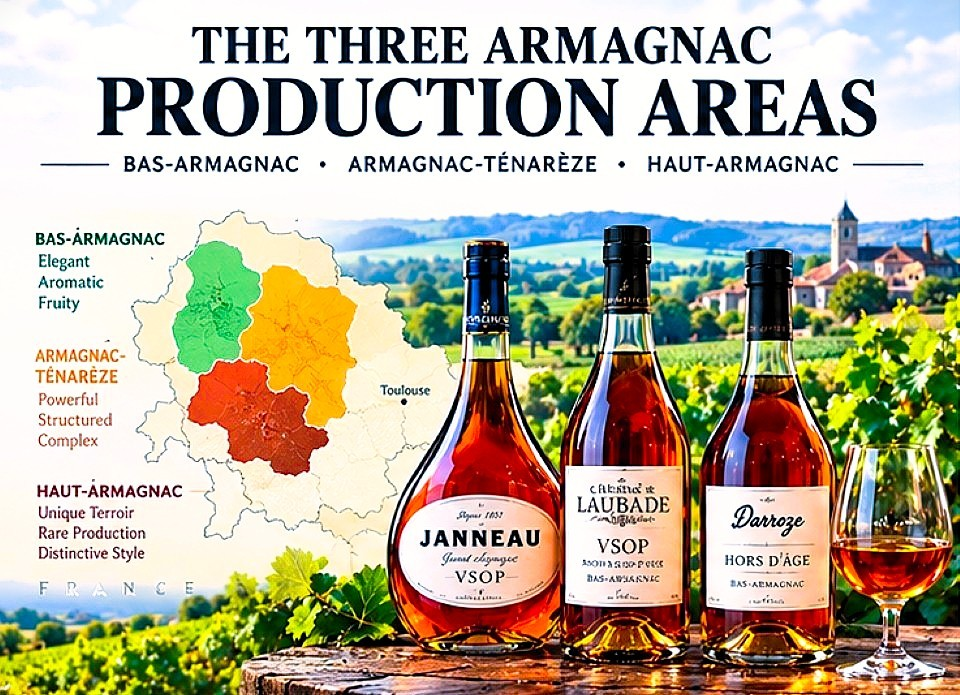
The three Armagnac production areas including Bas-Armagnac, Armagnac-Ténarèze and Haut-Armagnac with vineyard landscape and regional map
5. Château de Laubade
Château de Laubade is one of the great estate names of Bas-Armagnac. The official Armagnac organization has highlighted the château’s distinctive identity, including its own barrel production. The estate has a particularly strong reputation for premium Armagnac and wine tourism.
Best for
-
-
- Premium sipping
- Vintage
- Gifts
- Collectors
-
6. Tariquet
Château du Tariquet is a large and highly visible producer with a strong reputation for innovation. The producer has historically performed well in international competitions.
Official Armagnac competition coverage records gold medals for Tariquet VSOP and XO expressions and silver medals for Folle Blanche and other older bottlings.
Best for
-
-
- VSOP
- XO
- Folle Blanche
- Exploration
-
7. Gélas
Gélas is one of the historic Armagnac houses of Gascony. The official Armagnac organization specifically highlighted the house’s expertise in mono-cépage, or single-variety, eaux-de-vie.
Best for
-
-
- Single-grape Armagnac
- Collectors
- Terroir exploration
-
Why try it?
It’s a useful way to understand how grape variety changes the spirit.
8. Domaine d’Espérance
Domaine d’Espérance is an important estate producer associated with Armagnac-Ténarèze and Bas-Armagnac expressions. Official competition results have recognized Domaine d’Espérance vintage Armagnacs with silver medals.
Best for
-
-
- Vintage enthusiasts
- Ténarèze exploration
- Sipping
-
9. Castarède
Castarède is one of the historic Armagnac houses and an important modern name. Official competition coverage records Double Gold for the house’s Réserve de la Famille at the 2014 San Francisco World Spirits Competition.
Best for
-
-
- XO
- Older Armagnac
- Gifting
-
10. Samalens
Samalens has a strong reputation for distillation and aged Armagnac. Official Armagnac competition records include gold recognition for a 1995 vintage Samalens, as well as other medals for its older bottlings.
Best for
-
-
- Vintage Armagnac
- Sipping
-
11. Larressingle
Larressingle is one of the recognizable names associated with Gascon Armagnac. It offers accessible and mature expressions suitable for consumers who want to explore beyond the largest houses.
Best for
-
-
- Beginners
- VSOP
- Cocktails
-
12. Marquis de Montesquiou
Marquis de Montesquiou has long been associated with Armagnac’s premium international market. Official competition coverage has recognized its Bold / Vieille Réserve expressions.
Best for
-
-
- Premium sipping
- Gifts
- Older Armagnac
-
13. Comte de Lauvia
Comte de Lauvia is another internationally recognized Armagnac label. Its range has received recognition in international spirits competitions, including silver for XO in official Armagnac competition coverage.
Best for
-
-
- VSOP
- XO
- Everyday sipping
-
14. Baron de Sigognac
Baron de Sigognac is a familiar name for consumers looking to explore traditional Armagnac without immediately entering ultra-premium territory.
Best for
-
-
- VSOP
- Cocktails
- Casual sipping
-
Its broad consumer positioning makes it useful as an entry point.
15. Domaine Laballe
Domaine Laballe is particularly interesting because it combines traditional Armagnac culture with a modern, forward-looking approach. The official Armagnac organization has highlighted Laballe for its modernity and mixology work.
Best for
-
-
- Cocktails
- Modern Armagnac
- Mixology
-
16. Domaine de Papillon
Domaine de Papillon represents the small-estate side of Armagnac. These producers can be particularly interesting for consumers who want to move away from large commercial houses and toward estate-specific expressions.
Best for
-
-
- Exploration
- Estate Armagnac
-
17. Domaine de Magnaut
Domaine de Magnaut has received recognition in official Armagnac competitions. Its VSOP was among the gold medal winners recorded by the Armagnac organization.
Best for
-
-
- VSOP
- Food pairing
- Sipping
-
18. Domaine de Luquet
Domaine de Luquet is another estate-oriented producer appearing in official competition records. Its VSOP and vintage Armagnacs have received recognition.
Best for
-
-
- Vintage exploration
- VSOP
-
19. Domaine de Paguy
Domaine de Paguy is an estate in the Armagnac region with a growing wine-tourism identity. Official Armagnac coverage has recognized its vintage expressions and highlighted its themed vineyard events.
Best for
-
-
- Vintage Armagnac
- Wine tourism
-
20. Château de Briat
Château de Briat is associated with high-quality Armagnac and an estate-focused approach.
Best for
-
-
- Premium sipping
- Vintage
- Collectors
-
The brand fits particularly well into the category’s move toward terroir-driven, estate-specific Armagnac.
21. Domaine de Charron
Domaine de Charron has appeared repeatedly in official Armagnac competition coverage. Its vintage expressions have achieved gold and silver recognition across different competition years.
Best for
-
-
- Vintage Armagnac
- Collectors
-
22. Domaine de Maouhum
Domaine de Maouhum is another estate recognized in official competition results. A 1995 Bas-Armagnac earned gold in the vintage category.
Best for
-
-
- Vintage collectors
- Bas-Armagnac exploration
-
23. Château de Sandemagnan
Château de Sandemagnan has appeared in official Armagnac competition results. A vintage 1986 expression received bronze recognition in the 2014 official competition summary.
Best for
-
-
- Vintage exploration
-
24. Domaine du Péto
Domaine du Péto is particularly interesting from a tourism and estate perspective. The Armagnac organization has recognized the estate for organizing experiences designed to promote wine tourism.
Best for
-
-
- Estate exploration
- Regional Armagnac
-
25. Sempé
Sempé is an established Armagnac name with international visibility. Official competition results have included Sempé among recognized producers and vintage bottlings.
Best for
-
-
- Accessible Armagnac
- VSOP
- Vintage
-
26. Clé des Ducs
Clé des Ducs is another recognizable Armagnac label. An official competition summary records a Clé des Ducs 1986 vintage among the bronze medalists.
Best for
-
-
- Traditional Armagnac
- Vintage exploration
-
27. Maison Bonnefont
Maison Bonnefont represents the broader family-producer side of the appellation, with a focus on estate production and traditional methods.
Best for
-
-
- Regional discovery
- Independent Armagnac
-
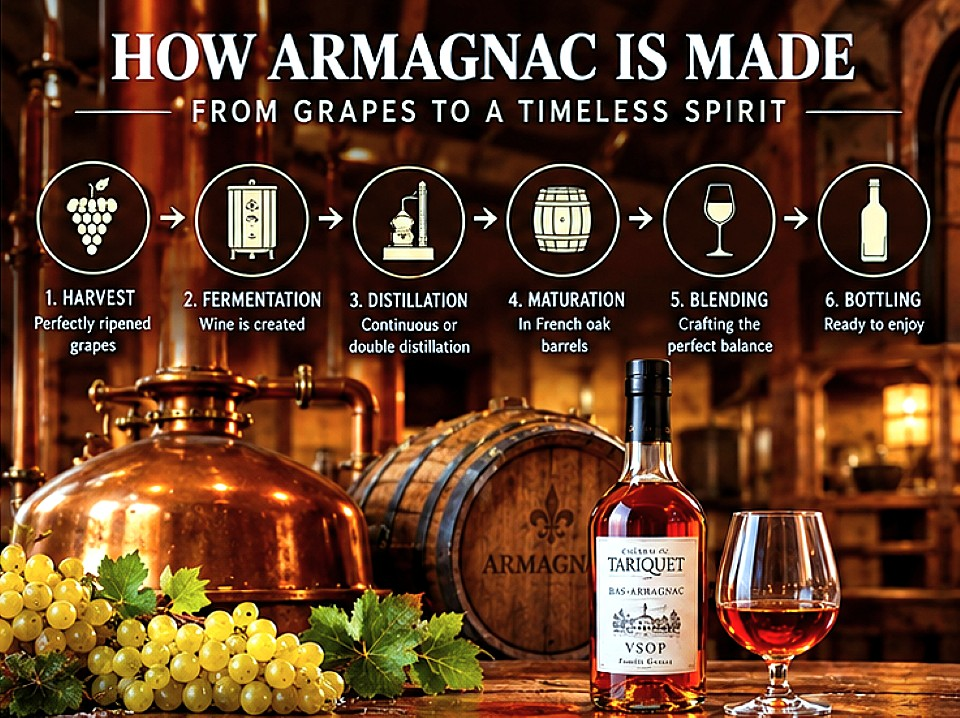
How Armagnac is made from grapes through fermentation, distillation, oak maturation, blending and bottling
28. Bordenueve Châteaux & Collections
Bordenueve is an Armagnac-Ténarèze producer listed in the official Armagnac directory. The producer offers Armagnac and Floc de Gascogne and welcomes visitors for cellar visits and tastings.
Best for
-
-
- Ténarèze exploration
- Estate visits
- Regional discovery
-
29. Domaine du Tariquet Single-Variety Expressions
Tariquet deserves additional attention for its grape-focused releases. Its Folle Blanche expressions have received international recognition, including medals for 12- and 15-year-old bottlings.
Best for
-
-
- Folle Blanche
- Single-variety tasting
- Experienced drinkers
-
30. Darroze Les Grands Assemblages
Darroze deserves another mention for its Les Grands Assemblages philosophy. While its estate-by-estate vintage bottlings may be the most fascinating for serious enthusiasts, its broader assemblies are an excellent way to understand how blending works.
The official Armagnac organization describes Darroze’s strength as a collection of Bas-Armagnacs from different properties and vintages, each retaining its individual provenance.
Best for
-
-
- Understanding blending
- Premium sipping
- Armagnac enthusiasts
-
Best Armagnac for Beginners
For a first bottle, you don’t necessarily need a 20-year-old vintage. A VSOP is often the sweet spot.
It can offer enough maturation to show:
-
-
- fruit
- oak
- spice
- roundness without becoming extremely expensive.
-
Good beginner-friendly houses to explore include:
-
-
- Janneau
- Delord
- Dartigalongue
- Tariquet
- Gélas
- Castarède
-
Best Armagnac for Sipping
For sipping, move into:
-
-
- XO
- Hors d’Âge
- Vintage
- single-estate bottlings.
-
Particularly interesting producers include:
-
-
- Darroze
- Delord
- Dartigalongue
- Château de Laubade
- Frapin-style estate philosophy
- Gélas
- Domaine d’Espérance
- François-style independent producers
-
The official Armagnac organization describes XO and Hors d’Âge as developing richer profiles including prunes, dried fruit, nuts, spice, vanilla and rancio.
Best Armagnac for Cocktails
You usually don’t need XO for a cocktail. The Armagnac organization’s own recommendations identify VS as especially suitable for cocktails, while VSOP can also work well in mixed drinks.
Good choices include:
-
-
- Janneau VS
- Delord VSOP
- Dartigalongue VSOP
- Tariquet VSOP
- Domaine Laballe
-
Best cocktails
Armagnac works particularly well in:
-
-
- Sidecar
- Sazerac
- French 75
- Brandy Crusta
- Old Fashioned
- Daisy
- Armagnac Sour
- Highballs
-
Best Vintage Armagnac
Vintage Armagnac is one of the category’s greatest advantages.
Because the bottle can represent a specific harvest year, it is ideal for:
-
-
- birthdays
- anniversaries
- weddings
- retirement gifts
- collecting.
-
Producers particularly worth exploring include:
-
-
- Darroze
- Dartigalongue
- Delord
- Tariquet
- Domaine d’Espérance
- Domaine de Charron
- Domaine de Maouhum
-
Best Armagnac for Gifts
Armagnac makes an excellent gift because it combines:
-
-
- history
- French heritage
- beautiful bottles
- age and longevity.
-
For a first-time recipient: Choose a VSOP.
For a serious spirits drinker: Choose XO.
For a collector: Choose a vintage.
For a special anniversary: Find the recipient’s birth or anniversary year.
For a premium gift:
-
-
- Château de Laubade
- Darroze
- Delord
- Dartigalongue
-
Camus-style luxury presentation is not the Armagnac model; vintage and estate provenance are often the more compelling story.
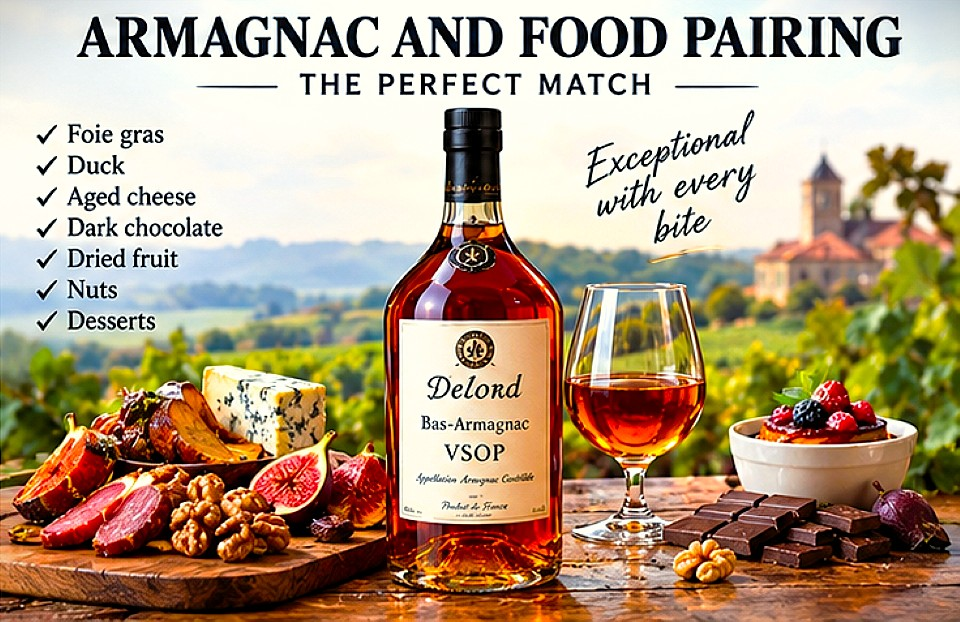
Armagnac and Food Pairing
Armagnac is exceptionally versatile at the table. The official Armagnac organization recommends mature Armagnacs with dishes such as:
-
-
- guinea fowl with fruit
- roast duck breast with honey
- mushroom omelettes
-
and desserts including:
-
-
- pear tart
- Tarte Tatin
- candied orange
- Black Forest cake
- chocolate mousse.
-
That gives you a huge range of opportunities.
Armagnac and Cheese
Try mature Armagnac with:
-
-
- Comté
- aged Gouda
- blue cheese
- washed-rind cheese
-
The spirit’s dried-fruit and nutty notes work naturally with mature cheese.
Armagnac and Chocolate
XO and Hors d’Âge can be spectacular with:
-
-
- dark chocolate
- truffles
- chocolate mousse
- chocolate tart
-
The official Armagnac guidance specifically highlights chocolate desserts as suitable pairings for mature styles.
Armagnac aging categories including VS, VSOP, XO, Hors d’Âge and Vintage with different levels of maturation and flavor
Armagnac and Duck
Gascony’s traditional cuisine makes this pairing particularly logical.
Try VSOP or XO with:
-
-
- duck breast
- duck confit
- foie gras
- duck with honey
-
The sweetness of the dish can emphasize dried-fruit notes in mature Armagnac.
How to Taste Armagnac
Start with a tulip-shaped glass. Pour a modest serving.
Observe:
-
-
- color
- clarity
- legs
-
Then smell gently. Young Armagnac may show:
-
-
- pear
- plum
- grape
- fresh fruit
-
VSOP can move toward:
-
-
- cooked fruit
- wood
- spice
-
XO can become more complex:
-
-
- prune
- dried fruit
- nuts
- vanilla
- rancio.
-
Take a small sip. Let it sit on the palate. Then evaluate the finish. A good mature Armagnac can evolve for a long time after the swallow.
Armagnac vs. Cognac
This is perhaps the biggest question for new drinkers. Both are: French grape brandies, but they are made in different regions and follow different production traditions.
Cognac
Produced in the Cognac appellation. Six crus. Double distillation is the standard traditional distillation method.
Armagnac
Produced in Gascony. Three production areas. Continuous column distillation is the traditional method, although double distillation is also permitted.
Flavor:
Broadly speaking, Armagnac often feels more rustic, aromatic and expressive, while Cognac is frequently associated with polished house blending. A beautifully made Armagnac can be extraordinarily elegant, cognac can be remarkably powerful and terroir-driven.
The best way to understand the difference is to taste them side by side.
Armagnac vs. Brandy
The simplest explanation: Armagnac is a type of brandy.But brandy is a huge category.
Brandy can be made from:
-
-
- grapes
- apples
- pears
- cherries
- and other fruit.
-
Armagnac is specifically a geographically protected French grape spirit. That protection is one of the reasons the region’s production methods matter so much.
Continuous Distillation Gives Armagnac Its Identity
The column still is perhaps the most important technical difference. The Armagnac organization’s educational material describes continuous distillation as the predominant method and highlights the role of the Armagnacais still.
This method can preserve more of the underlying wine’s character. It is one reason Armagnac can taste so expressive. And because some producers use double distillation while others favor continuous distillation, the category contains significant stylistic variety.
Current Armagnac Trends
Armagnac is a relatively small category compared with Cognac, whisky or vodka. But that size has an advantage. There is room for individuality.
The official Armagnac website maintains a directory of producers and ambassadors, reflecting a large network of houses, estates, merchants, bartenders and restaurateurs across the region.
Several trends are particularly interesting.
1. Vintage Armagnac
The vintage system gives the category strong collector appeal.
2. Single-estate production
Consumers increasingly want to know where the spirit came from.
3. Single-variety bottlings
Baco, Folle Blanche, Ugni Blanc and Colombard allow producers to emphasize grape character.
4. Cocktail growth
VS and VSOP are increasingly useful in contemporary mixology.
5. Armagnac tourism
The official Armagnac Route links approximately 120 producers and distilleries welcoming visitors in the region.
6. Modern presentation
Producers such as Laballe have been highlighted for combining traditional Armagnac culture with modern mixology.
Armagnac as a Collectible Spirit
Vintage Armagnac is particularly attractive because the bottle can represent an exact year. Unlike a conventional blend, the year becomes part of the identity.
That makes the category ideal for:
-
-
- birth-year bottles
- anniversary bottles
- historical vintages
- estate collections
- vertical tastings.
-
Imagine tasting:
-
-
- 1995
- 2000
- 2005
- 2010
-
from the same producer. You aren’t merely comparing age. You’re comparing harvest years. That’s what makes vintage Armagnac so fascinating.
How Armagnac Changes With Age
Young Armagnac tends to emphasize:
-
-
- fresh fruit
- grape
- pear
- plum
- floral aromas.
-
As it matures:
-
-
- cooked fruit
- spice
- oak
- vanilla
-
become more prominent. Eventually:
-
-
- prune
- dried fruit
- nuts
- cocoa
- rancio can emerge.
-
This isn’t simply a matter of becoming “smoother.” The spirit becomes more complex.
Does Older Always Mean Better?
No. That’s one of the most important things to understand.
Older Armagnac is usually:
-
-
- more mature
- more complex
- more expensive
-
but not necessarily better for every drinker.
-
-
- A young VS can be more appropriate for a Sidecar.
- A lively VSOP may make an excellent cocktail.
- A rich XO can be perfect after dinner.
- A 30-year-old vintage may be better enjoyed slowly.
-
Use the spirit according to the occasion.
Best Armagnac for a Home Bar
You don’t need ten bottles.
Start with:
1. VS: For cocktails.
2. VSOP: For cocktails and sipping.
3. XO: For after-dinner drinking.
4. Vintage: For a special occasion.
Add:
-
-
- lemon
- orange
- sugar
- bitters
- sweet vermouth
- sparkling wine
- ginger beer.
-
You’ll have a remarkably flexible Armagnac cocktail bar.
Easy Armagnac Cocktails
Armagnac Sidecar
-
-
- 50 ml Armagnac
- 20 ml orange liqueur
- 20 ml lemon juice
-
Shake with ice. Strain into a chilled coupe.
Armagnac Old Fashioned
-
-
- 60 ml Armagnac
- 7.5 ml sugar syrup
- 2 dashes Angostura
-
Stir with ice. Serve over a large cube.
Armagnac Sour
-
-
- 60 ml Armagnac
- 25 ml lemon juice
- 20 ml simple syrup
-
Shake.
Armagnac French 75
-
-
- 30 ml Armagnac
- 15 ml lemon
- 15 ml syrup
-
Top with Champagne.
Armagnac Highball
-
-
- 45 ml VS Armagnac
- 120 ml soda
-
Build over ice.
Armagnac food pairing with foie gras, duck, aged cheese, dark chocolate, dried fruit, nuts and desserts
Frequently Asked Questions
What is the most popular Armagnac brand in the world?
There is no single comprehensive worldwide sales ranking for Armagnac brands. Janneau, Delord and Dartigalongue are among the best-known established houses, while Darroze, Château de Laubade and Tariquet are particularly important among enthusiasts and premium consumers.
What is the best Armagnac brand?
There is no universal best. Janneau is useful for accessibility and production scale, Delord and Dartigalongue are excellent for traditional Bas-Armagnac exploration, and Darroze is particularly compelling for estate-by-estate vintage bottlings.
What is the difference between Armagnac and Cognac?
Both are French grape brandies, but they come from different appellations and use different production traditions. Armagnac is produced in Gascony and is especially associated with continuous column distillation. Cognac comes from the Cognac region and traditionally uses double distillation.
What is Bas-Armagnac?
Bas-Armagnac is one of the three Armagnac production areas and is often associated with aromatic, elegant and fruit-driven styles.
What is Armagnac-Ténarèze?
Armagnac-Ténarèze is one of the three official Armagnac production areas and is often associated with more structured eaux-de-vie that can develop considerably with age.
What is Haut-Armagnac?
Haut-Armagnac is the third official production area of the appellation.
What does VS mean in Armagnac?
VS indicates that the youngest eau-de-vie in the blend has been aged in wood for at least one year.
What does VSOP mean?
VSOP means the youngest eau-de-vie has spent at least four years in wood.
What does XO mean in Armagnac?
XO indicates a minimum of six years for the youngest eau-de-vie under the commercial denomination system.
What is Hors d’Âge Armagnac?
Hors d’Âge means the youngest eau-de-vie has spent more than 10 years in wood.
What is vintage Armagnac?
Vintage Armagnac identifies the year of the grape harvest shown on the bottle. The official Armagnac organization highlights vintage bottlings as a distinctive feature of the category.
What is Blanche Armagnac?
Blanche Armagnac is the clear, unaged category of Armagnac.
Is Armagnac made from grapes?
Yes. Armagnac is a grape-based spirit made from wine produced from permitted Armagnac grape varieties. Ugni Blanc, Baco, Folle Blanche and Colombard are among the most widely used.
What grape is most commonly used?
Ugni Blanc is one of the principal varieties and accounts for a large share of the region’s production, alongside Baco, Folle Blanche and Colombard.
How is Armagnac distilled?
Armagnac is most commonly produced using continuous column distillation in the traditional Armagnac still. Double distillation is also permitted.
Is Armagnac stronger than Cognac?
Not necessarily. Both can be bottled at different strengths depending on the product.
Is Armagnac smoother than Cognac?
“Smooth” is subjective. Armagnac is often more expressive and rustic, while some Cognacs are more polished and rounded through blending.
What is the best Armagnac for beginners?
A good VSOP is usually the best starting point because it balances fruit, oak and spice.
What is the best Armagnac for cocktails?
VS or VSOP is usually ideal. The official Armagnac organization specifically recommends VS for cocktails.
What is the best Armagnac for sipping?
XO, Hors d’Âge and vintage bottlings are excellent starting points.
What is the best Armagnac for a Sidecar?
A fruity VS or VSOP works beautifully.
What is the best Armagnac for an Old Fashioned?
A rich VSOP or XO is an excellent choice.
What is the best Armagnac for a Sazerac?
An aromatic VS or VSOP works well, especially with the absinthe rinse and bitters.
Can Armagnac be mixed with tonic?
Yes. A younger VS is especially suitable for highballs and lighter long drinks.
Can Armagnac be mixed with ginger beer?
Yes. Ginger’s spice pairs well with Armagnac’s fruit and oak characteristics.
Can you drink Armagnac neat?
Yes. VSOP, XO and vintage Armagnac are often excellent neat.
Should Armagnac be chilled?
Not necessarily. Mature Armagnac is generally better appreciated around cool room temperature.
Can Armagnac be served over ice?
Yes, particularly younger expressions and modern highball-style serves.
Should you warm Armagnac?
Extensively heating the glass isn’t necessary. Excessive warming can emphasize alcohol instead of aroma.
Does Armagnac get older in the bottle?
No. Once bottled, Armagnac no longer matures in the same way it does in oak.
What makes old Armagnac expensive?
Long maturation ties up inventory and involves evaporation, storage, oak, production costs, scarcity and collector demand.
What is the angel’s share?
It is the portion of spirit and water that naturally evaporates from barrels during maturation.
Is older Armagnac always better?
No. It is usually more mature, but the best age depends on how you intend to drink it.
What is the best Armagnac for a gift?
A vintage matching the recipient’s birth year or anniversary can be especially meaningful.
What food pairs with Armagnac?
Duck, foie gras, cheese, chocolate, dried fruit and desserts are excellent places to start. The official Armagnac organization specifically recommends mature styles with duck dishes, fruit-based desserts and chocolate.
Does Armagnac pair with chocolate?
Yes. XO and Hors d’Âge are particularly good with dark chocolate desserts.
Does Armagnac pair with cheese?
Yes. Mature cheese can work beautifully with XO and Hors d’Âge.
What is a single-estate Armagnac?
It is an Armagnac associated with one estate rather than a broad blend of unrelated properties.
What is single-cask Armagnac?
It is bottled from an individual barrel or cask rather than blended across multiple barrels.
Why is vintage Armagnac special?
The bottle represents a specific harvest year rather than a general age category, which makes it especially attractive for collectors.
Is Armagnac rare?
Compared with Cognac and major global spirits categories, Armagnac is relatively small, which contributes to the category’s artisanal and specialist reputation.
Can Armagnac be used in cocktails?
Absolutely. The official Armagnac organization specifically recommends VS for cocktails and identifies VSOP as suitable for cocktails as well.
Is Armagnac brandy?
Yes. Armagnac is a geographically protected French grape brandy.
Final Thoughts: The World’s Most Popular Armagnac Brands
Armagnac is one of those spirits that becomes more interesting the deeper you explore it. At first, it may seem similar to Cognac.
-
-
- Both are French.
- Both are grape-based.
- Both spend time in oak.
- Both can be sold as VSOP, XO and older expressions.
-
But the similarities end quickly. Armagnac has its own geographic identity.
-
-
- Its own production traditions.
- Its own grapes.
- Its own distillation methods.
-
And one of its greatest strengths is its individuality. The category’s three production regions—
-
-
- Bas-Armagnac
- Armagnac-Ténarèze
- Haut-Armagnac
-
—already create important differences.
Then add:
-
-
- Ugni Blanc
- Baco
- Folle Blanche
- Colombard
-
and the other permitted varieties. Then consider:
-
-
- continuous distillation
- double distillation
- oak
- age
- vintage
- estate
- blending.
-
The possibilities become enormous. That’s why the most interesting Armagnacs are not necessarily the most expensive.Sometimes a young VS shows exactly what the spirit is supposed to taste like.
-
-
- Fruit.
- Grape.
- Pear.
- Plum.
- Warmth.
-
Then a VSOP adds:
-
-
- cooked fruit
- oak
- spice
- greater roundness.
-
Then XO brings:
-
-
- prune
- dried fruit
- nuts
- vanilla
- deeper oak.
-
Eventually, old Armagnac can develop the complex mature notes described as:
-
-
- rancio
- cocoa
- dried fruit
- nuts
- aged wood.
-
That progression is one of the most rewarding things about exploring the category. And then comes vintage Armagnac. This may be the biggest reason collectors become fascinated with it. A vintage bottle isn’t simply “old.” It represents a particular harvest year.
That creates an emotional connection that few blended spirits can match. A 1975 Armagnac isn’t simply an old bottle. It’s an agricultural snapshot of 1975.
A 1990 bottle comes from another harvest. A 2000 bottle another. And the differences between them can be fascinating. That makes Armagnac particularly appropriate for birthdays, anniversaries and milestone gifts.
For newcomers, however, the best advice is simple:
Start with VSOP.
-
-
- Learn what the spirit tastes like.
- Then try XO.
- Then try a vintage.
- Taste them side by side.
- And don’t be afraid to use younger Armagnac in cocktails.
-
The official Armagnac organization itself recommends VS for cocktails. That is an important point. There is sometimes a tendency to believe premium grape brandy should only be consumed neat.
But Armagnac works beautifully with:
-
-
- lemon
- orange
- sugar
- bitters
- ginger
- sparkling wine
- soda.
-
A young VS can become a superb Sidecar. A VSOP can make a powerful Old Fashioned. An aromatic expression can transform a Sazerac. A lighter Armagnac can become an excellent highball. So the best bottle depends on the job.
For cocktails:
-
-
- VS:For cocktails and sipping:
- VSOP: For serious sipping:
- XO: For mature exploration:
- Hors d’Âge: For collectors:
- Vintage: For a direct expression of the distilled spirit:
- Blanche Armagnac
-
That’s a remarkably simple framework. Then choose the producer.
Start with a major house like:
-
-
- Janneau
- Delord
- Dartigalongue
- Tariquet.
-
Move into estate-focused producers:
-
-
- Darroze
- Château de Laubade
- Domaine d’Espérance
- Gélas
-
Then explore lesser-known houses. That is where Armagnac becomes really exciting. Because unlike huge global spirits categories, the Armagnac world still offers an enormous amount of producer individuality.
The official Armagnac directory itself reflects this regional diversity, listing houses, producers and ambassadors across the appellation. This is one of the biggest differences between Armagnac and many mainstream spirits.
You are not simply choosing between multinational brands. You can choose a family,
-
-
- An estate.
- A vineyard.
- A vintage.
- A grape variety.
- A barrel.
- A distillation method.
- A region.
-
That is a wine lover’s way of approaching spirits. And perhaps that is Armagnac’s greatest strength. It still feels connected to the land.
-
-
- To Gascony.
- To the vineyard.
- To the harvest.
- To copper stills.
- To oak cellars.
- To the producer.
- And to time.
-
That’s why Janneau is important. Why Delord is important. Why Dartigalongue is important. Why Darroze is important. Why Laubade, Tariquet, Gélas, Domaine d’Espérance, Laballe, Castarède and the many smaller estates deserve attention.
They’re not simply selling different labels. They’re expressing different versions of Armagnac. So the next time you’re standing in front of a spirits shelf and see a bottle of Armagnac, don’t overlook it. Pick it up. Read the label.
Look for:
-
-
- the age
- the vintage
- the terroir
- the grape
- the producer
-
-
-
- A cocktail?-Choose VS.
- A dinner?-Choose VSOP.
- A digestif?-Try XO.
- A serious tasting?-Look at Hors d’Âge.
- A collector’s bottle?-Find a vintage.
-
And if you really want to understand the category, taste several regions and producers side by side. That is when Armagnac stops being an obscure alternative to Cognac. It becomes what it really is:
One of France’s great historic spirits in its own right.