
Blog
Most Popular Brandy Brands in the World: 30 Famous Bottles Every Brandy Lover Should Know


Discover 30 of the Most Popular Brandy Brands in the World, including Torres, Hennessy, Rémy Martin, Martell, Courvoisier, St-Rémy, Metaxa, Carlos I, Lustau, Vecchia Romagna, Asbach, Ararat and more. Learn the differences between brandy, Cognac, Armagnac, Brandy de Jerez, Calvados and other regional spirits, how brandy is aged, which bottles are best for sipping and cocktails, and what to look for when choosing a brandy.
Brandy is one of the world’s oldest distilled-spirit categories, but it is also one of the broadest. Unlike categories such as Scotch whisky or Cognac, the word brandy doesn’t describe one single region or production tradition. It is a broad family of spirits generally made by distilling wine or fermented fruit.
That means the world of brandy includes very different styles from:
-
-
- France
- Spain
- Italy
- Greece
- Germany
- Armenia
- the United States
- Peru and Chile
-
and many other countries. Some of the world’s best-known brandies are actually protected regional spirits.
U.S. regulations explicitly distinguish Cognac, Armagnac, Brandy de Jerez, Calvados and Pisco as specific types within the broader brandy category. That diversity is what makes brandy so fascinating.
It also makes the phrase “most popular brandy brands in the world” more complicated than it initially sounds.
In 2026, Drinks International’s Brands Report provides one useful snapshot of what influential bars are actually serving. Torres Brandy led its 2026 bestselling-brandy ranking for the seventh consecutive year, appearing in close to 20% of surveyed venues. The report also placed Avallen, Metaxa, Lustau and St-Rémy among the leading brands in that bar sample.
At the broader retail and global-volume level, the picture can be different. Current Statista data based on 2025 worldwide sales list Old Admiral as the leading brandy brand by case volume and Mansion House second, illustrating how much a mass-market sales ranking can differ from a premium-bar ranking.
Table of Contents
-
-
- What Is Brandy?
- Brandy vs. Cognac vs. Armagnac
- Main Types of Brandy Around the World
- How Brandy Is Made
- Brandy Aging and Maturation
- VS, VSOP, XO and Other Age Terms
- How to Read a Brandy Label
- 30 Most Popular Brandy Brands in the World
- Torres
- Hennessy
- Rémy Martin
- Martell
- Courvoisier
- St-Rémy
- Metaxa
- Carlos I
- Lustau
- Vecchia Romagna
- Asbach
- Ararat
- Fundador
- Cardenal Mendoza
- Lepanto
- Fernando de Castilla
- D’Ussé
- Camus
- Delord
- Dartigalongue
- Janneau
- Darroze
- Château de Laubade
- Frapin
- Hine
- Delamain
- Laird’s
- Avallen
- Barsol
- Martell and the Modern Brandy Market
- Best Brandy for Beginners
- Best Brandy for Sipping
- Best Brandy for Cocktails
- Best Brandy for Gifts
- Brandy and Food Pairing
- How to Taste Brandy
- Brandy Around the World
- Current Brandy Trends
- Frequently Asked Questions
- Final Thoughts
-
What Is Brandy?
Brandy is a broad category of distilled spirits made primarily from wine or fermented fruit. Grape brandy is the most familiar type, but brandy can also be made from apples, pears, cherries and other fruits.
The U.S. Alcohol and Tobacco Tax and Trade Bureau defines fruit brandy broadly as a spirit distilled from fermented fruit juice or mash, while separately recognizing geographical categories such as Cognac, Armagnac, Brandy de Jerez, Calvados and Pisco.
This is why the word brandy can describe such a wide range of spirits. A bottle of Spanish Brandy de Jerez can taste completely different from Italian Vecchia Romagna.
Greek Metaxa has a distinctive recipe involving sweet Muscat wines, aged wine distillates and Mediterranean botanicals rather than following the same model as conventional grape brandy. Metaxa itself describes its product as a marriage of Muscat wines from the Aegean islands, fine aged wine distillates and Mediterranean botanicals.
Armenian brandy such as Ararat has its own regional identity. American apple brandies follow a completely different path.
That is why brandy is best understood as a family of spirits, not one single flavor profile.
Brandy vs. Cognac vs. Armagnac
This is one of the most important distinctions for beginners.
-
-
- Brandy: The broad category.
- Cognac: A protected French grape brandy produced in the Cognac appellation.
- Armagnac: A protected French grape brandy produced in Gascony.
- Brandy de Jerez: A protected Spanish grape brandy associated with Jerez.
- Calvados: A protected French apple or pear brandy category from Normandy.
- Pisco: A protected grape spirit associated with Peru and Chile.
-
These are not interchangeable terms.
-
-
- Calling a Cognac “French brandy” is broadly correct.
- Calling every French brandy “Cognac” is not.
-
Main Types of Brandy Around the World
1.French Brandy
France produces several important brandy styles.
The best known are:
-
-
- Cognac
- Armagnac
- Calvados
-
France also makes many other brandies.
2.Spanish Brandy
Spain has a huge brandy tradition centered especially around:
-
-
- Jerez
- Torres
- Fundador
- Lustau
- Cardenal Mendoza
- Fernando de Castilla
- Lepanto
-
Spanish brandy is particularly important in the international cocktail and after-dinner markets.
3.Italian Brandy
Italy’s best-known international example is: Vecchia Romagna
Italian brandy often occupies a particularly interesting intersection between digestif culture and cocktail culture.
4.Greek Brandy and Amber Spirits
The most famous name is: Metaxa
Metaxa is unusual because its official description emphasizes a combination of Muscat wine, wine distillates and botanicals rather than treating it as a conventional grape brandy.
5.Armenian Brandy
Ararat is the best-known international name.
6.American Brandy
The United States produces both grape and fruit brandies, including: Laird’s and numerous California grape-brandy producers.
How Brandy Is Made
The broad process is: fruit → fermentation → wine or cider → distillation → maturation → blending → bottling
The exact details depend on the category.
-
-
- Fermentation: Grapes or other fruit are fermented into a low-alcohol liquid.
- Distillation: That liquid is distilled.
- Aging: Many brandies are aged in oak.
- Blending: Producers may combine distillates of different ages, grapes, casks or production areas.
- Bottling: The final spirit is adjusted and bottled according to the relevant rules.
-
The exact legal and technical requirements differ significantly between Cognac, Armagnac, Spanish brandy, Calvados, Pisco and ordinary brandy. U.S. regulations explicitly recognize these as distinct spirit categories.
Brandy Aging and Maturation
Oak can transform brandy dramatically.
Young brandy may emphasize:
-
-
- grape
- pear
- plum
- fresh fruit
- floral notes.
-
Longer maturation can produce:
-
-
- vanilla
- caramel
- baking spice
- nuts
- dried fruit
- leather
- cocoa
- oak.
-
Time is not the only factor.
-
-
- The type of oak matters.
- The barrel history matters.
- The warehouse environment matters.
- The distillation method matters.
- And the master blender’s decisions matter.
-
VS, VSOP, XO and Other Age Terms
Age terminology is not standardized globally. That’s an important point. For Cognac, VS, VSOP and XO have protected legal meanings. For other brandies, age labels and classification systems can differ.
In Canada, federal regulations specify that age claims for brandy generally relate to the period the spirit has been held in wood, while the regulations provide specific treatment for products such as Cognac and Armagnac that comply with their own standards.
So don’t automatically assume: XO = exactly the same thing everywhere.
When buying a bottle, identify the spirit’s country and regional rules first.
How to Read a Brandy Label
Look for:
-
-
- country
- region
- producer
- age statement
- grape or fruit
- vintage
- cask information
- strength
- appellation
-
A label saying Cognac tells you much more than simply “brandy.” Similarly, Armagnac, Calvados, Brandy de Jerez and Pisco communicate specific geographical identities.
30 Most Popular Brandy Brands in the World
The list below combines current international relevance, recognition, category significance, bar presence and historical importance.
It intentionally includes several Cognac and Armagnac houses because Cognac and Armagnac are both types of brandy, while also giving significant space to Spanish, Italian, Greek, Armenian, American and other brandy traditions.
1. Torres
Country: Spain
Torres is one of the most important modern brandy names in the world. It has a particularly strong international on-trade presence.
In Drinks International’s 2026 Brands Report, Torres was the world’s bestselling brandy in its influential-bar sample for the seventh consecutive year, with close to 20% of surveyed venues listing it.
The brand’s visibility comes from a combination of:
-
-
- international distribution
- cocktail versatility
- Spanish heritage
- consistent quality.
-
Best known for
-
-
- Torres 10
- Torres 15
- Torres 20
-
Best for
-
-
- Cocktails
- Sipping
- After dinner
-
Torres is probably the most important name to know if you’re specifically looking for a widely available non-Cognac brandy.
2. Hennessy
Country: France
Hennessy is one of the world’s best-known Cognac houses. It belongs in any discussion of global brandy because Cognac is a type of brandy. The house was founded in 1765, and its identity is closely associated with luxury Cognac and international cocktail culture.
Famous expressions
-
-
- Hennessy VS
- Hennessy VSOP
- Hennessy XO
- Paradis
- Richard Hennessy
-
Best for
-
-
- Cocktails
- Sipping
- Luxury gifts
-
Hennessy is especially prominent in:
-
-
- Sidecars
- Sazeracs
- French 75 variations
-
and modern Cognac cocktails.
3. Rémy Martin
Country: France
Rémy Martin is another major Cognac house and one of the most important premium names in the wider brandy category. Founded in 1724, the house is particularly associated with Fine Champagne Cognac.
Famous expressions
-
-
- Rémy Martin VSOP
- 1738 Accord Royal
- Rémy Martin XO
- Louis XIII
-
Current bar relevance
Drinks International’s 2026 Cognac Brands Report placed Rémy Martin first in its survey of the world’s leading bars, ahead of Hennessy. That is significant for cocktail culture.
Best for
-
-
- Premium cocktails
- Sipping
- Gifting
-
4. Martell
Country: France
Founded in 1715, Martell is the oldest of the traditional major Cognac houses commonly grouped among the “big four.”
Famous expressions
-
-
- Martell VS
- Martell VSOP
- Cordon Bleu
- Martell XO
-
Flavor
Martell is often associated with an elegant, fruit-forward style.
Best for
-
-
- Sidecars
- Sipping
- Classic cocktails
-
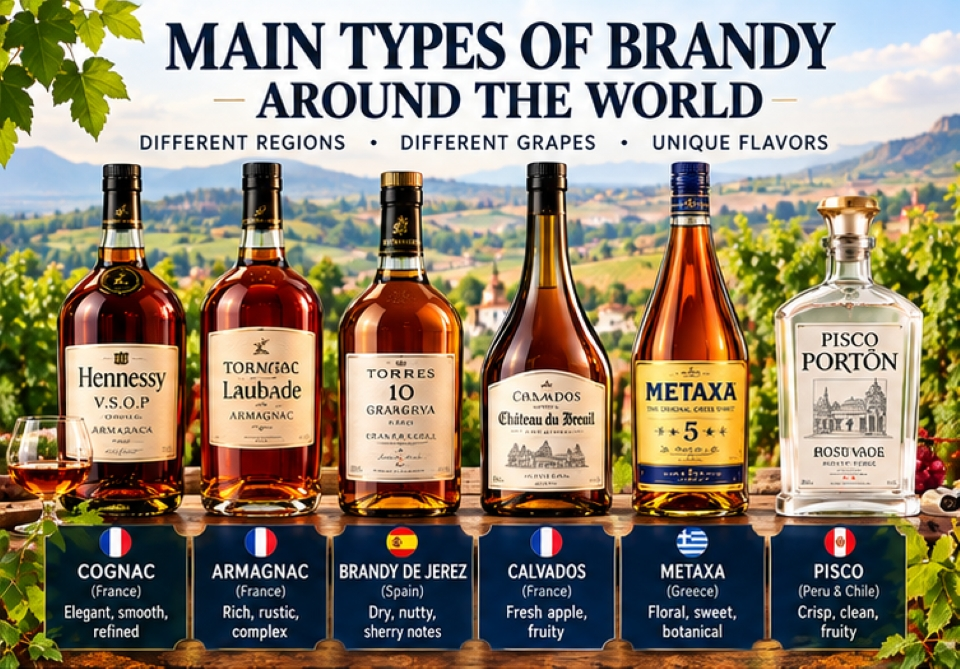
Main types of brandy around the world including Cognac, Armagnac, Brandy de Jerez, Calvados, Metaxa and Pisco
5. Courvoisier
Country: France
Courvoisier is one of the most famous Cognac names worldwide. Its heritage reaches into the 19th century and its brand identity has long been connected with premium Cognac.
Famous expressions
-
-
- Courvoisier VS
- Courvoisier VSOP
- Courvoisier XO
-
Best for
-
-
- Cocktails
- Sipping
- Gifting
-
Courvoisier is particularly recognizable among consumers who are new to the Cognac category.
6. St-Rémy
Country: France
St-Rémy is one of France’s most recognizable mainstream brandy brands outside the Cognac appellation. It is particularly useful for consumers who want French brandy without buying Cognac.
Best for
-
-
- Cocktails
- Casual sipping
- Value-oriented drinking
-
Drinks International placed St-Rémy among its leading brandy brands in 2026.
7. Metaxa
Country: Greece
Metaxa is one of the most distinctive products in the entire brandy conversation. The producer describes METAXA as a combination of:
-
-
- sweet Muscat wines
- fine aged wine distillates
- Mediterranean herbs and botanicals.
-
That makes it different from conventional grape brandy.
Famous expressions
-
-
- Metaxa 5 Stars
- Metaxa 7 Stars
- Metaxa 12 Stars
- Metaxa Grande Fine
- Private Reserve
-
Best for
-
-
- Sipping
- Cocktails
- Mediterranean-style drinks
-
Its official website also features dedicated cocktails, including Mojito, Sour and Greek Spritz variations.
8. Carlos I
Country: Spain
Carlos I is one of Spain’s best-known premium brandies. The brand belongs to the rich tradition of Spanish aged brandy and is frequently associated with polished after-dinner drinking.
Best for
-
-
- Sipping
- Premium cocktails
- Gifting
-
Flavor
Expect a profile built around:
-
-
- oak
- dried fruit
- vanilla
- spice in mature expressions.
-
9. Lustau
Country: Spain
Lustau is best known internationally for its sherry, but its brandy portfolio has become an important part of the Spanish premium-spirit landscape. Drinks International’s 2026 brandy results put Lustau among the leading brands in its top-bar sample.
Best for
-
-
- Sipping
- Cocktails
- Spanish spirits enthusiasts
-
Its connection to sherry culture is particularly attractive to drinkers who want a richer, more wine-influenced style.
10. Vecchia Romagna
Country: Italy
Vecchia Romagna is one of Italy’s most recognizable brandy brands. It has a long association with Italian after-dinner drinking and a significant international presence. Drinks International’s 2026 report placed Vecchia Romagna sixth among the leading brandy brands in its bar sample.
Best for
-
-
- Digestif drinking
- Sipping
- Coffee cocktails
-
11. Asbach
Country: Germany
Asbach is one of Germany’s classic brandy names. The brand is particularly associated with traditional German drinking culture and the famous Rüdesheimer Kaffee preparation.
Best for
-
-
- After dinner
- Coffee
- Traditional sipping
-
Flavor
Rich, warm and traditionally brandy-like.
12. Ararat
Country: Armenia
Ararat is Armenia’s most internationally recognized brandy label. The brand has become strongly associated with the country’s historic brandy-making tradition.
Best for
-
-
- Sipping
- Gifting
- Exploring Armenian spirits
-
Mature Ararat expressions can be especially interesting for enthusiasts who enjoy aged grape spirits but want something beyond French Cognac.
13. Fundador
Country: Spain
Fundador is one of the historic names of Spanish brandy. It is strongly connected with the Brandy de Jerez tradition.
Best for
-
-
- Cocktails
- Sipping
- Spanish brandy exploration
-
The brand is particularly useful for readers who want to understand why Jerez-style brandy is different from French grape brandy.
14. Cardenal Mendoza
Country: Spain
Cardenal Mendoza is a premium Spanish brandy associated with rich, mature styles.
Best for
-
-
- After dinner
- Sipping
- Gifting
-
It is often particularly attractive to drinkers who enjoy:
-
-
- dried fruit
- oak
- vanilla
- spice.
-
15. Lepanto
Country: Spain
Lepanto is one of Spain’s most distinctive premium brandies. Its identity is closely connected to Jerez and sherry-making traditions.
Best for
-
-
- Sipping
- Premium gifts
- Spanish spirits enthusiasts
-
16. Fernando de Castilla
Country: Spain
Fernando de Castilla is a highly respected name among serious Spanish brandy drinkers. Its brandy portfolio is especially interesting for consumers who want an artisanal, premium-oriented Jerez experience. Drinks International included Fernando de Castilla in its 2026 leading brandy ranking.
Best for
-
-
- Serious sipping
- Collectors
- Spanish brandy exploration
-
17. D’Ussé
Country: France
D’Ussé is a modern Cognac brand with substantial recognition in North America. It is a younger brand than the traditional historic Cognac houses, but its modern luxury positioning has helped make it one of the most visible Cognacs among a new generation of consumers.
Best for
-
-
- Cocktails
- Sipping
- Modern whiskey drinkers transitioning to Cognac
-
18. Camus
Country: France
Camus is a major independent family Cognac house. The producer is particularly associated with the Borderies cru and aromatic Cognac styles.
Best for
-
-
- Sipping
- Premium cocktails
- Cognac enthusiasts
-
Camus is particularly interesting for people who want something more terroir-focused than a mass-market Cognac.
19. Delord
Country: France
Delord is one of the most recognizable family-owned Armagnac producers. Its range includes:
-
-
- VS
- VSOP
- XO
-
and older/vintage expressions.
Best for
-
-
- Armagnac exploration
- Vintage drinking
- Sipping
-
20. Dartigalongue
Country: France
Dartigalongue is another historic Armagnac producer. The family business dates to 1838, and the producer has maintained a significant collection of mature and vintage Armagnac.
Best for
-
-
- Vintage Armagnac
- Collectors
- Traditional French brandy enthusiasts
-
21. Janneau
Country: France
Janneau is a historic Armagnac house and one of the most recognizable brands in the category. What makes Janneau particularly interesting is its use of both:
-
-
- continuous distillation
- double distillation
-
in its production approach. The official Armagnac information describes the house as combining eaux-de-vie from both methods.
Best for
-
-
- Cocktails
- VSOP
- Sipping
-
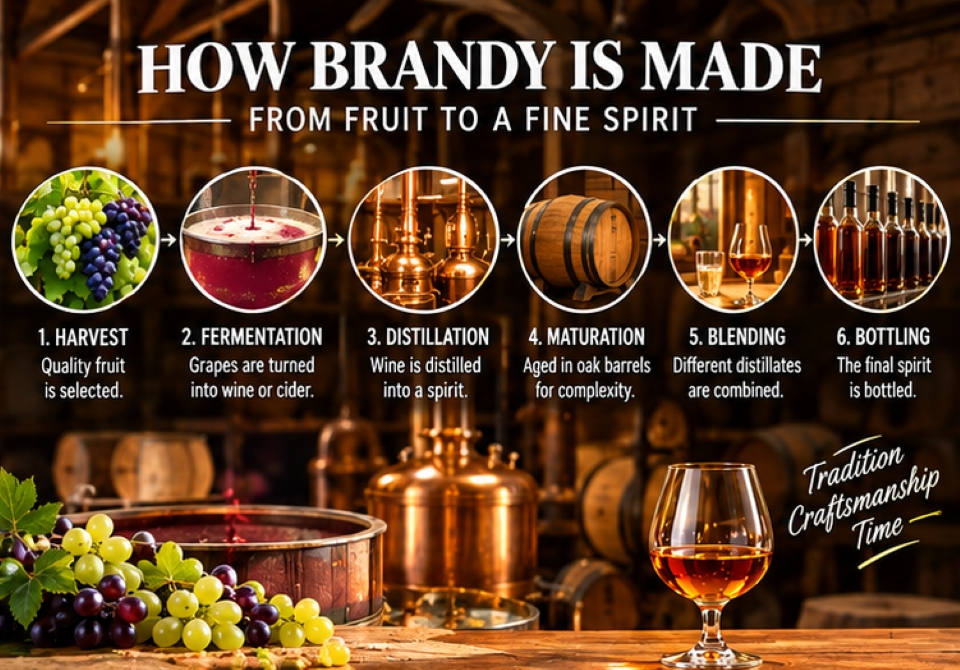
How brandy is made from fruit harvest and fermentation through distillation, oak maturation, blending and bottling
22. Darroze
Country: France
Darroze is particularly respected among serious Armagnac enthusiasts. The house is well known for bottling estate-specific Bas-Armagnac and vintage expressions.
Best for
-
-
- Collectors
- Vintage Armagnac
- Terroir exploration
-
This is less of a mainstream supermarket brand and more of an enthusiast destination.
23. Château de Laubade
Country: France
Château de Laubade is an important estate producer in Bas-Armagnac. The estate combines:
-
-
- vineyard
- distillation
- barrel aging
- wine-and-spirit hospitality.
-
Best for
-
-
- Premium sipping
- Gifts
- Vintage Armagnac
-
24. Frapin
Country: France
Frapin is best known as a Cognac producer with a strong estate identity and connection to Grande Champagne.
Best for
-
-
- Premium Cognac
- Sipping
- Collectors
-
It is especially appealing to consumers who want a more estate-oriented perspective on Cognac.
25. Hine
Country: France
Hine is one of Cognac’s classic historic houses. It is particularly respected in fine-dining and enthusiast circles.
Best for
-
-
- Sipping
- Fine dining
- Premium Cognac cocktails
-
26. Delamain
Country: France
Delamain is one of the best-known specialist Cognac houses for mature expressions. The house is particularly respected among serious Cognac enthusiasts.
Best for
-
-
- XO and older Cognac
- Sipping
- Collectors
-
It is a good example of how much the broad brandy category extends beyond mainstream labels.
27. Laird’s
Country: United States
Laird’s is one of America’s historic fruit-brandy producers and is especially famous for apple brandy. That makes it important for a broader discussion of what brandy really is.
Best for
-
-
- Cocktails
- American brandy exploration
- Apple-brandy cocktails
-
It is particularly relevant to classic American recipes such as the Jack Rose. Drinks International’s 2026 brandy report included Laird’s in its top-selling-brand sample.
28. Avallen
Country: England
Avallen is a modern example of how the brandy category is evolving beyond conventional grape spirits. It is made from apples and has developed a strong sustainability-focused identity. Drinks International ranked Avallen second among bestselling brandies in its 2026 bar report and first among its trending brandies.
Best for
-
-
- Modern cocktails
- Sustainability-conscious drinkers
- Light fruit brandy
-
29. Barsol
Country: Peru
Barsol is a well-known Pisco producer. Pisco is a distinct grape spirit category, and U.S. regulations identify Pisco as its own type of brandy-related geographic designation.
Best for
-
-
- Pisco cocktails
- Pisco Sour
- Latin American spirits exploration
-
30. Metaxa Private Reserve
Metaxa’s premium reserve expressions deserve separate attention because they demonstrate how far the broader category can move from conventional brandy. Metaxa’s current portfolio includes:
-
-
- 12 Stars
- Grande Fine
- Private Reserve METAXA Orama
- Angels’ Treasure Single Cask Strength, among others.
-
Best for
-
-
- Premium sipping
- Collectors
- Modern Greek spirits enthusiasts
-
Best Brandy for Beginners
If you are new to brandy, start with a style that is easy to understand. A good first bottle is often:
-
-
- VS
- VSOP
-
or a straightforward Spanish or Italian brandy.
Easy starting points
-
-
- Torres
- St-Rémy
- Metaxa 5 Stars
- Hennessy VS
- Rémy Martin VSOP
- Vecchia Romagna
-
The goal isn’t to buy the oldest bottle. It’s to learn the category. Try it neat. Then over ice. Then in a cocktail.
Best Brandy for Sipping
For sipping, move toward:
-
-
- VSOP
- XO
- Hors d’Âge
- Vintage
-
Excellent categories to explore include:
-
-
- Cognac
- Armagnac
- Brandy de Jerez
- Armenian brandy
- premium Italian brandy
-
Good producers to explore
-
-
- Rémy Martin
- Hennessy
- Martell
- Delamain
- Hine
- Darroze
- Delord
- Dartigalongue
- Fernando de Castilla
- Cardenal Mendoza
-
Best Brandy for Cocktails
This is where younger brandy shines.
Sidecar
Choose: Cognac or Armagnac VS/VSOP
Brandy Sour
Use: VSOP
French 75
A younger Cognac or Armagnac works well.
Sazerac
Try: Cognac or Armagnac as a variation.
Brandy Alexander
A smooth VSOP works beautifully.
Highballs
Try:
-
-
- Torres
- St-Rémy
- Janneau
-
or another flavorful but affordable young brandy.
Brandy and Food Pairing
Brandy has enormous food-pairing potential.
Young Brandy + Charcuterie
Spanish brandies can work beautifully with:
-
-
- Jamon
- cured meats
- olives
- aged cheese.
-
Cognac + Seafood
A dry Sidecar can complement:
-
-
- oysters
- shrimp
- ceviche
- light seafood.
-
Armagnac + Duck
A mature Armagnac can be wonderful with:
-
-
- duck breast
- duck confit
- foie gras.
-
Mature Brandy + Cheese
Try:
-
-
- Comté
- Gouda
- aged cheddar
- blue cheese.
-
XO Brandy + Chocolate
One of the classic combinations. Try mature brandy with:
-
-
- dark chocolate
- truffles
- chocolate mousse
- chocolate tart.
-
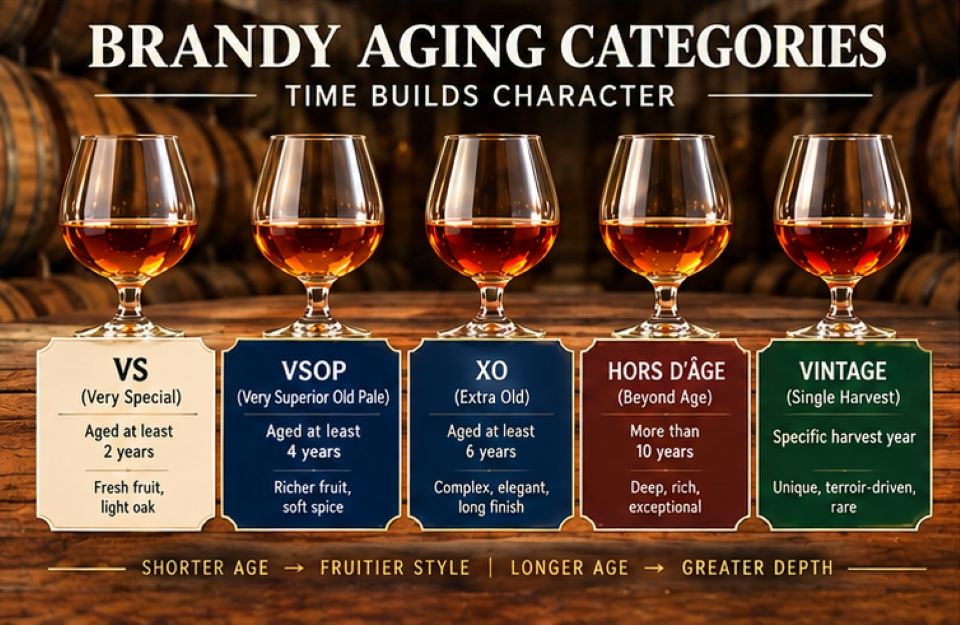
Brandy aging categories including VS, VSOP, XO, Hors d’Âge and Vintage showing how maturation changes flavor and character
How to Taste Brandy
Use a tulip-shaped glass. Pour a small amount.
Look at:
-
-
- color
- clarity
- viscosity
-
Then smell gently.
Young brandy
Look for:
-
-
- grape
- pear
- plum
- floral aromas
-
Aged brandy
Look for:
-
-
- vanilla
- oak
- spice
- dried fruit
- nuts
- cocoa
-
Take a small sip. Notice:
-
-
- sweetness
- heat
- fruit
- oak
- texture
- finish.
-
Then add a few drops of water. The aroma may change significantly.
Brandy Around the World
One of the best ways to appreciate brandy is to taste across countries.
France
Try:
-
-
- Cognac
- Armagnac
- Calvados
-
Spain
Try:
-
-
- Torres
- Fundador
- Lustau
- Lepanto
- Fernando de Castilla
- Cardenal Mendoza
-
Italy
Try: Vecchia Romagna
Greece
Try: Metaxa
Armenia
Try: Ararat
United States
Try: Laird’s
Peru
Try: Barsol
This turns brandy tasting into a global spirits tour.
Cognac vs. Other Brandy Styles
Cognac is often smoother and more polished in broad commercial perception, while Armagnac can show more overt fruit and rustic character.
Spanish brandy can emphasize:
-
-
- dried fruit
- oak
- sherry-derived richness
-
Italian brandy can be:
-
-
- soft
- warm
- digestif-friendly
-
Metaxa is:
-
-
- floral
- sweet
- botanical
-
Armenian brandy can offer:
-
-
- rich fruit
- oak
- spice
-
American fruit brandies can be:
-
-
- fresh
- apple-driven
- aromatic
-
The important thing is to stop assuming that “brandy” has one flavor.
Brandy and Cocktails
Brandy has been central to cocktail history for centuries. Some iconic drinks include:
-
-
- Sidecar
- Sazerac
- Vieux Carré
- Brandy Alexander
- Brandy Crusta
- French 75
- Metropolitan
- Between the Sheets
- Jack Rose
- Pisco Sour
- Horse’s Neck
-
That range demonstrates the category’s flexibility. Brandy works with:
-
-
- citrus
- sugar
- bitters
- vermouth
- coffee
- cream
- ginger
- sparkling wine
- fruit.
-
Current Brandy Trends
The brandy market in 2026 is surprisingly diverse. Several trends stand out.
1. Torres remains strong in premium bars: Drinks International’s 2026 report says Torres has led its brandy bestselling category for seven consecutive years.
2. Modern fruit brandies are gaining attention: Avallen’s strong position in the 2026 trending list demonstrates interest in apple-based and more contemporary brandy styles.
3. Metaxa is broadening the category: Metaxa continues to market itself as a distinctive Greek amber spirit and actively develops cocktail recipes and modern expressions.
4. Premiumization continues. Consumers remain interested in:
-
-
- XO
- vintage
- single-cask
- single-estate
-
5. Cocktail use remains important: Brandy’s usefulness in cocktails gives younger expressions a natural route into modern drinking culture.
Why Brandy Is Having a Cocktail Moment
One reason brandy remains relevant is its versatility.
A bartender can choose:
-
-
- young and fruity
- old and complex.
-
They can use:
-
-
- grape
- apple.
-
They can work with:
-
-
- Cognac
- Armagnac.
-
Or go in a completely different direction with:
-
-
- Metaxa
- Pisco.
-
This is a much bigger toolkit than many consumers realize.
Brandy for the Home Bar
A basic brandy bar can be simple. Start with:
Bottle 1
VS or VSOP grape brandy
Bottle 2
Cognac
Bottle 3
Armagnac
Bottle 4
Apple brandy or Pisco
Then add:
-
-
- Triple Sec
- sweet vermouth
- bitters
- lemon
- lime
- orange
- sugar
- ginger beer
- sparkling wine.
-
You can then make dozens of classic and modern drinks.
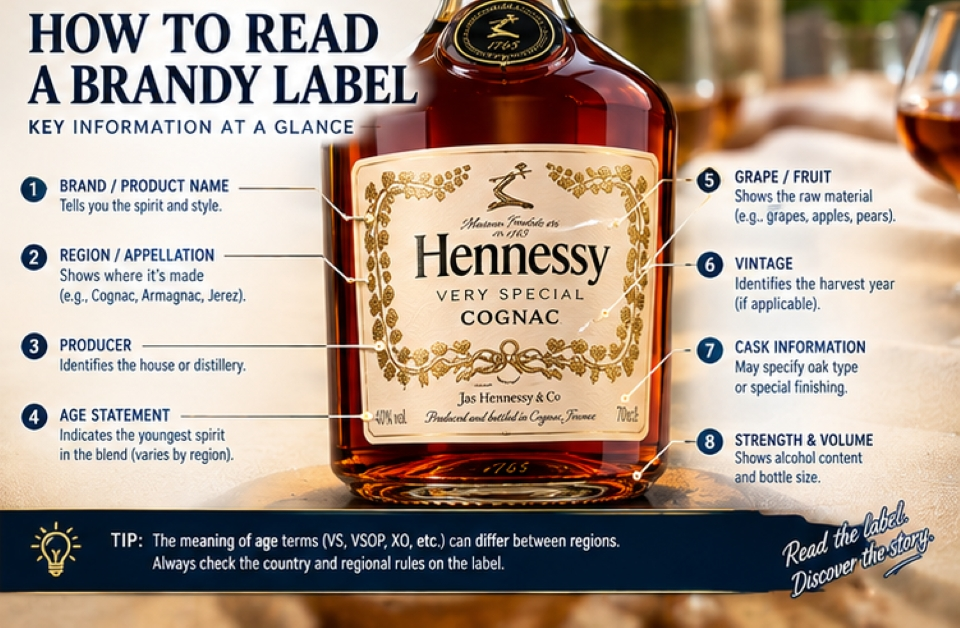
How to read a brandy label including brand name, region, producer, age statement, grape or fruit, vintage, cask information and strength
Frequently Asked Questions
What is the most popular brandy brand in the world?
There is no single global ranking that covers every brand using one consistent methodology. Torres led Drinks International’s 2026 bestselling-brandy ranking among influential bars for the seventh consecutive year, while broader worldwide sales rankings can produce a different result.
What is the biggest brandy brand in the world?
The answer depends on the data set and whether the category includes regionally operating brands, Cognac, fruit brandies and other geographically protected spirits. Current global-sales data and premium-bar data do not necessarily identify the same leader.
What is the best brandy brand?
There is no universally best brandy. The right bottle depends on whether you want a cocktail, an after-dinner drink, a vintage expression or a specific regional style.
Is Cognac a brandy?
Yes. Cognac is a specific geographically protected type of grape brandy.
Is Armagnac a brandy?
Yes. Armagnac is a protected French grape-brandy category.
Is Calvados brandy?
Yes. Calvados is a French apple brandy category.
Is Pisco brandy?
Pisco is a distinct protected grape-spirit category and is classified separately in U.S. regulations.
What is the difference between brandy and Cognac?
Brandy is the broad category. Cognac is one geographically protected type of brandy made in the Cognac region of France.
What is the difference between brandy and Armagnac?
Brandy is the broad category, while Armagnac is a protected French grape brandy from Gascony.
What is the difference between Cognac and Armagnac?
They are both French grape brandies but come from different regions and use different production traditions.
What is VS brandy?
The meaning depends on the specific category. In Cognac and other regulated styles, VS has a defined meaning; ordinary brandy labels may use different systems.
What does VSOP mean?
Again, the precise legal meaning depends on the category and producing country. For Cognac and Armagnac, VSOP has specific regulated age requirements.
What does XO mean?
The meaning depends on the regional spirit category. It should not automatically be assumed to have the same minimum age worldwide.
Is older brandy better?
Not necessarily. Older brandy is generally more mature, but younger brandy can be better for cocktails.
What is the best brandy for beginners?
Torres, St-Rémy, Metaxa 5 Stars, Hennessy VS and other approachable young expressions are good places to start.
What is the best brandy for sipping?
VSOP, XO, vintage and other mature expressions are generally more appropriate for sipping.
What is the best brandy for cocktails?
A flavorful VS or VSOP is usually the most practical choice.
What is the best brandy for a Sidecar?
Cognac VS or VSOP is traditional, but Armagnac can make an interesting variation.
What is the best brandy for a Sazerac?
Cognac is historically important, while Armagnac can also be used as a variation.
What is the best brandy for an Old Fashioned?
Cognac, Armagnac or a flavorful aged brandy can all work well.
What is the best brandy for a Brandy Alexander?
A smooth VSOP-style brandy is an excellent choice.
What is the best brandy for cocktails?
VS or VSOP generally provides the best combination of flavor and value.
Can you drink brandy over ice?
Yes. Younger brandies are especially suitable for casual drinking over ice.
Can you mix brandy with cola?
Yes. Spanish brandy and cola are a longstanding combination.
Can you mix brandy with ginger ale?
Yes. Brandy and ginger make a refreshing highball.
Can you mix brandy with tonic?
Yes. Younger brandy can work surprisingly well with dry tonic water.
Can brandy be mixed with coffee?
Yes. Brandy and coffee are a classic after-dinner pairing.
What food goes well with brandy?
Cheese, chocolate, dried fruit, duck, foie gras, charcuterie, seafood and desserts can all work depending on the brandy style.
Is brandy good with chocolate?
Yes. Mature grape brandies can be excellent with dark chocolate.
Is brandy good with cheese?
Yes. Richer brandies work particularly well with aged cheeses.
What is the best brandy for steak?
A rich, mature brandy or brandy-based Old Fashioned can work well with steak.
What is the best brandy for dessert?
XO Cognac, mature Armagnac, Brandy Alexander and coffee-based brandy cocktails are all strong choices.
What is Metaxa?
Metaxa is a Greek amber spirit made from sweet Muscat wines, aged wine distillates and Mediterranean botanicals.
Is Metaxa the same as Cognac?
No. Metaxa has its own distinct recipe and identity.
What is Torres Brandy?
Torres is a major Spanish brandy brand and the leading bestselling brandy in Drinks International’s 2026 premium-bar survey.
What is Spanish brandy?
Spanish brandy is a broad category that includes important regional traditions, particularly Brandy de Jerez.
What is Brandy de Jerez?
It is a protected Spanish grape-brandy category associated with the Jerez region.
What is Armenian brandy?
Armenian brandy is a major regional grape-brandy tradition, with Ararat being its most recognizable international brand.
What is apple brandy?
Apple brandy is a spirit distilled from fermented apples or cider. Laird’s is one of the best-known American examples.
What is fruit brandy?
Fruit brandy is made by distilling fermented fruit juice or mash. U.S. regulations define fruit brandy broadly and distinguish it from specific protected categories.
What is the best fruit brandy?
That depends on the fruit and style. Apple brandy, pear brandy and cherry brandy can all be excellent.
What is the best brandy for a gift?
A recognizable Cognac such as Hennessy or Rémy Martin is an easy gift choice, while a vintage Armagnac or premium Spanish brandy can be more distinctive.
What is a luxury brandy?
Luxury brandy usually refers to mature, limited, vintage or prestige expressions rather than one formally defined global class.
Does brandy improve in the bottle?
Generally no. Brandy develops primarily during maturation in wood.
Should brandy be refrigerated?
Usually not. Store it upright in a cool, dark place.
Can brandy go bad after opening?
It can slowly lose aromatic quality over a long period, particularly with significant air exposure, although high-proof spirits are comparatively stable.
What is the best way to drink brandy?
Try it neat first, then with a few drops of water, over ice or in a cocktail depending on the style.
What glass should you use for brandy?
A tulip-shaped glass is excellent for appreciating aromas, while rocks and highball glasses are more suitable for cocktails.
Should you warm brandy?
Overheating the glass can emphasize alcohol rather than aroma. Cool room temperature is a better starting point.
What brandy is best for cocktails?
Younger, flavorful and reasonably priced expressions generally make the most sense.
Why is brandy popular?
Its enormous range of flavors, regional diversity and cocktail versatility make it useful in many drinking occasions.
What countries are famous for brandy?
France, Spain, Italy, Greece, Armenia, the United States and South America all have important brandy or grape-spirit traditions.
Final Thoughts: The World’s Most Popular Brandy Brands
Brandy may be one of the most misunderstood categories in the spirits world. Many consumers hear the word and immediately think of a large Cognac snifter. But brandy is far bigger than that. It includes:
-
-
- Cognac
- Armagnac
- Brandy de Jerez
- Calvados
- Pisco
- Italian brandy
- Greek amber spirits
- Armenian brandy
- American apple brandy
-
and many other regional and fruit-based traditions. That diversity is what makes brandy so exciting.
-
-
- Torres: It represents modern Spanish brandy and currently leads Drinks International’s premium-bar brandy sales ranking for the seventh consecutive year.
- Hennessy: It represents the global luxury Cognac market.
- Rémy Martin: represents another historic Cognac tradition, and its rise to the top of Drinks International’s 2026 Cognac survey shows how quickly the premium-bar landscape can change.
- Martell and Courvoisier: add even more depth to the traditional Cognac category.
- St-Rémy: demonstrates the importance of mainstream French brandy.
- Metaxa: shows how radically different a Greek amber spirit can be from traditional grape brandy. Its combination of Muscat wine, wine distillates and Mediterranean botanicals makes it genuinely distinctive.
- Vecchia Romagna: represents Italy.
- Asbach: represents Germany.
- Ararat: represents Armenia.
- Fundador, Lustau, Cardenal Mendoza, Lepanto and Fernando de Castilla demonstrate the depth of Spanish brandy.
- Janneau, Delord, Dartigalongue, Darroze, Frapin and Hine show how much diversity remains inside the French grape-brandy world.
- Laird’s, Avallen and Barsol remind us that brandy isn’t limited to traditional European grape spirits.
-
This is also why you should be careful when asking which brandy is “the best.” The answer depends on what you are trying to do.
-
-
- For a cocktail: VS or VSOP
- For sipping: VSOP or XO
- For collecting: Vintage
- For discovering terroir: Armagnac
- For polished luxury: Cognac
- For Spanish character: Brandy de Jerez
- For fruit: Apple brandy
- For something completely different: Metaxa
-
The smartest way to explore brandy is therefore not simply to chase age. Start with style. Taste a Spanish brandy next to Cognac. Taste Cognac next to Armagnac. Compare a grape brandy with apple brandy. Then try Metaxa.
The differences can be dramatic. You may discover that you prefer:
-
-
- fruit, rather than oak.
- spice, rather than sweetness.
- floral aromas, rather than heavy barrel character.
-
Or perhaps you prefer an expressive younger spirit in cocktails to a decades-old sipping brandy. That’s all part of the fun. Brandy is also an unusually useful category for a home bar. A good young brandy can make:
-
-
- Sidecars
- Sours
- French 75s
- Brandy Alexanders
- Highballs
- Old Fashioned variations.
-
A mature bottle can be enjoyed slowly after dinner. And a vintage bottle can become a memorable gift for a birthday, anniversary or milestone. The category also remains remarkably relevant to modern cocktail culture.
Drinks International’s 2026 data show both continued dominance from Torres and rising interest in brands such as Avallen and Metaxa.
That suggests brandy is not simply surviving on tradition. It is adapting. Modern producers are exploring:
-
-
- fruit-based brandies
- single-estate products
- premium bottlings
- sustainable production
- cocktail-friendly expressions
- new serving rituals.
-
The broader category also benefits from a renewed consumer interest in provenance. People increasingly want to know:
-
-
- Where was it made?
- What fruit was used?
- How was it distilled?
- How long was it aged?
- What cask was used?
- Was it blended?
-
Those questions turn brandy from a generic brown spirit into an agricultural and regional product. That may ultimately be its greatest advantage. Wine drinkers can approach brandy through grape varieties and terroir. Whiskey drinkers can approach it through oak and maturation.
Cocktail drinkers can approach it through versatility. Collectors can approach it through vintage and provenance. And casual drinkers can simply enjoy it. That’s why brandy continues to occupy an important place in the global spirits world. The key is to explore beyond the familiar names.
Start with the giants:
-
-
- Torres
- Hennessy
- Rémy Martin
- Martell
- Courvoisier
-
Then explore:
-
-
- St-Rémy
- Metaxa
- Lustau
- Vecchia Romagna
- Ararat
-
Then move into the enthusiast world:
-
-
- Darroze
- Delord
- Dartigalongue
- Delamain
- Hine
- Fernando de Castilla
- Frapin
-
That’s where brandy gets truly interesting. Because the deeper you go, the less the category feels like one giant product family. It becomes a map of cultures.
-
-
- France.
- Spain.
- Italy.
- Greece.
- Armenia.
- The United States.
- South America.
-
Each producing a different expression of distilled fruit and wine. So the next time you see a bottle labeled brandy, don’t assume you already know what it tastes like.
-
-
- Read the label.
- Look at the country.
- Look at the region.
- Look at the age.
- Look at the producer.
- Then pour a glass.
-
You may be surprised at just how much the world of brandy has to offer.