
Blog
Most Popular Ouzo Brands in the World: 30 Famous Greek Ouzo Brands You Should Know


Discover 30 Most Popular Ouzo Brands in the World: including Ouzo Plomari, Ouzo 12, Mini, Barbayanni, Tsantali, Pilavas, Babatzim, Idoniko and Ouzo of Tyrnavos. Learn what ouzo is, why it turns cloudy when water is added, how Greek ouzo is made, the differences between Lesvos and mainland styles, the best way to serve ouzo, and which brands are worth trying with Greek meze and seafood.
Ouzo is one of Greece’s signature spirits.
The clear, anise-forward drink has become closely associated with the Greek islands, seaside tavernas, long summer evenings and tables covered with small plates of seafood, olives, cheese and meze.
But ouzo is much more than a holiday drink.
It is a protected geographical indication, a major part of Greek food culture and a category with a surprisingly large number of producers and styles. The European Union recognizes Ouzo/Ούζο as a geographical indication associated with Greece and Cyprus, while Greek regional designations include Ouzo of Mytilene, Ouzo of Plomari, Ouzo of Kalamata, Ouzo of Thrace and Ouzo of Macedonia.
Among consumers, a handful of brands dominate awareness.
Ouzo Plomari Isidoros Arvanitis, Ouzo 12, Ouzo Mini Mytilinis, Ouzo Barbayanni and Ouzo Tsantali are repeatedly identified as leading or best-known brands in Greek-market and tourism sources. Older Greek tourism material has also described Plomari, Barbayanni, Mini, Ouzo 12 and Tsantali as the best-known brands.
Ouzo 12 has an especially strong international claim: its official site says it was ranked the world’s No. 1 ouzo according to an IWSR report, while Campari identifies Germany and Greece as its top markets.
Ouzo Plomari is another major name. The producer says the brand’s recipe dates to 1894, and current company information says the ouzo is exported to more than 35 countries, with exports representing 60% of production volume.
The Greek market is also highly fragmented. Euromonitor’s current 2026 Greece report says spirits remain a concentrated market overall and specifically includes brand-level shares for the spirits category, while older Euromonitor-based data reproduced elsewhere show Mini, Ouzo Plomari, Ouzo 12, Tsantali and Barbayanni among the leading ouzo brands.
Table of Contents
-
-
- What Is Ouzo?
- Why Is Ouzo So Popular?
- Is Ouzo a Greek Spirit?
- What Does Ouzo Taste Like?
- What Is the Ouzo Effect?
- How Ouzo Is Made
- Ouzo and Anise
- Ouzo and Fennel
- Ouzo and Mastiha
- Why Lesvos Is Famous for Ouzo
- The Major Ouzo Regions
- How to Drink Ouzo
- Water, Ice or Neat?
- The Best Food for Ouzo
- 30 Popular Ouzo Brands
- Ouzo Plomari
- Ouzo 12
- Ouzo Mini
- Barbayanni
- Ouzo Tsantali
- Stoupakis Kazanisto
- Makedoniko
- Babatzim
- Ouzo Pitsiladi
- Idoniko
- Pilavas
- Ouzo Veto
- Ouzo of Tyrnavos
- Ouzo Giannatsi
- Ouzo Kefi
- Ouzo Matis
- Ouzo Lino
- Ouzo Jivaeri
- Ouzo Dimino
- Ouzo Kakitsi
- Ouzo Apalarina
- Ouzo Giokarinis
- Ouzo Kouroumichali
- Ouzo Kronos
- Ouzo Matarelli
- Ouzo Samara
- Ouzo Smyrnio
- Ouzo Psaropoula
- Ouzo Veto Spentza
- Ouzo Brettos
- Best Ouzo for Beginners
- Best Ouzo for Seafood
- Best Ouzo for Meze
- Best Ouzo for Summer
- Best Ouzo for Collectors
- Ouzo Cocktails
- Ouzo vs. Tsipouro
- Ouzo vs. Sambuca
- Ouzo vs. Pastis
- Current Ouzo Trends
- Frequently Asked Questions
- Final Thoughts
-
What Is Ouzo?
Ouzo is an anise-flavoured Greek spirit. Its distinctive character comes primarily from anise and other botanicals, depending on the producer’s recipe.
European legislation defines ouzo within the distilled-anis category and sets specific production rules for using anise, with possible use of fennel, Chios mastic and other aromatic seeds, plants and fruits. The regulations also require the anise-flavoured alcohol obtained by distillation to play a substantial role in the final product.
That means ouzo is more than ordinary neutral alcohol with anise flavoring added afterward. Traditional production incorporates botanical ingredients through processes such as distillation or maceration, and particular producers may use multiple distillations.
The result is normally:
-
-
- clear
- aromatic
- anise-forward
- herbal.
-
Its usual alcohol strength is relatively high, although products vary. The official Athens Guide notes a range roughly from the high 30s to the upper 40s in alcohol by volume.
Why Is Ouzo So Popular?
Ouzo’s popularity comes from more than its flavor. It is deeply connected to Greek social dining. In Greece, ouzo is traditionally associated with meze, seafood, olives, salads, grilled dishes and small savory plates.
It is usually consumed slowly. The drink is not simply the first course before dinner. It is part of the meal itself. That’s why an ouzeri or seaside taverna can feel completely different from a conventional cocktail bar.
The official Athens Guide describes ouzo as especially suited to enjoying with food and notes that it is traditionally consumed in relaxed café and seaside-taverna settings.
That cultural connection has helped ouzo travel internationally.
Is Ouzo a Greek Spirit?
Yes. The EU recognizes Ouzo/Ούζο as a protected geographical indication connected with Greece and Cyprus. However, when discussing production, Greece is the key reference point for the category. Several Greek regions have their own recognized ouzo identities.
The EU list includes:
-
-
- Ouzo of Mitilene
- Ouzo of Plomari
- Ouzo of Kalamata
- Ouzo of Thrace
- Ouzo of Macedonia.
-
This regional diversity is one reason Greek ouzo can vary considerably from bottle to bottle.
What Does Ouzo Taste Like?
Anise is the dominant flavor.
Expect:
-
-
- licorice
- anise seed
- fennel
- herbs
- citrus
- peppery spice
- floral notes
- mastiha-like resinous character.
-
The producer’s botanical recipe can dramatically change the balance.
-
-
- Some ouzos are: sweet and soft
- while others are: dry and powerful.
- Some emphasize: anise
- while others show more: herbs, mastic, citrus, spice.
-
That is why serious ouzo drinkers often have a favorite brand.
What Is the Ouzo Effect?
One of the most visually interesting things about ouzo is what happens when water is added.
The clear spirit becomes:
-
-
- cloudy white
- milky white.
-
This is called the Ouzo Effect.
The phenomenon occurs because anise contains essential oils, particularly anethole, which is soluble in alcohol but much less soluble when the alcohol concentration is reduced with water.
The resulting tiny droplets scatter light. Ouzo Plomari’s current FAQ describes this cloudy appearance as a natural result of the anise essential oils interacting with water.
It isn’t a defect. It is one of ouzo’s defining visual characteristics.
How Ouzo Is Made
A simplified ouzo production sequence is: agricultural alcohol → botanicals → distillation/maceration → blending → dilution → filtration → bottling, The exact recipe varies by producer.
Ouzo 12, for example, describes a traditional process using selected ingredients such as anise, fennel seeds and other aromatic seeds, plants and fruits, followed by double distillation in copper vessels.
Ouzo Plomari describes a more elaborate traditional process in which botanicals and aromatic ingredients undergo distillation, the heart fraction is collected, and the spirit is distilled again. The producer says each distillation lasts approximately nine hours.
Barbayanni likewise describes multiple slow distillations in small copper stills, with the middle fraction retained and later blended with water.
These production choices help create differences between brands.
Ouzo and Anise
Anise is the signature ingredient. Its aroma is often described as:
-
-
- licorice-like
- sweet
- herbal
- spicy
-
The intensity varies by producer. For example, Barbayanni describes its Blue Label as an elegant, classic ouzo with anise and aromatic herbs, bottled at 46% ABV.
Ouzo Plomari emphasizes Lisvori anise grown on Lesvos, along with more than 15 herbs and seeds. This regional ingredient focus is part of the category’s identity.
Ouzo and Fennel
Fennel contributes a greener, slightly sweeter aromatic character. Some producers emphasize fennel as a key part of their botanical balance.
Pilavas describes its flagship ouzo as based on carefully selected ingredients and double distillation, while its Ouzo Gold uses various seeds during distillation to provide sweetness without adding sugar.
That demonstrates why two apparently similar bottles can taste surprisingly different.
Ouzo and Mastiha
Mastiha is the aromatic resin associated with the Greek island of Chios. Certain ouzo recipes use mastiha or mastic-derived ingredients.
METAXA Ouzo is a current example. The producer describes its Ouzo as balancing anise with Chios mastic, producing floral, spicy, herbal and “sea-breeze” notes. It is bottled at 40% ABV and distilled in copper stills in small batches.
This is a useful reminder that “ouzo” doesn’t automatically mean “one-note anise.”
Why Lesvos Is Famous for Ouzo
Lesvos has become almost synonymous with Greek ouzo.
The Lesvos Geopark says the island’s ouzo tradition dates back to the middle of the 19th century and identifies local anise as an important reason for the island’s reputation. It lists numerous distilleries including Varvagianni, VETO, Giannatsi, Dimino, EPOM, Isidorou Arvaniti, Kefi, Kouroumichali, Kronos, Matarelli, Matis, Pitsiladi, Samara, Smyrnio and Psaropoula.
The island is also connected with four of the five best-known Greek ouzo brands identified by the official Athens Guide: Isidoros Arvanitis Ouzo Plomari, Barbayanni, Mini Mytilinis and Ouzo Tsantali, with Ouzo 12 being the fifth.
That concentration tells you something important: Lesvos is not simply famous for ouzo marketing. It is a genuine production center.
The Major Ouzo Regions
Lesvos / Mytilene
Known for:
-
-
- anise
- herbs
- richness
- traditional distillation
-
Plomari
Especially famous for:
-
-
- Ouzo Plomari
- Barbayanni
-
and numerous smaller traditional producers.
Tyrnavos
Tyrnavos has a separate ouzo tradition.
The Agricultural Cooperative Winery & Distillery of Tyrnavos currently describes its Ouzo of Tyrnavos as being made from grapes exclusively from the Tyrnavos area, with herbs and star anise in traditional copper stills. It also notes recent competition recognition, including Best Ouzo 2024 and a silver award in 2025.
Chios
Chios is also associated with mastiha and ouzo production.
Macedonia
Northern Greek producers such as Babatzim contribute another regional style.
How to Drink Ouzo
The classic approach is simple:
-
-
- Pour ouzo into a small glass.
- Add a little cold water.
- Then optionally add ice.
-
As water lowers the alcohol concentration, the drink becomes cloudy and the aromas open. Ouzo Plomari currently recommends serving its ouzo chilled around 8–10°C, with water or according to personal preference.
Water first or ouzo first?
Traditionally, ouzo is often poured first and water added afterward. The visual change becomes part of the ritual.
Water, Ice or Neat?
Neat
Best for: tasting the concentrated aroma
With water
Best for: traditional service, opening the aromatics
With ice
Best for: hot weather, casual drinking
Water + ice
A popular modern option. The key is to experiment. Different brands can respond differently to dilution.
What Food Goes Best With Ouzo?
Ouzo loves savory food. Some of the best pairings include:
-
-
- octopus
- grilled shrimp
- calamari
- sardines
- anchovies
- mussels
- feta
- olives
- stuffed vine leaves
- grilled vegetables
- spicy sausages
- seafood salads
- Greek meze
-
Ouzo Plomari specifically recommends seafood, fresh fish, octopus, calamari, prawns, olives, cheeses, stuffed vine leaves and other savory appetizers.
The official Athens Guide likewise describes ouzo as traditionally accompanied by meze. The reason is simple. Anise and botanical flavors cut through salty, oily and grilled foods beautifully.
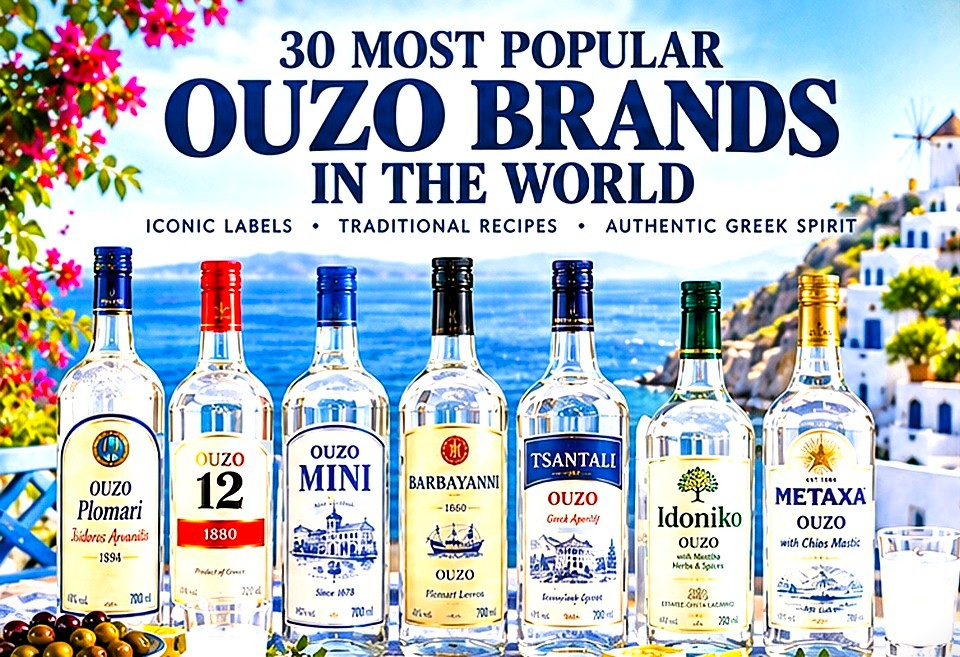
30 most popular ouzo brands including Ouzo Plomari, Ouzo 12, Ouzo Mini, Barbayanni, Tsantali, Idoniko and Metaxa Ouzo
30 Most Popular Ouzo Brands in the World
1. Ouzo Plomari Isidoros Arvanitis
Origin: Plomari, Lesvos
Ouzo Plomari is one of the most recognizable ouzo brands in Greece and internationally. The current producer history traces the recipe to 1894, when Isidoros Arvanitis began developing his ouzo in Plomari. The distillery now operates 18 handcrafted copper stills, according to the producer.
Its recipe emphasizes:
-
-
- Lisvori anise
- fennel
- mastiha
- herbs
- seeds
- soft spring water.
-
Best for
-
-
- Classic Greek ouzo
- Seafood
- Meze
- Summer drinking
-
The producer says its exports now reach more than 35 countries.
2. Ouzo 12
Origin: Historical roots in Constantinople; produced in Volos, Greece
Ouzo 12 is one of the most internationally recognizable Greek ouzo brands. Its story begins in 1880 at the Kalogiannis distillery in Constantinople, where customers requested ouzo from Barrel No. 12. The brand was later bottled in Greece and is now produced in Volos, central Greece.
Ouzo 12’s official site says it was ranked the world’s No. 1 ouzo according to an IWSR report. The brand also posted 10% sales growth in Greece in 2025, according to January 2026 reporting from Athinorama.
Best for
-
-
- International availability
- Classic ouzo service
- Gifts
- Everyday drinking
-
3. Ouzo Mini Mytilinis
Origin: Mytilene, Lesvos
Ouzo Mini has one of the strongest mass-market positions among Greek ouzo brands. Its official history traces the tradition to Mytilene and says the label has been produced on Lesvos for more than 50 years, while the modern distillery lineage goes back much further.
Pernod Ricard acquired 95% of EPOM in 1996, and Mini remains one of the company’s Greek ouzo brands.
Best for
-
-
- Beginners
- Mild ouzo
- Summer
-
The producer describes Mini as smooth and mellow.
4. Ouzo Barbayanni
Origin: Plomari, Lesvos
Barbayanni is one of the classic Plomari producers. The family business dates to 1860, when Efstathios Varvayannis established the distillery in Plomari.
Its current range includes:
-
-
- Blue
- Green
- Red / Evzon
- Black / Aphrodite
-
and a collectible expression. All five are described by the producer as 100% distilled, made in small copper stills.
Best for
-
-
- Ouzo enthusiasts
- Strong anise
- Traditional Plomari style
-
Blue is bottled at 46%, Green at 42%, Evzon at 47% and Aphrodite at 48%.
5. Ouzo Tsantali
Origin: Greece
Tsantali is one of the historically important commercial Greek spirits names and one of the brands consistently identified among leading ouzos in Greek tourism and market sources. The Tsantali name also appears in official records for Greek ouzo production dating back decades.
Best for
-
-
- Mainstream Greek ouzo
- Meze
- Cocktails
-
6. Stoupaki Kazanisto
Origin: Chios
Kazanisto is a well-known ouzo from Chios and appeared among leading Greek ouzo brands in Euromonitor-based market data. It is especially interesting for consumers who want to explore the Chios side of Greek ouzo, where mastiha plays an important cultural role.
Best for
-
-
- Regional exploration
- Herbal ouzo fans
-
7. Makedoniko Ouzo
Origin: Northern Greece
Makedoniko is another established Greek label included in historical brand-share data and associated with the Tsantali portfolio.
Best for
-
-
- Mainland Greek style
- Meze
- Everyday drinking
-
8. Babatzim Ouzo
Origin: Macedonia
Babatzim has an extraordinary family history. The company traces its roots to 1875 in Constantinople, while the modern Greek business developed after the family settled in Greece in the early 20th century.
Its current site describes Babatzim Ouzo as a 100% distillate using anise and fennel seeds from Macedonia.
Best for
-
-
- Traditionalists
- Macedonian spirits
- Meze
-
9. Ouzo Pitsiladi
Origin: Lesvos
Pitsiladi is a respected Lesvos ouzo appearing among the leading brands in historical market-share data. It also appears in the current Lesvos Geopark list of island distilleries.
Best for
-
-
- Strong ouzo styles
- Lesvos exploration
- Seafood
-
10. Idoniko
Producer: Estates Costa Lazaridi
Origin: Drama, Macedonia
Idoniko is produced by Estates Costa Lazaridi, a well-established Greek wine and spirits producer. The producer says Idoniko has represented Macedonian distilling tradition since 1992, using slow, repeated distillation in copper stills and retaining the heart of the distillation.
The LCBO currently lists Domaine Costa Lazaridi Idoniko Ouzo, describing aromas of anise, mastiha, citrus, mint and spices, and specifically recommending it with meze and grilled seafood.
Best for
-
-
- Canadian consumers
- Seafood
- Mastiha and herbal flavors
-
11. Pilavas Ouzo
Origin: Patras
Pilavas is a family-owned Greek distillery with roots going back to 1940. The producer says its ouzo continues to follow the family’s original philosophy of selected ingredients, double distillation and a period of rest before bottling.
Best for
-
-
- Soft, approachable ouzo
- Beginners
- Meze
-
12. Ouzo Veto
Origin: Mytilene, Lesvos
Ouzo Veto dates to 1892, when Georgios Spentzas began his distilling history in Pergamon in Asia Minor before the business continued in Mytilene after 1948.
The modern range includes:
-
-
- Veto Silver
- Veto Gold
- Veto Metallic
- Spentza 1892.
-
Best for
-
-
- Lesvos-style exploration
- Travel
- Strong traditional character
-
The producer’s Metallic expression uses recyclable metal packaging and is bottled at 42% ABV.
13. Ouzo of Tyrnavos
Origin: Tyrnavos
This is one of the most interesting regional ouzos. The Tyrnavos cooperative describes it as being made exclusively from grapes from the Tyrnavos region, along with herbs and star anise, using a traditional copper still.
It received Best Ouzo recognition in the 2024 Thessaloniki International Wine & Spirits Competition and silver in 2025.
Best for
-
-
- Regional tasting
- Wine-and-grape-spirit enthusiasts
- Macedonian/Thessalian food
-
14. Ouzo Giannatsi
Origin: Plomari, Lesvos
Giannatsi is a regional Plomari producer listed by the Lesvos Geopark among the island’s traditional ouzo distilleries.
Best for
-
-
- Local Lesvos exploration
- Traditional ouzo tastings
-
15. Ouzo Kefi
Ouzo Kefi has a long Mytilene connection. The current producer history says Ioannis Linos worked in Mytilene distilleries and later helped establish Ouzo Kefi in the 1950s; the brand became one of the top distillation companies on Lesvos in the 1960s.
Best for
-
-
- Mytilene-style ouzo
- Traditionalists
-
16. Ouzo Matis
Origin: Mytilene
Matis is another old Mytilene distillery. Its history begins in 1861, according to the producer, and the family continues to make ouzo alongside other traditional spirits. Current products include ouzo at 39% and 40% ABV.
Best for
-
-
- Local Lesvos traditions
- Lighter styles
-
17. Ouzo Lino
Ouzo Lino is a Mytilene ouzo with roots in the island’s historic Kefi distilling tradition. The producer describes its history as beginning with a 1927-born distiller, Ioannis A. Linos, whose work eventually led to the Ouzo Kefi business before the Lino family continued the tradition.
Best for
-
-
- Island exploration
-
18. Ouzo Jivaeri
Producer: Katsaros Distillery
Jivaeri comes from the Katsaros distillery and is presented as a traditional Greek ouzo using agricultural alcohol, mineral-rich water and aromatic seeds and herbs.
Best for
-
-
- Tyrnavos region
- Herbal character
-
19. Ouzo Dimino
Dimino is another Lesvos label identified among the island’s traditional distilleries. It is particularly interesting for enthusiasts building a broader Lesvos tasting lineup.
Best for: Regional tastings
20. Ouzo Kakitsi
Kakitsi represents the smaller-scale side of Greek ouzo production. Older Greek travel sources identify Kakitsi among Chios ouzos worth exploring.
Best for
-
-
- Chios exploration
- Small-producer discovery
-
21. Ouzo Apalarina
Apalarina is another Chios ouzo cited among regional labels in Greek travel material.
Best for
-
-
- Regional tasting
- Chios spirits
-
22. Ouzo Giokarinis
Giokarinis is associated with Samos. Greek travel sources identify it among the island’s notable ouzo labels.
Best for
-
-
- Samos exploration
- Island-to-island comparisons
-
23. Ouzo Kouroumichali
Kouroumichali is listed by the Lesvos Geopark among the island’s ouzo distilleries.
Best for: Lesvos enthusiasts
24. Ouzo Kronos
Kronos is another traditional Lesvos label appearing in the Geopark’s distillery list.
Best for: Regional discovery
25. Ouzo Matarelli
Matarelli is a Lesvos producer included in the island’s traditional distillery network. The brand is particularly interesting for drinkers who want to move beyond the best-known commercial labels.
Best for: Small-producer tasting
26. Ouzo Samara
Samara is another Lesvos ouzo listed among local distilleries and has appeared in Greek travel references to traditional island ouzos.
Best for: Local exploration
27. Ouzo Smyrnio
Smyrnio appears among the traditional Lesvos distilleries listed by the Lesvos Geopark.
Best for: Lesvos tasting flights
28. Ouzo Psaropoula
Psaropoula is another traditional Lesvos label included by the Geopark.
Best for: Island-style exploration
29. Ouzo Veto Spentza 1892
The Spentza 1892 label is part of the Ouzo Veto family’s current product portfolio and represents the distillery’s effort to combine historical identity with a premium expression.
Best for: History-focused tastings
30. METAXA Ouzo
Producer: House of Metaxa
METAXA Ouzo is an interesting modern interpretation of the category.
The producer describes it as a balance of:
-
-
- anise
- Chios mastic
- and other botanical notes.
-
It is distilled in 100% copper stills in small batches and bottled at 40% ABV.
Best for
-
-
- Modern Greek spirits
- Mastiha fans
- Floral/herbal styles
-
METAXA also publishes an Ouzo Ritual using 5 cl of METAXA Ouzo, ice and a splash of soda water.
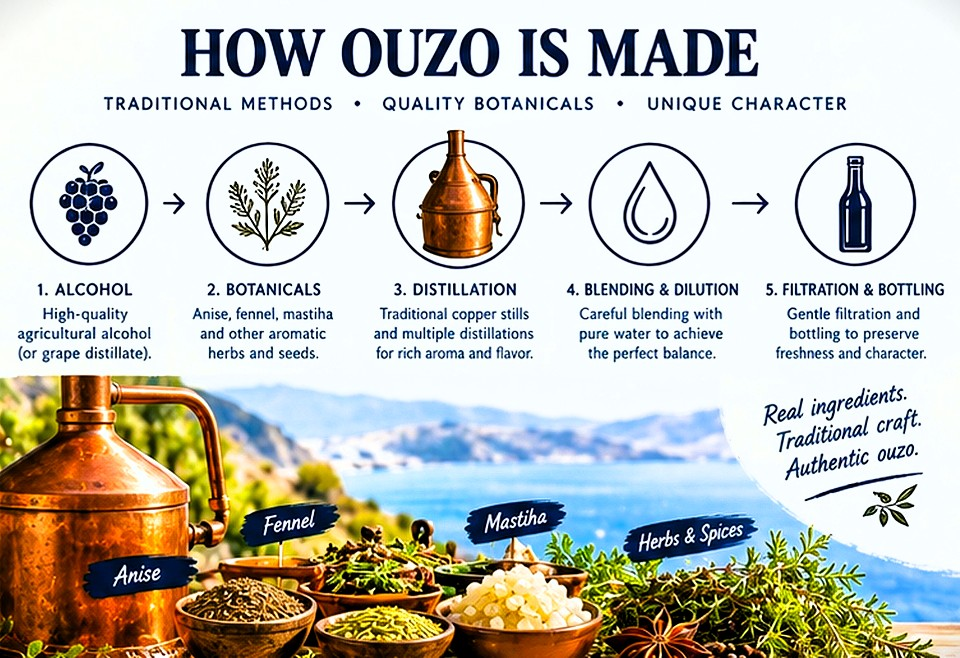
How ouzo is made using agricultural alcohol, anise, fennel, mastiha, aromatic herbs, copper stills, blending and dilution
Best Ouzo for Beginners
If you’re completely new to ouzo, don’t begin with the strongest bottle you can find. Start with an approachable expression.
Good starting choices
-
-
- Ouzo Mini
- Ouzo 12
- Ouzo Plomari
- Pilavas
- Idoniko
-
These give you different interpretations of the category without requiring advanced knowledge.
A good tasting sequence is: Mini → Ouzo 12 → Plomari → Barbayanni → Idoniko. That lets you move from accessible styles toward more distinctive regional expressions.
Best Ouzo for Seafood
Ouzo and seafood are natural partners.
Try:
-
-
- Ouzo Plomari
- Barbayanni
- Idoniko
- Ouzo 12
-
with:
-
-
- grilled octopus
- calamari
- shrimp
- sardines
- mussels
- anchovies
-
The LCBO’s tasting note for Idoniko specifically recommends it with meze and grilled seafood. Ouzo Plomari likewise recommends fish, seafood, octopus, calamari and prawns.
Best Ouzo for Meze
Meze is arguably where ouzo makes the most sense.
Try it with:
-
-
- feta
- olives
- taramosalata
- dolmades
- grilled peppers
- eggplant dishes
- seafood
- fried zucchini
- small sausages
- salty cured meats
-
Ouzo’s herbal and anise notes work particularly well with salty foods.
Best Ouzo for Summer
For summer, look for:
-
-
- lighter alcohol
- fresh anise
- citrus
- herbs
- clean finish
-
1. Ouzo Mini is particularly approachable.
2. Ouzo Plomari is a strong classic choice.
3. Barbayanni Green at 42% offers a softer expression than some of the family’s higher-proof bottlings.
4. METAXA Ouzo also offers a contemporary option at 40% with mastiha and floral notes.
Best Ouzo for Collectors
Ouzo isn’t generally collected in the same way as vintage Cognac or rare Scotch.
But collectors can still look for:
-
-
- limited editions
- historic labels
- special bottles
- regional releases
- older packaging
-
Ouzo Plomari currently issues limited-edition bottles; its 2025 and 2026 designs draw on maritime and Greek cultural themes.
These can make attractive additions to a Greek-spirit collection even when the primary appeal is packaging and provenance rather than barrel aging.
Ouzo Cocktails
Ouzo is primarily known as a food-and-social drink, but it can work in cocktails. The most successful combinations usually retain its anise character rather than burying it.
Try:
-
-
- Ouzo Lemonade
- Ouzo Tonic
- Ouzo Spritz
- Ouzo Sour
- Greek Collins
- Ouzo Mojito
- Ouzo Fizz
- Mastiha-Ouzo Sour
-
Ouzo Sour
-
-
- 50 ml ouzo
- 25 ml fresh lemon juice
- 15 ml simple syrup
- Ice
-
Shake. Strain over fresh ice.
Ouzo Tonic
-
-
- 45 ml ouzo
- 100–120 ml tonic
- Lemon peel
-
Build over ice.
Ouzo Spritz
-
-
- 30 ml ouzo
- 60 ml sparkling wine
- 30 ml soda
- Lemon
-
Build over ice.
METAXA’s official site also maintains an extensive cocktail collection around its Greek products, including tonic, spritz, sour and other contemporary combinations.
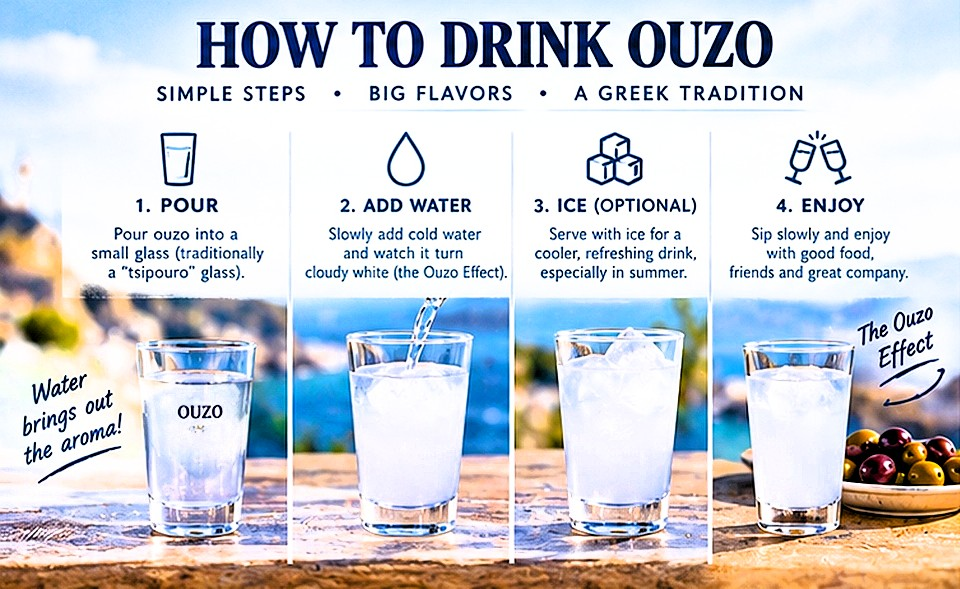
How to drink ouzo by serving it with cold water, optional ice and traditional Greek meze while experiencing the ouzo effect
Ouzo vs. Tsipouro
These are often confused. They are different spirits.
Ouzo
Anise-forward. Botanically flavored. Typically diluted with water.
Tsipouro
A grape-marc spirit with its own Greek regional traditions.
It may be:
-
-
- aniseed
- without anise.
-
The easiest rule: Ouzo tastes like anise. Tsipouro tastes like grape spirit and regional botanicals. Don’t substitute one automatically for the other.
Ouzo vs. Sambuca
Both are anise-flavored spirits. But they’re not the same.
Ouzo
-
-
- Greek
- savory-food oriented
- usually diluted with water
-
Sambuca
Italian: often sweeter, commonly served neat or in cocktails. The flavor relationship is obvious, but the drinking culture is quite different.
Ouzo vs. Pastis
Ouzo and pastis are both anise-rich Mediterranean spirits. But pastis is French. Ouzo is Greek.
EU regulations distinguish them legally, and the ouzo category has specific production requirements involving Greek geographical origin and distilled botanical alcohol.
Pastis generally has a more pronounced licorice/botanical identity and different sweetening rules. Both are excellent with cold water. But they tell very different cultural stories.
What Is the Best Ouzo Brand?
Different bottles emphasize different characteristics.
-
-
- For international recognition: Ouzo 12
- For classic Plomari style: Ouzo Plomari
- For traditional copper-still production: Barbayanni
- For a softer beginner style: Mini
- For Macedonian character: Babatzim
- For regional Tyrnavos identity: Ouzo of Tyrnavos
- For mastiha-driven modern style: METAXA Ouzo
-
The better question is: What kind of ouzo do you like?
What Is the Most Popular Ouzo Brand in the World?
Ouzo 12 officially describes itself as the world’s most popular ouzo and cites an IWSR 2023 report for its No. 1 claim.
Meanwhile, Ouzo Plomari says it is the best-selling ouzo in Greece and reports substantial international exports.
A Euromonitor-based historical Greek-market table reproduced in a later overview showed Mini and Ouzo Plomariou as the two largest brands in 2023, followed by Ouzo 12, Tsantali and Barbayanni.
So there is no single number that should be presented as an unquestioned worldwide ranking.
The safest conclusion is that Ouzo 12, Ouzo Plomari and Mini are among the strongest internationally recognized commercial brands, while Barbayanni and Tsantali are also major names in the Greek category.
Current Ouzo Trends
Ouzo remains strongly connected to its traditional drinking culture, but several developments are worth watching.
1. International distribution
Ouzo Plomari says exports represent 60% of production volume and reach more than 35 countries. Ouzo 12 identifies Germany and Greece as its leading markets.
2. Premium regional identity
Smaller producers are emphasizing:
-
-
- Lesvos
- Tyrnavos
- Chios
- Macedonia
-
and other regional identities.
3. Traditional production methods
Copper stills and repeated distillation remain central to many premium ouzo stories. Barbayanni describes slow second and third distillation, while Plomari uses multiple long distillation stages.
4. Modern cocktail use
METAXA publishes an extensive cocktail collection, while official Armagnac-style cocktail culture demonstrates the broader opportunity for Greek spirits to move into modern mixology.
5. Packaging and limited editions
Premium packaging remains important, especially for travel retail, gifting and collecting. Ouzo Plomari’s recent limited editions are a good example.
Why Lesvos Remains Central to the Ouzo Story
The concentration of major producers on Lesvos is extraordinary. The island’s Geopark lists a long roster of ouzo distilleries, while historical sources have repeatedly highlighted Lesvos as the center of Greek ouzo production. That makes Lesvos particularly interesting for spirits tourism.
A visitor can explore:
-
-
- Plomari
- Mytilene
- traditional distilleries
- ouzeri
- seafood restaurants
- local anise cultivation.
-
Ouzo Plomari itself operates a visitor museum and distillery experience in Plomari, including a tour of its 18 copper stills. For anyone serious about Greek spirits, that is a fascinating destination.
How to Build an Ouzo Tasting
You can create a simple five-bottle tasting:
-
-
- Mini: Start gently.
- Ouzo 12: Classic commercial style.
- Ouzo Plomari: Plomari expression.
- Barbayanni Blue: More concentrated and 46% ABV.
- Idoniko: Mastiha, citrus and herbal notes.
-
Taste each:
-
-
- neat
- with a little water
- with food.
-
This is much more educational than tasting everything neat at full strength.
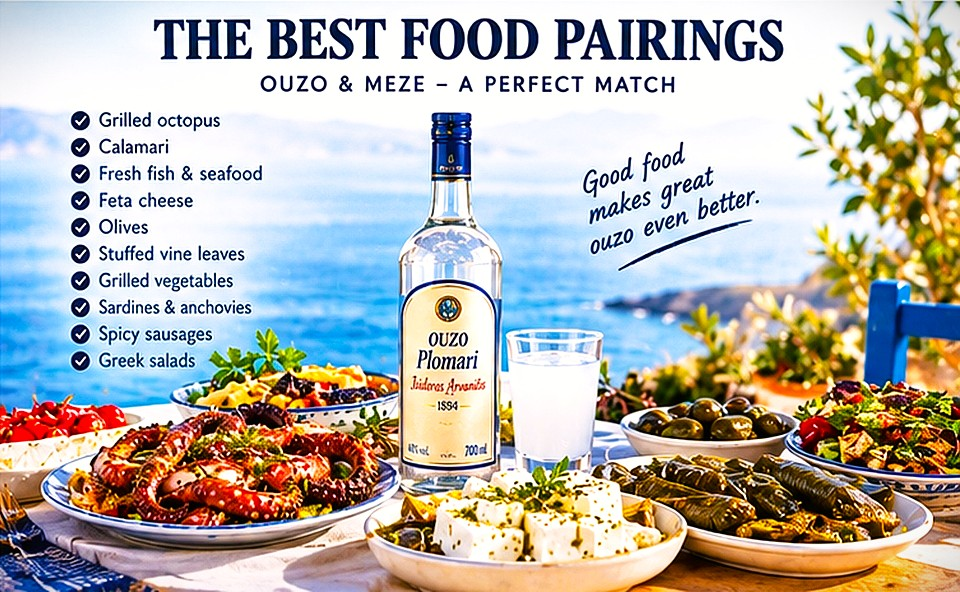
Best ouzo food pairings including grilled octopus, calamari, fresh seafood, feta cheese, olives, dolmades and Greek meze
Frequently Asked Questions
What is the most popular ouzo brand in the world?
Ouzo 12’s official website says it is the world’s No. 1 ouzo according to an IWSR 2023 report. Ouzo Plomari separately says it is the best-selling ouzo in Greece and reports exports to more than 35 countries. Because different sources use different markets and methodologies, there is no single universally accepted global ranking.
What are the best-known ouzo brands?
Ouzo Plomari, Ouzo 12, Mini Mytilinis, Barbayanni and Tsantali are among the best-known commercial Greek ouzo brands.
What is ouzo made from?
Ouzo is an anise-flavored spirit made from agricultural alcohol and botanicals, with recipes commonly involving anise and potentially fennel, Chios mastic and other aromatic ingredients.
Is ouzo made from grapes?
The category is based on agricultural alcohol, and some traditional producers emphasize grape-derived alcohol. Ouzo of Tyrnavos specifically describes its distillate as being made from grapes from the Tyrnavos region.
Why does ouzo turn white with water?
The anise essential oils become less soluble when the alcohol concentration is reduced with water, forming tiny droplets that scatter light. Ouzo Plomari identifies this as the natural “Ouzo Effect.”
Should ouzo be served with water?
Yes. Water is a traditional way of serving ouzo and helps open the aromas.
Should ouzo be served with ice?
It can be. Many drinkers use ice, although some prefer adding cold water first.
Can you drink ouzo neat?
Yes, although it is often enjoyed with water or alongside food.
What food pairs with ouzo?
Seafood, meze, olives, feta, grilled vegetables, fish, octopus, calamari and prawns are excellent choices.
What is the best ouzo for seafood?
Ouzo Plomari, Barbayanni, Ouzo 12 and Idoniko are good starting points.
What is the best ouzo for beginners?
Mini, Ouzo 12 and softer ouzo styles are good introductions.
What is the strongest ouzo?
Some traditional labels reach the upper 40% ABV range. Barbayanni Aphrodite is 48% ABV, while Evzon is 47% and Blue is 46%.
What is the smoothest ouzo?
“Smoothest” is subjective, but Mini, Green-label Barbayanni and several softer commercial styles are good places to begin.
What is the best ouzo from Lesvos?
There is no objective single winner. Plomari, Barbayanni, Mini, Pitsiladi, Veto, Matis and other Lesvos labels provide different styles.
What is the best ouzo from Plomari?
Ouzo Plomari and Barbayanni are two of the most recognized Plomari names. The Athens Guide specifically identifies both among the best-known Greek ouzos.
What is Ouzo 12?
Ouzo 12 is a Greek ouzo brand whose history begins in Constantinople in 1880 and whose name comes from Barrel No. 12. It is now produced in Volos, Greece.
Who owns Ouzo 12?
Ouzo 12 is part of the Campari Group. Campari says it acquired the brand in 1999.
Who owns Ouzo Mini?
Ouzo Mini is part of the Pernod Ricard portfolio; the producer history says Pernod Ricard acquired 95% of EPOM in 1996.
What is Barbayanni?
Barbayanni is a historic family ouzo producer from Plomari, Lesvos, founded in 1860.
What is Ouzo Plomari?
It is the flagship ouzo of Plomari Distillery Isidoros Arvanitis, with a recipe dating to 1894.
What is Idoniko?
Idoniko is an ouzo from Estates Costa Lazaridi in Drama, Macedonia, with an aromatic profile featuring anise, mastiha, citrus, mint and spices.
What is Ouzo of Tyrnavos?
It is a regional ouzo from Tyrnavos made with locally sourced grapes, herbs and star anise in traditional copper stills.
Is ouzo stronger than vodka?
Not necessarily. Bottle strength varies. Many ouzos are in the 38–48% ABV range, while standard vodka is commonly 40% ABV.
Is ouzo stronger than sambuca?
Not necessarily. Both categories contain different products at different strengths.
What is the difference between ouzo and sambuca?
Ouzo is Greek and strongly associated with meze and water service; sambuca is Italian and generally sweeter.
What is the difference between ouzo and pastis?
Both are anise-rich spirits, but ouzo is Greek and has specific protected production rules, while pastis is French and follows different requirements.
What is the difference between ouzo and tsipouro?
Ouzo is anise-flavored; tsipouro is a Greek grape-marc spirit that may or may not contain anise.
Can you use ouzo in cocktails?
Yes. Ouzo can be used in Sours, highballs, spritzes, tonic drinks and other recipes.
What mixer goes with ouzo?
Water is the traditional choice. Soda, tonic, citrus, lemonade and sparkling wine can also work in cocktails.
Can you mix ouzo with tonic?
Yes. A simple ouzo tonic is a refreshing modern serve.
Can you mix ouzo with lemon?
Yes. Lemon is one of the most natural partners for the spirit.
Can you mix ouzo with soda?
Yes. METAXA’s official Ouzo Ritual uses ouzo, ice and a splash of soda water.
Can you mix ouzo with cola?
It is possible, although traditional ouzo drinking usually centers on water and food.
Is ouzo sweet?
Some ouzos are perceived as sweeter than others, but the exact balance depends on the producer’s recipe.
Does ouzo contain sugar?
Recipes and labeling rules vary by product, and the final perceived sweetness can come from the botanical profile as well as formulation.
Is ouzo gluten-free?
This depends on the product and producer rather than the category alone. Check the specific producer’s information.
Is ouzo vegan?
Many ouzos contain only plant-derived ingredients, but verify the specific brand if this matters for you.
How should you store ouzo?
Keep the bottle tightly closed in a cool place away from direct sunlight.
Does ouzo age in the bottle?
No. Ouzo is generally bottled ready to drink and doesn’t mature like an aged whisky or Cognac.
Is ouzo good with grilled fish?
Yes. Seafood is one of the classic pairings.
Is ouzo good with cheese?
Yes. Feta and other salty cheeses pair naturally with the spirit.
Is ouzo good with spicy food?
It can be, particularly with salty, grilled or herb-rich dishes.
What is the best ouzo for a Greek dinner?
Ouzo Plomari, Barbayanni, Ouzo 12, Tsantali or Idoniko are all useful starting points.
What is the best ouzo for a gift?
Ouzo Plomari, Barbayanni and Ouzo 12 are easily recognizable choices, while limited-edition or regional bottles can be more distinctive.
Final Thoughts: The Most Popular Ouzo Brands in the World
Ouzo is one of those spirits that makes much more sense when you understand the culture around it. It isn’t simply an anise-flavored alcoholic drink.
-
-
- It is a social ritual.
- It is a food pairing.
- It is a regional product.
-
And for many Greeks, it is part of the rhythm of everyday life. The category also has a surprisingly deep producer landscape. Start with the major names.
-
-
- Ouzo Plomari brings more than 130 years of history and a distinctive Plomari identity. Its current production centers on traditional copper stills and locally connected ingredients such as Lisvori anise.
- Ouzo 12 represents international scale and a history reaching back to 1880. Its official site cites IWSR 2023 data for its worldwide No. 1 claim, while the brand also recorded 10% sales growth in Greece during 2025.
- Ouzo Mini represents the softer, highly accessible side of the category.
- Barbayanni represents the traditional family-distillery model of Plomari, with multiple 100%-distilled expressions made in small copper stills.
- Tsantali represents another major commercial Greek spirits name.
-
Then there is the second layer.
-
-
- Stoupaki Kazanisto
- Makedoniko
- Babatzim
- Pitsiladi
- Idoniko
- Pilavas
- Veto
- Ouzo of Tyrnavos show how much variety exists outside the best-known international labels.
-
Idoniko is especially interesting because its aromatic profile brings together anise, mastiha, citrus, mint and spices.
Ouzo of Tyrnavos is fascinating because it emphasizes grapes from the Tyrnavos region and has received recent competition recognition.
And then there are dozens of smaller island and regional names.
-
-
- Giannatsi
- Kefi
- Matis
- Lino
- Jivaeri
- Dimino
- Kakitsi
- Apalarina
- Giokarinis
- Kronos
- Matarelli
- Samara
- Smyrnio
- Psaropoula
-
and others.
The Lesvos Geopark’s distillery list demonstrates just how concentrated the island’s ouzo culture remains. That’s the real story behind Greek ouzo. The global category may look simple from a distance: clear spirit + anise + water.
But up close, the differences become fascinating.
-
-
- One producer may emphasize: anise.
- Another: fennel.
- Another: mastiha.
- Another: citrus.
- Another: herbs.
- Another: a dry, powerful finish.
-
And those distinctions become even more obvious when the bottle is served with food.
-
-
- Ouzo and seafood are classic partners.
- Ouzo and feta work.
- Ouzo and olives work.
- Ouzo and grilled vegetables work.
- Ouzo and meze work.
-
That is why you shouldn’t judge ouzo simply as an anise spirit.
-
-
- Try it with food.
- Try different regions.
- Try different producers.
- Try water.
- Try ice.
-
Then compare. A five-bottle tasting of:
-
-
- Mini
- Ouzo 12
- Ouzo Plomari
- Barbayanni
- Idoniko
-
can teach you more about the category than simply buying the most expensive bottle. And don’t overlook the visual ritual. Pour the clear spirit. Add cold water. Watch it turn cloudy. Smell it again. Take a small sip. Then eat something salty.
That is ouzo.
-
-
- It’s not meant to be rushed.
- It is meant to be shared.
-
This is also why ouzo remains so strongly associated with summer.
-
-
- Warm weather.
- Cold water.
- Seafood.
- Conversation.
-
And a small table covered with meze. Yet the category is changing as well. Brands are becoming more international.
-
-
- Ouzo Plomari reports exports to more than 35 countries.
- Ouzo 12 identifies Germany and Greece as key markets.
- METAXA Ouzo are experimenting with new presentations, including an Ouzo Ritual with soda water.
-
And premium producers continue to emphasize traditional copper distillation, local ingredients and heritage. That’s a healthy combination.
-
-
- Tradition gives ouzo its identity.
- Modern presentation gives it new audiences.
-
The result is a category that can appeal to:
-
-
- Greek-food lovers
- cocktail enthusiasts
- anise-spirit drinkers
- travelers
- collectors
-
people simply looking for something different.
-
-
- For a beginner, the easiest path is: Mini → Ouzo 12 → Plomari → Barbayanni.
- For a curious enthusiast: Plomari → Barbayanni → Idoniko → Ouzo of Tyrnavos → smaller Lesvos producers.
- For a collector: limited editions, regional bottles, historic labels, small-producer releases.
- For a cocktail drinker: younger, aromatic ouzo. Combined with: lemon, tonic, soda, ginger or sparkling wine.
- For the food lover: seafood + meze + cold water + ouzo.
-
It is difficult to imagine a more distinctly Greek drinking ritual.
So whether you choose Ouzo Plomari, Ouzo 12, Mini, Barbayanni, Tsantali, Babatzim, Idoniko, Pilavas, Veto or a small regional producer, pay attention to the differences.
The more bottles you taste, the more you’ll realize that ouzo is not one flavor. It is a whole Greek spirits culture expressed through anise, herbs, regional ingredients, copper stills, family recipes and food.
And that is precisely why the world’s most popular ouzo brands continue to attract attention far beyond Greece.