
Blog
Most Popular Absinthe Cocktails in the World: 30 Classic Recipes Every Absinthe Lover Should Try

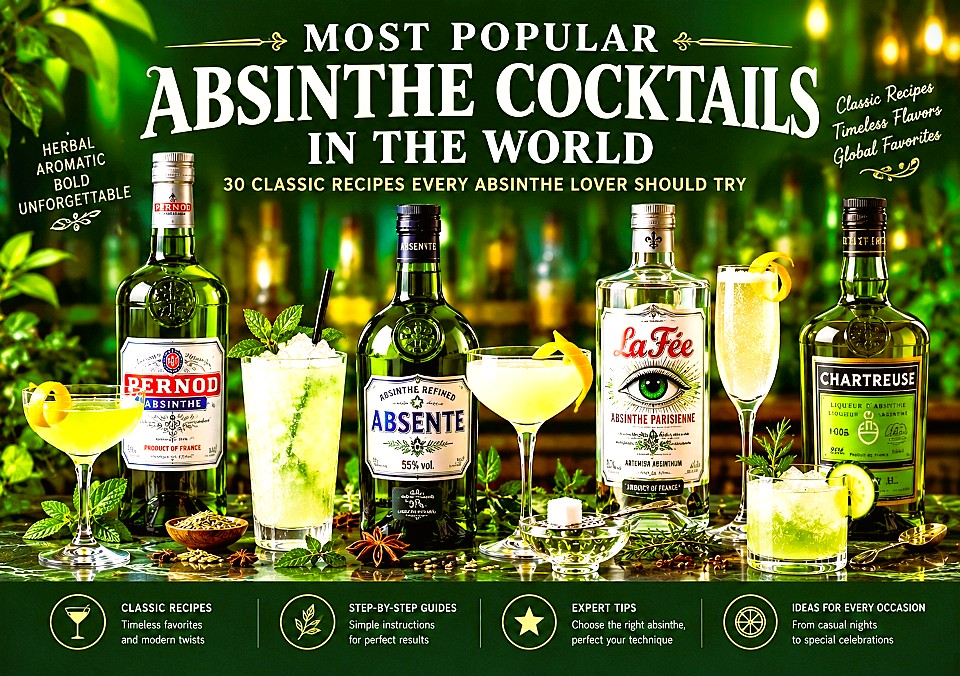
Discover 30 of the most popular and iconic absinthe cocktails in the world, from the Sazerac, Corpse Reviver No. 2 and Absinthe Frappé to Death in the Afternoon, Absinthe Sour, Absinthe Martini and classic French-style absinthe drinks. Learn the recipes, ingredients, preparation methods, best absinthe styles, cocktail variations and tips for making absinthe drinks at home.
Absinthe is one of the most distinctive spirits in the world—and one of the most misunderstood. Its history is surrounded by legends of bohemian Paris, Belle Époque cafés, artists, writers and the famous “green fairy.” Yet modern absinthe has evolved far beyond its historical reputation.
Today, absinthe is an exceptionally versatile cocktail ingredient.
It can be the main spirit in a drink, but it can also function like an aromatic seasoning. A small quantity may be used as a rinse, dash or mist, adding powerful notes of anise, fennel, wormwood and herbs without dominating the entire cocktail. Difford’s Guide specifically identifies these multiple roles for absinthe, including use as a base spirit, aromatic modifier, rinse and mist.
That versatility explains why absinthe continues to appear in classic cocktails.
The Sazerac is perhaps the most famous example. The International Bartenders Association’s current recipe uses absinthe to rinse the glass, followed by Cognac, sugar and Peychaud’s bitters; the IBA also notes that rye whiskey replaced Cognac historically after the American Civil War as Cognac became difficult to obtain.
The Corpse Reviver No. 2 uses only a dash of absinthe, but that tiny quantity adds an unmistakable herbal and anise aroma to a combination of gin, Cointreau, Lillet Blanc and lemon juice.
And then there is the Absinthe Frappé, a drink with a direct historical connection to New Orleans that dates to the 1870s. Modern versions combine absinthe, chilled water, sweetness and crushed ice.
The result is an unusually broad cocktail category. Some absinthe drinks are:
-
-
- strong and spirit-forward
- sweet and refreshing
- bitter and herbal
- citrusy and tart
- sparkling
- creamy
- fruity
- cold, diluted and aromatic.
-
There is also a misconception that making absinthe cocktails requires complicated equipment. In reality, many of the classics require only:
-
-
- a jigger
- a mixing glass or shaker
- ice
- fresh citrus
- a few quality modifiers
- and a bottle of good absinthe.
-
The key is learning how much absinthe to use. Because many absinthes are bottled at approximately 50–70% ABV, a little can go a very long way. The cocktail should be measured carefully, and alcoholic drinks should always be enjoyed responsibly.
This guide brings together 30 of the most popular, influential and interesting absinthe cocktails, combining classic recipes, historical drinks and modern absinthe-centered variations.
Table of Contents
-
-
- What Makes Absinthe So Useful in Cocktails?
- How Much Absinthe Should You Use?
- Best Absinthe Styles for Cocktails
- 30 Most Popular Absinthe Cocktails
- Sazerac
- Corpse Reviver No. 2
- Absinthe Frappé
- Death in the Afternoon
- Absinthe Cocktail
- Absinthe Drip
- Absinthe Sour
- Absinthe Martini
- Absinthe Mojito
- Absinthe & Tonic
- Absinthe Highball
- Absinthe Rickey
- Absinthe Frappe Variation
- Morning Glory Fizz
- Monkey Gland
- Chrysanthemum
- La Louisiane
- Remember the Maine
- Obituary Cocktail
- Necromancer
- White Elephant’s Cocktail
- Tremblement de Terre
- Green Beast
- Absinthe Flip
- Absinthe Daiquiri
- Absinthe Spritz
- Absinthe Sour Variations
- Best Absinthe Cocktails for Beginners
- Best Absinthe Cocktails for Summer
- Best Absinthe Cocktails for Dinner
- Best Absinthe Cocktails for a Home Bar
- How to Make Better Absinthe Cocktails
- Choosing the Right Absinthe
- Current Absinthe Cocktail Trends
- Frequently Asked Questions
- Final Thoughts
-
What Makes Absinthe So Useful in Cocktails?
Absinthe has a unique role in cocktail construction because it can provide an enormous amount of flavor with a very small quantity. Traditional absinthe typically emphasizes:
-
-
- Wormwood
- Anise
- Fennel
- Herbal botanicals
- Citrus
- Mint
- Spice
-
Those aromas are extremely concentrated. That means a cocktail doesn’t necessarily need 30 or 60 ml of absinthe. Sometimes one dash is enough.
The Corpse Reviver No. 2 is the perfect example. The IBA specifies just one dash of absinthe alongside equal 30 ml measures of gin, Cointreau, Lillet Blanc and fresh lemon juice.
The effect is subtle but important. Without absinthe, the cocktail tastes like a citrusy gin drink. With it, the drink acquires an additional layer of:
anise + herbs + bitterness + aroma.
This makes absinthe behave similarly to bitters in some cocktails.
How Much Absinthe Should You Use?
There isn’t one universal amount. The answer depends on the recipe.
As a rinse
-
-
- Use approximately: 5–10 ml
- Swirl it around the inside of a chilled glass, then discard the excess.
-
This is traditional in drinks such as the Sazerac. The IBA’s current recipe specifically calls for rinsing a chilled Old Fashioned glass with absinthe before the cocktail is strained into it.
As a dash
-
-
- Use: a few drops to approximately 1 ml
-
This is ideal when you want aroma rather than a pronounced anise flavor.
As a primary spirit
You may use: 20–30 ml or more. But this is where the choice of absinthe matters most.
-
-
- A strongly wormwood-driven absinthe can dominate quickly.
- A softer, more balanced bottle may work beautifully as the foundation.
-
Best Absinthe Styles for Cocktails
French-style absinthe
Excellent for:
-
-
- Sazerac
- Corpse Reviver No. 2
- Classic absinthe cocktails
-
Typically emphasizes:
wormwood + anise + fennel + herbs
Swiss blanche
Excellent for:
-
-
- Martinis
- Sours
- Delicate cocktails
-
Often cleaner and more subtle.
American craft absinthe
Excellent for:
-
-
- Contemporary cocktails
- Botanical drinks
- Complex sours
-
St. George Absinthe Verte, for example, uses wormwood, fennel and star anise alongside botanicals including mint, tarragon, Genovese basil, lemon balm, hyssop and stinging nettle.
Czech-style absinthe
Can be useful in:
-
-
- Bitter cocktails
- Strong herbal drinks
- Contemporary variations
-
But Czech products can have significantly different profiles from French and Swiss styles.
30 Most Popular Absinthe Cocktails in the World
1. Sazerac
Style: Spirit-forward, herbal, spicy
Ingredients:
-
-
- 50 ml Cognac
- 10 ml absinthe
- 1 sugar cube
- 2 dashes Peychaud’s bitters
- Lemon zest
-
The current IBA recipe calls for using absinthe to rinse the chilled glass rather than retaining the full 10 ml in the finished drink. The IBA also explains that rye whiskey later substituted for Cognac after the Civil War.
Method:
-
-
- Rinse a chilled Old Fashioned glass with absinthe.
- Add crushed ice and set aside.
- Stir Cognac, sugar and Peychaud’s bitters with ice.
- Discard the ice and excess absinthe from the prepared glass.
- Strain the cocktail into the glass.
- Express lemon zest over the drink.
-
Best absinthe: Traditional French-style absinthe.
Best occasion: After dinner or before a meal.
Why it’s famous?
The Sazerac demonstrates how a relatively small amount of absinthe can transform a whiskey or Cognac cocktail.
2. Corpse Reviver No. 2
Style: Tart, citrusy, aromatic
Ingredients:
-
-
- 30 ml gin
- 30 ml Cointreau
- 30 ml Lillet Blanc
- 30 ml fresh lemon juice
- 1 dash absinthe
- Orange zest
-
These proportions are the current IBA specification.
Method:
-
-
- Add everything to a shaker with ice.
- Shake well.
- Strain into a chilled cocktail glass.
- Garnish with orange zest.
-
Best absinthe: A clean, aromatic French or Swiss absinthe.
Why it works?
-
-
- It’s an excellent lesson in balance.
- The citrus is bright.
- The orange liqueur is sweet.
- The Lillet is soft and floral.
- The gin brings botanical character.
- The absinthe adds an herbal top note.
-
3. Absinthe Frappé
Style: Cold, sweet, herbal and refreshing
The Absinthe Frappé is one of the most important absinthe-centered cocktails. Difford’s Guide traces the drink to New Orleans in the early 1870s and identifies a version dating to around 1873–1874.
Ingredients:
A modern recipe can use:
-
-
- 30 ml absinthe
- 10 ml anisette
- 30 ml chilled water
- 5 ml rich sugar syrup
- Crushed ice
- Mint
-
Method:
-
-
- Shake the ingredients with ice.
- Fine strain over crushed ice.
- Churn gently.
- Garnish with mint.
-
Difford’s current version uses these proportions and serves the drink in an Old Fashioned glass over crushed ice.
Best for: Warm summer evenings.
4. Death in the Afternoon
Style: Sparkling, herbal, dry
This famous drink combines absinthe with Champagne or another dry sparkling wine.
Ingredients:
-
-
- 30 ml absinthe
- 90–120 ml chilled Champagne or sparkling wine
- Optional sugar syrup
-
Method:
-
-
- Pour absinthe into a chilled coupe.
- Top slowly with sparkling wine.
-
Why it works?
The sparkling wine dilutes the absinthe while adding:
-
-
- Acidity
- Carbonation
- Elegance
-
Best for: Brunches, celebrations and aperitifs.
Best absinthe: A refined French or Swiss blanche.
5. Absinthe Cocktail
The classic Absinthe Cocktail is one of the simplest ways to explore the spirit. Difford’s Guide’s current version combines absinthe, chilled water and sugar syrup and serves the drink in a chilled coupe.
Ingredients:
-
-
- 30 ml absinthe
- 75 ml chilled water
- 7–8 ml rich sugar syrup
- Mint
-
Method:
-
-
- Shake with ice.
- Fine strain into a chilled coupe.
- Garnish with mint.
-
Flavor: Sweetened herbal complexity.
Best for: Absinthe beginners.
6. Absinthe Drip
The Absinthe Drip is essentially the traditional absinthe service expressed as a cocktail ritual.
Difford’s Guide describes the traditional method as absinthe, sugar and cold water, with the water slowly dripping over the sugar.
Ingredients:
-
-
- 30 ml absinthe
- 1 sugar cube
- 90–150 ml chilled water
-
Method:
-
-
- Pour absinthe into the glass.
- Place sugar on an absinthe spoon.
- Slowly drip cold water over the sugar.
- Watch the louche develop.
-
Best for: Traditionalists.
Pro tip: Don’t rush. The slow addition of water is part of the experience.
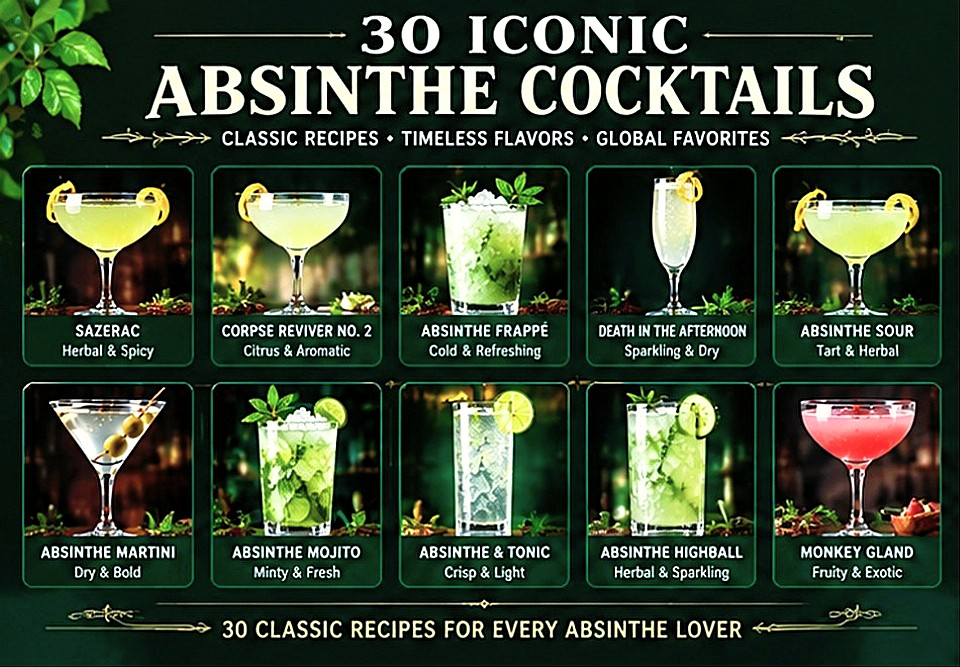
30 iconic absinthe cocktails including Sazerac, Corpse Reviver No. 2, Absinthe Frappé, Death in the Afternoon, Absinthe Sour, Absinthe Martini and Absinthe Mojito
7. Absinthe Sour
Style: Tart, herbal, creamy
Ingredients:
-
-
- 45 ml absinthe
- 25 ml fresh lemon juice
- 15 ml simple syrup
- Optional egg white
- 2 dashes Creole-style bitters
-
Method:
-
-
- Dry shake if using egg white.
- Add ice.
- Shake again.
- Double strain into a chilled coupe.
-
Best for: Experienced absinthe drinkers.
Flavor: Think:
lemon + anise + herbs + bitters
8. Absinthe Martini
Style: Dry, herbal, spirit-forward
Difford’s Guide includes an Absinthe Martini using dry gin, dry vermouth and absinthe.
Ingredients:
-
-
- 45 ml dry gin
- 15 ml dry vermouth
- 5 ml absinthe
-
Method:
-
-
- Stir with ice.
- Strain into a chilled Martini glass.
-
Garnish: Lemon twist.
Best gin: Classic London Dry.
Best for: Martini enthusiasts.
9. Absinthe Mojito
Style: Minty, citrusy, herbal
Difford’s Guide lists an Absinthe Mojito among its absinthe-centered cocktails, combining lime, mint, absinthe and lemonade.
Ingredients:
-
-
- 30 ml absinthe
- 20 ml fresh lime juice
- Fresh mint
- 10 ml simple syrup
- Lemonade or soda
- Crushed ice
-
Method:
-
-
- Gently press mint with lime and syrup.
- Add absinthe and ice.
- Top with lemonade.
- Stir gently.
-
Best for: Summer.
10. Absinthe & Tonic
Style: Bitter, refreshing, herbal
Ingredients:
-
-
- 20–30 ml absinthe
- 100–150 ml tonic water
- Ice
- Lemon peel
-
Method:
-
-
- Fill a highball with ice.
- Add absinthe.
- Top with tonic.
- Stir gently.
-
Best for: Drinkers who want a lighter way to experience absinthe.
Pro tip: Use a dry tonic. A very sweet tonic can exaggerate the licorice notes.
11. Absinthe Highball
Style: Herbal, sparkling, refreshing
Ingredients:
-
-
- 30 ml absinthe
- 15 ml lemon juice
- 10 ml simple syrup
- 90 ml soda water
- Ice
-
Method:
-
-
- Shake absinthe, lemon and syrup with ice.
- Strain into a tall glass.
- Top with soda.
-
Best garnish: Lemon peel and mint.
Best occasion: Summer gatherings.
12. Absinthe Rickey
Style: Dry, tart, refreshing
A Rickey normally consists of spirit, lime and soda. Using absinthe produces a much more herbal interpretation.
Ingredients:
-
-
- 30 ml absinthe
- 25 ml fresh lime juice
- Soda water
- Ice
-
Method:
-
-
- Build over ice.
- Add lime juice and absinthe.
- Top with soda.
-
Best for: Hot weather.
Pro tip: Don’t add sugar. The dry profile is the point.
13. Absinthe Frappé with Mint
This variation emphasizes the cooling character of mint.
Ingredients:
-
-
- 30 ml absinthe
- 15 ml chilled water
- 10 ml sugar syrup
- Fresh mint
- Crushed ice
-
Method:
-
-
- Shake.
- Pour over crushed ice.
- Add fresh mint.
-
Best for: Outdoor summer entertaining.
The historical Absinthe Frappé was strongly associated with New Orleans and remained popular as an intensely chilled drink.
14. Morning Glory Fizz
Style: Citrus, refreshing, complex
The Morning Glory Fizz is an old-school cocktail where a small quantity of absinthe can provide an important aromatic element.
Typical ingredients:
-
-
- Scotch whisky
- Lemon
- Lime
- Sugar
- Egg white
- Absinthe
- Soda
-
Method:
-
-
- Shake the ingredients vigorously.
- Strain into a chilled tall glass.
- Top with soda.
-
Why use absinthe?
Because the herbal aroma cuts through the smoky whisky and citrus.
Best for: Classic cocktail enthusiasts.
15. Monkey Gland
Style: Fruity, citrusy, herbal
The IBA’s recipe includes:
-
-
- 45 ml dry gin
- 45 ml fresh orange juice
- 1 tablespoon absinthe
- 1 tablespoon grenadine
-
Shake with ice and strain into a chilled cocktail glass. (iba-world.com)
Flavor:
-
-
- Orange
- Juniper
- Sweet fruit
- Anise
-
Best for: Adventurous drinkers.
16. Chrysanthemum
Style: Herbal, floral, lightly sweet
The classic Chrysanthemum cocktail uses:
-
-
- Dry vermouth
- Benedictine
- Absinthe
-
A typical modern interpretation is:
-
-
- 60 ml dry vermouth
- 30 ml Benedictine
- 2–3 dashes absinthe
-
Method:
-
-
- Stir with ice.
- Strain into a chilled coupe.
-
Best for: Low-proof aperitif drinking.
Why it’s interesting?
The cocktail demonstrates how absinthe can play the role of a botanical modifier without becoming the base spirit.
17. La Louisiane
Style: Spicy, herbal, rich
A classic New Orleans cocktail.
Ingredients:
-
-
- Rye whiskey
- Sweet vermouth
- Benedictine
- Peychaud’s bitters
- Absinthe
-
Method:
-
-
- Stir with ice.
- Strain into a chilled cocktail glass.
-
Best for: Negroni and Manhattan drinkers looking for something more herbal.
18. Remember the Maine
Style: Rich, spicy, bittersweet
Ingredients:
-
-
- Rye whiskey
- Sweet vermouth
- Cherry liqueur
- Absinthe
-
Method:
-
-
- Stir with ice.
- Strain into a chilled coupe.
-
Flavor profile:
-
-
- Rye spice
- Cherry
- Sweet vermouth
- Anise
-
Best for: Whiskey lovers.
19. Obituary Cocktail
Style: Dry, bitter, intense
This is essentially a highly spirit-forward Martini variation.
Ingredients:
-
-
- Gin
- Dry vermouth
- Absinthe
-
Suggested ratio:
-
-
- 60 ml gin
- 30 ml dry vermouth
- 5 ml absinthe
-
Method:
-
-
- Stir with ice.
- Strain into a chilled cocktail glass.
-
Best for: Serious Martini drinkers.
Pro tip: Use a softer absinthe if you’re new to the combination.
20. Necromancer
Style: Herbal, citrusy, sweet
The Necromancer is a modern cocktail combining:
-
-
- Gin
- St-Germain
- Lemon juice
- Ginger syrup
- Absinthe
-
Method:
-
-
- Shake with ice.
- Fine strain into a chilled cocktail glass.
-
Why it works?
The floral elderflower balances the powerful herbal character of absinthe.
21. White Elephant’s Cocktail
Style: Rich, aromatic, classic
This old cocktail brings together absinthe with other traditional liqueurs and modifiers.
Best for: Historical cocktail exploration.
Flavor:
-
-
- Anise
- Herbs
- Sweet liqueur
- Spice
-
These older cocktails are particularly interesting for people who want to explore the historical role of absinthe beyond the Sazerac.
22. Tremblement de Terre
Style: Powerful, rich, aromatic
The name translates roughly as “earthquake.” The cocktail traditionally combines:
-
-
- Absinthe
- Cognac
-
and is usually diluted and served chilled.
Suggested modern version
-
-
- 30 ml absinthe
- 30 ml Cognac
- Ice
-
Method:
-
-
- Shake or stir depending on interpretation.
-
Best for: Experienced drinkers. Because both spirits can be high-proof, this is not a beginner cocktail.
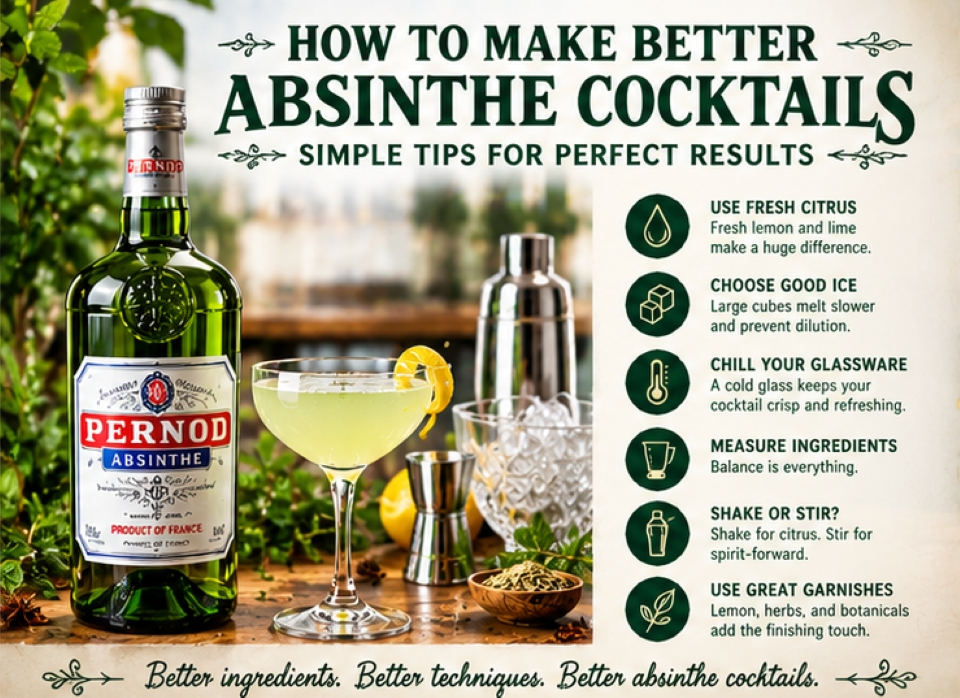
How to make better absinthe cocktails using fresh citrus, quality ice, chilled glassware, measured ingredients, proper shaking and stirring techniques
23. Green Beast
Style: Refreshing, citrusy, herbal
The Green Beast is an absinthe-based long drink.
Ingredients:
-
-
- 30 ml absinthe
- 30 ml fresh lime juice
- 15 ml simple syrup
- 90 ml chilled water
- Cucumber
- Ice
-
Method:
-
-
- Shake absinthe, lime and syrup.
- Pour over ice.
- Add water.
- Garnish with cucumber.
-
Best for: Summer drinking.
24. Absinthe Flip
Style: Rich, creamy, dessert-like
Ingredients:
-
-
- 30 ml absinthe
- 15 ml sweet vermouth
- 1 whole egg
- 10 ml simple syrup
- Nutmeg
-
Method:
-
-
- Dry shake vigorously.
- Add ice.
- Shake again.
- Strain into a chilled coupe.
- Grate nutmeg over the top.
-
Best for: After dinner.
Pro tip: The egg changes the absinthe dramatically, turning an intense botanical spirit into a richer, softer drink.
25. Absinthe Daiquiri
Style: Tart, herbal, tropical
Ingredients:
-
-
- 30 ml white rum
- 20 ml absinthe
- 25 ml lime juice
- 15 ml simple syrup
-
Method:
-
-
- Shake thoroughly with ice.
- Fine strain into a chilled coupe.
-
Why it works?
Rum provides sweetness and body. Lime provides acidity. Absinthe adds herbal depth.
Best for: Summer.
26. Absinthe Spritz
Style: Light, sparkling, herbal
Ingredients:
-
-
- 20 ml absinthe
- 15 ml elderflower liqueur
- 90 ml sparkling wine
- 30 ml soda water
- Ice
-
Method:
-
-
- Build over ice.
- Add absinthe and elderflower.
- Top with sparkling wine.
- Finish with soda.
- Garnish
- Lemon peel and mint.
-
Best for: Brunch and aperitivo.
27. Absinthe Sour with Grapefruit
Style: Bitter, tart, aromatic
Ingredients:
-
-
- 35 ml absinthe
- 25 ml grapefruit juice
- 15 ml lemon juice
- 15 ml simple syrup
- Optional egg white
-
Method:
-
-
- Dry shake if using egg white.
- Shake again with ice.
- Double strain.
-
Flavor: The grapefruit’s bitterness works beautifully with wormwood.
Best for: Fans of bitter cocktails.
28. Absinthe & Ginger Ale
Style: Spicy, sweet, refreshing
Difford’s Guide lists an Absinthe Spider Highball using absinthe, aromatic bitters and ginger ale, illustrating how ginger can soften and complement absinthe’s herbal intensity.
Easy version:
-
-
- 30 ml absinthe
- 100–120 ml ginger ale
- 2 dashes aromatic bitters
- Ice
- Lime
-
Method:
-
-
- Build over ice.
- Top with ginger ale.
- Add bitters.
-
Best for: Casual home-bar drinking.
29. Absinthe Cocktail with Anisette
Ingredients:
-
-
- 30 ml absinthe
- 10 ml anisette
- 60 ml chilled water
- 5 ml sugar syrup
- Lemon twist
-
Method:
-
-
- Shake with ice.
- Fine strain into a chilled coupe.
-
Flavor: Very aromatic and strongly anise-driven.
Best for: Absinthe enthusiasts.
30. Absinthe & Champagne
Style: Elegant, sparkling, aromatic
This is one of the simplest luxury-style absinthe drinks.
Ingredients:
-
-
- 10–15 ml absinthe
- 90–120 ml very cold Champagne or dry sparkling wine
-
Method:
-
-
- Add absinthe to a chilled flute or coupe.
- Top slowly with sparkling wine.
-
Best garnish: Lemon twist.
Best occasion: Celebrations, New Year’s Eve and sophisticated dinner parties.
Best Absinthe Cocktails for Beginners
If you’re new to absinthe, don’t start with the strongest drink. Start with a cocktail where absinthe is balanced by other ingredients.
Best choices
Corpse Reviver No. 2
The absinthe is only a dash.
Sazerac
The rinse is aromatic without making the whole drink taste overwhelmingly anise-heavy.
Death in the Afternoon
Sparkling wine softens the spirit.
Absinthe Frappé
Cold water, sweetness and crushed ice make the drink more approachable.
Absinthe & Tonic
An easy long drink.
Best Absinthe Cocktails for Experienced Drinkers
Once you’ve become accustomed to absinthe’s botanical character, try:
-
-
- Absinthe Sour
- Absinthe Martini
- Obituary
- Tremblement de Terre
- Absinthe Flip
- Absinthe Daiquiri
-
These drinks allow the absinthe to become a much more important part of the flavor profile.
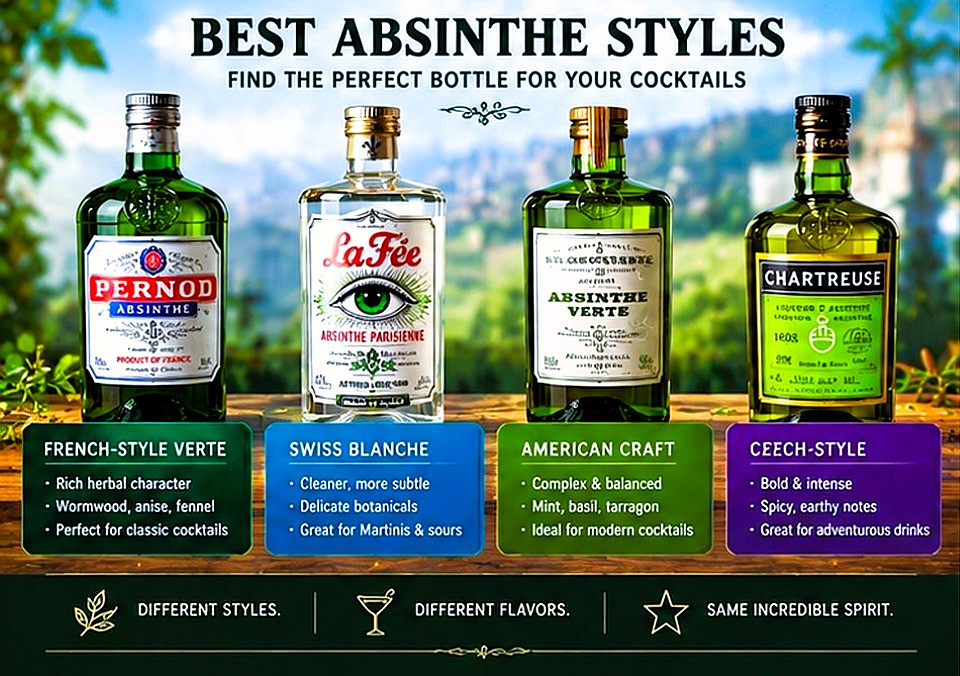
Best absinthe styles for cocktails including French-style verte, Swiss blanche, American craft and Czech-style absinthe
Best Absinthe Cocktails for Summer
For warm weather, choose drinks with:
citrus + crushed ice + carbonation + herbs
Excellent options include:
-
-
- Absinthe Frappé
- Absinthe Mojito
- Green Beast
- Absinthe & Tonic
- Absinthe Highball
- Absinthe Rickey
- Absinthe Spritz
- Absinthe Daiquiri
-
The Absinthe Frappé has a particularly strong historical connection with warm-weather drinking because the drink was designed around heavy chilling and crushed ice.
Best Absinthe Cocktails for Dinner
Choose more structured drinks.
Before dinner
-
-
- Absinthe & Tonic
- Death in the Afternoon
- Corpse Reviver No. 2
-
With dinner
-
-
- Sazerac
- Absinthe Martini
- La Louisiane
-
After dinner
-
-
- Absinthe Flip
- Obituary
- Tremblement de Terre
-
Best Absinthe Cocktails for a Home Bar
You don’t need dozens of ingredients.
With:
-
-
- Absinthe
- Gin
- Rye
- Cognac
- Dry vermouth
- Sweet vermouth
- Lemon
- Lime
- Sugar
- Bitters
- Sparkling wine
- Soda
-
you can make a remarkable range of absinthe cocktails. The most useful first five are:
-
-
- Sazerac
- Corpse Reviver No. 2
- Absinthe Frappé
- Absinthe Martini
- Death in the Afternoon
-
How to Make Better Absinthe Cocktails
1. Measure the absinthe
This is the most important rule. Absinthe is powerful. A few extra milliliters can completely change a cocktail.
2. Chill aggressively
Absinthe cocktails are often much better when served cold. Use:
-
-
- cold glassware
- cold ingredients
- good ice
-
3. Use fresh citrus
Fresh lemon and lime make an enormous difference.
4. Use good dilution
Do not treat dilution as a mistake. Water opens up aromas and reduces alcohol intensity.
5. Match your absinthe to the recipe
A highly bitter absinthe might be perfect for a rinse. A smoother absinthe may be preferable when it forms the base.
6. Don’t over-garnish
Absinthe already has an enormous aromatic profile. A simple lemon peel or mint leaf is often enough.
Rinse vs. Dash vs. Base Spirit
Understanding these three roles will make you much better at absinthe cocktails.
Absinthe rinse
Best for:
-
-
- Sazerac
- Corpse Reviver variations
- Spirit-forward cocktails
-
The goal is aroma.
Absinthe dash
Best for:
-
-
- Corpse Reviver No. 2
- classic sours
- Martini variations
-
The goal is subtle complexity.
Absinthe as a base
Best for:
-
-
- Absinthe Frappé
- Absinthe Sour
- Absinthe Drip
- Tremblement de Terre
-
Here the absinthe becomes the star.
How the Louche Changes Cocktails
The louche is not only a visual effect. When water is added, essential oils from anise and other botanicals become less soluble and form a cloudy suspension. This changes the aroma and texture.
You may notice more:
-
-
- Anise
- Fennel
- Mint
- Herbs
- Citrus
-
This is why the traditional Absinthe Drip remains such an important way to experience the spirit. Difford’s Guide identifies the slow addition of water as the traditional preparation and emphasizes the importance of patience while the sugar dissolves and the drink balances.
Choosing the Right Absinthe for Cocktails
For Sazerac
Look for:
-
-
- French verte
- traditional herbal style
-
For Corpse Reviver No. 2
Look for:
-
-
- clean and aromatic
-
For Absinthe Frappé
Look for:
-
-
- balanced anise + herbs
-
For Martini
Look for:
-
-
- elegant + dry
-
A Swiss blanche can be particularly interesting.
For Absinthe Sour
Look for:
-
-
- herbal + bitter + complex
-
For summer drinks
Look for:
-
-
- fresh + minty + citrus-forward
-
Absinthe and Modern Cocktail Culture
Absinthe has moved far beyond its old reputation as a mysterious historical drink. Modern bartenders now use it in several distinct ways.
Difford’s Guide describes absinthe as a base spirit, aromatic modifier, rinse and mist, which explains why one bottle can have applications across a large cocktail menu.
This is particularly relevant to today’s cocktail bars because small amounts of absinthe can add a strong aromatic signature without requiring an expensive pour.
The result is a spirit that behaves almost like a liquid seasoning. That makes it valuable even when the customer isn’t specifically ordering “an absinthe cocktail.”
The Sazerac Remains the Essential Absinthe Cocktail
If you only learn one absinthe cocktail, learn the Sazerac. The combination of:
whiskey or Cognac + sugar + bitters + absinthe
is a perfect illustration of what absinthe contributes. It doesn’t necessarily dominate. Instead, it gives the cocktail a recognizable aromatic edge.
The IBA’s current recipe preserves the absinthe-rinse technique and also explains the historical transition from Cognac to rye whiskey.
That historical flexibility is part of the Sazerac’s appeal. It is simultaneously:
-
-
- a New Orleans classic
- a whiskey cocktail
- a Cognac cocktail
- an absinthe cocktail.
-
The Corpse Reviver Shows the Opposite Approach
The Corpse Reviver No. 2 demonstrates that absinthe doesn’t need to be the main ingredient. The current IBA recipe uses only one dash. Yet the absinthe still matters. That’s an important lesson for anyone building cocktails at home:
more absinthe does not automatically mean more flavor.
Sometimes one dash is exactly right.
Current Absinthe Cocktail Trends
The modern absinthe scene is developing in several directions.
1. Historic cocktails are returning
Bartenders are revisiting recipes that disappeared from menus for decades.
2. Absinthe is being used as a modifier
Instead of using it as the principal spirit, bartenders use:
-
-
- rinses
- mists
- dashes
- and tiny additions.
-
3. Highballs are becoming more important
Long drinks such as:
-
-
- Absinthe & Tonic
- Absinthe Highball
-
and ginger-based drinks make the spirit more approachable.
4. Fresh botanicals are increasingly important
Mint, basil, cucumber, citrus and herbs can soften absinthe’s intensity.
5. Modern cocktail culture is moving beyond myths
The drink is increasingly evaluated on:
-
-
- quality
- botanical balance
- distillation
- recipe design
- historical authenticity
-
rather than the old “green fairy” mythology.
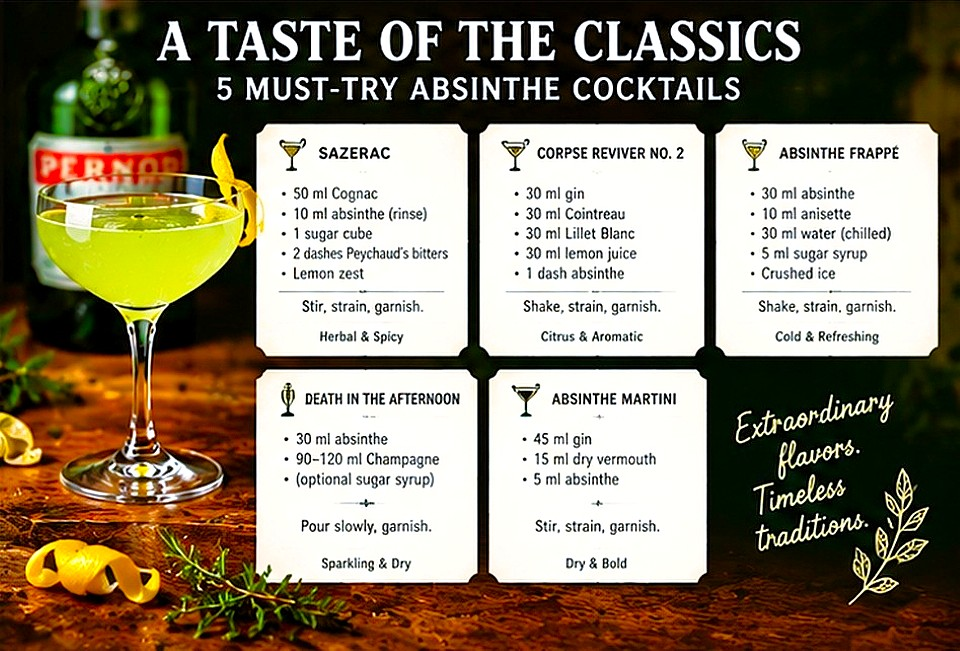
Five must-try absinthe cocktails including Sazerac, Corpse Reviver No. 2, Absinthe Frappé, Death in the Afternoon and Absinthe Martini with recipes
Frequently Asked Questions
What is the most popular absinthe cocktail in the world?
There is no definitive worldwide ranking specifically for absinthe cocktails. The Sazerac is arguably the most internationally famous classic in which absinthe plays a major role, while Corpse Reviver No. 2 and Absinthe Frappé are also highly recognizable.
What is the best absinthe cocktail for beginners?
The Corpse Reviver No. 2, Sazerac, Death in the Afternoon and Absinthe Frappé are excellent starting points because absinthe is balanced by other ingredients or diluted.
What is the classic absinthe cocktail?
The Sazerac is one of the most important classic cocktails featuring absinthe. The traditional absinthe service itself can also be considered a foundational absinthe drink.
What is a Sazerac?
A classic New Orleans cocktail traditionally built around Cognac or rye whiskey, sugar, Peychaud’s bitters and an absinthe rinse. The current IBA version uses Cognac.
What is Corpse Reviver No. 2?
It combines equal parts gin, Cointreau, Lillet Blanc and fresh lemon juice with a dash of absinthe.
What is Absinthe Frappé?
It is a chilled absinthe cocktail historically associated with New Orleans and dating to the 1870s. Modern recipes commonly combine absinthe, water, sweetness and crushed ice.
What is Death in the Afternoon?
A classic-style drink that combines absinthe with Champagne or dry sparkling wine.
Can you drink absinthe in cocktails?
Yes. Absinthe is especially useful in cocktails because a small amount can contribute substantial botanical aroma.
How much absinthe should you put in a cocktail?
It depends on the recipe. A rinse or dash may use only a few milliliters or less, while an absinthe-based cocktail may use 20–30 ml or more.
Should absinthe cocktails be shaken or stirred?
Citrus-based drinks are generally shaken, while spirit-forward drinks such as the Sazerac and Absinthe Martini are generally stirred or otherwise prepared without shaking. The IBA Sazerac recipe specifically calls for stirring the remaining ingredients over ice.
What is the best gin for Corpse Reviver No. 2?
A crisp London Dry gin works particularly well because its juniper and citrus character complements the lemon and orange liqueur.
What is the best whiskey for a Sazerac?
Rye whiskey is an excellent choice for a spicy, structured version, while Cognac produces the traditional style reflected in the IBA recipe.
Can I use rye whiskey instead of Cognac in a Sazerac?
Yes. Rye became associated with the drink historically after Cognac became difficult to obtain.
Should I burn absinthe in a cocktail?
The traditional absinthe ritual does not require burning the spirit. Cold water and gradual dilution are the classic approach.
Can you make an Absinthe Martini?
Yes. Absinthe can be combined with dry gin and dry vermouth for an herbal Martini variation. Difford’s Guide lists an Absinthe Martini among its absinthe cocktail recipes.
What is an Absinthe Sour?
A sour that uses absinthe as the base spirit, usually combined with lemon juice, sugar syrup and optionally egg white and bitters.
What is the best absinthe for cocktails?
A balanced absinthe with clear anise, fennel and herbal notes is generally the most versatile. Extremely bitter or aggressive bottles can be harder to use.
Is French absinthe good for cocktails?
Yes. French-style absinthe is especially useful in classic cocktails such as the Sazerac and Corpse Reviver No. 2.
Is Swiss absinthe good for cocktails?
Yes. Swiss blanche styles can be excellent in Martinis and delicate cocktails where a cleaner botanical profile is desirable.
Can absinthe be used with tonic?
Yes. An Absinthe & Tonic is a relatively simple long drink that uses tonic water to dilute the spirit and add bitterness.
Can absinthe be mixed with ginger ale?
Yes. Ginger’s spice and sweetness can work well with absinthe’s herbal and anise character. Difford’s Guide includes an absinthe-and-ginger highball among its cocktail examples.
What garnish works with absinthe cocktails?
Lemon, orange, lime, mint and cucumber are all useful choices, depending on the recipe.
What is the best absinthe cocktail for summer?
Absinthe Frappé, Green Beast, Absinthe Mojito, Absinthe & Tonic and Absinthe Highball are excellent warm-weather options.
What is the strongest absinthe cocktail?
High-proof spirit-forward drinks such as Tremblement de Terre or concentrated absinthe-based drinks can be extremely strong. Measure carefully and drink responsibly.
Does water reduce the strength of absinthe?
Yes. Adding water dilutes the alcohol concentration, and it also causes the characteristic louche by reducing the solubility of essential oils.
What is the louche?
The louche is the cloudy transformation that occurs when cold water is added to absinthe.
Why does absinthe turn cloudy?
Essential oils from ingredients such as anise and fennel become less soluble as water dilutes the alcohol, producing a cloudy suspension.
Does absinthe always have to be green?
No. Blanche absinthe is clear, while verte absinthe is traditionally green.
Is absinthe a liqueur?
Traditional absinthe is generally classified as a distilled spirit rather than a sweet liqueur.
Is absinthe safe in cocktails?
Licensed and legally marketed absinthe is regulated according to the jurisdiction where it is sold. Because many bottles are high in alcohol, servings should be measured and consumed responsibly.
Does modern absinthe cause hallucinations?
Modern regulated absinthe should not be treated as a hallucinogenic drink. The famous reputation surrounding absinthe is rooted heavily in historical mythology and sensationalism.
Can absinthe replace bitters?
In some cocktails, a dash of absinthe can provide a similar aromatic function, but absinthe and bitters are not interchangeable in every recipe.
Can you use too much absinthe?
Absolutely. Because the spirit is highly aromatic, an excess can overwhelm a drink with anise, wormwood and alcohol.
Final Thoughts: The World’s Most Popular Absinthe Cocktails
Absinthe cocktails are a fascinating intersection of history, spirits, botany and modern mixology. Few other spirits can play so many different roles.
-
-
- A tiny amount can transform a cocktail.
- A rinse can perfume a glass.
- A dash can add anise and herbal complexity.
- A mist can provide an aromatic first impression.
- Or the spirit can become the foundation of the drink itself.
-
That’s what makes absinthe so useful behind the bar. The Sazerac demonstrates the power of an absinthe rinse.
-
-
- Corpse Reviver No. 2 proves that a single dash can matter.
- Absinthe Frappé shows how the spirit can become the center of a refreshing long drink.
- Death in the Afternoon demonstrates how sparkling wine can transform absinthe into an elegant celebratory drink.
-
Then there are the less familiar classics.
-
-
- La Louisiane
- Remember the Maine
- Chrysanthemum
- Obituary
- Morning Glory Fizz
- and Monkey Gland
-
all reveal different sides of absinthe. Modern bartenders have taken the category even further. Today, you can find absinthe combined with:
-
-
- ginger
- cucumber
- basil
- mint
- grapefruit
- elderflower
- sparkling wine
- tonic
- and fresh citrus.
-
That means there is an absinthe cocktail for almost every palate. If you’re a beginner, don’t start with the most intense absinthe you can find. Start with a balanced cocktail.
-
-
- Try the Corpse Reviver No. 2.
- Then taste a Sazerac.
- Then try an Absinthe Frappé.
-
You’ll begin to understand the difference between:
-
-
- absinthe as a seasoning
- absinthe as the main spirit.
-
Then move into the more serious drinks.
-
-
- Try an Absinthe Martini.
- Try an Absinthe Sour.
- Try an Obituary.
-
Then explore the historic New Orleans cocktails. The deeper you go, the more interesting the category becomes. And that’s perhaps the biggest misconception surrounding absinthe. It isn’t simply a mysterious green drink from old paintings. It’s a remarkably sophisticated botanical spirit.
The current cocktail world recognizes that. Modern bar guides use absinthe as a base, rinse, modifier and aromatic mist. Historic cocktails continue to be rediscovered. Traditional serving methods remain popular.
And specialist producers are creating everything from classic French verte to clear Swiss blanche and modern American craft absinthe.
The result is a category that sits comfortably between:
-
-
- spirits history
- craft distilling
- cocktail culture
- and modern gastronomy.
-
The key to making great absinthe cocktails is simple:
-
-
- measure carefully
- use fresh ingredients
- keep drinks cold
- understand dilution
- choose the right absinthe
- and respect the spirit’s intensity.
-
You don’t need a complicated home bar with one good bottle of absinthe, gin, whiskey, Cognac, vermouth, citrus, sugar, bitters and sparkling wine, you can explore an enormous range of recipes. Start with the classics. Then experiment.
-
-
- Try a Sazerac with rye.
- Try one with Cognac.
-
Compare a French verte with a Swiss blanche. Use a tiny absinthe rinse in a Martini. Try a dash in a Corpse Reviver. Make an Absinthe Frappé on a hot summer evening. Then try a sparkling Absinthe & Champagne drink for a celebration. You’ll quickly discover that the most interesting question isn’t:
“Do I like absinthe?” “Which style of absinthe cocktail do I like?”
-
-
- Maybe you prefer the crispness of a Sazerac.
- Maybe the citrus of a Corpse Reviver.
- Maybe the refreshing chill of an Absinthe Frappé.
- Maybe a sparkling Death in the Afternoon.
- Maybe you want something intensely herbal.
- Maybe you prefer something sweet and tropical.
-
That flexibility is what keeps absinthe relevant. And it is why the spirit continues to find a place on serious cocktail menus around the world.
-
-
- So pour carefully.
- Use good ingredients.
- Respect the history.
- And explore the recipes one drink at a time.
-