
Blog
Most Popular Grappa Cocktails in the World: 30 Italian Grappa Recipes to Try

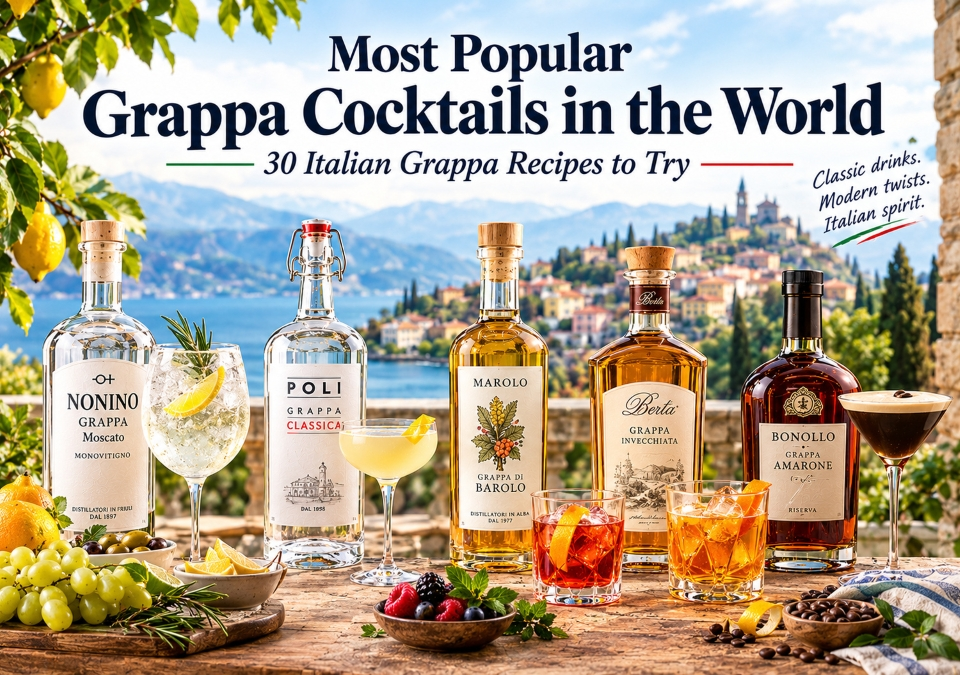
Most Popular Grappa Cocktails in the World
Discover 30 popular grappa cocktails from Italy and around the world, including Grappa Tonic, Grappa Sour, Grappa Spritz, Grappa Espresso, Basil Smash, Margarita-style drinks, coffee cocktails, modern Italian highballs and contemporary recipes inspired by leading grappa producers. Learn which grappa is best for cocktails, how to mix grappa with tonic, citrus, coffee and sparkling wine, and which grappa drinks are best for summer, dinner and after-dinner occasions.
Grappa has spent generations being associated with the end of an Italian meal. Pour a little into a small glass. Take a sip. Perhaps follow it with coffee. But the modern grappa world has become much larger than that.
Italian producers and international bartenders increasingly use grappa in highballs, sours, spritzes, coffee drinks, herbal cocktails and twists on established classics. Nonino maintains an extensive cocktail library containing dozens of grappa and distillate-based creations, while Poli publishes a dedicated collection of contemporary grappa cocktails that includes tonic drinks, sours, spritz-style serves and classic-inspired twists.
This is an important development because grappa has something distinctive to bring to a cocktail. It isn’t neutral.
Its aroma can be grapey, floral, herbal, fruity, peppery, spicy or wood-driven, depending on the grape, distillation and maturation.
-
-
- A young Moscato grappa may bring floral fruit.
- A Prosecco-derived grappa can offer a bright, aromatic profile.
- A Nebbiolo-based grappa can provide deeper grape and spice character.
-
An aged grappa can contribute vanilla, caramel, toast, dried fruit and oak. That gives a bartender many different directions. And Italy’s producers are actively exploring them.
Nonino’s current cocktail library includes NoninoTonic, Nonino Sour, Nonino Espresso, Nonino Basil Smash, Nonino Ginger, Moscato NoninoTonic, Supernova, Black Vino, Giannola 38, Sangria Nonino and many more.
Poli similarly presents a dedicated collection of grappa-oriented drinks and notes that grappa can now be served cold, mixed, shaken and paired with contrasting flavors rather than being restricted to a traditional after-dinner role.
There is even a very current example: in February 2026, Charles Schumann created Tomodachi, combining aged Nonino grappa with sake, amber vermouth and Amaro Nonino Quintessentia. So the cocktail story isn’t theoretical. It is happening now.
This guide brings together 30 popular, notable and practical grappa cocktails, combining producer-published drinks, established cocktail formats and clearly labeled adaptations.
There is no single authoritative worldwide ranking of grappa cocktails, so this is a curated guide rather than an official sales ranking.
Table of Contents
-
-
- What Is Grappa?
- Why Grappa Works in Cocktails
- What Does Grappa Taste Like?
- Which Grappa Is Best for Cocktails?
- Young vs. Aged Grappa for Cocktails
- How to Choose Grappa for a Recipe
- 30 Most Popular Grappa Cocktails
- Grappa Tonic
- Moscato Grappa Tonic
- Grappa Sour
- Nonino Basil Smash
- Grappa Espresso
- Nonino Ginger
- Grappa Spritz
- Grappa Highball
- Grappa Collins
- Grappa Rickey
- Grappa Mojito
- Grappa Margarita
- Grappa Paloma
- Grappa Negroni
- Grappa Old Fashioned
- Grappa Manhattan
- Grappa French 75
- Grappa Sidecar
- Grappa Bee’s Knees
- Grappa Gimlet
- Grappa Lemon Drop
- Grappa Berry Smash
- Grappa Peach Smash
- Grappa Espresso Martini
- Grappa Coffee Old Fashioned
- Grappa Chocolate Cocktail
- Grappa Amaro Highball
- Tomodachi
- Best Grappa Cocktails for Summer
- Best Grappa Cocktails for Dinner
- Best Grappa Cocktails for Beginners
- Best Grappa for Cocktails
- How to Make Better Grappa Cocktails
- Grappa Food Pairings
- Grappa vs. Brandy in Cocktails
- Frequently Asked Questions
- Final Thoughts
-
What Is Grappa?
Grappa is an Italian grape-pomace spirit. The essential distinction is that grappa is made from vinaccia, or the grape skins and other solid material remaining after winemaking.
The Consorzio Nazionale Grappa states that the name “grappa” is reserved for grape-pomace spirit produced in Italy. That makes grappa fundamentally different from a grape spirit distilled from wine. The starting material is different.
The production tradition is different. And the flavor can be very different.
Italian law and geographical-identification rules give grappa a distinctly Italian identity, while individual regional expressions can also carry additional geographical designations. For example, Grappa della Valle d’Aosta is a separately registered geographical indication.
Why Grappa Works in Cocktails
Grappa’s biggest advantage is aromatic intensity. A small quantity can make itself known. That makes it particularly effective alongside lemon, lime, tonic, soda, ginger, coffee, sparkling wine, vermouth, amaro, and fresh herbs.
The goal isn’t to disguise the grappa. It’s to frame it. For instance:
-
-
- grappa + tonic emphasizes freshness.
- grappa + lemon emphasizes acidity and fruit.
- grappa + coffee emphasizes roasted and grape aromas.
- grappa + mint emphasizes freshness.
- grappa + vermouth and bitters emphasizes complexity.
-
That’s precisely the direction taken by the major producer cocktail libraries. Nonino says its cocktail program has been developed with international mixologists since 2007, while Poli maintains a dedicated cocktail collection built around the idea of mixing grappa with spices, citrus, shakers and bar spoons.
What Does Grappa Taste Like?
There is no single grappa flavor. A Moscato grappa may smell strongly of flowers, fruit, grape and herbs.
Nonino’s current Moscato expression is described with aromatic notes and is paired by the producer with cream desserts, ice cream and fresh fruit.
A Prosecco-derived grappa may have a fresh, bright character that works with lime, ginger, berries and sparkling ingredients. Nonino currently publishes Prosecco-based cocktail creations including Black Vino and Supernova.
Aged grappa moves in another direction.
Expect:
-
-
- vanilla
- oak
- dried fruit
- cocoa
- caramelized notes.
-
That is why aged grappa is especially interesting in:
-
-
- Old Fashioned-style drinks
- Manhattan-style drinks
- coffee cocktails
- dessert cocktails.
-
Which Grappa Is Best for Cocktails?
For most recipes, young or moderately aged grappa is the practical choice. A good starting point is 40–45% ABV with a clear, expressive grape profile. You don’t need a rare 15-year-old bottle for a Grappa Tonic.
In fact, the fruit-forward character of young grappa can be much more effective. Nonino’s official NoninoTonic uses 3 cl of 41° or 43° grappa, tonic water, lemon, ice and rosemary.
That gives you an excellent model: strong aromatic spirit + dilution + citrus + herb.
Young vs. Aged Grappa for Cocktails
Young Grappa
Best for:
-
-
- tonics
- highballs
- sours
- Mojitos
- spritzes
- fruit cocktails
-
It keeps its freshness.
Aged Grappa
Best for:
-
-
- Old Fashioneds
- Manhattans
- Negronis
- coffee drinks
- dessert cocktails
-
It contributes extra texture and oak.
Cask-strength Grappa
Best for: serious spirit-forward cocktails but use smaller quantities and carefully control dilution.
How to Choose Grappa for a Recipe
For citrus
Choose: young, aromatic grappa
For tonic
Choose: clean, dry grappa
For coffee
Choose: aged or robust grappa
For herbs
Choose: fresh, floral grappa
For bitters
Choose: aged grappa
For sparkling wine
Choose: fruit-forward grappa
For chocolate
Choose: barrel-aged grappa
30 Most Popular Grappa Cocktails
1. Grappa Tonic
Style: Fresh, crisp, aromatic
One of the simplest and most useful grappa cocktails.
Ingredients
-
-
- 30 ml grappa
- 80–100 ml tonic water
- Ice
- Lemon
- Rosemary
-
Method
-
-
- Fill an aperitif or highball glass with ice.
- Add grappa.
- Top with tonic.
- Add a small spray or squeeze of lemon.
- Stir gently.
-
Garnish: Lemon slice and rosemary.
The official NoninoTonic recipe uses 3 cl Grappa Nonino at 41° or 43°, 8 cl tonic water, lemon, ice and a rosemary sprig.
Best for:
-
-
- Beginners
- Summer
- Aperitif
-
2. Moscato Grappa Tonic
Style: Floral, fresh, lightly sweet
Moscato grappa gives the basic tonic format a more aromatic profile.
Ingredients
-
-
- 40 ml Moscato grappa
- 100 ml tonic
- Ice
- Mint or sage
- Lemon peel
-
Method
-
-
- Build over ice.
- Top with tonic.
- Stir gently.
-
Garnish: Mint or sage.
Nonino currently publishes Moscato NoninoTonic, specifically describing it as a fresh long drink using Moscato grappa and mint or sage for drinkers who enjoy floral flavors.
3. Grappa Sour
Style: Tart, fresh, balanced
Ingredients
-
-
- 50 ml grappa
- 25 ml fresh lemon juice
- 15 ml simple syrup
- 1 dash aromatic bitters
-
Method
-
-
- Shake hard with ice.
- Strain into a chilled coupe or over fresh ice.
-
Garnish: Lemon peel.
Nonino currently lists Nonino Sour in its cocktail program and describes it as a fresh long drink for people who enjoy sour flavors.
Best for: First-time grappa drinkers
4. Nonino Basil Smash
Style: Herbal, fruity, fresh
The Basil Smash is an established cocktail structure that has also been adapted specifically for grappa.
Ingredients
-
-
- 50 ml young grappa
- 20 ml lemon juice
- 15 ml simple syrup
- 8 basil leaves
- Ice
-
Method
-
-
- Gently muddle basil with syrup.
- Add grappa and lemon.
- Shake vigorously.
- Double strain over fresh ice.
-
Garnish: Fresh basil.
Nonino describes its Nonino Basil Smash as a grappa twist on Jörg Meyer’s famous Gin Basil Smash, replacing gin with Grappa Nonino 43°.
Best for:
-
-
- Summer
- Herbal cocktail fans
-
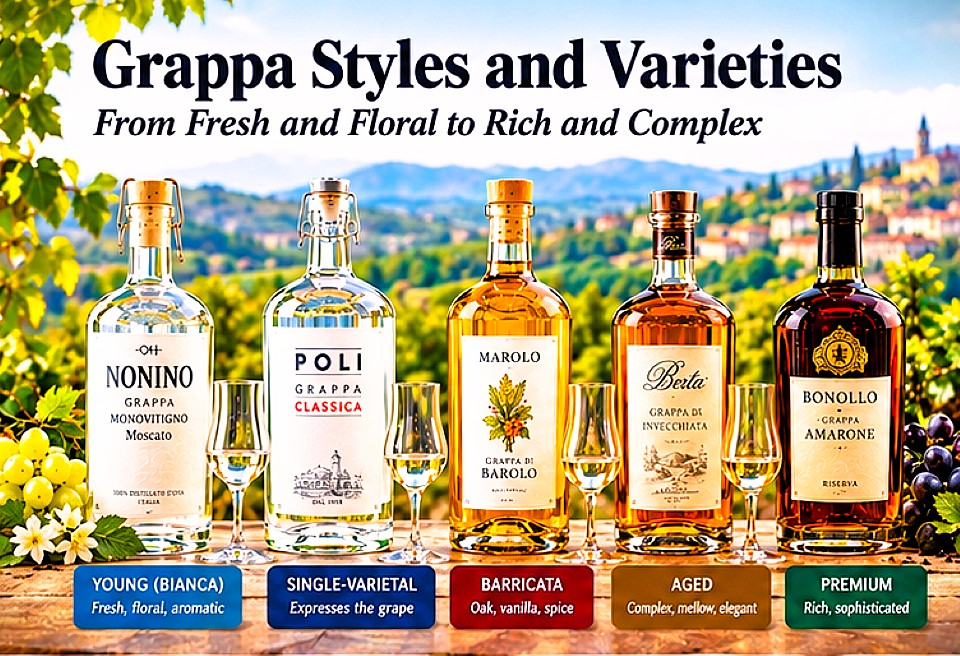
Italian grappa styles and varieties including young grappa, single-varietal, barricata, aged and premium grappa
5. Grappa Espresso
Style: Rich, bitter, aromatic
Ingredients
-
-
- 40 ml grappa
- 30 ml fresh espresso
- 15 ml coffee liqueur
- 5–10 ml simple syrup
-
Method
-
-
- Shake vigorously with ice.
- Double strain into a chilled coupe.
-
Garnish: Three coffee beans.
Nonino currently lists Nonino Espresso in its cocktail collection.
6. Nonino Ginger
Style: Spicy, citrusy, refreshing
For a home-bar adaptation:
Ingredients
-
-
- 40 ml grappa
- 15 ml fresh lemon juice
- 10 ml ginger syrup
- 80 ml tonic
- Ice
-
Method
-
-
- Build the first three ingredients over ice.
- Top with tonic.
-
Garnish: Lemon and ginger.
Nonino’s current cocktail library includes Nonino Ginger, while the producer separately describes GingerSpirit as spicy, citrusy and persistent, with cocktails designed around its ginger and lemongrass profile.
7. Grappa Spritz
Style: Sparkling, bright, aperitif-friendly
Ingredients
-
-
- 30 ml grappa
- 60 ml Prosecco
- 30 ml soda water
- 10 ml lemon juice
- Ice
-
Method
-
-
- Build in a large wine glass.
- Add ice.
- Pour in grappa and lemon.
- Top with Prosecco and soda.
-
Garnish: Orange peel.
Best for:
-
-
- Brunch
- Aperitif
- Summer
-
8. Grappa Highball
Style: Light, refreshing
Ingredients
-
-
- 45 ml young grappa
- 100–120 ml sparkling water
- Ice
- Lemon
-
Method
-
-
- Build in a tall glass.
- Top with sparkling water.
-
Garnish: Lemon peel.
This is the purest way to let a fresh grappa remain recognizable without adding too much sweetness.
9. Grappa Collins
Style: Citrusy, long, refreshing
Ingredients
-
-
- 50 ml grappa
- 25 ml lemon juice
- 15 ml simple syrup
- 75 ml soda
- Ice
-
Method
-
-
- Shake grappa, lemon and syrup.
- Strain over fresh ice.
- Top with soda.
-
Garnish: Lemon wheel.
10. Grappa Rickey
Style: Dry, tart, very refreshing
Ingredients
-
-
- 50 ml grappa
- 25 ml lime juice
- 100 ml soda water
- Ice
-
Method: Build directly over ice.
Garnish: Lime wedge.
Best for: Drinkers who prefer dry cocktails with little added sugar.
11. Grappa Mojito
Style: Minty, citrusy, refreshing
Ingredients
-
-
- 50 ml grappa
- ½ lime
- 6–8 mint leaves
- 2 teaspoons sugar
- Soda water
- Crushed ice
-
Method
-
-
- Muddle lime and sugar gently.
- Add mint.
- Add grappa and crushed ice.
- Top with soda.
- Stir.
-
Garnish: Mint and lime.
This is an adaptation rather than a traditional rum Mojito.
12. Grappa Margarita
Style: Citrus, tart, aromatic
Ingredients
-
-
- 45 ml grappa
- 20 ml orange liqueur
- 25 ml lime juice
- 10 ml agave syrup
- Ice
-
Method
-
-
- Shake.
- Strain over fresh ice.
-
Garnish: Lime wheel and optional half salt rim.
Poli currently publishes Sarparita, a Margarita-inspired twist that combines grappa with lime, Triple Sec, sugar and grape brandy. That makes the Margarita format particularly appropriate for grappa experimentation.
13. Grappa Paloma
Style: Bitter, citrusy, refreshing
Ingredients
-
-
- 45 ml grappa
- 60 ml grapefruit juice
- 15 ml lime juice
- 10 ml agave syrup
- 60 ml soda
- Ice
-
Method
-
-
- Shake the first four ingredients.
- Strain over ice.
- Top with soda.
-
Garnish: Grapefruit wedge.
Best for:
Summer
Patio drinking
14. Grappa Negroni
Style: Bitter, herbal, complex
Ingredients
-
-
- 30 ml grappa
- 30 ml Campari
- 30 ml sweet vermouth
- Ice
-
Method
-
-
- Stir.
- Serve over a large cube.
-
Garnish: Orange peel.
This is an adaptation of the classic Negroni structure. Nonino’s current cocktail library contains Negronino, illustrating how Italian grappa and bitter aperitivo traditions can be combined in modern mixology.
15. Grappa Old Fashioned
Style: Rich, spirit-forward
Ingredients
-
-
- 50 ml aged grappa
- 7.5 ml simple syrup
- 2 dashes aromatic bitters
- Orange peel
-
Method
-
-
- Stir with ice.
- Strain over a large cube.
- Express orange peel.
-
Best for
-
-
- Aged grappa
- Cold-weather drinking
-
16. Grappa Manhattan
Style: Rich, herbal, elegant
Ingredients
-
-
- 50 ml aged grappa
- 25 ml sweet vermouth
- 2 dashes bitters
- Ice
-
Method
-
-
- Stir until thoroughly chilled.
- Strain into a coupe.
-
Garnish: Cherry.
Why it works? Aged grappa can provide the fruit and wood complexity normally supplied by a mature whiskey.
17. Grappa French 75
Style: Sparkling, citrusy, elegant
Ingredients
-
-
- 30 ml grappa
- 15 ml lemon juice
- 15 ml simple syrup
- 60 ml dry sparkling wine
-
Method
-
-
- Shake the first three ingredients.
- Strain into a flute.
- Top with sparkling wine.
-
Garnish: Lemon twist.
This is an adaptation rather than the traditional gin-based French 75.
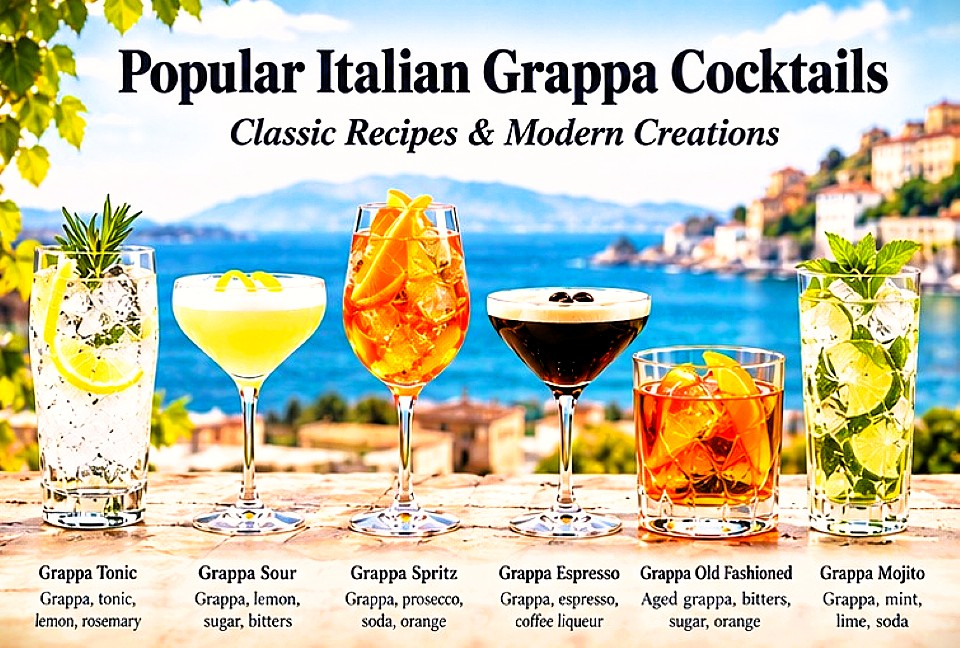
Popular Italian grappa cocktails including Grappa Tonic, Grappa Sour, Grappa Spritz, Grappa Espresso, Grappa Old Fashioned and Grappa Mojito
18. Grappa Sidecar
Style: Citrus, bright, elegant
Ingredients
-
-
- 50 ml grappa
- 20 ml orange liqueur
- 20 ml lemon juice
- Ice
-
Method
-
-
- Shake.
- Strain into a chilled coupe.
-
Garnish: Orange twist.
Best for: Citrus lovers
19. Grappa Bee’s Knees
Style: Floral, honeyed, tart
Ingredients
-
-
- 50 ml grappa
- 25 ml lemon juice
- 15 ml honey syrup
- Ice
-
Method
-
-
- Shake vigorously.
- Strain into a coupe.
-
Garnish: Lemon peel.
Tip: A floral Moscato-based grappa can work particularly well.
20. Grappa Gimlet
Style: Crisp, tart, compact
Ingredients
-
-
- 50 ml grappa
- 25 ml fresh lime juice
- 15 ml simple syrup
- Ice
-
Method
-
-
- Shake.
- Strain into a chilled coupe.
-
Garnish: Lime wheel.
Best for
-
-
- Short drinks
- Aperitif
-
21. Grappa Lemon Drop
Style: Sweet-tart, citrusy
Ingredients
-
-
- 45 ml grappa
- 25 ml lemon juice
- 15 ml orange liqueur
- 10 ml simple syrup
- Ice
-
Method
-
-
- Shake.
- Strain into a chilled cocktail glass.
-
Garnish: Lemon twist. Optional sugar rim.
22. Grappa Berry Smash
Style: Fruity, fresh, aromatic
Ingredients
-
-
- 50 ml young grappa
- 4 strawberries or mixed berries
- 20 ml lemon juice
- 15 ml simple syrup
- Mint
- Ice
-
Method
-
-
- Muddle berries gently.
- Add the remaining ingredients.
- Shake.
- Strain over crushed ice.
-
Garnish: Fresh berries and mint.
23. Grappa Peach Smash
Style: Juicy, fruity, summery
Ingredients
-
-
- 50 ml grappa
- ½ ripe peach
- 20 ml lemon juice
- 15 ml honey syrup
- Mint
- Ice
-
Method
-
-
- Muddle peach gently.
- Shake everything with ice.
- Strain over crushed ice.
-
Garnish: Peach and mint.
24. Grappa Espresso Martini
Style: Coffee, bitter-sweet, rich
Ingredients
-
-
- 45 ml aged grappa
- 30 ml espresso
- 20 ml coffee liqueur
- 10 ml simple syrup
-
Method
-
-
- Shake hard with ice.
- Double strain.
-
Garnish: Three coffee beans.
For an Italian-style dessert cocktail, this is one of the most logical ways to use aged grappa.
25. Grappa Coffee Old Fashioned
Style: Deep, aromatic, bittersweet
Ingredients
-
-
- 45 ml aged grappa
- 10 ml coffee liqueur
- 5 ml demerara syrup
- 2 dashes chocolate bitters
- Ice
-
Method
-
-
- Stir.
- Serve over a large cube.
-
Garnish: Orange peel and coffee bean.
Best for
-
-
- After dinner
- Chocolate desserts
-
26. Grappa Chocolate Cocktail
Style: Rich, dessert-like
Ingredients
-
-
- 40 ml barrel-aged grappa
- 20 ml dark crème de cacao
- 20 ml espresso
- 10 ml cream
- Ice
-
Method
-
-
- Shake.
- Strain into a chilled coupe.
-
Garnish: Grated dark chocolate.
Tip: Use a relatively dry grappa so the drink doesn’t become overly sweet.
27. Grappa Amaro Highball
Style: Bitter, herbal, long
Ingredients
-
-
- 30 ml grappa
- 25 ml Italian amaro
- 100 ml soda water
- 10 ml lemon juice
- Ice
-
Method
-
-
- Build over ice.
- Top with soda.
-
Garnish: Lemon peel.
This style works especially well because grappa and amaro share the ability to contribute strong aromatics in relatively small quantities.
28. Grappa Sangria
Style: Fruity, refreshing, party-friendly
Ingredients
-
-
- 150 ml grappa
- 450 ml dry red or rosé wine
- 100 ml orange juice
- 50 ml lemon juice
- 50 ml simple syrup
- Sliced orange
- Apple
- Berries
- Ice
-
Method
-
-
- Combine everything except ice.
- Chill.
- Serve over plenty of ice.
-
Producer connection: Nonino currently publishes a Sangria Nonino created by mixologist Roberto Rossi at Can Carlos in Formentera, combining its Moscato grappa with a fruit-forward aperitif concept.
29. Supernova-Style Grappa Cocktail
Style: Fresh, aromatic, spicy
This cocktail is inspired by Nonino’s Supernova, which combines its Prosecco-derived grappa with lime and ginger and is presented as a fresh aperitif.
Home adaptation
-
-
- 40 ml Prosecco-based grappa
- 20 ml lime juice
- 10 ml ginger syrup
- 60 ml soda water
- Ice
-
Method
-
-
- Shake grappa, lime and ginger syrup.
- Strain over ice.
- Top with soda.
-
Garnish: Caramelized ginger or lime peel.
30. Tomodachi
Style: Elegant, complex, modern. This is one of the most contemporary grappa cocktails in the article.
In February 2026, Charles Schumann created Tomodachi at his Munich bar, combining:
-
-
- Aged Nonino grappa
- Sake
- Amber vermouth
- Amaro Nonino Quintessentia
-
Nonino describes the drink as a collaboration between Italian and Japanese flavor traditions, with aged grappa contributing vanilla and dried-fruit notes, sake adding silkiness, and vermouth and amaro creating a sweet-bitter structure.
Home-inspired version
-
-
- 30 ml aged grappa
- 20 ml sake
- 20 ml amber vermouth
- 10 ml amaro
- Ice
-
Method
-
-
- Stir thoroughly.
- Strain into a chilled coupe.
-
Garnish: Expressed orange peel.
This is best treated as a modern adaptation inspired by the published Tomodachi concept rather than as a reproduction of the original bartender’s complete recipe.
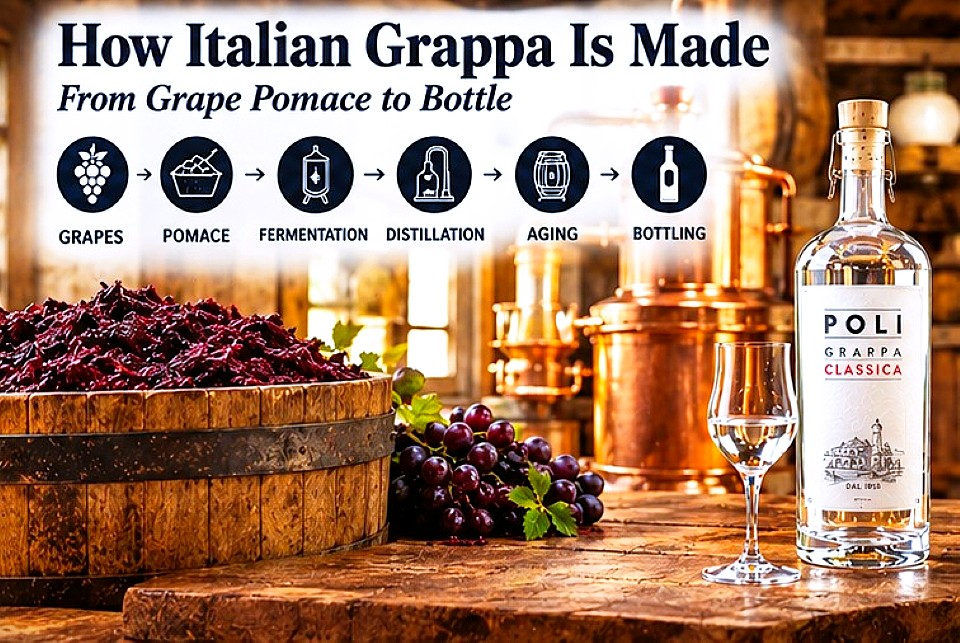
How Italian grappa is made from grape pomace through fermentation, distillation, aging and bottling
Best Grappa Cocktails for Summer
For hot weather, choose drinks with:
-
-
- ice
- citrus
- carbonation
- mint
- fresh fruit.
-
The strongest choices are:
-
-
- Grappa Tonic: Simple and refreshing.
- Moscato Grappa Tonic: More floral.
- Grappa Highball: Extremely easy.
- Grappa Collins: Citrus-forward.
- Grappa Rickey: Dry and crisp.
- Grappa Mojito: Mint and lime.
- Grappa Paloma: Grapefruit and soda.
- Grappa Berry Smash: Fresh fruit.
- Grappa Peach Smash: Summer stone fruit.
-
Nonino’s cocktail program includes multiple refreshing long drinks, while its Moscato NoninoTonic is specifically presented as a floral long drink with mint or sage.
Best Grappa Cocktails for Dinner
For dinner, don’t automatically choose the sweetest cocktail. A dry aperitif often works better.
Before dinner
-
-
- Grappa Tonic
- Grappa Spritz
- Grappa Rickey
-
With food
-
-
- Grappa Sour
- Grappa Collins
- Grappa Amaro Highball
-
After dinner
-
-
- Grappa Espresso
- Grappa Espresso Martini
- Grappa Coffee Old Fashioned
- Grappa Chocolate Cocktail
-
Best Grappa Cocktails for Beginners
Start with relatively simple combinations.
-
-
- Grappa Tonic: Grappa + tonic + lemon.
- Grappa Highball: Grappa + soda.
- Grappa Sour: Grappa + lemon + sugar.
- Grappa Spritz: Grappa + sparkling wine + soda.
- Grappa Espresso: Grappa + coffee.
-
These teach the five fundamental ways grappa behaves in a cocktail:
-
-
- dilution
- acidity
- carbonation
- sweetness
- roasted flavor.
-
Best Grappa for Cocktails
There isn’t one universally best bottle. Think about the profile.
For Tonic
Use a: young, crisp grappa.
For Sour
Use a: fresh, aromatic grappa.
For Spritz
Use: floral or fruity grappa.
For coffee
Use:aged grappa.
For Old Fashioned
Use: barrel-aged grappa.
For herb cocktails
Use: Moscato or other aromatic single-varietal grappa.
For richer cocktails
Use: aged Nebbiolo or Amarone-related grappa.
Grappa Brands Particularly Interesting for Cocktails
Nonino
Nonino has one of the most extensive producer-created cocktail libraries in the category, including NoninoTonic, Basil Smash, Espresso, Ginger, Supernova, Moscato NoninoTonic and many more.
Poli
Poli’s official cocktail collection includes:
-
-
- Miele Tonic
- Camomilla Collins
- Poli Negroni
- Sarparita
- Holy Sarpa and several other contemporary serves.
-
Marolo
Marolo maintains a particularly interesting cocktail archive around its MILLA camomile grappa liqueur, including MILLA Freschissima, MILLA Mule, Bambolina, Dirty Daiquiri and Julep di Pomona.
This is useful evidence that the grappa cocktail movement extends well beyond one producer.
How to Make Better Grappa Cocktails
1. Use fresh citrus: Fresh lemon and lime are dramatically better than stale bottled juice in simple cocktails.
2. Don’t oversweeten: Grappa already has a fruit-derived aromatic impression.
3. Use good ice: Dilution is part of the recipe.
4. Start with smaller pours: Aromatic grappa can dominate.
5. Use carbonation intelligently: Tonic and soda are among the easiest ways to soften the alcohol.
6. Match the grape to the cocktail: Moscato can be excellent with , mint, sage, citrus and floral ingredients.
Nebbiolo-based grappa can be more suitable for bitters, vermouth, oak and coffee.
7. Don’t waste an ultra-aged grappa
Use expensive mature bottles simply. An excellent 15-year-old grappa doesn’t need to become a cocktail with nine ingredients.
Shake or Stir?
The basic rule is simple.
Shake when the drink contains:
-
-
- lemon
- lime
- fruit
- cream
- egg white
-
Examples:
-
-
- Grappa Sour
- Grappa Margarita
- Berry Smash
- Chocolate Cocktail
-
Stir when the drink contains:
-
-
- vermouth
- amaro
- bitters
- and mostly spirit.
-
Examples:
-
-
- Grappa Negroni
- Grappa Manhattan
- Grappa Old Fashioned
- Tomodachi
-
Grappa and Food Pairing
Grappa’s relationship with Italian food is one of its greatest strengths.
Seafood
Try:
-
-
- Grappa Tonic
- Grappa Rickey
- Grappa Highball
-
Cheese
Try:
-
-
- Grappa Spritz
- Grappa Sour
- or a simple young grappa.
-
Pasta
A light aperitif can work before or alongside lighter dishes.
Roast meats
Aged grappa works especially well in after-dinner service.
Dessert
Try:
-
-
- Grappa Espresso
- Grappa Chocolate Cocktail
- Grappa Espresso Martini
-
Fruit desserts
Moscato grappa is especially interesting with:
-
-
- peach
- pear
- apple
- berries
-
Nonino specifically recommends its Moscato grappa with cream-based desserts, ice cream and fresh fruit.
Grappa and Coffee
This deserves its own section. Italy already has a strong cultural association between espresso and digestifs. Grappa fits naturally.
The simplest version is essentially: espresso + a small amount of grappa. But modern cocktail bars can take that much further.
Try:
-
-
- Grappa Espresso
- Grappa Espresso Martini
- Grappa Coffee Old Fashioned
- Grappa Chocolate Cocktail
-
Nonino’s current cocktail library includes Nonino Espresso, and its wider collection contains numerous coffee-focused creations.
Grappa and Sparkling Wine
Sparkling wine is another excellent partner. Why? Because bubbles provide:
-
-
- dilution
- texture
- freshness
- and lift.
-
That’s why a simple: grappa + Prosecco + soda can produce an excellent aperitif.
A more complex example is Serendipity-style thinking, although that particular cocktail belongs to the broader world of apple-fruit spirits.
For grappa, keep the sparkling ingredient dry. Very sweet sparkling wine can overwhelm the spirit.
Grappa and Ginger
Ginger works particularly well with grappa. The spice creates contrast. The grape character supplies fruitiness. The combination is especially successful in:
-
-
- highballs
- sours
- and spritzes.
-
Nonino’s current program includes Nonino Ginger, while its Prosecco-based Supernova combines lime and ginger for a fresh aperitif.
Grappa vs. Brandy in Cocktails
These spirits aren’t interchangeable.
Grappa
Made from: grape pomace
Often: fresh, aromatic, grapey, floral
Brandy
Usually made by distilling: wine or other fermented fruit material.
Often: rounder, oakier, fruit-sweet, and richer.
The difference becomes obvious in cocktails. Replacing Cognac with grappa in a Sidecar makes the drink much more aromatic and grape-forward. Replacing grappa with Cognac generally makes it smoother and more oak-driven.
Grappa vs. Cognac in Cocktails
-
-
- oak
- dried fruit
- vanilla
- roundness.
-
Young grappa can provide:
-
-
- fresh grape
- herbs
- floral aromatics
- brightness.
-
For: Sours, Highballs and Spritzes, young grappa can be particularly expressive.
For: spirit-forward winter cocktails, aged grappa is more appropriate.
Grappa vs. Pisco in Cocktails
Both are grape-related spirits. Pisco is famous for Pisco Sour and other South American drinks.
Grappa is traditionally connected to Italian digestifs espresso and increasingly modern mixology.
Both can work with lime, lemon, fruit and herbs. But their aromatic signatures are different. That’s exactly why they can make interesting alternatives in cocktail experimentation.
Current Grappa Cocktail Trends
Grappa’s cocktail movement is no longer a niche experiment. The evidence is visible in producer activity.
1. Large cocktail libraries
Nonino maintains a huge online collection of grappa and distillate cocktails.
2. International bartenders
Nonino’s archive includes recipes created by bartenders and mixologists from:
-
-
- London
- Berlin
- New York
- Singapore
- Munich
-
and other international cocktail centers.
3. Classic cocktail twists
Poli uses familiar cocktail structures such as:
-
-
- Margarita
- Collins
- Negroni
-
and Pisco Punch-style drinks as starting points for Italian interpretations.
4. Cross-cultural cocktails
Tomodachi is a 2026 example of grappa meeting:
-
-
- sake
- vermouth
- amaro.
-
5. Fresh ingredients and sustainability
Nonino has also highlighted “no waste” citrus-cordial concepts and cocktail applications of fresh ingredients in its cocktail archive.
6. Grappa as a serious cocktail base
The old idea that grappa exists only as an after-dinner digestive is increasingly incomplete. Poli explicitly describes grappa as moving into cold, mixed and shaken service, and Nonino maintains an extensive mixology program with international bartenders.

Italian grappa food pairings with seafood, Parmigiano, Pecorino, Gorgonzola, roast meats, fruit desserts, chocolate and coffee
Frequently Asked Questions
What is the most popular grappa cocktail?
There is no authoritative worldwide ranking of grappa cocktails. Grappa Tonic, Grappa Sour, Grappa Spritz, Grappa Espresso and Basil Smash-style drinks are among the most accessible and recognizable formats, while producers such as Nonino and Poli publish large collections of additional recipes.
What is the best grappa cocktail for beginners?
Grappa Tonic, Grappa Highball and Grappa Sour are excellent starting points.
What is the easiest grappa cocktail?
Grappa Highball is one of the easiest: grappa, ice and sparkling water.
What is the best grappa cocktail for summer?
Grappa Tonic, Moscato Grappa Tonic, Grappa Spritz, Grappa Mojito, Grappa Paloma and Grappa Berry Smash.
What is the best grappa cocktail for dinner?
Grappa Sour, Grappa Collins, Grappa Tonic and Grappa Spritz work well before or alongside dinner.
What is the best grappa cocktail after dinner?
Grappa Espresso, Grappa Espresso Martini and Grappa Coffee Old Fashioned.
What grappa is best for cocktails?
Young, aromatic grappa is generally the easiest place to start.
Can aged grappa be used in cocktails?
Yes. Aged grappa works particularly well in Old Fashioned, Manhattan, Negroni and coffee-style recipes.
Can you mix grappa with tonic?
Yes. Nonino publishes an official NoninoTonic recipe using grappa, tonic, lemon, ice and rosemary.
Can you mix grappa with soda?
Yes. Soda is one of the easiest ways to lengthen grappa.
Can you mix grappa with Prosecco?
Yes. It works particularly well in Spritz-style cocktails.
Can you mix grappa with lemon?
Yes. Lemon is one of the best ingredients for balancing grappa.
Can you mix grappa with lime?
Yes. Lime is especially useful in Mojito, Gimlet, Margarita and Rickey-style drinks.
Can you mix grappa with ginger?
Yes. Ginger works particularly well with aromatic grape spirits.
Can you mix grappa with coffee?
Yes. Coffee and grappa have a long Italian association, and modern producers such as Nonino publish espresso-based cocktails.
Can you make an espresso martini with grappa?
Yes. Aged grappa can create a rich variation on the classic coffee cocktail.
Can you make a Negroni with grappa?
Yes. Replace gin with grappa to create a grappa-forward variation.
Can you make an Old Fashioned with grappa?
Yes. Aged grappa works particularly well.
Can you make a Manhattan with grappa?
Yes. Use aged grappa with sweet vermouth and bitters.
Can you make a Margarita with grappa?
Yes. Poli currently publishes a Margarita-style grappa cocktail called Sarparita.
Can you make a Mojito with grappa?
Yes. Use young grappa with lime, mint, sugar and soda.
Can you make a French 75 with grappa?
Yes, as an adaptation using sparkling wine.
Can you make a Sidecar with grappa?
Yes. Replace the Cognac with grappa for a fruitier, more aromatic variation.
Can you make a Sour with grappa?
Yes. Grappa, lemon and simple syrup form a very straightforward combination.
What fruit goes best with grappa?
Apple, pear, peach, berries, citrus, pineapple, kiwi and grape are all interesting.
What herbs go best with grappa?
Mint, basil, rosemary and sage can work particularly well.
What is the best grappa for a Grappa Tonic?
A young, aromatic grappa around the low-40% ABV range is a practical choice.
What is the best grappa for a Grappa Sour?
A fresh, balanced grappa with clear grape aromatics.
What is the best grappa for coffee cocktails?
Aged grappa is especially useful because wood and dried-fruit notes can complement roasted coffee.
What is the best grappa for a Negroni?
A flavorful young or moderately aged grappa that can stand beside bitter Campari and vermouth.
What is the best grappa for an Old Fashioned?
A barrel-aged grappa with oak, vanilla and dried-fruit character.
Is Nonino good for cocktails?
Nonino maintains a large official cocktail library containing numerous grappa cocktails and works with international mixologists.
Does Nonino make a Grappa Tonic?
Yes. The producer publishes NoninoTonic using grappa, tonic, lemon, ice and rosemary.
Does Nonino make a Basil Smash?
Yes. Nonino publishes a grappa-based Basil Smash that replaces gin with Grappa Nonino 43°.
Does Nonino make a coffee cocktail?
Yes. Its current cocktail program includes Nonino Espresso.
Does Poli make grappa cocktails?
Yes. Poli maintains a dedicated online collection of grappa cocktails and contemporary spirits drinks.
Does Marolo make grappa cocktails?
Yes. Marolo publishes a cocktail archive including numerous recipes using its MILLA camomile grappa liqueur and other products.
What is Tomodachi?
Tomodachi is a contemporary 2026 cocktail created by Charles Schumann using aged Nonino grappa, sake, amber vermouth and Amaro Nonino Quintessentia.
What is Moscato NoninoTonic?
It is a Nonino cocktail combining Moscato grappa with tonic and mint or sage, designed around floral flavors.
What is Supernova?
Nonino’s Supernova is a cocktail based on Prosecco-derived grappa, lime and ginger, designed as a fresh aperitif.
What is Nonino Ginger?
It is a cocktail built around Nonino GingerSpirit, with spicy and citrus character. The producer publishes several recipes using the ginger distillate.
Is grappa a type of brandy?
Grappa is a distinct Italian grape-pomace spirit rather than ordinary wine brandy. The Consorzio Nazionale Grappa specifically defines the category around grape pomace.
Is grappa made from grapes?
Yes, but specifically from the solid grape material left after winemaking.
Is grappa distilled from wine?
No. It is distilled from grape pomace.
Is grappa strong?
Yes. Italian grappa has a minimum legal alcoholic strength of 37.5% ABV, and many products are bottled above 40%.
Should grappa be chilled for cocktails?
Usually no need. Ice in the cocktail provides the necessary chilling and dilution.
What glass should you use for grappa cocktails?
Highballs for long drinks, coupes for Sours and short cocktails, and rocks glasses for spirit-forward recipes.
Should grappa cocktails be shaken?
Shake recipes containing citrus, juice or other ingredients that benefit from aeration.
Should grappa cocktails be stirred?
Stir spirit-forward recipes containing vermouth, amaro and bitters.
What food goes with grappa cocktails?
Seafood, cheese, cured meats, grilled dishes, fruit desserts, chocolate and coffee are all useful pairings.
Does grappa go with chocolate?
Yes. Especially aged grappa.
Does grappa go with cheese?
Yes. Young and aged styles can be paired with different cheeses.
Does grappa go with coffee?
Absolutely. Coffee is one of the classic Italian companions for grappa.
Can grappa cocktails be made ahead?
Some can. Batch Sours and punches can be prepared ahead, but fresh citrus and carbonation are better added close to serving.
Can grappa cocktails be batched for parties?
Yes. Highballs, punches and Spritz-style drinks can be batched efficiently.
What is the best garnish for grappa cocktails?
Lemon, lime, orange, grapefruit, mint, rosemary, sage, basil, apple and berries are all useful.
Final Thoughts: The World’s Most Popular Grappa Cocktails
Grappa has changed. Or perhaps more accurately the way people understand grappa has changed. For generations, the spirit was often treated as a simple end-of-meal digestive. Today, that is only one part of the story.
Italian producers are showing bartenders that grappa can be:
-
-
- fresh
- aromatic
- complex
- versatile
- surprisingly modern.
-
Nonino’s current cocktail library alone contains an enormous range of grappa-based drinks and collaborations, while Poli has developed a dedicated cocktail collection built around the idea of mixing grappa with citrus, spices and contemporary bar techniques.
That movement is important because grappa has qualities that are especially useful in modern mixology. First, it has personality. A neutral spirit can disappear behind its mixers. Good grappa doesn’t.
It gives a cocktail:
-
-
- grape
- fruit
- flowers
- herbs
- spice
- wood.
-
Second, it works beautifully with dilution.
-
-
- A little tonic.
- A little soda.
- A little sparkling wine.
- And the spirit becomes longer, lighter and more aromatic.
-
That’s why the simplest recipes are often among the most successful.
-
-
- Grappa Tonic
- Moscato Grappa Tonic
- Grappa Highball
- Grappa Rickey
-
They don’t need ten ingredients. They just need a good bottle. And a good bartender. The same is true of the Grappa Sour. Lemon gives acidity. Syrup gives balance. Grappa provides the identity. Then there are the herbal drinks.
The Nonino Basil Smash is a particularly good example of how a familiar cocktail can become something distinctly different when gin is replaced by grappa. Nonino itself describes the drink as a grappa twist on Jörg Meyer’s Gin Basil Smash.
This is the kind of adaptation that makes sense. You recognize the cocktail structure. But the base spirit changes the entire experience.
The same principle works with:
-
-
- Margaritas
- Negronis
- Old Fashioneds
- Manhattans
- French 75s
- Sidecars.
-
Grappa doesn’t have to copy another spirit. It can reinterpret the structure. That’s the difference between a thoughtful substitution and simply replacing one bottle with another. The coffee category may be even more natural.
Italy’s relationship with espresso is legendary. Grappa has long been associated with after-dinner coffee culture.
So drinks such as:
-
-
- Grappa Espresso
- Grappa Espresso Martini
- Grappa Coffee Old Fashioned
- Grappa Chocolate Cocktail
-
feel almost inevitable. Nonino’s current cocktail collection already includes Nonino Espresso, while the producer also maintains an enormous library of related aperitif and cocktail recipes.
Then come the more adventurous drinks.
-
-
- Supernova combines Prosecco-derived grappa with lime and ginger.
- Moscato NoninoTonic uses floral grappa with tonic and fresh herbs.
- Tomodachi brings aged grappa into a cocktail with sake, vermouth and amaro.
-
These recipes demonstrate the broader direction of the category. Grappa is becoming a bridge between Italian tradition and international mixology. Tomodachi is particularly revealing because it is so current.
In February 2026, Charles Schumann created the drink in Munich by combining aged Nonino grappa with sake, amber vermouth and Amaro Nonino Quintessentia. Nonino describes the result as a meeting between Italian and Japanese flavors.
That’s a long way from the old stereotype of grappa as a simple digestive. And the producer community is not alone.
Poli publishes its own recipes, including:
-
-
- Miele Tonic
- Camomilla Collins
- Poli Negroni
- Sarparita
- Holy Sarpa
-
and other modern drinks. Marolo similarly maintains a cocktail archive with recipes created by bartenders in the United States and elsewhere around its MILLA camomile grappa liqueur. So the trend is broader than any single producer. And it makes sense.
Grappa’s agricultural identity is perfectly suited to the current interest in:
-
-
- regional spirits
- terroir
- craft distilling
- local ingredients
- sustainable production.
-
The spirit is literally connected to the winemaking process. The grape is harvested. Wine is produced. Pomace remains. The pomace is distilled. The result becomes another expression of the same agricultural landscape. That gives grappa a strong story. It also gives it complexity.
-
-
- Try a Moscato grappa and you can explore floral notes.
- Try a Nebbiolo-based grappa and the experience changes.
- Try an Amarone-associated grappa and you may encounter deeper dried-fruit and barrel characteristics.
- Try a barrel-aged grappa and you get another transformation.
- That’s why cocktail selection matters.
-
A young grappa belongs in:
-
-
- Tonic
- Highball
- Sour
- Mojito
- Spritz.
-
A mature grappa belongs in:
-
-
- Old Fashioned
- Manhattan
- Negroni
- coffee cocktails.
-
And an exceptional vintage or single-cask bottle? That may simply deserve a glass.
-
-
- No shaker.
- No syrup.
- No garnish.
- Just the spirit.
-
The biggest mistake people make with grappa cocktails is assuming that more complexity equals a better cocktail. Usually, it doesn’t. Because the spirit already has complexity.
-
-
- Start with: grappa + lemon.
- Then: grappa + tonic.
- Then: grappa + ginger.
- Then: grappa + coffee.
-
Only after that should you begin adding multiple liqueurs and bitters. The same principle applies to food. Grappa is not only a cocktail spirit. It is a food companion.
Young grappa can work with:
-
-
- seafood
- fresh cheese
- salads
- lighter dishes.
-
Aged grappa can move toward:
-
-
- hard cheese
- roasted meat
- chocolate
- nuts
- coffee.
-
That flexibility makes grappa ideal for a complete Italian-style dinner.
-
-
- Start with: Grappa Tonic.
- Move to: Grappa Sour.
- Finish with: Grappa Espresso.
-
Three cocktails. One spirit. Three completely different experiences.
For a summer party:
-
-
- Grappa Spritz
- Moscato Grappa Tonic
- Grappa Mojito
- Grappa Berry Smash
-
For an autumn dinner:
Grappa Negroni
Grappa Manhattan
Grappa Old Fashioned
For winter:
-
-
- Grappa Coffee Old Fashioned
- Grappa Chocolate Cocktail
- Grappa Espresso Martini
-
And for an adventurous cocktail evening:
-
-
- Tomodachi
- Supernova-inspired Grappa Cocktail
- Nonino Basil Smash
- Grappa Margarita
-
That variety is precisely why grappa deserves a place in a modern spirits collection. You don’t need twenty bottles.
Start with one young grappa and one aged grappa. Add tonic, soda, lemon, lime, coffee, vermouth, sparkling wine, ginger and fresh herbs.
You will already have enough ingredients to build a surprisingly sophisticated grappa cocktail menu. And perhaps the most important thing to remember is that there is no single definition of a “proper” grappa cocktail.
-
-
- There are traditional Italian serves.
- There are producer-created recipes.
- There are classic cocktail adaptations.
- There are modern bartender inventions.
- There are completely original home-bar drinks.
-
The best approach is to identify which category you’re making.
-
-
- If you’re reproducing a producer’s cocktail, present it as the producer’s recipe.
- If you’re adapting a Sidecar, say so.
- If you’re creating your own Grappa Sour, call it an adaptation or original recipe.
-
That transparency makes the article more useful and more trustworthy. It also makes the world of grappa easier to explore. Because this is ultimately what grappa cocktails are about discovery. Try one recipe. Then another. Change the citrus. Change the garnish.
-
-
- Try Moscato.
- Try Nebbiolo.
- Try a barrel-aged bottle.
- Compare tonic with soda.
- Compare lemon with grapefruit.
- Compare coffee with chocolate.
-
And see what happens. The spirit is remarkably adaptable. That’s why modern producers continue to build cocktail programs around it.
And that’s why grappa is moving beyond the digestif glass and into the contemporary cocktail bar.