
Blog
Most Popular Italian Grappa Brands in the World: 30 Famous Grappa Producers to Know

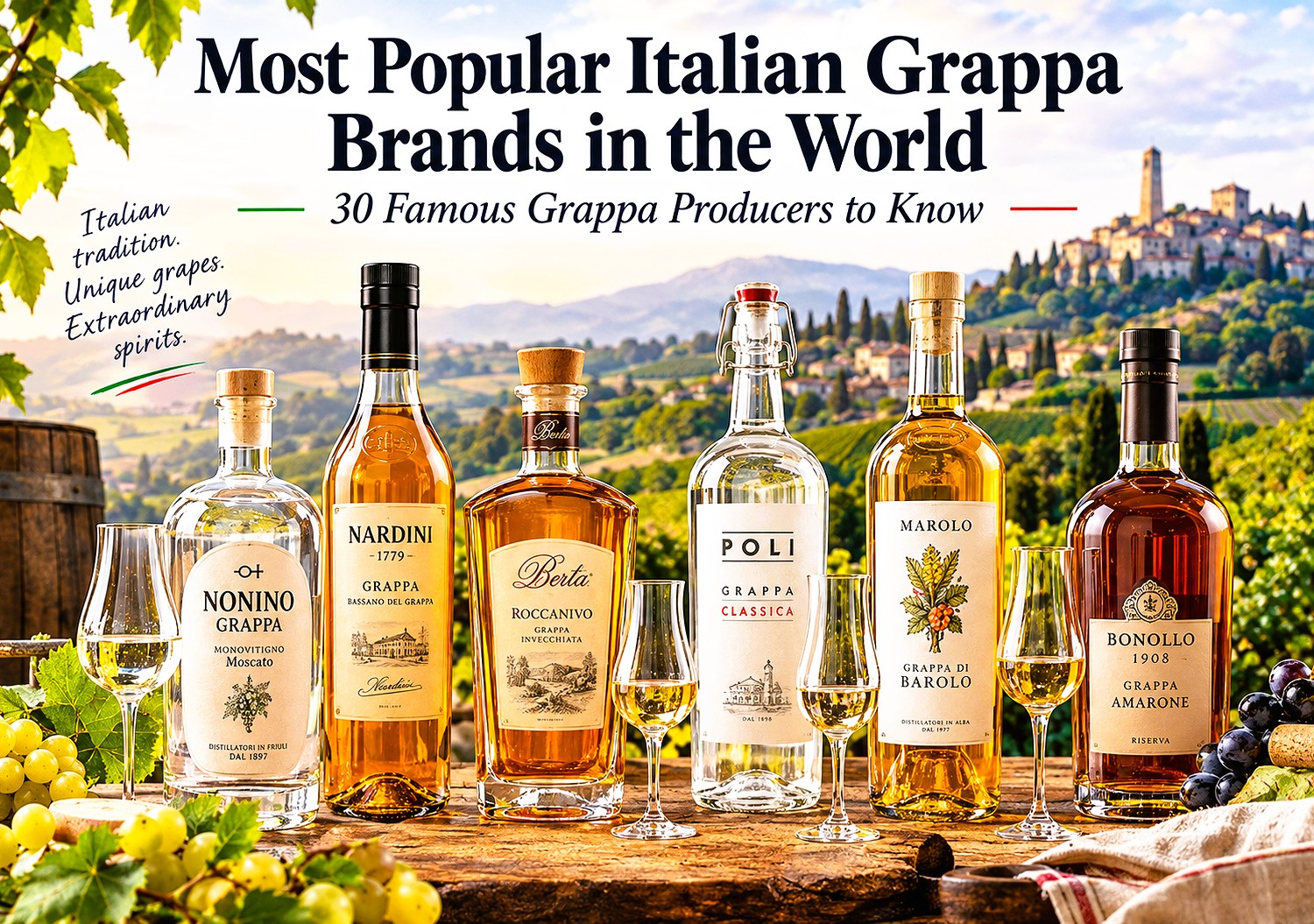
Most Popular Italian Grappa Brands in the World.
Discover 30 of the most popular and notable Italian grappa brands in the world, including Nonino, Nardini, Berta, Poli, Marolo, Bonollo, Sibona, Marzadro, Castagner, Roner and more. Learn what grappa is, how it is made from grape pomace, the difference between young and aged grappa, single-varietal expressions, regional styles, how to drink grappa, the best grappa for beginners and cocktails, and how to pair Italian grappa with coffee, chocolate, cheese and food.
Grappa is one of Italy’s most distinctive spirits. It is also one of the country’s great examples of turning an agricultural by-product into a highly individual finished product.
Instead of distilling grape wine, grappa is made from grape pomace—the skins, seeds and remaining grape solids left after winemaking. That raw material carries the aromatic identity of the grapes and, depending on how it is handled and distilled, can produce a spirit ranging from clean and floral to powerful, spicy, fruity, woody and intensely aromatic.
Italy remains the heartland of the category.
Current data from AssoDistil show that grappa continued to be the main driver of Italian spirits production, with about 80,000 hectolitres of grappa produced in 2025. Earlier AssoDistil data also documented meaningful international exports, with Germany, Switzerland, Austria, the United States and Canada among important destinations for bottled Italian grappa.
The category is also increasingly visible outside Italy.
Names such as Nonino, Nardini, Berta, Poli, Marolo and Bonollo have become familiar to international spirits enthusiasts, while smaller producers are attracting attention through single-varietal releases, long aging, unusual casks, organic production and highly regional grappas.
Table of Contents
-
-
- What Is Grappa?
- Why Grappa Is Uniquely Italian
- How Grappa Is Made
- What Is Grape Pomace?
- Fresh Pomace vs. Stored Pomace
- How Grappa Is Distilled
- Young vs. Aged Grappa
- What Is Barricata Grappa?
- Single-Varietal Grappa
- Regional Grappa in Italy
- 30 Most Popular Italian Grappa Brands and Producers
- Nonino
- Nardini
- Distillerie Berta
- Poli
- Marolo
- Bonollo 1908
- Sibona
- Marzadro
- Castagner
- Roner
- Tosolini
- Bonaventura Maschio
- Andrea da Ponte
- Fratelli Francoli
- Deta Distillery
- La Valdôtaine
- Levi Serafino
- Mazzetti d’Altavilla
- Bocchino
- Nannoni
- Rossi d’Angera
- Domenis 1898
- Pisoni
- Unterthurner
- Segnana
- Capovilla
- Dellavalle
- Magnoberta
- Valverde
- Best Grappa for Beginners
- Best Grappa for Sipping
- Best Grappa for Cocktails
- Best Grappa for Gifts
- How to Drink Grappa
- Grappa and Coffee
- Grappa and Food Pairing
- Grappa and Chocolate
- Grappa and Cheese
- Grappa Cocktails
- Grappa vs. Brandy
- Grappa vs. Cognac
- Grappa vs. Pisco
- Current Grappa Trends
- Frequently Asked Questions
- Final Thoughts
-
What Is Grappa?
Grappa is an Italian grape-pomace spirit. The key distinction is important: Grappa is not distilled wine. Wine is produced from grape juice. Grappa is made from the solid grape material left over from winemaking.
That material is called pomace or vinaccia in Italian. It can contain skins, seeds and remaining grape pulp. The quality of that raw material is enormously important.
Poli, for example, says its distillery works with fresh, healthy grape pomace obtained from wineries in its area and distills it using copper batch steam stills.
Nonino likewise emphasizes fresh, soft pomace, carefully selected and taken to the distillery immediately after winemaking.
That helps explain why premium grappa can preserve an unmistakable relationship with the grapes and wine territory from which it came.
Why Grappa Is Uniquely Italian
The name Grappa is protected as an Italian geographical indication under European spirit-drink rules. The category is closely tied to Italy’s winemaking regions and traditions.
Italy’s current national grappa ecosystem is represented by organizations including the Consorzio Nazionale Grappa, whose membership includes major producers and regional institutions such as Nardini, Bonollo, Bonaventura Maschio, Roner, Marzadro, Mazzetti d’Altavilla, Berta, Nannoni, Rossi d’Angera and others.
This producer network demonstrates something important: there isn’t one single Italian grappa style. Instead, the category reflects Italy’s enormous wine diversity.
A grappa made from Moscato will taste different from one made from Prosecco/Glera, Nebbiolo, Amarone grapes, Schioppettino or Barbera.
That relationship between grape and spirit is central to the modern grappa movement.
How Grappa Is Made
The process begins when wine producers finish making wine. The remaining grape pomace is transferred to a distillery. The best producers work quickly because fresh pomace can deteriorate.
Nonino’s production method specifically emphasizes immediate distillation after controlled fermentation to preserve the characteristics of the original grape variety.
The simplified process is: grapes → winemaking → pomace → fermentation → distillation → resting/aging → dilution → bottling
The result is a high-strength spirit with strong aromatic potential.
What Is Grape Pomace?
Pomace is what remains after the useful juice has been extracted from grapes during winemaking.
It contains skins, seeds and residual grape material. The skins are particularly important because they contain aromatic compounds. That means grappa can sometimes retain a surprising impression of the vineyard.
For example, Nonino’s single-varietal grappas are designed specifically to express the characteristics of individual grape varieties. Its current range includes Moscato, Sauvignon Blanc, Merlot, Prosecco, Ribolla Gialla and other monovarietal grappas.
Marolo follows a similar philosophy, offering grappas made from varieties including Barolo/Nebbiolo, Moscato, Arneis, Barbaresco, Barbera, Dolcetto and Freisa.
Fresh Pomace vs. Stored Pomace
Freshness can make a significant difference. Fresh pomace preserves aromatic compounds more effectively. Nonino says its pomace is selected fresh and soft, then immediately fermented and distilled.
Poli likewise emphasizes the use of fresh, wholesome grape pomace from local wineries. This is particularly important when making single-varietal grappa because the objective is to preserve the character of the specific grape.
How Grappa Is Distilled
Traditional grappa can be distilled in different still configurations. Copper is particularly important.
Poli says its traditional copper stills operate in discontinuous batch cycles using steam, while Nonino describes its copper steam stills and careful separation of heads and tails to retain the heart of the distillate.
Capovilla is another example of an artisanal approach, using a double-distillation bain-marie system and organic grape pomace.
Distillation is not simply about producing alcohol. It is about selecting which volatile compounds make it through.
That’s what determines whether the final spirit smells:
-
-
- floral
- fruity
- herbal
- spicy
- powerful.
-
Young vs. Aged Grappa
Not all grappa is aged.
Giovane / Bianca
Usually clear. Often:
-
-
- fresh
- grapey
- floral
- direct.
-
Aged / Barricata
Usually amber or golden. Often:
-
-
- vanilla
- spice
- caramel
- oak
- dried fruit.
-
The aging process can be transformative.
Berta, for example, built part of its identity around long-aged grappa. The company’s history says that Paolo Berta began storing unsold grappa in large wooden barrels, an experience that helped inspire its later focus on aged grappa.
What Is Barricata Grappa?
Barricata generally refers to grappa matured in wooden barrels, often smaller barrels that promote greater wood contact. The exact barrel program varies.
Some producers use:
-
-
- oak
- acacia
- cherry
- or other woods.
-
Some experiment with former wine or fortified-wine casks.
Bonollo’s current Ligneum collection, for example, uses 500-liter oak tonneaux for grappa expressions including Cru Italiae, Prosecco and Moscato.
Poli also produces highly specialized barrel-finished spirits, including its La Première project using grape marc from a Bordeaux Premier Cru and subsequent aging in its underground cellars.
Single-Varietal Grappa
One of the biggest developments in premium grappa was the movement toward single-varietal expression.
Nonino’s official history identifies December 1, 1973 as the date when Benito and Giannola Nonino created a commercial single-varietal grappa by distilling Picolit pomace separately. This helped change the way premium grappa was presented.
Instead of: “This is grappa.”
the bottle could say: “This is grappa made from this particular grape.”
That puts grappa into conversation with wine. And it makes tasting much more interesting.
Regional Grappa in Italy
Grappa follows Italy’s wine map.
Friuli-Venezia Giulia
Associated with: Nonino, Domenis, Tosolini and aromatic grape varieties.
Veneto
Known for: Nardini, Poli, Andrea da Ponte, Bonaventura Maschio and other historic distilleries.
Piedmont
Especially important for: Berta, Marolo, Sibona, Mazzetti d’Altavilla, Bocchino, Francoli and numerous smaller producers.
Trentino
Associated with: Marzadro, Pisoni, Segnana and other mountain distillers.
Alto Adige
Associated with: Roner, Unterthurner and fruit/spirit traditions influenced by the Alpine region.
Lombardy
Home to historic names including: Rossi d’Angera and other regional distilleries.
Tuscany
Known for producers such as: Nannoni and distinctive grape-variety-focused grappas.
30 Most Popular Italian Grappa Brands and Producers
1. Nonino
Region: Friuli-Venezia Giulia
Nonino is arguably one of the most internationally recognizable names in modern premium grappa. The family has been distilling since 1897, and the company says its 1973 single-varietal Picolit grappa marked a major change in how grappa was produced and presented.
The current range includes:
-
-
- Friulana
- Vendemmia
- Monovitigno
- Cru
-
and long-aged Riserva expressions.
Nonino operates five traditional distilleries with copper batch steam stills and continues to emphasize fresh pomace and carefully controlled distillation.
Best for:
-
-
- Single-varietal exploration
- Premium sipping
- Gifts
- Collectors
-
2. Nardini
Region: Veneto
Nardini is one of the foundational names of Italian grappa.
The company dates to 1779, when Bortolo Nardini established the original distillery in Bassano del Grappa. The Consorzio Nazionale Grappa describes Nardini as a family business with more than two centuries of history and says the seventh generation continues the tradition.
Nardini Grappa is one of Italy’s most recognizable traditional styles.
Best for:
-
-
- Traditional Italian grappa
- History
- Classic drinking
-
Nardini’s Grappa Bianca is also currently listed by the LCBO in Canada, making it particularly relevant to Canadian readers.
3. Distillerie Berta
Region: Piedmont
Berta was founded in 1947 by Paolo Berta in Nizza Monferrato. The brand is particularly associated with rich, carefully aged grappas and luxury presentation. Its current site says Berta products are distributed in more than 70 countries.
One of its best-known expressions is: Roccanivo.
Berta’s history says barrel aging played a major role in transforming grappa’s image from a rustic spirit into a premium product.
Best for:
-
-
- Aged grappa
- Luxury gifts
- After-dinner sipping
-
4. Poli
Region: Veneto
Poli has roots going back centuries, with its distillery founded in 1898 in Schiavon. The family continues to emphasize handcrafted production in small batches. Its traditional method uses copper stills and fresh grape pomace.
Poli produces both young and aged grappas and has developed highly specialized expressions, including single-varietal and barrel-aged releases.
Best for:
-
-
- Classic Veneto styles
- Single-varietal tasting
- Premium grappa
-
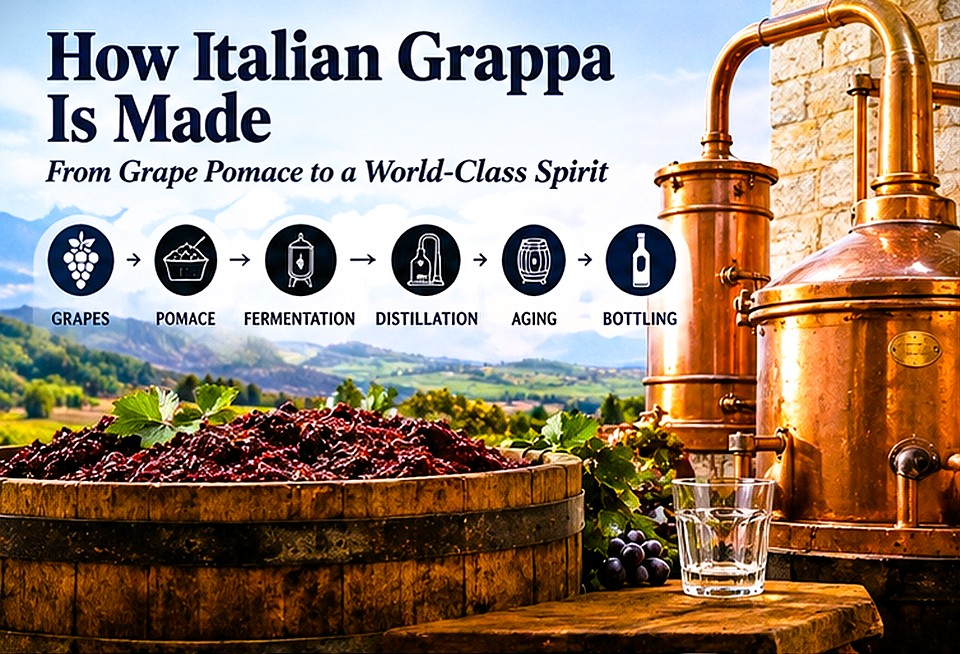
How Italian grappa is made from grape pomace through fermentation, distillation, aging and bottling
5. Marolo
Region: Piedmont
Marolo was founded in 1977 by Paolo Marolo in Alba. The company’s philosophy is strongly tied to Piedmont’s famous wine territory.
Its current range includes grappas from:
-
-
- Barolo
- Moscato
- Arneis
- Barbaresco
- Barbera
- Nebbiolo
- Freisa and other varieties.
-
Marolo also helped establish the idea of single-vineyard grappa, using pomace from specific vineyard sites.
Best for:
-
-
- Piedmontese wine lovers
- Barolo enthusiasts
- Single-vineyard exploration
-
6. Bonollo 1908
Region: Veneto
Bonollo is one of the major names in Italian grappa. Its current portfolio ranges from young grappas to long-aged reserves and cask-matured collections.
Its famous: OF Amarone Barrique. It’s made from pomace associated with Amarone della Valpolicella and aged in small French oak barrels. Bonollo’s Ligneum collection takes barrel maturation even further with 500-liter oak tonneaux.
Best for:
-
-
- Amarone lovers
- Barrel-aged grappa
- Modern premium releases
-
7. Sibona
Region: Piedmont
Antica Distilleria Sibona is one of Piedmont’s notable traditional producers. The company is part of the Consorzio Tutela Grappa del Piemonte e Grappa di Barolo network. Its current grappa range includes expressions connected with Piedmont’s major wine grapes and long maturation.
Sibona has also received recent competition recognition. At the 2026 Alambicco d’Oro, ANAG awarded Best Gold in the aged-grappa category to its Grappa Riserva Barolo 5 Years and Grappa Riserva Speciale Barolo Millesimata.
Best for:
-
-
- Barolo-based grappa
- Aged grappa
- Piedmont tastings
-
8. Marzadro
Region: Trentino
Marzadro is one of the major names associated with Trentino grappa. The producer is represented in the national grappa sector, with Alessandro Marzadro serving on the Consorzio Nazionale Grappa board.
The brand is known for both classic and aged expressions, including the Giare line. At the 2026 Alambicco d’Oro, Giare Amarone received a Best Gold award in the aged-grappa category.
Best for:
-
-
- Trentino styles
- Barrel-aged grappa
- Gifting
-
9. Castagner
Region: Veneto
Castagner is part of the modern Italian premium-grappa movement and a member of the national grappa sector organizations. The producer works with different grape varieties and styles, including both young and aged expressions.
Best for:
-
-
- Modern Italian grappa
- Varietal exploration
-
10. Roner
Region: Alto Adige / South Tyrol
Roner is one of the best-known Alpine distillers. Its portfolio includes:
-
-
- grappa
- fruit distillates
- liqueurs and other spirits.
-
At the 2026 Alambicco d’Oro, Roner Grappa Gewürztraminer received Best Gold in the aromatic-grappa category.
Best for:
-
-
- Aromatic grappa
- Alpine spirits
- Gewürztraminer lovers
-
11. Bepi Tosolini
Region: Friuli-Venezia Giulia
Bepi Tosolini is a historic Friulian distillery and a long-established name among Italian grappa producers. It appeared among the more frequently cited grappa brands in an older specialist survey alongside Poli, Berta, Nonino and Sibona.
Best for:
-
-
- Friulian grappa
- Traditional styles
-
12. Bonaventura Maschio
Region: Veneto
Bonaventura Maschio is the producer behind: La Grappa 903
The company is named after Bonaventura Maschio, who was born in 1903. The 903 line uses a balance of different pomaces distilled in dedicated copper stills. Its 903 Barrique expression is a barrel-aged version of the style.
Best for:
-
-
- Everyday sipping
- Barrique styles
- Classic Veneto
-
13. Andrea da Ponte
Region: Veneto
Andrea da Ponte is an established northern Italian producer included in the Consorzio Nazionale Grappa network. The producer is especially associated with Veneto’s Prosecco-growing landscape.
Best for:
-
-
- Prosecco-country grappa
- Veneto enthusiasts
-
14. Fratelli Francoli
Region: Piedmont
Francoli is another established northern Italian distillery and is included among members of the Piemonte and Barolo grappa consortium. It produces a broad selection of grappas and spirits.
Best for:
-
-
- Piedmont
- Traditional tasting
-
15. Deta Distillery
Region: Tuscany
Deta is a long-established Italian distillery and current member of the national grappa network
Best for:
-
-
- Tuscan spirits
- Regional exploration
-
16. La Valdôtaine
Region: Valle d’Aosta
La Valdôtaine represents one of Italy’s most geographically distinctive grappa traditions. The official national grappa consortium identifies La Valdôtaine as a member, while the EU separately protects Grappa della Valle d’Aosta / Grappa de la Vallée d’Aoste as a geographical indication.
The technical specification requires batch distillation of fermented or semi-fermented grape pomace using raw materials from authorized grape varieties grown and processed in Valle d’Aosta.
Best for:
-
-
- Mountain terroir
- Regional Italian spirits
- Collectors
-
17. Levi Serafino
Region: Piedmont
Levi Serafino is one of Piedmont’s recognized grappa producers and a member of the Piemonte and Grappa di Barolo consortium.
Best for:
-
-
- Piedmontese grappa
- Traditional producers
-
18. Mazzetti d’Altavilla
Region: Piedmont
Mazzetti d’Altavilla is another long-established Piedmontese name represented in the national grappa sector and the Piemonte consortium. The house produces a wide range of grappa and related spirits.
Best for:
-
-
- Piedmont
- Regional tasting flights
-
19. Distilleria Bocchino
Region: Piedmont
Bocchino is one of Piedmont’s historic grappa names and appears among producers listed by Italian specialist retailers and sector organizations.
Best for:
-
-
- Piedmontese traditions
- Classic grappa
-
20. Nannoni
Region: Tuscany
Nannoni is one of Italy’s important artisanal grappa producers and a member of the national sector network. The Tuscan location makes it especially interesting for enthusiasts who want to explore grappa connected with central Italy’s wine culture.
Best for:
-
-
- Tuscan grappa
- Small-batch exploration
-
21. Rossi d’Angera
Region: Lombardy
Rossi d’Angera is one of northern Italy’s historic distillers. The company is part of the Consorzio Nazionale Grappa network, with Arturo Rossi serving on the national association’s board.
Best for:
-
-
- Lombard spirits
- Traditional producers
-
22. Domenis 1898
Region: Friuli-Venezia Giulia
The name Domenis is associated with a long Friulian distillation tradition. It appears in Italian grappa producer listings and represents the region’s strong culture of grape-pomace distillation.
Best for:
-
-
- Friuli
- Traditional white grappa
-
23. Pisoni
Region: Trentino
Distilleria Fratelli Pisoni is another important Trentino producer. At the 2026 Alambicco d’Oro, its Clessidra 20 received Best Gold in the aged-grappa category.
Best for:
-
-
- Aged Trentino grappa
- Collectors
-
24. Unterthurner
Region: South Tyrol
Antica Distilleria Privata Unterthurner is a member of the national grappa sector and is represented on the Consorzio Nazionale Grappa board.
Best for:
-
-
- South Tyrol
- Alpine grappa
-
25. Segnana
Region: Trentino
Segnana, associated with the Fratelli Lunelli group, is one of Trentino’s recognizable distilling names and appears in Italian grappa producer listings.
Best for:
-
-
- Trentino
- Food pairing
- Classic Italian spirits
-
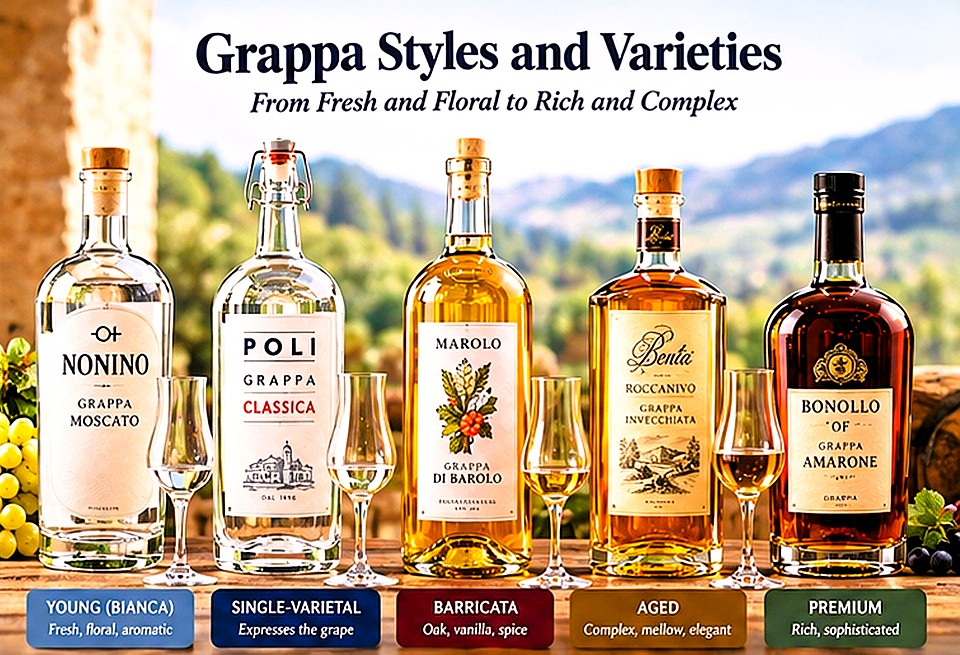
Italian grappa styles and varieties including young grappa, single-varietal, barricata, aged and premium grappa
26. Capovilla
Region: Veneto
Capovilla is particularly interesting for serious distillate enthusiasts. The producer describes its grappas as being made with organic pomace, using an original bain-marie double-distillation system designed to extract only the noblest components of the raw material.
Capovilla also works extensively with fruit distillates.
Best for:
-
-
- Artisanal distilling
- Purist tasting
- Advanced enthusiasts
-
27. Dellavalle
Region: Piedmont
Distilleria Dellavalle is part of the Piemonte and Grappa di Barolo consortium network.
Best for: Piedmontese regional exploration
28. Magnoberta
Region: Piedmont
Magnoberta is a historic Piedmontese distillery and current consortium member.
Best for:
-
-
- Traditional Piedmont
- Regional tasting
-
29. Valverde
Region: Piedmont
Valverde Liquori & Grappe is another producer in the Piemonte and Grappa di Barolo consortium. Its products include aged Piedmontese grappas. At the 2026 Alambicco d’Oro, Grappa di Barolo Stravecchia from Distilleria Valverde received Best Gold.
Best for: Aged Piedmontese grappa
30. Torino Distillati
Region: Piedmont
Torino Distillati is another recognized producer in the Piemonte and Grappa di Barolo consortium.
Best for:
-
-
- Piedmont
- Modern distillation
- Regional exploration
-
Best Grappa for Beginners
Grappa has an intimidating reputation because some bottles can be extremely aromatic or high in alcohol. Start with something clean, young, well-balanced and ideally around the low-40% ABV range.
Good styles to explore include:
-
-
- Nardini Grappa Bianca
- Nonino Vendemmia
- Poli Grappa
- Marzadro
- Bonaventura Maschio 903
-
A younger grappa lets you understand the basic character of the spirit before oak, smoke and long aging complicate the profile.
Nardini’s current Grappa Bianca, for example, is available through the LCBO and is described with aromas including cocoa, toasted nuts, white pepper, spice and floral notes.
Best Grappa for Sipping
For sipping, you can move toward:
-
-
- Monovitigno
- Riserva
- Barricata
- Stravecchia and older single-cask releases.
-
Excellent producers to explore include:
-
-
- Nonino
- Berta
- Marolo
- Poli
- Bonollo
- Sibona
- Marzadro
- Pisoni
- Lem? no, that’s Calvados—not grappa.
-
The best way to drink mature grappa is slowly. A small pour. A tulip-shaped glass. Room temperature or slightly cool. And time to let the aromas develop.
Nonino recommends around 12°C and an open tulip-shaped glass for several of its grappas.
Best Grappa for Cocktails
Young grappa is generally the better choice. You want aroma, freshness and enough personality to survive dilution.
Nonino has actively developed grappa cocktail culture, publishing drinks such as NoninoTonic and promoting grappa and distillates in cocktails and aperitifs.
Marolo also explicitly discusses the modern renaissance of grappa in mixology, saying bartenders increasingly use it as a flavorful core ingredient rather than a neutral base.
That makes grappa surprisingly useful behind a modern cocktail bar.
How to Drink Grappa
There are several traditional approaches.
Neat: The classic choice. Especially suitable for:
-
-
- aged grappa
- single-varietal grappa
- vintage releases
-
Chilled: Useful for:
-
-
- young grappa
- summer drinking
- aperitif occasions
-
With coffee: A small amount can be added to espresso. This is an Italian tradition often referred to as Caffè Corretto.
In cocktails: Modern producers increasingly promote tonics, highballs, sours and spritz-style drinks.
Grappa and Coffee
Grappa and coffee are a natural combination.
A simple:
Caffè Corretto- combines coffee with a small amount of spirit. Grappa works particularly well because its grape-derived aroma can add fruit, floral notes, herbs and spice.
For a modern version, try:
-
-
- 30 ml young grappa
- 30 ml espresso
- 10 ml coffee liqueur
- Ice
-
Shake. Strain into a chilled cocktail glass. This turns the classic coffee pairing into a contemporary cocktail. Nonino’s current cocktail library shows the broader trend toward using grappa in modern drinks.
Grappa and Food Pairing
Grappa is often thought of as simply an after-dinner drink. That’s too narrow. Its regional character makes it useful with many foods.
Grappa + cheese
Try:
-
-
- Parmigiano Reggiano
- Gorgonzola
- aged Pecorino
- Taleggio
-
Grappa + chocolate
Aged grappa can work beautifully with:
-
-
- dark chocolate
- chocolate cake
- truffles
- hazelnut desserts
-
Grappa + fruit
Young aromatic grappa can pair with:
-
-
- pear
- apple
- peach
- berries
-
Grappa + coffee
A natural after-dinner combination.
Grappa + nuts
Aged grappa can complement:
-
-
- almonds
- hazelnuts
- walnuts
-
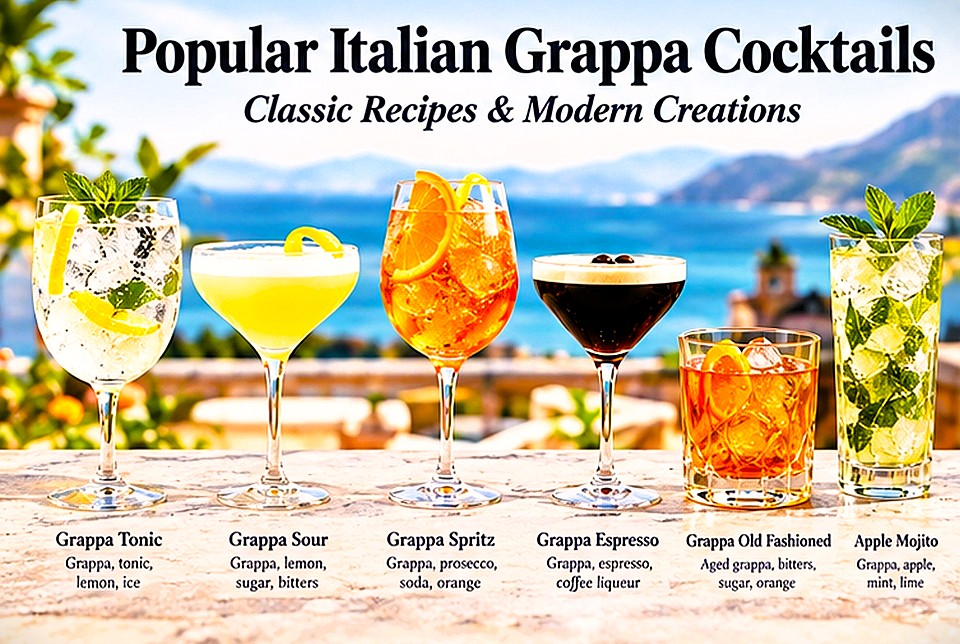
Popular Italian grappa cocktails including Grappa Tonic, Grappa Sour, Grappa Spritz, Grappa Espresso, Grappa Old Fashioned and Grappa Mojito
Grappa and Chocolate
This pairing works particularly well with barrel-aged grappa.
Wood aging contributes:
-
-
- vanilla
- toast
- caramel
- spice.
-
Chocolate contributes:
-
-
- cocoa
- bitterness
- richness.
-
Try: Berta Roccanivo + dark chocolate or Bonollo OF Amarone Barrique + chocolate truffles. The result can feel surprisingly close to a dessert wine experience—except much more spirit-driven.
Grappa and Cheese
Cheese is another natural partner. Young grappa can refresh the palate after rich cheese. Mature grappa can match the deeper flavors of aged cheese.
Try:
-
-
- Parmigiano Reggiano + young grappa
- Gorgonzola + mature grappa
- Pecorino + Nebbiolo-based grappa
- Taleggio + aromatic grappa
-
Piedmontese grappa is particularly interesting with local cheeses because the grape and food traditions come from the same territory.
Grappa Cocktails
Modern grappa is not restricted to neat service.
Grappa Tonic
-
-
- 45 ml grappa
- 120 ml tonic
- Lemon or grapefruit
- Ice
-
Build in a large glass.
Grappa Sour
-
-
- 50 ml grappa
- 25 ml lemon juice
- 15 ml simple syrup
- 2 dashes bitters
-
Shake. Strain over ice.
Grappa Spritz
-
-
- 30 ml grappa
- 60 ml sparkling wine
- 30 ml soda
- Orange peel
-
Grappa Collins
-
-
- 45 ml grappa
- 25 ml lemon juice
- 15 ml simple syrup
- Soda water
-
Grappa Espresso
-
-
- 40 ml grappa
- 30 ml espresso
- 15 ml coffee liqueur
-
Shake with ice.
Grappa Old Fashioned
-
-
- 50 ml aged grappa
- 7.5 ml simple syrup
- 2 dashes bitters
- Orange peel
-
Stir with ice.
The modern cocktail movement around grappa isn’t entirely new. Nonino says it began introducing bartenders to grappa cocktails around the turn of the century, while Marolo describes grappa as a core ingredient for modern mixology.
Grappa vs. Brandy
Grappa and brandy are related but different.
Brandy: A broad category of distilled fermented fruit or wine-based beverages.
Grappa: A specific Italian grape-pomace spirit. The simplest distinction:
Brandy is commonly distilled from wine or fermented fruit. Grappa is distilled from grape pomace left from winemaking. That difference gives grappa a distinct relationship with Italian winemaking.
Grappa vs. Cognac
Cognac is made from wine and is produced under a specific French geographical indication. Grappa is made from grape pomace and is an Italian geographical-indication spirit.
Cognac tends to develop:
-
-
- vanilla
- oak
- dried fruit
- floral notes through long maturation.
-
Young grappa can taste:
-
-
- fresh
- grapey
- herbal
- aromatic.
-
They are both excellent after dinner, but they tell completely different stories.
Grappa vs. Pisco
Both are grape-derived spirits. But Pisco is made from grapes or wine depending on the national production framework. Grappa is made from Italian grape pomace.
Pisco is strongly associated with Peru and Chile, while grappa is fundamentally Italian. Their cocktail cultures are also different.
Pisco is famous for Pisco Sour, while grappa is increasingly used in sours, highballs, tonics and coffee drinks.
Current Grappa Trends
The grappa category is changing.
1. Premiumization
AssoDistil’s current industry commentary argues that grappa has the potential to occupy a luxury position, partly because available Italian pomace limits how much can be produced.
2. Single-varietal production
Nonino helped establish this approach in the 1970s, and producers such as Marolo and Bonollo continue to highlight grape-specific character.
3. Long aging
Producers increasingly use oak, acacia, Sherry casks, wine casks and other barrels. Nonino currently offers grappa aged for periods ranging from months to decades, including very old single-cask and Sherry-cask releases.
4. Cask innovation
Bonollo’s Ligneum collection uses large oak tonneaux, while Poli has experimented with grape marc from Bordeaux and specialized long-aged projects.
5. Mixology
Nonino and Marolo are actively promoting grappa in cocktails, helping the spirit move beyond traditional after-dinner service.
6. International exports
AssoDistil’s latest detailed published export data show that Germany has historically been the largest bottled-grappa export destination, with Switzerland, Austria, the United States and Canada also represented.
Why Italian Grappa Is Becoming More Interesting Internationally
For many decades, grappa had a reputation as a strong, rustic digestive. That image is increasingly incomplete. The modern premium category is much more sophisticated.
Look at:
-
-
- Nonino Picolit
- Marolo Barolo
- Berta aged releases
- Bonollo Amarone
- Poli Prosecco
- Roner Gewürztraminer
- Sibona Barolo
- Pisoni aged grappa
-
These aren’t interchangeable spirits.
-
-
- They reflect the grape.
- The wine region.
- The distiller.
- The still.
- The aging vessel.
- The blending philosophy.
-
In other words, modern grappa has become increasingly similar to fine wine in one crucial respect provenance matters.
How to Build a Grappa Tasting
A five-bottle tasting can teach you a great deal.
1. Young white grappa
Example: Nardini Bianca
2. Single-varietal
Example: Nonino Moscato
3. Piedmontese varietal
Example: Marolo Barolo
4. Barrel-aged
Example: Bonollo OF Amarone Barrique
5. Mature reserve
Example: Berta
Taste them in that order. The progression takes you from fresh to aromatic, regional, oaky and mature.

Italian grappa food pairings with seafood, Parmigiano, Pecorino, Gorgonzola, roast meats, fruit desserts, chocolate and coffee
Frequently Asked Questions
What is grappa?
Grappa is an Italian spirit distilled from grape pomace left after winemaking.
Is grappa a brandy?
Grappa is a distinct Italian grape-pomace spirit, although it belongs to the broader world of fruit and wine-related distillates.
Where is grappa made?
Grappa is associated with Italy and is produced throughout Italian wine regions.
What is the best grappa brand?
There is no single universally accepted best brand. Nonino, Nardini, Berta, Poli, Marolo, Bonollo, Sibona, Marzadro and many regional producers represent different styles.
What are the most famous grappa brands?
Nonino, Nardini, Berta and Poli are among the most internationally recognizable names, while Marolo, Bonollo, Sibona and Marzadro are also highly visible premium producers.
What is the oldest grappa brand?
Nardini dates to 1779 and is one of the oldest continuously operating grappa distilleries.
When was Nonino founded?
Nonino traces its distilling history to 1897.
When was Poli founded?
Poli’s distillery was founded in 1898 in Schiavon.
When was Berta founded?
Distillerie Berta was established in 1947 by Paolo Berta.
When was Marolo founded?
Marolo was founded in 1977 by Paolo Marolo in Alba.
What is single-varietal grappa?
It is grappa made from pomace associated with one grape variety rather than a blend of different varieties.
Why is Nonino important to single-varietal grappa?
Nonino says Benito and Giannola Nonino created a commercial single-varietal Picolit grappa in 1973.
What is grappa barricata?
It is grappa matured in wooden barrels, often developing vanilla, spice, toast and caramel notes.
What is aged grappa?
Grappa that has spent time in wood rather than being bottled immediately after distillation.
What does young grappa taste like?
It can be fresh, floral, grapey, herbal and aromatic.
What does aged grappa taste like?
It can develop vanilla, caramel, spice, dried fruit, toasted wood and nutty notes.
What is the best grappa for beginners?
A smooth young grappa such as Nardini, Nonino Vendemmia, Poli or Marzadro is a practical starting point.
What is the best grappa for sipping?
Single-varietal, aged and reserve grappas from producers such as Nonino, Berta, Marolo, Poli, Sibona and Bonollo are useful choices.
What is the best grappa for cocktails?
A young, aromatic grappa usually works best.
Can you mix grappa with tonic?
Yes. Grappa Tonic is a simple contemporary long drink.
Can you make a sour with grappa?
Yes. Lemon, sugar and bitters work well with young grappa.
Can grappa be used in an Old Fashioned?
Yes, particularly aged grappa.
Can grappa be mixed with coffee?
Yes. Caffè Corretto is a traditional Italian way to combine coffee and spirits.
What coffee goes with grappa?
Espresso is the classic choice.
What food goes with grappa?
Cheese, chocolate, nuts, fruit desserts, coffee and a range of Italian foods can work.
Does grappa go with chocolate?
Yes. Mature, barrel-aged grappa can be especially good with dark chocolate.
Does grappa go with cheese?
Yes. Young grappa can refresh rich cheese, while aged grappa can match stronger aged varieties.
Does grappa go with dessert?
Yes. Try it with apple, pear, hazelnut, chocolate and cream-based desserts.
What glass should you use for grappa?
A tulip-shaped glass is especially useful because it concentrates aromas. Nonino recommends an open tulip-shaped glass around 12°C for several expressions.
Should grappa be chilled?
Young grappa can be served chilled, while aromatic and aged examples are often better slightly cool rather than very cold.
Should grappa be served at room temperature?
Mature expressions can be served around cellar or cool-room temperature, depending on the producer and personal preference.
Does grappa age in the bottle?
No. Like other distilled spirits, maturation primarily occurs in wood or other storage vessels before bottling.
What grape varieties are used for grappa?
Many varieties are used, including Moscato, Prosecco/Glera, Nebbiolo, Barbera, Arneis, Merlot, Sauvignon Blanc, Picolit and others.
What is Moscato grappa?
Grappa made from Moscato grape pomace, often aromatic and floral. Nonino’s current Moscato Grappa is bottled at 41% ABV and is described with aromas of roses, thyme and vanilla.
What is Prosecco grappa?
Grappa made from pomace associated with grapes used for Prosecco. Nonino’s current expression uses Glera pomace and is bottled at 38% ABV.
What is Barolo grappa?
Grappa made from pomace from Barolo-related Nebbiolo grapes. Marolo produces several Barolo grappas.
What is Amarone grappa?
A grappa made from pomace associated with Amarone della Valpolicella. Bonollo’s OF Amarone Barrique is a notable example.
Is grappa strong?
Yes. Many traditional grappas are around 40% ABV or higher, and some are bottled at significantly higher strengths. Nonino currently offers a 50% ABV Tradizione expression, for example.
Is grappa sweet?
Traditional grappa is generally not a sweet liqueur. The impression of sweetness varies according to grape variety, aromatic profile and aging.
Is grappa gluten-free?
Grape-based grappa does not contain gluten inherently, but people with specific dietary requirements should verify individual producer information and processing.
Is grappa vegan?
Many grappas may be vegan, but this should be checked with the specific producer.
Is grappa made from wine?
Not directly. Grappa is made from grape pomace left after winemaking.
Is grappa made from grapes?
Yes, but specifically from the solid grape material remaining after winemaking rather than simply fermented grape juice.
Is grappa the same as Cognac?
No. Cognac is a French grape-wine spirit; grappa is an Italian grape-pomace spirit.
Is grappa the same as Pisco?
No. Both are grape-related spirits, but they have different raw materials, geographical identities and production traditions.
Is grappa the same as Marc?
No. Marc is a French pomace spirit; grappa is the Italian category.
What is the most popular grappa in Italy?
There is no single current authoritative nationwide ranking covering every producer and every sales channel.
What is the most popular grappa in the world?
There is no single universally accepted global ranking. International recognition and domestic sales can produce different results.
Is Nonino good grappa?
Nonino is one of the most internationally recognized premium grappa producers and is especially known for single-varietal and aged expressions.
Is Nardini good grappa?
Nardini is one of Italy’s longest-established grappa producers and its Bianca expression remains widely distributed.
Is Berta good grappa?
Berta is particularly known for aged premium grappa and has expanded distribution to more than 70 countries according to the producer.
Is Poli good grappa?
Poli is an established family distillery founded in 1898 and remains strongly associated with handcrafted Veneto grappa.
Is Marolo good grappa?
Marolo is particularly notable for Piedmontese single-varietal and single-vineyard grappas.
Is Bonollo good grappa?
Bonollo produces both young and mature grappas, including OF Amarone Barrique and the Ligneum aged collection.
Final Thoughts: The Most Popular Italian Grappa Brands in the World
Italian grappa is one of those spirits that becomes more interesting the more you learn about it. At first glance, the category can appear simple.
-
-
- A clear or amber spirit.
- A grape connection.
- A high alcohol level.
-
But underneath that simplicity is an enormous amount of variety. The starting point is grape pomace. But pomace from which grapes? That’s the first question.
-
-
- Moscato?
- Nebbiolo?
- Prosecco/Glera?
- Barbera?
- Sauvignon Blanc?
- Merlot?
- Picolit?
-
The answer can radically change the character of the final spirit. That’s why Nonino’s single-varietal philosophy was so significant. The company says its 1973 Picolit grappa marked a turning point in the way grappa was produced, introduced and presented.
Suddenly, grappa could be understood through the grape. That idea spread.
-
-
- Marolo built a portfolio around some of Piedmont’s most famous grape varieties.
- Bonollo does the same through expressions such as Moscato, Chardonnay and Amarone.
- Poli produces a wide range of grape-linked spirits and emphasizes fresh pomace and copper batch distillation.
- Capovilla takes the artisanal concept even further with organic pomace and a carefully controlled double-distillation bain-marie method.
-
Then there’s aging. A young grappa can be:
-
-
- clear
- fresh
- floral
- grapey
- herbal.
-
An aged grappa can become:
-
-
- golden
- vanilla-rich
- spicy
- nutty
- caramelized
- wood-driven.
-
That’s where Berta, Bonollo, Marolo, Sibona and other producers become particularly interesting.
-
-
- Berta’s history is closely connected to the development of aged grappa as a premium product.
- Bonollo’s OF Amarone Barrique brings pomace from Amarone della Valpolicella into French-oak maturation. Bonollo’s Ligneum collection uses 500-liter oak tonneaux, while Marolo has spent decades experimenting with woods and long aging.
- Poli has experimented with extraordinary projects, including its La Première spirit made from grape marc sourced from a Bordeaux Premier Cru.
-
And that’s before you reach the regional differences.
-
-
- Friuli.
- Veneto.
- Piedmont.
- Trentino.
- South Tyrol.
- Lombardy.
- Tuscany.
- Valle d’Aosta.
-
Each brings a different agricultural and cultural environment. That means the phrase “Italian grappa”
doesn’t tell you nearly enough.
You need to ask:
-
-
- Where was it produced?
- Which grapes?
- How fresh was the pomace?
- How was it distilled?
- Was it aged?
- What kind of wood was used?
- Is it single-varietal?
- Is it a blend?
-
Those questions turn grappa from a generic digestive into a serious tasting category. And that is exactly what is happening internationally.
Current industry information from AssoDistil shows that grappa remains the leading component of Italy’s aquavit production, with around 80,000 hectolitres produced in 2025.
Earlier export data show that bottled grappa reaches international markets including Germany, Switzerland, Austria, the United States and Canada. That international distribution matters because grappa is no longer confined to Italian restaurants and family tables.
It is appearing in:
-
-
- specialty spirits stores
- cocktail bars
- fine-dining restaurants
- airport retail
- premium gift collections
- international tasting events.
-
The cocktail movement is especially interesting. Nonino actively promotes grappa in cocktails and aperitifs, while Marolo explicitly describes the modern mixology movement as using grappa as a flavorful core ingredient rather than treating it as a neutral spirit. That’s an important change.
Grappa doesn’t need to compete with vodka, gin, rum, whisky by pretending to taste like them. It can bring something completely different.
-
-
- Grape aromatics.
- Floral notes.
- Pepper.
- Herbs.
- Spice.
- Fruit.
-
And, with aging, oak and vanilla.
-
-
- A simple Grappa Tonic can reveal those aromatics.
- A Grappa Sour can put them into an acidic structure.
- A Grappa Espresso can connect the spirit to Italy’s coffee culture.
- An Old Fashioned-style grappa cocktail can show how barrel-aged expressions work with bitters and sugar.
-
But neat drinking remains fundamental. For a young grappa, try: 12°C and a tulip-shaped glass. For an aged grappa, take your time. Swirl gently. Smell. Taste. Let the spirit open.
Nonino’s own serving guidance recommends an open tulip-shaped glass and approximately 12°C for several expressions and then there is food. This is where grappa’s Italian identity becomes especially clear.
A little grappa after:
-
-
- Parmigiano Reggiano
- Pecorino
- Gorgonzola
- dark chocolate
- hazelnut dessert
- espresso
-
makes immediate culinary sense. The pairing isn’t an afterthought. It is part of the culture. The same raw material that produced the wine can produce a spirit that finishes the meal. That circular agricultural relationship is one of grappa’s greatest strengths.
-
-
- The best way to explore the category is therefore not to ask: “Which grappa is the best?”
- A better question is: “Which style of grappa do I want to discover?”
-
For fresh and aromatic:
-
-
- Nonino
- Nardini
- Poli
- Roner
-
For Piedmont:
-
-
- Berta
- Marolo
- Sibona
- Mazzetti
-
For barrel-aged:
-
-
- Bonollo
- Berta
- Marzadro
- Poli
- Pisoni
-
For Alpine styles:
-
-
- Roner
- Marzadro
- Pisoni
- Unterthurner
-
For deeply artisanal distillation:
-
-
- Capovilla
- Nonino
- Marolo
-
That is the real beauty of the category. There is no reason to stop at one bottle. Start with a young white grappa.
-
-
- Then try a Moscato.
- Then a Nebbiolo-based expression.
- Then a barrel-aged version.
- Then a mountain grappa.
- Then an old reserve.
-
The progression teaches you more than any single tasting note. You start to recognize grape variety, distillation style, regional identity and wood. And eventually you understand why Italian grappa has such a devoted following.
It isn’t simply a strong spirit made from what remained after wine. It is a distilled expression of Italian winemaking. Every vineyard leaves something behind. Grappa takes that material and gives it another life.
That’s why the category has such a compelling philosophy:
-
-
- Wine captures the juice.
- Grappa captures the pomace.
-
And Italy has spent generations learning how to turn that humble raw material into something worthy of a place alongside the world’s great spirits.
From Nardini’s 1779 heritage to Nonino’s 1970s single-varietal revolution, from Poli’s Veneto family tradition to Marolo’s Piedmont vineyard focus, from Berta’s long aging to Bonollo’s cask experimentation, the category continues to evolve.
And that makes now a particularly interesting time to explore Italian grappa. The old traditions are still there.
But so are:
-
-
- single-varietal grappas
- organic pomace
- long-aged reserves
- single casks
- unusual woods
- cocktails
- international distribution.
-
Whether you’re a wine lover, whisky collector, cocktail enthusiast or simply curious about Italian spirits, grappa offers an entirely different perspective.
-
-
- Start with one bottle.
- Taste it slowly.
- Learn the grape.
- Learn the region.
- Then compare.
-
That’s where the real adventure begins.