
Blog
Most Popular Absinthe Brands in the World: 30 Famous Absinthe Bottles Every Absinthe Lover Should Know

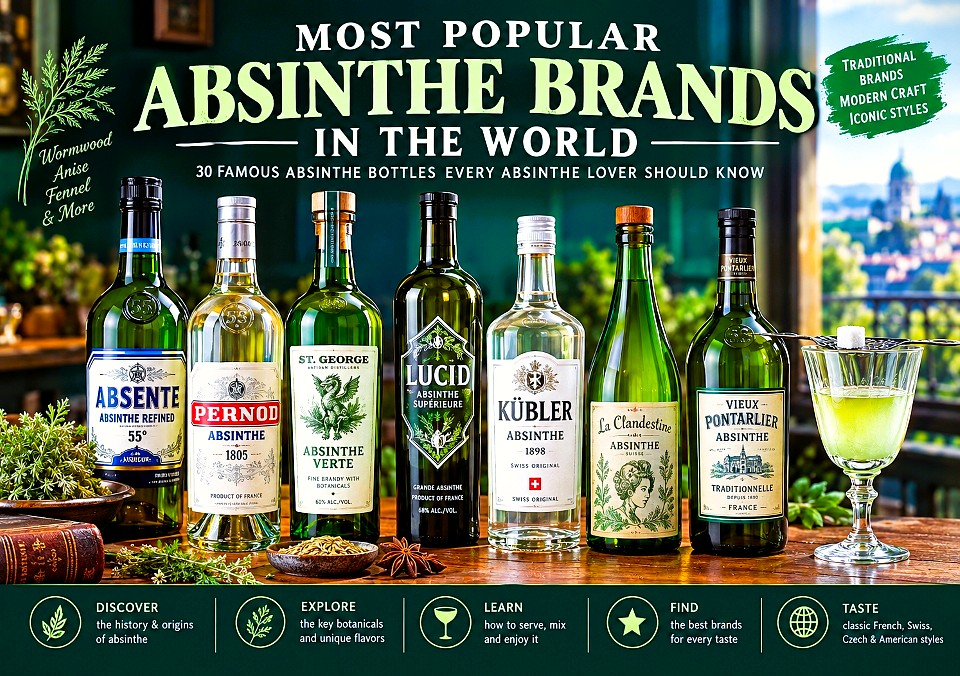
Discover 30 of the most popular and influential absinthe brands in the world, including Absente, Pernod Absinthe, St. George Absinthe Verte, Lucid, Kübler, La Clandestine, Vieux Pontarlier, La Fée, Jade, Duplais and more. Learn about traditional absinthe, wormwood, anise, fennel, the famous louche, absinthe history, serving methods, cocktail uses and how to choose the right bottle.
Absinthe is one of the most fascinating spirits in the world. Few alcoholic beverages have a history quite as dramatic.
For generations, absinthe was associated with Belle Époque cafés, artists, writers, bohemian culture and the legendary “green fairy.” It became famous for its brilliant color, high alcohol content and powerful botanical aroma, before prohibition and changing public perceptions pushed it out of mainstream drinking culture.
Today, absinthe is enjoying a very different kind of revival.
Modern producers in France, Switzerland, the Czech Republic, Spain and the United States are making traditional-style absinthes, while contemporary bartenders use the spirit in classics such as the Sazerac, Corpse Reviver No. 2, Absinthe Frappé and Death in the Afternoon.
The category is also much larger than many people realize. Some absinthes are:
- Bright green and herbal
- Completely clear
- Dry and anise-forward
- Floral and aromatic
- Bitter and intensely wormwood-driven
- Soft and rounded
- Spicy and complex
And while the name “Absente” appears in your requested title, the broader category is conventionally spelled “absinthe.” The article below therefore uses “absinthe” for the category while including Absente as a specific brand.
There is also an important legal point.
In the United States, the Alcohol and Tobacco Tax and Trade Bureau says products using ingredients that typically contain thujone require formula approval and must be thujone-free under the applicable U.S. standard, which the TTB defines as less than 10 parts per million.
In the European Union, current regulations set maximum thujone levels that differ according to the beverage category and whether the beverage is produced from Artemisia species.
So the modern absinthe on your shelf is not the mythical, unrestricted spirit of old Paris. It’s a carefully regulated botanical spirit with a remarkable history and a surprisingly sophisticated flavor profile.
Table of Contents
- What Is Absinthe?
- What Is Absinthe Made From?
- The Famous “Holy Trinity” of Absinthe
- Wormwood and Thujone Explained
- Why Absinthe Turns Cloudy
- The History of Absinthe
- Absinthe Styles Around the World
- The 30 Most Popular Absinthe Brands
- Absente
- Pernod Absinthe
- St. George Absinthe Verte
- Lucid
- Kübler
- La Clandestine
- Vieux Pontarlier
- La Fée
- Jade Absinthe
- Duplais
- Grande Absente
- Nouvelle-Orléans
- Leopold Brothers Absinthe Verte
- Mansinthe
- Obsello
- Butterfly Absinthe
- Sirène Absinthe
- Delaware Phoenix
- Marteau
- Common Sense Absinthe
- Golden Moon Redux
- Leopold Brothers Verte
- Other Famous Absinthe Names
- Best Absinthe for Beginners
- Best Absinthe for Traditional Preparation
- Best Absinthe for Cocktails
- Best French Absinthe
- Best Swiss Absinthe
- Best American Absinthe
- Green vs. Blanche Absinthe
- How to Serve Absinthe
- How to Choose the Right Absinthe
- Frequently Asked Questions
- Final Thoughts
What Is Absinthe?
Absinthe is a distilled herbal spirit traditionally made using:
wormwood + anise + fennel
along with other botanicals. The result is a highly aromatic, often high-proof spirit with a distinctive herbal and licorice-like character.
Absinthe is usually associated with:
- Green color
- High alcohol
- Herbal aromas
- Anise
- Wormwood
- Fennel
- Citrus
- Mint
- Spices
- Bitter complexity
The spirit can be enjoyed in several ways, but the traditional method is particularly famous because adding cold water creates the louche—the transformation from a clear spirit into a cloudy, opalescent drink.
What Is Absinthe Made From?
Traditional absinthe begins with a neutral or distilled alcohol base, often derived historically from wine in French and Swiss styles.
The botanicals are then introduced through combinations of:
- Maceration
- Distillation
- Secondary infusion
The exact recipe varies dramatically from producer to producer.
Common botanicals include:
Grande wormwood, Green anise, Fennel, Pontic wormwood, Hyssop, Lemon balm, Mint, Angelica, Coriander, Licorice
This is why two absinthes can taste so different. One may be extremely anise-forward. Another may emphasize wormwood and bitterness. Another may showcase floral herbs. Another may have a citrusy, minty finish.
The Famous “Holy Trinity” of Absinthe
The three botanicals traditionally associated with classic absinthe are:
Wormwood
The bitter, herbal backbone.
Anise
Provides the characteristic licorice-like aroma.
Fennel
Adds sweetness, spice and complexity. Together, they create the classic absinthe profile. But serious producers rarely stop there.
St. George Absinthe Verte, for example, uses wormwood, fennel and star anise in a brandy base and then adds mint, tarragon, Genovese basil, lemon balm, hyssop and stinging nettle.
That illustrates how modern artisan absinthe can take a traditional foundation and develop an entirely individual botanical signature.
Wormwood and Thujone Explained
Wormwood contains compounds including thujone, which became central to absinthe’s mythology. Historical stories often attributed hallucinations and unusual behavior to thujone.
Modern absinthe, however, is heavily regulated.
In the United States, the TTB says imported distilled spirits made with ingredients that typically contain thujone require formula approval and must contain less than 10 parts per million thujone to qualify as thujone-free under the applicable standard.
European regulations also establish maximum levels for thujone in alcoholic beverages, including separate limits depending on whether the beverage is produced from Artemisia species.
So the sensational claim that modern legal absinthe is a hallucinogenic drug is misleading. The real experience is botanical, aromatic and alcoholic. And the alcohol itself is significant.
Many absinthes are bottled around:
50–70% ABV which means they should be treated as a powerful spirit.
Why Does Absinthe Turn Cloudy?
This is called the louche. When absinthe is bottled, essential oils from anise, fennel and other botanicals remain dissolved in the alcohol.
When you slowly add chilled water, the alcohol concentration falls. The essential oils become less soluble and begin to separate from the liquid.
The result is:
clear → cloudy → milky → opalescent
This visual transformation is one of the most beautiful parts of traditional absinthe service. The louche can also release additional aromas.
Suddenly you may notice:
- Anise
- Fennel
- Mint
- Floral herbs
- Citrus
- Spice
That is why traditional preparation is about more than dilution. It’s also an aroma experience.
The History of Absinthe
Absinthe became strongly associated with 19th-century France and Switzerland, eventually developing a huge cultural following.
The drink was particularly popular in the cafés of Paris. Its ritualized preparation became part of social life.
But by the early 20th century, negative campaigns increasingly associated absinthe with:
- Addiction
- Madness
- Violence
- Mental illness
The famous image of the “green fairy” became part of the mythology. Absinthe bans followed in a number of countries.
The United States prohibited absinthe in 1912. St. George Spirits notes that its Absinthe Verte was the first legal American absinthe released after the U.S. ban was lifted in 2007.
That modern revival is important because it helped transform absinthe from a forbidden historical curiosity into a legitimate spirits category.
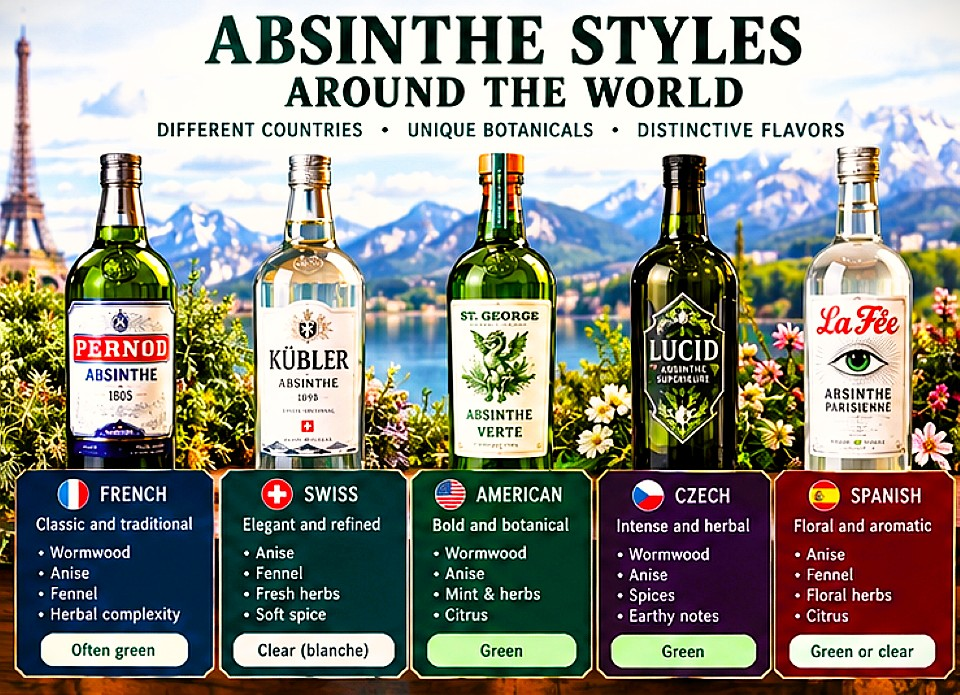
Absinthe Styles Around the World
French Absinthe
Often emphasizes:
- Anise
- Fennel
- Wormwood
- Herbal complexity
- Traditional distillation
Swiss Absinthe
Often includes both:
- Green absinthe
- Clear “blanche” absinthe
Swiss clear absinthes can be especially elegant and refined.
Czech Absinthe
Czech-style products can differ significantly from classic French and Swiss absinthe.
They may emphasize:
- Bitter wormwood
- Strong herbal notes
- Lower anise character
- Sweetness
- Distinctive modern styles
Not every Czech product should be assumed to represent the traditional French/Swiss profile.
American Absinthe
Modern American artisan distillers have developed highly creative interpretations. The most important early example is St. George Absinthe Verte.
The 30 Most Popular Absinthe Brands in the World
1. Absente
Country: France
Style: French-style absinthe
Absente is one of the most recognizable brands associated with modern absinthe culture. Its name is particularly important because of the way it brings the word absinthe into mainstream spirits retail.
Absente is commonly associated with a sweeter, accessible interpretation of the category.
Best for
- Beginners
- Casual tasting
- Absinthe cocktails
- Exploring the category
Why try it?
It’s a familiar entry point for people discovering absinthe for the first time.
2. Pernod Absinthe
Country: France
Producer: Pernod Ricard
Pernod has one of the most important historical connections to absinthe.
The Pernod company says its origins date back to 1805, and its historical story is deeply connected with absinthe production in Pontarlier. The modern Pernod Absinthe is described by the company as a return to a traditional-style absinthe using grande wormwood, anise and aromatic herbs. It is bottled at 68% ABV.
Flavor profile
Expect:
- Anise
- Herbal notes
- Wormwood
- Spice
- Freshness
Best for
Traditional-style drinking and cocktails.
Why try it?
Few names have a stronger historical connection to absinthe.
3. St. George Absinthe Verte
Country: United States
Producer: St. George Spirits
ABV: 60%
St. George Absinthe Verte is one of the defining bottles of the modern American absinthe revival. The producer calls it the first legal American absinthe released after the U.S. ban was lifted in 2007.
Its botanical recipe includes:
- Wormwood
- Fennel
- Star anise
- Mint
- Tarragon
- Genovese basil
- Lemon balm
- Hyssop
- Stinging nettle
The resulting spirit is intensely herbaceous, with notes of licorice, citrus, grass and sarsaparilla.
Best for
Experienced drinkers and cocktails.
4. Lucid Absinthe Supérieure
Country: France
Lucid has become one of the best-known modern absinthe brands in North America. It is particularly important because the brand became associated with the U.S. absinthe revival after federal restrictions were relaxed.
Typical character
- Anise
- Wormwood
- Herbal notes
- Citrus
- Spice
Best for
Traditional preparation and cocktails.
How to serve absinthe using cold water, sugar and an absinthe spoon to create the traditional louche
5. Kübler
Country: Switzerland
Kübler is an important Swiss absinthe brand known for its clear, uncolored style. It represents the Swiss “blanche” tradition beautifully.
Flavor profile
Expect:
- Anise
- Fennel
- Herbs
- Soft spice
- Creamy texture
Best for
Drinkers who want clear Swiss absinthe.
6. La Clandestine
Country: Switzerland
La Clandestine has become one of the best-known names in Swiss absinthe. It’s particularly associated with a refined and elegant style.
Typical character
- Fresh herbs
- Anise
- Fennel
- Floral notes
- Light spice
Best for
Beginners looking for an elegant absinthe.
7. Vieux Pontarlier
Country: France
Region: Pontarlier
Vieux Pontarlier is closely associated with the historic absinthe-producing region of Pontarlier. The producer describes the absinthe as being made in small quantities in century-old stills using local plants, green anise and fine herbs.
Typical character
- Anise
- Mint
- Herbal freshness
- Citrus
- Balanced bitterness
Best for
Traditional absinthe enthusiasts.
8. La Fée
Country: France / Czech Republic depending on expression
La Fée is one of the internationally recognizable names in contemporary absinthe. The brand has developed a range of expressions exploring classic French and modern interpretations.
Best for
9. Jade Absinthe
Country: France
Jade is highly regarded among serious absinthe enthusiasts for its focus on historical recreation. Several expressions are based around old recipes and historical styles.
Best for
Collectors and traditionalists.
10. Duplais
Country: Switzerland
Duplais is known for taking inspiration from 19th-century Swiss absinthe.
Typical character
- Wormwood
- Anise
- Fennel
- Herbs
- Spice
Best for
Traditional absinthe enthusiasts.
11. Grande Absente
Country: France
Grande Absente is one of the widely recognized French brands in modern absinthe retail. It tends to offer a powerful profile with strong anise and herbal notes.
Best for
- Traditional preparation
- Cocktails
- Strong-flavored spirits enthusiasts
12. Absinthe Nouvelle-Orléans
Style: French-inspired
Nouvelle-Orléans-style absinthe reflects the enormous historical connection between absinthe and New Orleans cocktail culture.
Its role is particularly interesting in drinks such as:
Sazerac
Absinthe Frappé
Best for
Cocktails and historical cocktail enthusiasts.
13. Leopold Brothers Absinthe Verte
Country: United States
Leopold Brothers is one of America’s most respected craft distilling families. Its absinthe is designed around a complex botanical structure.
Typical notes
- Herbal
- Anise
- Wormwood
- Floral
- Citrus
Best for
American craft-spirit enthusiasts.
14. Mansinthe
Country: Switzerland
Mansinthe gained international attention because of its association with musician Marilyn Manson. Despite the novelty factor, it is a genuine absinthe with a serious botanical character.
Typical notes
- Wormwood
- Anise
- Herbaceous
- Citrus
- Spice
Best for
Collectors and curious enthusiasts.
15. Obsello
Country: Spain
Obsello became known for its Spanish interpretation of absinthe.
Flavor profile
- Anise
- Fennel
- Herbs
- Citrus
- Spice
Best for
Drinkers exploring absinthe beyond France and Switzerland.
16. Butterfly Absinthe
Country: United States
Butterfly Absinthe represents the contemporary American craft movement. It focuses on traditional botanical foundations with modern production.
Best for
Artisan-spirit enthusiasts.
17. Sirène Absinthe Superieure
Country: United States
Sirène is one of the notable American craft absinthes. The brand is particularly associated with a traditional absinthe profile and strong botanical expression.
Best for
Traditional-style service and cocktails.
18. Delaware Phoenix
Country: United States
Delaware Phoenix is particularly interesting because it approaches absinthe through small-scale artisan distilling.
Best for
Collectors and craft-spirit enthusiasts.
19. Marteau Absinthe de la Belle Époque
Country: United States
Marteau is designed around historic French-style absinthe traditions. The name itself reflects the Belle Époque period that has become central to absinthe’s cultural identity.
Best for
Traditionalists and serious absinthe drinkers.
20. Common Sense Absinthe
Country: United States
Common Sense is another American craft expression worth exploring.
Best for
Absinthe enthusiasts looking beyond the major commercial brands.
21. Golden Moon Redux Absinthe
Country: United States
Golden Moon’s Redux is an American interpretation of traditional absinthe.
Typical character
- Herbaceous
- Anise
- Wormwood
- Citrus
- Spice
Best for
Craft-spirit enthusiasts.
22. Leopold Brothers Absinthe Verte
This expression deserves additional recognition because Leopold Brothers has become one of America’s respected craft producers. Its approach focuses heavily on botanical balance rather than gimmick.
Best for
23. Vieux Carré Absinthe Supérieure
Country: United States
Vieux Carré Absinthe Supérieure is particularly associated with New Orleans cocktail culture. Its name references the city’s historic French Quarter.
Best for
Sazeracs and classic New Orleans cocktails.
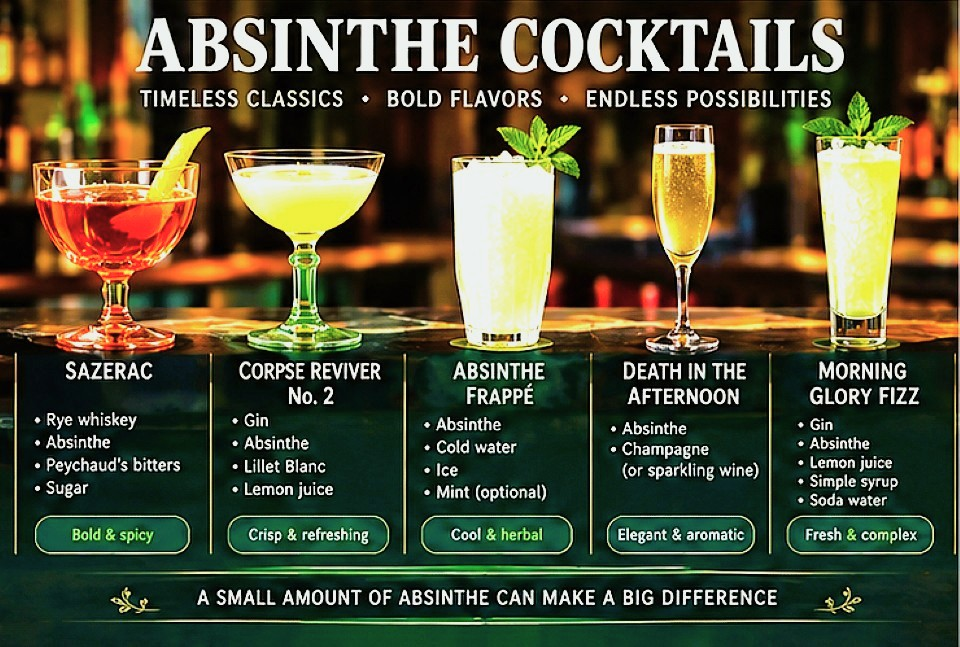
Absinthe cocktail guide featuring the Sazerac, Corpse Reviver No. 2, Absinthe Frappé, Death in the Afternoon and Morning Glory Fizz
24. St. George Absinthe Verte
St. George deserves a second mention because its role in the American revival is so important. It is also particularly useful for cocktails.
The producer itself recommends small amounts in anise-spirit cocktails and identifies drinks including the Morning Glory Fizz, Beach House Gimlet, Absinthe Frappé and Root of All Evil.
25. Pernod’s Historical Absinthe Legacy
Although modern Pernod is primarily known internationally as an anise-based spirit and pastis, its corporate history remains deeply tied to absinthe.
Pernod Ricard describes Pernod Fils as a leading absinthe producer before the category was banned and says modern Pernod Absinthe represents a return of the historic spirit.
Why it matters
For absinthe history, Pernod is essential reading—and tasting.
26. La Clandestine Blanche
The clear Swiss style deserves separate mention because it demonstrates how different absinthe can be without the famous green color.
Best for
Traditional Swiss service.
27. Kübler 1898
Kübler’s historic branding emphasizes the Swiss heritage of absinthe and offers an excellent gateway into the blanche style.
Best for
Comparative tastings. Try it beside a green French-style absinthe and the differences become obvious.
28. Vieux Pontarlier 7 Year
The Vieux Pontarlier range extends into aged expressions. The producer currently lists a 7-year Vieux Pontarlier alongside its traditional absinthe portfolio.
Best for
Collectors and experimental tastings.
29. Absinthe Bourgeois
Country: France
Absinthe Bourgeois is part of the modern French revival of traditional absinthe. The Fils d’Émile Pernot distillery currently lists Absinthe Bourgeois among its portfolio of traditionally produced absinthes.
Best for
Traditional French absinthe exploration.
30. Berthe de Joux
Country: France
Another contemporary French absinthe from the Fils d’Émile Pernot portfolio. The producer describes its range as being created using traditional methods and authentic recipes, with Berthe de Joux among its featured absinthe expressions.
Best for
Exploring small-production French absinthe.
Best Absinthe Brands for Beginners
For your first bottle, you probably don’t need the most bitter or highest-proof expression. I’d start with:
Absente
Accessible and recognizable.
Lucid
A classic modern entry point.
La Clandestine
Elegant and refined.
Kübler
Great introduction to clear Swiss absinthe.
Pernod Absinthe
Historically important and strongly traditional.
St. George
For anyone who wants a more complex American interpretation.
Best Absinthe for Traditional Preparation
For the classic ritual, look for an absinthe with enough anise, fennel and herbal complexity to produce a beautiful louche.
Excellent choices include:
- Pernod Absinthe
- Vieux Pontarlier
- La Clandestine
- Kübler
- Lucid
- St. George Absinthe Verte
Best Absinthe for Cocktails
Not every expensive absinthe should be used in a cocktail. Classic drinks generally require only a small quantity, so a strongly flavored bottle can provide plenty of character.
Sazerac
Try:
- Pernod Absinthe
- Vieux Carré Absinthe
- St. George
Corpse Reviver No. 2
Try:
- Lucid
- La Clandestine
Absinthe Frappé
Try:
- St. George
- Pernod
Death in the Afternoon
Try:
- St. George
- Lucid
A high-quality absinthe can transform a cocktail with just a small rinse or dash.
Best French Absinthe Brands
If you want traditional French character, consider:
- Pernod Absinthe
- Vieux Pontarlier
- La Fée
- Grande Absente
- Absinthe Bourgeois
- Jade
French absinthe often emphasizes:
anise + fennel + wormwood + floral herbs
Best Swiss Absinthe Brands
For Switzerland, explore:
- Kübler
- La Clandestine
- Duplais
Blanche vs. Verte
Swiss producers are especially famous for clear blanche absinthe. These can be extraordinarily elegant.
Because there is no green color to distract the eye, the emphasis becomes:
aroma + texture + clarity + louche
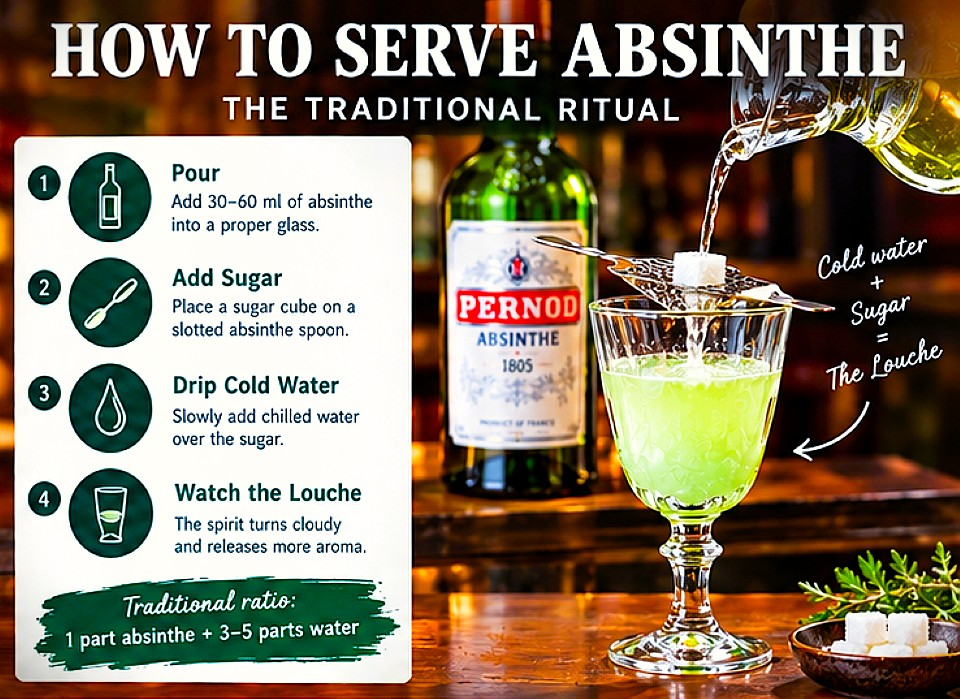
How to serve absinthe using cold water, sugar and an absinthe spoon to create the traditional louche
Best American Absinthe Brands
American craft distillers have built some highly distinctive modern interpretations.
St. George
The best-known historical pioneer.
Leopold Brothers
Craft-focused and complex.
Sirène
Traditional-inspired.
Delaware Phoenix
Small-scale artisan production.
Marteau
Historical French inspiration. These demonstrate how American distillers have adapted a centuries-old European tradition.
Green vs. Blanche Absinthe
Verte
Green absinthe gets its color through a secondary herbal infusion.
Common herbs include:
- Hyssop
- Melissa
- Mint
The resulting color can range from:
- bright emerald to
- yellow-green to
- feuille morte as natural chlorophyll changes with age and light.
St. George explains that its Absinthe Verte is intensely emerald when freshly infused but naturally shifts toward a “dead leaf” hue as chlorophyll changes over time.
Blanche
Blanche absinthe is clear.
It emphasizes:
- Anise
- Fennel
- Wormwood
- Fresh herbs
- Texture
Both can be excellent.
How t: Serve Absinthe
Traditional absinthe service is relatively simple.
Step 1: Pour a small amount of absinthe into a proper glass.
Step 2: Place a slotted absinthe spoon over the glass.
Step 3: Add a sugar cube if desired.
Step 4: Slowly drip chilled water over the sugar and into the absinthe.
Step 5: Watch the louche develop. The water-to-absinthe ratio varies by style and personal preference.
A common approach is roughly:
1 part absinthe + 3–5 parts water, but there is no single universal ratio.
Should You Burn the Sugar?
The flaming absinthe ritual is popular in some modern bars, but it isn’t the traditional French preparation.
The classic ritual is:
cold water + sugar + patience
not:
fire + spectacle.
Some modern drinkers enjoy flaming absinthe, but there’s little reason to assume it produces a better drink. For a traditional experience, use cold water and let the spirit louche naturally.
How to Drink Absinthe Responsibly
Absinthe can be a very high-proof spirit. Many bottles are 60% ABV or higher. That means a traditional serving should be treated more like a measured tasting pour than a large glass of spirits.
The louche makes the drink look gentle and cloudy. The alcohol content has not disappeared. Drink slowly, measure carefully and never drive after consuming alcohol.
Is Absinthe Hallucinogenic?
This is one of the most persistent myths surrounding the category. Modern regulated absinthe should not be treated as a hallucinogenic beverage.
The mythology largely comes from historical perceptions, very high alcohol consumption and sensationalized accounts surrounding absinthe.
U.S. regulation specifically addresses thujone, and TTB requires products made with ingredients that typically contain thujone to meet the applicable thujone-free standard for U.S. labeling and sale.
The most obvious effect of drinking absinthe is simply that it is a strong alcoholic beverage.
What Does Absinthe Taste Like?
The most recognizable flavor is: anise, but serious absinthe is much more complex.
You may detect:
- Fennel
- Wormwood
- Mint
- Lemon balm
- Citrus peel
- Angelica
- Coriander
- Floral herbs
- Licorice
- Spice
- Bitterness
The flavor can range from:
- fresh + floral to:
- dry + bitter to:
- rich + herbal to:
- sweet + anise-forward.
That’s why tasting several different absinthes is so rewarding.
How to Choose the Right Absinthe
Ask yourself what you’re looking for.
Want a traditional French profile?
Try:
- Pernod
- Vieux Pontarlier
- Jade
Want clear Swiss absinthe?
Try:
- Kübler
- La Clandestine
Want an American craft style?
Try:
- St. George
- Leopold Brothers
Want cocktail use?
Try:
- Lucid
- Pernod
- St. George
Want something unusual?
Try:
- Jade
- Duplais
- Marteau
Current Absinthe Revival
The modern absinthe revival is still evolving. The category isn’t simply recreating the past.
Contemporary producers are experimenting with:
- Botanical sourcing
- Local wormwood
- New distillation techniques
- Historic recipes
- Cask maturation
- Regional styles
- American-grown botanicals
A particularly telling development is happening in Pontarlier itself.
In August 2026, a new distillery and dedicated absinthe bar opened in Pontarlier, with the founders offering around 40 absinthe references from local, Swiss, Czech, German and Italian producers.
That tells us something important. Absinthe isn’t merely surviving. It is developing into a real category of specialist spirits culture.
Absinthe and Cocktail Culture
Absinthe has always played an important supporting role in cocktails. Unlike whiskey or rum, it often isn’t the primary ingredient. A cocktail may use:
- a rinse
- a dash
- a teaspoon
or just a small amount.
But the impact can be enormous.
The botanical intensity of absinthe can add:
- Anise
- Herbal complexity
- Aroma
- Spice
- Bitterness
to otherwise simple cocktails. That is why a quality bottle belongs in a serious home bar even if you don’t drink it traditionally very often.
Best Cocktails Using Absinthe
Sazerac
One of the most famous absinthe-accented cocktails.
Corpse Reviver No. 2
Uses absinthe as a subtle aromatic component.
Death in the Afternoon
Combines absinthe and sparkling wine.
Absinthe Frappé
A classic New Orleans-style drink. St. George currently highlights Absinthe Frappé among its suggested recipes.
Morning Glory Fizz
Another cocktail where a small amount of absinthe adds significant botanical complexity.
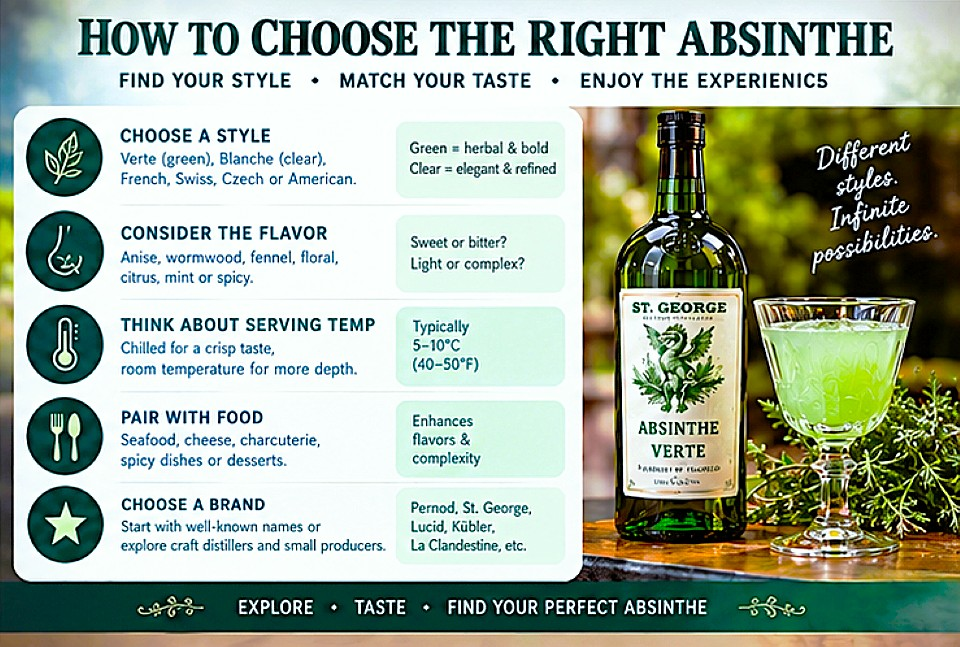
How to choose the right absinthe based on style, flavor, serving temperature, food pairing and brand
Frequently Asked Questions About Absinthe
What is the most popular absinthe brand in the world?
There is no reliable single worldwide sales ranking for absinthe comparable with major whisky or vodka categories. Pernod, St. George, Lucid, Kübler, La Clandestine and Absente are among the most recognizable modern names.
What is the best absinthe?
It depends on your preferred style. Pernod and Vieux Pontarlier are useful for traditional French character, Kübler and La Clandestine for Swiss styles, and St. George for American craft absinthe.
Is Absente the same as absinthe?
Absente is a specific brand/product name; absinthe is the broader spirit category.
Is absinthe illegal?
No. Absinthe is legally produced and sold in many countries, subject to local regulations.
In the United States, TTB regulates products made with botanicals that typically contain thujone and requires applicable formulas to meet the federal standard for thujone-free absinthe products.
Does absinthe make you hallucinate?
Modern regulated absinthe should not be treated as a hallucinogenic drink. The spirit’s reputation largely comes from historical mythology and sensationalized accounts.
Is thujone dangerous?
Thujone is a naturally occurring compound associated with wormwood and some other plants, and its presence in alcoholic products is regulated. EU and U.S. rules place limits on allowable levels.
How strong is absinthe?
Many traditional absinthes are bottled around 50–70% ABV, although individual products vary considerably.
What does absinthe taste like?
Absinthe typically tastes herbal, bitter, anise-forward and aromatic, with flavors such as fennel, wormwood, mint, citrus and spice.
Why does absinthe turn white?
The addition of water causes essential oils to come out of solution, creating the cloudy louche.
What is a green absinthe?
A green absinthe, or verte, gets its color from a secondary herbal infusion.
What is blanche absinthe?
Blanche is clear absinthe that isn’t given the green color associated with a secondary herbal infusion.
Is Swiss absinthe different from French absinthe?
Often, yes. Swiss producers are particularly famous for clear blanche styles, while French absinthe is strongly associated with verte expressions and the historic Pontarlier tradition.
What is the best absinthe for beginners?
Lucid, La Clandestine, Absente, Pernod and approachable St. George-style products are good starting points.
What is the best absinthe for a Sazerac?
Pernod Absinthe, Vieux Carré-style absinthe and St. George Absinthe Verte are all strong choices.
What is the best absinthe for a Corpse Reviver No. 2?
Lucid, Pernod or La Clandestine can work well.
Should you put sugar in absinthe?
Sugar is traditional and can soften bitterness, but it is not mandatory. Some artisan producers recommend drinking their absinthe without sugar. St. George, for example, explicitly recommends no sugar for its Absinthe Verte.
How much water should you add to absinthe?
A common starting point is roughly 3–5 parts cold water to 1 part absinthe, but the ideal ratio depends on the bottle and your preference.
Do you drink absinthe straight?
You can taste a small amount neat, but traditional service usually involves dilution with chilled water.
Can you drink absinthe over ice?
Yes. Some modern drinkers enjoy it over ice, and St. George specifically recommends a large ice cube as one way to encourage a louche.
Can absinthe be used in cocktails?
Absolutely. It is a classic ingredient in drinks including the Sazerac, Corpse Reviver No. 2, Death in the Afternoon and Absinthe Frappé.
Is absinthe a liqueur?
Traditional absinthe is generally treated as a distilled spirit rather than a sweet liqueur.
Why is absinthe green?
Natural green absinthe gets its color primarily through chlorophyll from secondary herbal infusion.
Why does green absinthe turn brown?
Natural chlorophyll can degrade with age and light exposure, causing a green absinthe to become more yellow or brown over time. St. George describes this transformation in its own product documentation.
Where did absinthe originate?
The modern commercial tradition developed particularly strongly in Switzerland and France, with Pontarlier becoming one of the historic centers of production.
Why was absinthe banned?
A combination of temperance movements, political lobbying, concerns about alcohol abuse and sensationalized stories about absinthe’s effects contributed to bans in several countries.
Is absinthe stronger than vodka?
Many absinthes are considerably higher in alcohol than standard vodka, but individual products vary.
What is the traditional absinthe ritual?
Typically, absinthe is poured into a glass, a spoon and sugar cube are placed above it, and ice-cold water is slowly dripped over the sugar into the spirit to produce the louche.
Final Thoughts: The World’s Most Popular Absinthe Brands
Absinthe is one of those rare spirits where the history is almost as interesting as the drink itself.
It has been:
celebrated, feared, banned, mythologized, and finally revived.
Today, however, the modern absinthe world is much more sophisticated than the old “green fairy” stereotype suggests.
The category includes:
- classic French verte
- clear Swiss blanche
- Czech-style absinthe
- American craft absinthe
historically reconstructed recipes and highly innovative modern interpretations.
The most important names include:
- Pernod
- Absente
- St. George
- Lucid
- Kübler
- La Clandestine
- Vieux Pontarlier
- La Fée
- Jade
- Duplais
and many smaller producers. If you’re new to absinthe, start with an accessible bottle.
Try:
- Pernod or
- Lucid or
- La Clandestine
Then compare that with:
St. George Absinthe Verte
The differences can be extraordinary. You may notice that one bottle is strongly dominated by anise. Another may be much more herbal. A third may emphasize mint and citrus. A fourth may be dry and bitter.
Then try the traditional preparation:
- Pour a small amount.
- Add cold water slowly.
- Watch the louche develop.
- Smell the glass.
- Taste it again.
- The experience changes.
That’s part of the magic. And if you’re primarily interested in cocktails, you don’t need dozens of bottles. One good absinthe can make a huge difference in your home bar. A small amount in a Sazerac can completely change the drink.
A rinse in a Corpse Reviver No. 2 adds an aromatic dimension.
A small amount in a Morning Glory Fizz gives the cocktail a distinctive herbal finish. The key is understanding that absinthe is often a powerful seasoning ingredient, not simply a spirit to drink in large quantities.
The modern legal environment also matters.
In the United States, thujone-containing products are subject to specific federal requirements, while European regulations establish their own maximum thujone levels.
So today’s absinthe is very different from the mythical drink of old posters and paintings. It is regulated. It is carefully distilled. And in the hands of serious producers, it can be remarkably elegant.
Perhaps the most exciting part is what happens next.
A new generation of distillers is experimenting with absinthe while historic regions such as Pontarlier continue to support dedicated producers and specialist bars. A new Pontarlier venue opened in June 2026 with around 40 absinthe references from multiple countries, a sign of how much specialist interest the category continues to attract.
That makes this an excellent time to explore. Start with a French absinthe. Then try a Swiss blanche. Then an American verte. Try them side by side.
Pay attention to:
- anise
- wormwood
- fennel
- floral herbs
- citrus
- mint
- bitterness
- and texture.
You may discover that the absinthe you enjoy most isn’t the strongest or the most expensive. It is simply the one that balances its botanicals most beautifully. And that is the true secret of great absinthe. Not mystery. Not mythology. Not hallucinations.
Botanical balance.