
Blog
The World’s Best Wines: 50 Bottles Every Wine Lover Should Try

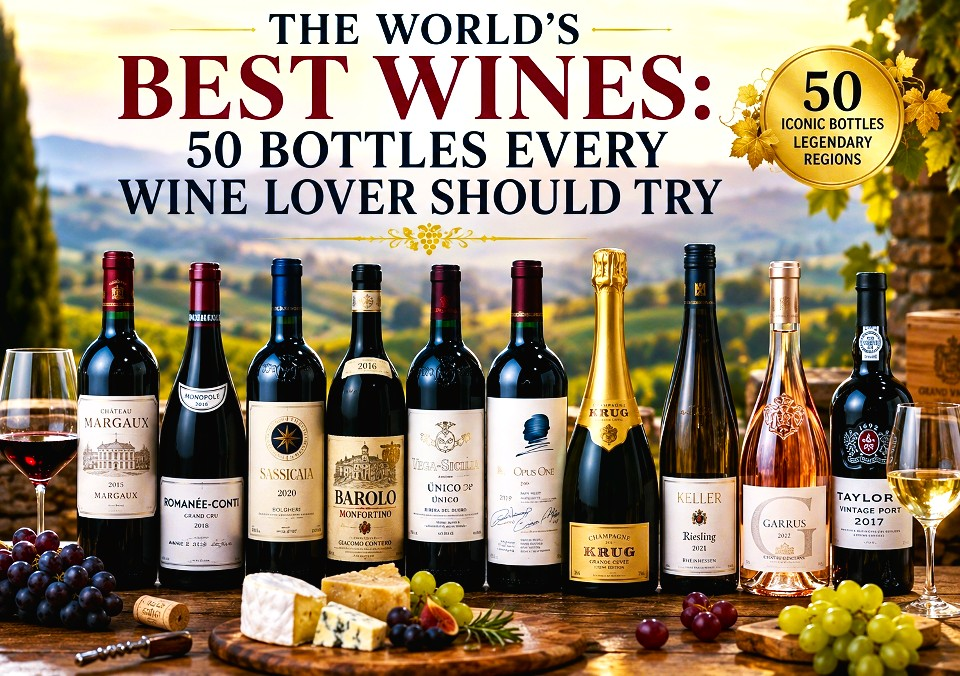
Discover 50 of the world’s best and most iconic wines, from legendary Bordeaux and Burgundy to Napa Cabernet, Barolo, Brunello, Rioja, Champagne, Prosecco, Port, Madeira and beyond. Explore the bottles every serious wine lover should taste at least once, plus tasting notes, regions, grapes, food pairings and tips for choosing the right wine.
Wine is one of the few beverages capable of telling the story of a place, a climate, a grape variety, a vineyard and sometimes an entire civilization.
A great bottle can be powerful or delicate, young or ancient, inexpensive or extraordinarily rare. It can be enjoyed at a neighborhood dinner, opened for a wedding anniversary or carefully cellared for decades.
But what are the world’s best wines?
There is no single objective answer.
A wine’s greatness can be judged by historical reputation, terroir, winemaking precision, longevity, scarcity, critical acclaim, cultural importance, consumer demand or sheer pleasure in the glass. Some bottles are legendary because they have been produced for centuries. Others are exciting because they represent a new generation of wineries and regions.
It is also important to separate “best” from “most expensive.” A $30 bottle can provide more immediate pleasure than a $3,000 bottle, while a famous collectible may be important to wine history without being the ideal choice for a casual Tuesday dinner.
This guide therefore takes a broader approach.
The 50 bottles below represent a selection of world-renowned wines that every wine lover should consider experiencing, spanning classic European estates, New World icons, important indigenous varieties, sparkling wines, rosé, sweet wines and fortified wines.
Current wine-market conditions make that diversity especially relevant. The International Organisation of Vine and Wine estimated global wine consumption at 208 million hectolitres in 2025, down 2.7% from 2024, while also reporting that global production remained historically low. At the same time, newer consumer groups are showing increasing interest in experimentation, premium wines, sustainability and sparkling wine.
This isn’t an exact ranking from 1 to 50. Instead, it is a bucket list of remarkable bottles and iconic wine styles.
Some are famous. Some are luxurious. Some are surprisingly approachable.
All have something worth learning from.
Table of Contents
- What Makes a Wine One of the World’s Best?
- How to Use This Wine Bucket List
- The 50 World’s Best Wines
- Bordeaux Classics
- Burgundy Icons
- Italian Greats
- Spanish Legends
- California and New World Icons
- Australian, South American and South African Stars
- The World’s Great White Wines
- Champagne and Sparkling Wine
- Rosé
- Sweet and Dessert Wines
- Port, Madeira and Sherry
- Best Wines for Beginners
- Best Wines for a Special Occasion
- Best Wines for Food Pairing
- How to Choose a Great Bottle
- Frequently Asked Questions
- Final Thoughts
What Makes a Wine One of the World’s Best?
A great wine usually combines several characteristics.
Terroir
The best wines often communicate something about where they come from.
The limestone of Burgundy.
The gravel soils of Bordeaux.
The volcanic soils of Etna.
The high elevations of Mendoza.
The maritime climate of Napa or the Pacific Northwest.
The Douro Valley’s dramatic slopes.
These factors can influence the character of the wine.
Balance
Great wine doesn’t necessarily mean maximum power.
The finest bottles balance:
- Fruit
- Acidity
- Tannin
- Alcohol
- Texture
- Oak
- Aroma
- Finish
A wine with extraordinary concentration but poor balance may be less enjoyable than a more moderate wine.
Complexity
As great wines develop, they can show multiple layers.
Fruit may evolve into:
- Earth
- Tobacco
- Leather
- Flowers
- Herbs
- Spice
- Mineral notes
- Dried fruit
Longevity
Some of the world’s great wines can age for decades.
But ageability isn’t mandatory for greatness.
Some wines are designed to be enjoyed young and fresh.
Historical Significance
Certain wines are important because they changed the way people think about wine.
Super-Tuscans.
Napa Cabernet.
Australian Shiraz.
Argentine Malbec.
New Zealand Sauvignon Blanc.
These styles helped redefine their respective regions on the international stage.
How to Use This Wine Bucket List
You don’t need to buy all 50 bottles.
In fact, you shouldn’t.
Use this guide as a road map for exploration.
Try different:
- Grapes
- Regions
- Price levels
- Wine styles
- Vintages
A particularly useful approach is comparative tasting.
For example:
Bordeaux Cabernet blend vs. Napa Cabernet
Barolo vs. Barbaresco
Burgundy Chardonnay vs. California Chardonnay
Rioja vs. Ribera del Duero
Prosecco vs. Champagne
Port vs. Madeira
Comparing wines teaches you much more than simply drinking expensive bottles.
The World’s Best Wines: 50 Bottles Every Wine Lover Should Try
1. Château Margaux — Margaux, Bordeaux
Grape blend: Cabernet Sauvignon-led Bordeaux blend
Château Margaux is one of Bordeaux’s legendary First Growth estates.
Its wines are famous for combining power with elegance rather than relying solely on weight.
Expect:
- Cassis
- Blackcurrant
- Violet
- Cedar
- Tobacco
- Earth
Young Château Margaux can be tightly structured. With age, it can become extraordinarily complex.
Best with: Prime beef, lamb, truffles and aged cheese.
Why try it: A benchmark for elegant Bordeaux Cabernet blends.
2. Château Lafite Rothschild — Pauillac, Bordeaux
Another Bordeaux First Growth, Château Lafite Rothschild is synonymous with longevity and refinement.
The style is generally more restrained than some richer New World Cabernets.
Typical notes include:
- Blackcurrant
- Cedar
- Graphite
- Violet
- Tobacco
- Earth
Best with: Beef tenderloin, roast lamb and game.
Why try it: One of the world’s most historically important Cabernet-based wines.
3. Château Latour — Pauillac, Bordeaux
Château Latour is known for power, structure and extraordinary aging potential.
The wine often shows:
- Cassis
- Blackberry
- Graphite
- Tobacco
- Cedar
- Spice
Its structure makes it particularly interesting for long-term cellaring.
Best with: Steak, lamb and rich braised meats.
Why try it: An archetype of powerful, ageworthy Pauillac.
4. Château Haut-Brion — Pessac-Léognan, Bordeaux
Haut-Brion is one of Bordeaux’s original First Growths and one of the region’s most distinctive estates.
Its red wine can combine:
- Black fruit
- Smoke
- Tobacco
- Earth
- Gravel
- Cedar
The estate is particularly fascinating because its personality differs from the Médoc First Growths.
Best with: Beef, lamb, mushrooms and truffles.
Why try it: A legendary Bordeaux wine with a distinctive smoky, savory personality.
5. Château Mouton Rothschild — Pauillac, Bordeaux
Mouton Rothschild combines the prestige of Bordeaux with a fascinating artistic tradition: famous artists have designed its labels over the years.
The wine itself is powerful, aromatic and structured.
Expect:
- Cassis
- Blackberry
- Dark chocolate
- Cedar
- Mint
- Tobacco
Best with: Grilled steak, lamb and aged cheese.
Why try it: A wine where art, culture and fine wine history meet.
Burgundy Icons
6. Domaine de la Romanée-Conti Romanée-Conti — Burgundy
Few wines possess the legendary status of Romanée-Conti.
Produced from a tiny Grand Cru vineyard in Burgundy, it is among the world’s most famous and scarce Pinot Noirs.
The style is associated with:
- Red cherry
- Raspberry
- Rose
- Violet
- Earth
- Spice
Its reputation comes not only from rarity but from Burgundy’s extraordinary terroir and decades of meticulous cultivation.
Best with: Roast duck, game birds, mushrooms and refined cuisine.
Why try it: One of the ultimate expressions of Pinot Noir.
7. Comtes Georges de Vogüé Musigny — Burgundy
Musigny is one of Burgundy’s great Grand Cru sites.
A top Musigny can combine:
- Floral aromas
- Red fruit
- Spice
- Earth
- Silky tannins
It can be incredibly elegant without sacrificing depth.
Best with: Duck, mushroom dishes, veal and delicate game.
Why try it: A quintessential example of sophisticated Burgundy Pinot Noir.
8. Domaine Leflaive Puligny-Montrachet — Burgundy
Burgundy isn’t only about red wine.
Puligny-Montrachet is one of the world’s most famous Chardonnay appellations.
Top examples combine:
- Lemon
- White flowers
- Apple
- Pear
- Flint
- Mineral texture
Best with: Lobster, crab, scallops and roast chicken.
Why try it: An ideal demonstration of how extraordinary Burgundy Chardonnay can be.
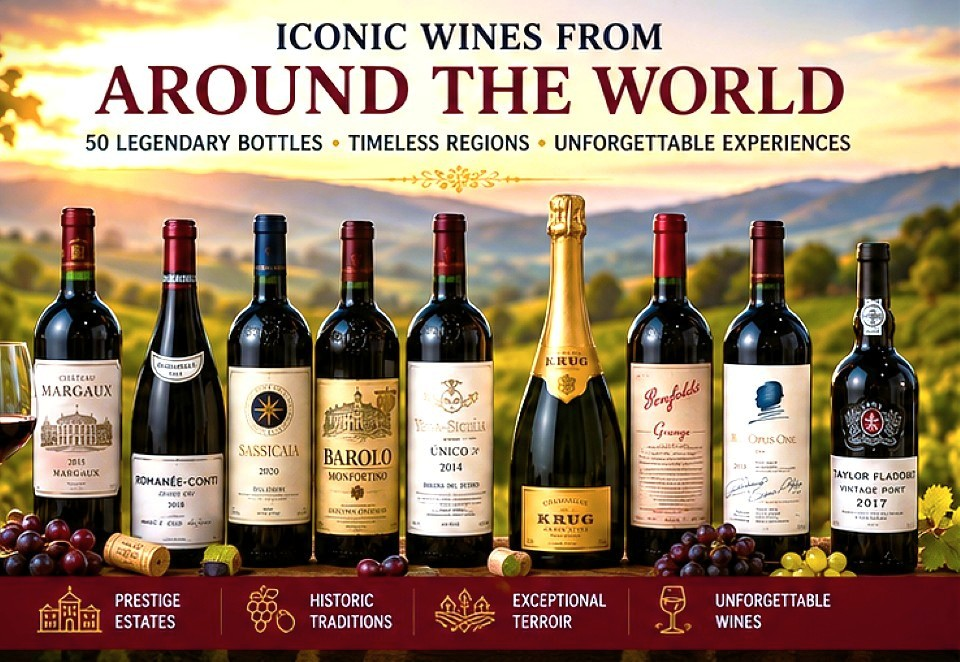
Iconic wines from around the world including Bordeaux, Burgundy, Barolo, Rioja, Napa Cabernet, Champagne and Port
Italian Greats
9. Sassicaia — Bolgheri, Tuscany
Sassicaia helped establish Bolgheri as one of Italy’s most important fine-wine regions.
It is primarily Cabernet Sauvignon and Cabernet Franc and represents a distinctly Italian interpretation of Bordeaux varieties.
Expect:
- Cassis
- Blackberry
- Herbs
- Cedar
- Tobacco
- Graphite
Best with: Steak, lamb and game.
Why try it: One of the wines that transformed modern Italian fine wine.
10. Ornellaia — Bolgheri, Tuscany
Ornellaia is another legendary Bolgheri estate.
Its red blend typically emphasizes:
- Blackberry
- Blackcurrant
- Plum
- Herbs
- Vanilla
- Spice
Best with: Steak, lamb, roast beef and rich pasta.
Why try it: A polished modern classic from Tuscany’s Mediterranean coast.
11. Tignanello — Tuscany
Tignanello is one of Italy’s most influential Super-Tuscan wines.
Its blend is based on Sangiovese with international varieties.
The result often shows:
- Cherry
- Blackberry
- Herbs
- Tobacco
- Spice
- Oak
Best with: Steak, pasta, pizza and aged cheese.
Why try it: One of the defining wines of modern Tuscany.
12. Solaia — Tuscany
Solaia is another prestigious Super-Tuscan.
The wine typically combines Cabernet Sauvignon and other Bordeaux varieties with Sangiovese.
Expect:
- Blackcurrant
- Blackberry
- Chocolate
- Herbs
- Cedar
- Spice
Best with: Beef, lamb and aged cheese.
Why try it: A superb bridge between traditional Italian and international wine styles.
13. Gaja Barbaresco — Piedmont
Angelo Gaja helped bring international attention to the quality potential of Piedmont.
Nebbiolo-based Barbaresco can be both powerful and remarkably aromatic.
Typical characteristics include:
- Rose
- Cherry
- Violet
- Tar
- Herbs
- Tobacco
Best with: Truffle dishes, mushrooms, braised beef and aged cheese.
Why try it: An iconic expression of Nebbiolo.
14. Giacomo Conterno Monfortino Barolo — Piedmont
Monfortino is one of Barolo’s most revered wines.
It is built around Nebbiolo and known for extraordinary longevity.
Expect:
- Sour cherry
- Rose
- Tobacco
- Leather
- Spice
- Earth
Best with: Truffles, braised beef, game and aged cheese.
Why try it: A benchmark for traditional Barolo.
15. Produttori del Barbaresco Riserva — Piedmont
One of the world’s great values in serious Nebbiolo comes from Produttori del Barbaresco.
Its Riserva wines can deliver remarkable complexity without the price of the rarest Piedmont icons.
Best with: Pasta with mushrooms, lamb and truffle dishes.
Why try it: Serious Nebbiolo at a comparatively accessible level.
Spanish Legends
16. Vega Sicilia Único — Ribera del Duero
Vega Sicilia Único is one of Spain’s most famous wines.
The combination of Tempranillo and other permitted varieties creates a wine known for:
- Dark fruit
- Tobacco
- Cedar
- Leather
- Spice
- Earth
Long aging is central to its identity.
Best with: Roast lamb, beef, game and aged cheese.
Why try it: A benchmark of Spanish fine wine.
17. Pingus — Ribera del Duero
Dominio de Pingus is one of Spain’s most famous modern cult wines.
Based primarily on Tempranillo, Pingus can be:
- Deep
- Powerful
- Concentrated
- Aromatic
- Structured
Best with: Roast lamb, grilled beef and rich Spanish dishes.
Why try it: An important example of modern Spanish fine winemaking.
18. La Rioja Alta Gran Reserva 904 — Rioja
For wine lovers who want classic Rioja without an extreme price tag, Gran Reserva 904 is a superb bottle to know.
Expect:
- Red cherry
- Dried fruit
- Vanilla
- Cedar
- Leather
- Spice
Best with: Roast lamb, pork, tapas and Manchego.
Why try it: A beautiful example of traditionally aged Rioja.
19. CVNE Imperial Gran Reserva — Rioja
Imperial is one of Rioja’s classic names.
The wine combines Tempranillo-led fruit with substantial maturation.
Expect:
- Plum
- Cherry
- Tobacco
- Vanilla
- Leather
Best with: Lamb, roast meats and Spanish cured meats.
Why try it: A classic reference point for traditional Rioja.
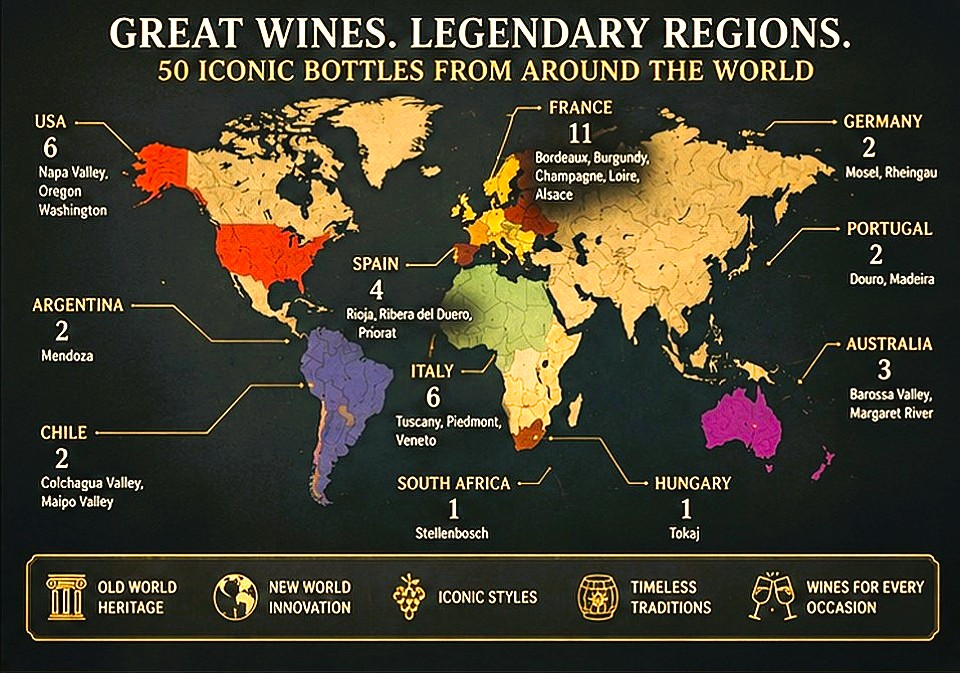
Great wines from legendary wine regions including France, Italy, Spain, the United States, Australia, Argentina and Portugal
California and New World Icons
20. Opus One — Napa Valley
Opus One is one of the world’s best-known California Cabernet-based wines.
The wine was created from a collaboration between Robert Mondavi and Baron Philippe de Rothschild and blends Napa Valley fruit with Bordeaux varieties.
Expect:
- Cassis
- Blackberry
- Plum
- Cedar
- Dark chocolate
- Oak
Best with: Prime steak and lamb.
Why try it: A globally recognized symbol of Napa fine wine.
21. Dominus Estate — Napa Valley
Dominus is another iconic Napa Cabernet-based wine.
Its style can combine:
- Blackberry
- Cassis
- Graphite
- Herbs
- Cedar
- Spice
Best with: Steak, lamb and roasted vegetables.
Why try it: A Napa wine with a distinctly Bordeaux-influenced character.
22. Ridge Monte Bello — California
Monte Bello is one of California’s historic fine wines.
Based on Cabernet Sauvignon with Bordeaux varieties, it is known for structure and aging potential.
Expect:
- Blackcurrant
- Plum
- Tobacco
- Earth
- Herbs
- Spice
Best with: Beef, lamb and mushroom dishes.
Why try it: A historic California alternative to Napa’s dominant Cabernet style.
23. Screaming Eagle Cabernet Sauvignon — Napa Valley
Screaming Eagle is one of California’s most famous cult Cabernets.
Production is highly limited, and bottles are exceptionally sought after.
The wine is known for concentration, richness and elegance.
Best with: Prime steak, lamb and luxury dining.
Why try it: One of Napa Valley’s legendary collectible wines.
24. Heitz Cellar Martha’s Vineyard Cabernet Sauvignon — Napa Valley
Martha’s Vineyard Cabernet has an important place in Napa history.
The wine is associated with:
- Cassis
- Blackberry
- Herbs
- Cedar
- Mint
- Tobacco
Best with: Beef, lamb and grilled meats.
Why try it: A historic example of vineyard-specific Napa Cabernet.
Australian, South American and African Stars
25. Penfolds Grange — Australia
Penfolds Grange is arguably Australia’s most famous wine.
Made primarily from Shiraz, with Cabernet Sauvignon also used in some vintages, Grange is powerful and ageworthy.
Expect:
- Blackberry
- Plum
- Chocolate
- Spice
- Smoke
- Toasted oak
Best with: Steak, lamb and barbecue.
Why try it: The defining icon of Australian fine wine.
26. Henschke Hill of Grace — Australia
Hill of Grace is another Australian Shiraz legend.
The wine comes from an exceptionally old vineyard and can combine ripe fruit with remarkable savory complexity.
Expect:
- Blackberry
- Plum
- Pepper
- Herbs
- Earth
- Spice
Best with: Roast lamb, beef and game.
Why try it: One of the world’s benchmark single-vineyard Shiraz wines.
27. Château Musar — Lebanon
Château Musar is one of the world’s most fascinating wines because it demonstrates how great wine can emerge from a region outside the usual Western European and New World categories.
Its red wines commonly feature native Lebanese grapes including Cinsault and Carignan.
Expect:
- Red fruit
- Dried herbs
- Earth
- Leather
- Spice
Best with: Lamb, Middle Eastern cuisine and roast meats.
Why try it: A distinctive wine with history, personality and remarkable aging ability.
28. Almaviva — Chile
Almaviva is a celebrated Chilean Bordeaux-style wine.
The wine is typically based on Cabernet Sauvignon and complementary Bordeaux varieties.
Expect:
- Cassis
- Blackberry
- Plum
- Cedar
- Tobacco
- Spice
Best with: Steak, lamb and grilled meats.
Why try it: A leading example of Chilean fine wine.
29. Clos Apalta — Chile
Clos Apalta from the Colchagua Valley has become one of Chile’s internationally recognized premium red wines.
The blend emphasizes Bordeaux varieties and can show:
- Blackberry
- Plum
- Cassis
- Herbs
- Spice
Best with: Beef, lamb and rich Chilean dishes.
Why try it: A strong introduction to Chile’s premium red-wine potential.
30. Catena Zapata Adrianna Vineyard Malbec — Argentina
The Adrianna Vineyard is one of Argentina’s most famous high-altitude vineyards.
Its Malbec can combine:
- Blackberry
- Blueberry
- Violet
- Herbs
- Mineral notes
High-elevation Mendoza is one of the world’s most exciting regions for serious Malbec.
Best with: Argentine steak, lamb and grilled meats.
Why try it: A reference bottle for modern high-altitude Malbec.
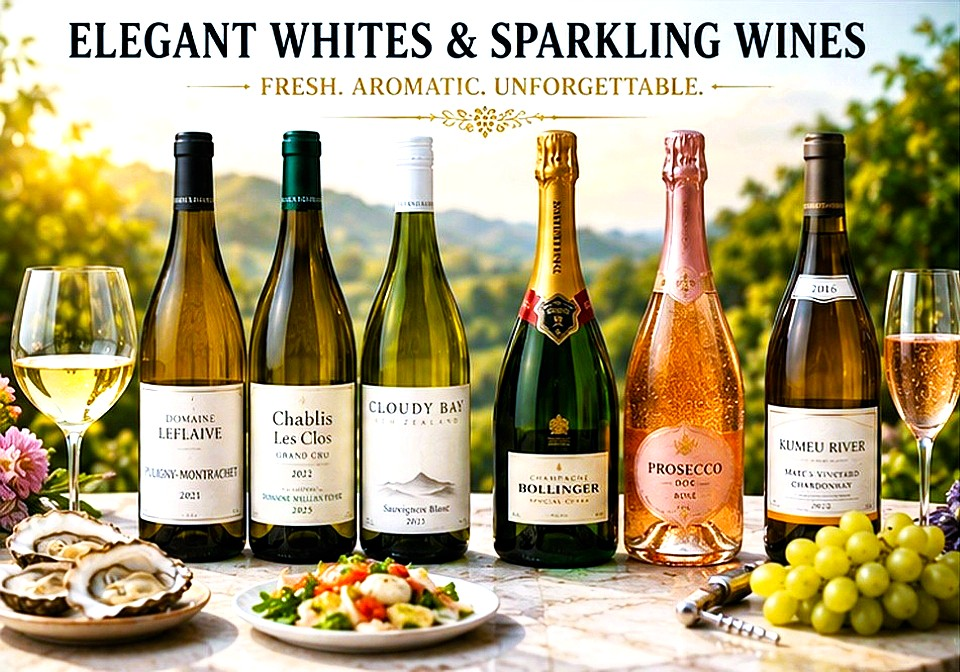
World-class white and sparkling wines including Chardonnay, Chablis, Riesling, Sauvignon Blanc, Champagne, Prosecco and Burgundy
The World’s Great White Wines
31. Egon Müller Scharzhofberger Riesling — Mosel
German Riesling can be among the world’s most ageworthy and complex white wine styles.
Egon Müller is one of the most famous names in the category.
Depending on sweetness level, the wines can show:
- Lime
- Green apple
- Peach
- Apricot
- Honey
- Mineral notes
Best with: Asian cuisine, seafood or simply as a contemplative wine.
Why try it: A benchmark for world-class Riesling.
32. Dönnhoff Niederhäuser Hermannshöhle Riesling — Nahe
Dönnhoff is one of Germany’s most respected Riesling producers.
Hermannshöhle wines can combine:
- Citrus
- Peach
- Herbs
- Minerals
- Floral aromas
Best with: Shellfish, spicy food and seafood.
Why try it: A superb introduction to premium dry and off-dry German Riesling.
33. Domaine Leflaive Bâtard-Montrachet — Burgundy
Bâtard-Montrachet is one of Burgundy’s most prestigious white-wine Grand Crus.
The best examples can combine:
- Citrus
- Peach
- White flowers
- Hazelnut
- Toast
- Mineral character
Best with: Lobster, crab, scallops and sophisticated poultry dishes.
Why try it: A defining expression of luxury Burgundy Chardonnay.
34. Chablis Grand Cru Les Clos — Burgundy
Les Clos is one of Chablis’s great Grand Cru vineyards.
The style tends to emphasize:
- Lemon
- Green apple
- Mineral notes
- Flint
- Salinity
With age, complexity increases.
Best with: Oysters, shellfish and seafood.
Why try it: One of the world’s classic expressions of mineral Chardonnay.
35. Leeuwin Estate Art Series Chardonnay — Margaret River
Australia is better known for Shiraz, but Margaret River produces exceptional Chardonnay.
Leeuwin Estate’s Art Series Chardonnay is one of Australia’s best-known premium examples.
Expect:
- Lemon
- Peach
- Citrus
- Toast
- Vanilla
- Hazelnut
Best with: Lobster, crab, roast chicken and rich seafood.
Why try it: A powerful demonstration of Australia’s Chardonnay potential.
36. Kumeu River Maté’s Vineyard Chardonnay — New Zealand
Kumeu River has established a strong reputation for high-quality Chardonnay.
The wine can show:
- Citrus
- Apple
- Stone fruit
- Toast
- Mineral character
- Creamy texture
Best with: Roast chicken, shellfish, salmon and creamy sauces.
Why try it: A superb example of New Zealand Chardonnay.
37. Cloudy Bay Sauvignon Blanc — Marlborough
Cloudy Bay helped make New Zealand Sauvignon Blanc famous around the world.
The style is intensely aromatic, with:
- Passion fruit
- Citrus
- Gooseberry
- Fresh herbs
- Tropical fruit
Best with: Oysters, goat cheese, seafood and salads.
Why try it: One of the world’s benchmark New World Sauvignon Blancs.
38. Domaine Huet Vouvray — Loire Valley
Vouvray demonstrates how versatile Chenin Blanc can be.
Depending on the bottling, it can be:
- Dry
- Off-dry
- Sweet
- Sparkling
Typical flavors include:
- Apple
- Pear
- Quince
- Honey
- Citrus
- Mineral notes
Best with: Seafood, pork, roast chicken and soft cheeses.
Why try it: A masterclass in the versatility of Chenin Blanc.
Champagne and Sparkling Wine
39. Dom Pérignon Brut — Champagne
Dom Pérignon is one of the world’s most recognizable luxury Champagnes.
The style generally emphasizes:
- Citrus
- Apple
- Pear
- Toast
- Brioche
- Mineral notes
Long aging adds complexity.
Best with: Oysters, caviar, lobster, sushi and fine appetizers.
Why try it: A globally recognized benchmark for prestige Champagne.
40. Krug Grande Cuvée — Champagne
Krug Grande Cuvée demonstrates the complexity that can be achieved through blending wines from different vintages and vineyards.
It commonly shows:
- Citrus
- Apple
- Brioche
- Nuts
- Toast
- Spice
Best with: Seafood, roast poultry and sophisticated tasting menus.
Why try it: One of the world’s great examples of complex non-vintage Champagne.
41. Bollinger Special Cuvée — Champagne
Bollinger is famous for a style that often gives Pinot Noir substantial prominence.
Expect:
- Apple
- Citrus
- Toast
- Brioche
- Hazelnut
- Spice
Best with: Smoked salmon, roast chicken, charcuterie and seafood.
Why try it: A richer, food-friendly Champagne style.
42. Prosecco DOC Rosé — Veneto and Friuli-Venezia Giulia
Prosecco has become one of the world’s most commercially important sparkling wines. The Prosecco DOC Consortium reported 667 million bottles bottled in 2025, a 1.1% increase over 2024.
Prosecco DOC Rosé adds Pinot Noir to the traditional Prosecco framework and is especially popular for aperitivo and celebrations.
Expect:
- Strawberry
- Raspberry
- Apple
- Pear
- Floral notes
Best with: Antipasti, seafood, salads and brunch.
Why try it: A modern sparkling style with enormous international popularity.
Rosé
43. Château d’Esclans Garrus — Provence
Garrus is one of Provence’s best-known premium rosés.
It demonstrates that rosé can be serious, textured and gastronomic rather than simply a casual summer drink.
Expect:
- Peach
- Strawberry
- Citrus
- Herbs
- Floral notes
Best with: Grilled seafood, lobster, Mediterranean food and salads.
Why try it: A premium example of modern Provence rosé.
44. Domaine Tempier Bandol Rosé — Provence
Bandol is famous for Mourvèdre, and its rosés can have more structure than many pale Provence styles.
Expect:
- Strawberry
- Peach
- Citrus
- Herbs
- Spice
Best with: Mediterranean seafood, grilled fish and Provençal dishes.
Why try it: A more savory, serious style of rosé.
Sweet and Dessert Wines
45. Château d’Yquem — Sauternes
Château d’Yquem is one of the world’s legendary sweet wines.
Made primarily from Sémillon and Sauvignon Blanc affected by noble rot, it can age for decades.
Expect:
- Apricot
- Peach
- Honey
- Citrus
- Saffron
- Vanilla
Best with: Foie gras, blue cheese and fruit desserts.
Why try it: A benchmark for the world’s great sweet wines.
46. Royal Tokaji Aszú 5 Puttonyos — Hungary
Tokaji Aszú is one of Europe’s historic sweet-wine treasures.
The wines can combine:
- Apricot
- Orange peel
- Honey
- Dried fruit
- Spice
- Acidity
The combination of sweetness and acidity creates extraordinary balance.
Best with: Foie gras, blue cheese and fruit desserts.
Why try it: One of the world’s classic dessert-wine traditions.
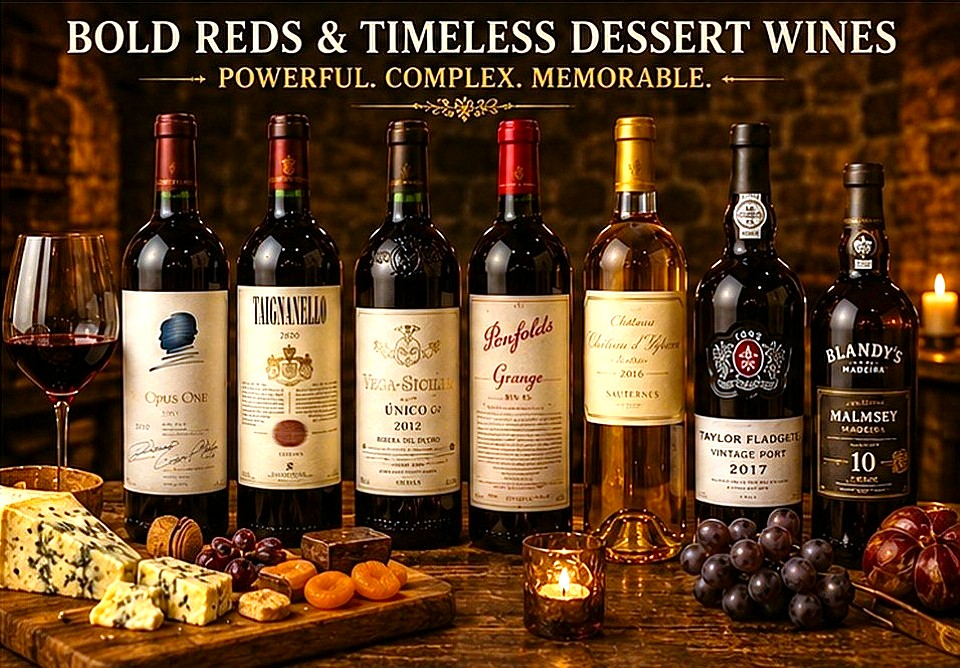
World-class red and dessert wines including Napa Cabernet, Barolo, Rioja, Penfolds Grange, Sauternes, Port and Madeira
Fortified Wine Classics
47. Taylor Fladgate Vintage Port — Douro Valley
Vintage Port is one of Portugal’s great contributions to the world of wine.
Taylor Fladgate is one of the historic Port houses.
Young Vintage Port can show:
- Blackberry
- Plum
- Black cherry
- Chocolate
- Spice
With age, tertiary flavors become increasingly complex.
Best with: Stilton, blue cheese, dark chocolate and nuts.
Why try it: An essential benchmark for serious Port lovers.
48. Blandy’s Malmsey Madeira — Madeira
Madeira is unlike almost any other wine.
Its traditional production involves controlled heat and oxidation, creating wines capable of extraordinary longevity.
Malmsey is the sweetest of the classic Madeira styles.
Expect:
- Raisin
- Caramel
- Dried citrus
- Nuts
- Spice
- Coffee
Best with: Chocolate, nuts, dried fruit and rich desserts.
Why try it: One of the world’s most durable and distinctive wines.
49. Lustau East India Solera Sherry — Jerez, Spain
Sherry offers some of the greatest diversity in the wine world.
An East India Solera style combines Oloroso and Pedro Ximénez influences in a richer expression.
Expect:
- Raisin
- Caramel
- Nuts
- Spice
- Dried fruit
Best with: Blue cheese, desserts, nuts and roasted meats.
Why try it: A gateway into the extraordinary world of fortified Spanish wine.
50. Madeira Sercial — Madeira
If Malmsey represents sweet Madeira, Sercial demonstrates the opposite side of the island’s wine spectrum.
Sercial is among the driest traditional Madeira styles.
Expect:
- Lemon
- Green apple
- Almond
- Salinity
- Dried citrus
- Mineral notes
It can be astonishingly fresh despite its age.
Best with: Oysters, smoked salmon, almonds and savory appetizers.
Why try it: Few wines demonstrate the coexistence of acidity, age and oxidative character quite like Madeira.
The Best Wines for Beginners
You don’t need to start with Romanée-Conti or Château Margaux.
For someone beginning a serious wine journey, I’d start with recognizable styles.
Cabernet Sauvignon
Try Napa or Bordeaux.
Chardonnay
Compare Burgundy with California or Australia.
Pinot Noir
Try Burgundy, Oregon or New Zealand.
Sauvignon Blanc
Compare New Zealand with Sancerre.
Malbec
Try Argentina.
Tempranillo
Try Rioja.
Sangiovese
Try Chianti Classico.
Riesling
Try Germany.
Prosecco
Start with a dry Prosecco DOC.
Champagne
Try Brut Champagne.
These ten styles cover an enormous portion of the global wine spectrum.
The Best Wines for a Special Occasion
When the occasion really matters, classic bottles remain hard to beat.
Anniversary
Champagne, Burgundy or Barolo
Wedding
Prestige Champagne or Prosecco
Steak Dinner
Napa Cabernet, Bordeaux or Malbec
Romantic Dinner
Pinot Noir or Burgundy
Christmas Dinner
Rioja, Barolo or Champagne
Dessert
Sauternes, Port or Madeira
The right bottle should match the atmosphere, the meal and the people you’re drinking with.
The Best Wines for Food Pairing
One of the easiest ways to understand wine is to taste it with food.
Steak
Choose:
- Cabernet Sauvignon
- Malbec
- Syrah
- Bordeaux
- Barolo
Seafood
Choose:
- Chablis
- Sauvignon Blanc
- Albariño
- Champagne
- Pinot Gris
Pasta with Tomato Sauce
Choose:
- Chianti
- Sangiovese
- Barbera
- Montepulciano d’Abruzzo
Lamb
Choose:
- Rioja
- Bordeaux
- Syrah
- Malbec
- Tempranillo
Sushi
Choose:
- Riesling
- Champagne
- Sauvignon Blanc
- Grüner Veltliner
Cheese
Choose according to the cheese.
Blue cheese: Port or Sauternes
Goat cheese: Sauvignon Blanc
Manchego: Rioja
Aged cheddar: Cabernet Sauvignon
Brie: Chardonnay
How to Choose a Great Bottle
The most expensive bottle isn’t necessarily the best bottle for you.
Use these five questions.
1. What grape do you enjoy?
This is the easiest starting point.
2. What food are you serving?
Food can completely change the way a wine tastes.
3. Do you prefer light or full-bodied wine?
Pinot Noir and Sauvignon Blanc are generally lighter than Cabernet Sauvignon and Syrah.
4. Do you like oak?
If you enjoy vanilla, toast and creaminess, look for oak-aged Chardonnay or Cabernet.
5. Do you want to drink it now or cellar it?
Some wines are designed for immediate enjoyment.
Others need time.
Why Vintage Matters
Wine is an agricultural product.
That means every vintage can differ.
Weather influences:
- Ripening
- Acidity
- Sugar levels
- Disease pressure
- Yield
- Phenolic development
A famous wine from a difficult vintage may taste very different from the same wine produced in a great year.
That’s why serious wine buyers should pay attention to:
vintage + producer + region + storage history
rather than simply buying a famous label.
Why Wine Prices Can Vary So Dramatically
Some bottles cost $20.
Others cost $20,000.
Several factors contribute.
Scarcity
Tiny production creates competition.
Vineyard size
Grand Cru Burgundy vineyards can be extremely small.
Reputation
Historic estates command premiums.
Aging
Long cellar aging costs money.
Demand
Collector demand can dramatically increase prices.
Vintage
Exceptional vintages can become much more valuable.
But remember:
Price and pleasure are not the same thing.
A wine can be expensive because it is rare.
That doesn’t mean it will be your favorite.
Organic, Biodynamic and Sustainable Fine Wine
The modern fine-wine world is also increasingly interested in organic and regenerative farming.
IWSR’s 2026 analysis identifies sustainability-led offerings alongside sparkling wine and no/low-alcohol wine as areas of continuing consumer interest, even as overall wine consumption faces long-term pressure.
That creates another fascinating avenue for exploration.
Look for bottles from producers practicing:
- Organic viticulture
- Biodynamic farming
- Regenerative agriculture
- Water conservation
- Biodiversity management
Some famous wine regions are increasingly filled with producers working this way.
This means the definition of “great wine” is gradually becoming broader.
Quality still matters.
But so does how the vineyard is managed.
Current Global Wine Trends
The global wine industry is changing.
OIV’s latest annual report shows that global wine consumption fell 2.7% in 2025 to an estimated 208 million hectolitres, continuing a longer-term decline in mature markets. OIV also reported that global vineyard surface area declined for a sixth consecutive year in 2025.
At the same time, not all categories are moving in the same direction.
IWSR reports that younger legal-drinking-age consumers are becoming increasingly important to the future of wine, with more openness to experimentation and premium purchases. Sparkling wine is also showing greater resilience than much of the still-wine market.
This is particularly relevant to the wines in this guide.
Classic fine wine isn’t disappearing.
Instead, consumers are exploring it alongside:
- Sparkling wine
- Organic wine
- Natural wine
- Alternative formats
- Rosé
- Premium regional wines
- No- and low-alcohol alternatives
That creates a much wider definition of what it means to be a modern wine lover.
How to Build a 12-Bottle World’s Best Wine Collection
You don’t need 50 bottles.
Start with 12.
Bottle 1
Bordeaux Cabernet blend
Bottle 2
Napa Cabernet Sauvignon
Bottle 3
Burgundy Pinot Noir
Bottle 4
Barolo
Bottle 5
Rioja Gran Reserva
Bottle 6
Argentine Malbec
Bottle 7
Burgundy Chardonnay
Bottle 8
New Zealand Sauvignon Blanc
Bottle 9
German Riesling
Bottle 10
Champagne
Bottle 11
Prosecco
Bottle 12
Vintage Port or Madeira
This collection gives you a tour of the major wine families without requiring an enormous cellar.
10 Wine Comparisons Every Wine Lover Should Try
For serious learning, these comparisons are particularly valuable.
Bordeaux vs. Napa Cabernet
Old World structure versus New World richness.
Burgundy vs. Oregon Pinot Noir
Different interpretations of the same grape.
Barolo vs. Barbaresco
Two expressions of Piedmont Nebbiolo.
Rioja vs. Ribera del Duero
Two major expressions of Tempranillo.
Sancerre vs. Marlborough Sauvignon Blanc
Two radically different interpretations of Sauvignon Blanc.
Burgundy Chardonnay vs. California Chardonnay
Minerality versus richer oak-influenced styles.
Prosecco vs. Champagne
Fruit-forward sparkling wine versus traditional-method prestige sparkling wine.
Port vs. Madeira
Two very different fortified-wine traditions.
Chianti Classico vs. Brunello
Different expressions of Sangiovese.
Argentine Malbec vs. Bordeaux
A fascinating comparison involving a grape with strong roots in both regions.
the-worlds-best-wines
Frequently Asked Questions
What is the world’s best wine?
There is no universally accepted single best wine. Wines such as Romanée-Conti, Château Margaux, Château Lafite Rothschild, Barolo Monfortino, Vega Sicilia Único, Sassicaia and Screaming Eagle are among the world’s most prestigious, but the “best” wine depends on taste, occasion and budget.
What are the world’s most famous wines?
Some of the best-known include Château Margaux, Château Lafite Rothschild, Romanée-Conti, Château d’Yquem, Sassicaia, Opus One, Penfolds Grange, Vega Sicilia Único, Dom Pérignon and Taylor Fladgate Vintage Port.
What is the best red wine in the world?
There is no universal winner. Cabernet Sauvignon, Pinot Noir, Nebbiolo, Sangiovese, Tempranillo, Syrah and Malbec all produce world-class wines.
What is the best white wine in the world?
Chardonnay and Riesling are two of the strongest candidates for the world’s greatest white-wine grapes, but Sauvignon Blanc, Chenin Blanc and other varieties can also produce exceptional wines.
What is the world’s most expensive wine?
Prices vary dramatically by auction, vintage, provenance and rarity, so there is no single permanent “most expensive wine.” Extremely scarce Burgundy, Bordeaux, Napa cult wines and other collectible bottles can reach extraordinary prices.
Is expensive wine better?
Not necessarily. Price is influenced by rarity, land cost, production, aging, reputation and collector demand. Personal preference remains more important than price.
What wine should every wine lover try?
A good starter bucket list would include Bordeaux, Burgundy Pinot Noir, Napa Cabernet, Barolo, Rioja, Malbec, Riesling, Chardonnay, Champagne, Prosecco and Port.
What wine is best for beginners?
Start with recognizable varieties such as Merlot, Cabernet Sauvignon, Chardonnay, Sauvignon Blanc, Pinot Noir and Prosecco.
What is the best wine with steak?
Cabernet Sauvignon, Malbec, Bordeaux, Syrah and Barolo are excellent choices.
What is the best wine with seafood?
Sauvignon Blanc, Chablis, Albariño, Champagne and Pinot Gris are excellent starting points.
What is the best wine with cheese?
It depends on the cheese. Port works beautifully with blue cheese, Sauvignon Blanc with goat cheese, Rioja with Manchego and Chardonnay with Brie.
What is the best wine for a special occasion?
Champagne is the classic choice, but a fine Bordeaux, Burgundy, Barolo or Napa Cabernet can be equally memorable.
What is the best dessert wine?
Château d’Yquem, Tokaji, Port and Madeira are all excellent choices, depending on the dessert.
Which country makes the best wine?
France and Italy remain two of the world’s most important fine-wine countries, but Spain, the United States, Australia, Germany, Portugal, Argentina, Chile, South Africa and many others produce exceptional wine.
Is Prosecco a great wine?
Absolutely. Greatness isn’t limited to luxury still wines. Prosecco DOC has become one of the world’s most successful sparkling categories, with 667 million bottles bottled in 2025.
Final Thoughts: 50 Bottles That Define the World of Wine
There is no single bottle that can legitimately be called the world’s best wine.
Wine is too diverse for that.
A legendary Bordeaux may be extraordinary for its structure and longevity.
A great Burgundy may be unforgettable because of its perfume and elegance.
A Napa Cabernet may provide incredible concentration and depth.
Barolo may seduce you with roses, cherries and earthy complexity.
Rioja can demonstrate the magic of long aging.
Malbec can show how altitude transforms a grape.
Riesling can combine sweetness, acidity and extraordinary longevity.
Sauvignon Blanc can deliver an explosion of freshness.
Champagne can turn an ordinary evening into a celebration.
Prosecco can make aperitivo effortless.
Port can end a dinner beautifully.
Madeira can demonstrate what happens when a wine is allowed to defy time.
That is why this list is not meant to be a rigid ranking.
Think of it as a wine bucket list.
Some bottles are famous because generations of winemakers perfected them.
Some are important because they changed the reputation of an entire region.
Some are worth trying because they reveal what a grape can become under extraordinary conditions.
And some are simply delicious.
The world’s wine industry is currently going through a period of significant change. OIV data show declining global consumption and historically constrained production, while IWSR’s latest research highlights younger consumers, premium experimentation, sustainability and sparkling wine as important parts of the category’s future.
That makes the next generation of wine exploration particularly interesting.
A great wine collection doesn’t need to be filled exclusively with famous labels.
It should contain different places, different grapes, different traditions and different experiences.
Taste Bordeaux beside Napa.
Taste Burgundy beside Oregon.
Taste Rioja beside Ribera del Duero.
Compare Prosecco with Champagne.
Open Port beside Madeira.
Try an old wine.
Then try something young and vibrant.
Most importantly, don’t let price determine your curiosity.
The best bottle is the bottle that teaches you something—or the one that creates a memory you don’t forget.
So start with one bottle from this list.
Then another.
Soon you’ll have your own definition of the world’s best wines.
And that is where the real fun begins.