
Blog
Best Organic Red Wine Brands in the World: Top 25 Wines

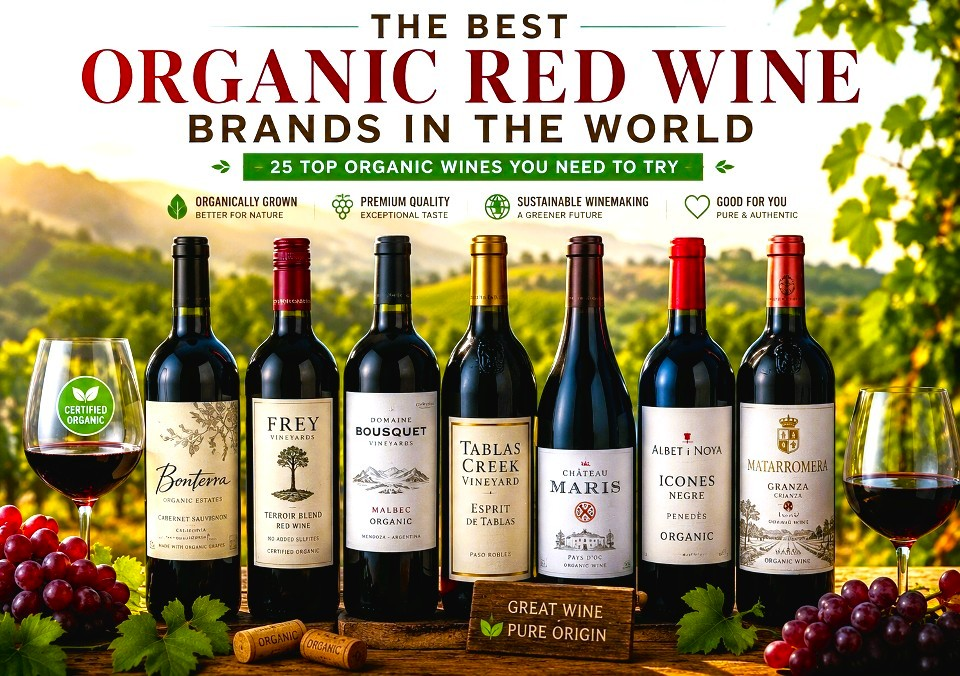
Discover the best organic red wine brands in the world, from Bonterra and Frey Vineyards to Domaine Bousquet, Tablas Creek, Château Maris and Albet i Noya. Explore certified organic, biodynamic and regenerative organic wines, the best organic red grape varieties, food pairings, buying tips and what to look for on the label.
Organic wine has moved far beyond the niche shelves where it was once found.
Today, some of the world’s most interesting wineries are farming organically, biodynamically or regeneratively, producing red wines that can compete with conventional wines on quality, character and value. From high-altitude Malbec from Argentina and Mediterranean Grenache and Syrah to California Cabernet Sauvignon, Spanish Tempranillo and Italian indigenous varieties, organic red wine now covers an enormous range of styles.
But there is an important distinction that shoppers should understand:
Organic wine is not one particular taste or style.
Organic certification primarily concerns how the grapes are grown and how the wine is produced under a particular certification standard. A certified organic Cabernet Sauvignon can be powerful and oak-aged, while an organic Pinot Noir can be light and elegant. A biodynamic Rhône blend can be earthy and complex, while an organic Malbec can be rich, fruity and approachable.
The certification rules also vary between markets. In the United States, for example, a wine carrying the USDA organic designation cannot contain added sulfites, while wine made with certified organic grapes can contain added sulfur dioxide within the applicable limit and cannot use the USDA Organic seal.
That is why choosing the best organic red wine brands requires looking beyond the word “organic” on the front label.
This guide explores 25 producers and brands worth knowing, explains the different organic certifications, compares major red varieties and gives practical recommendations for choosing an organic red wine for dinner, gifts, celebrations or everyday drinking.
Table of Contents
- What Is Organic Red Wine?
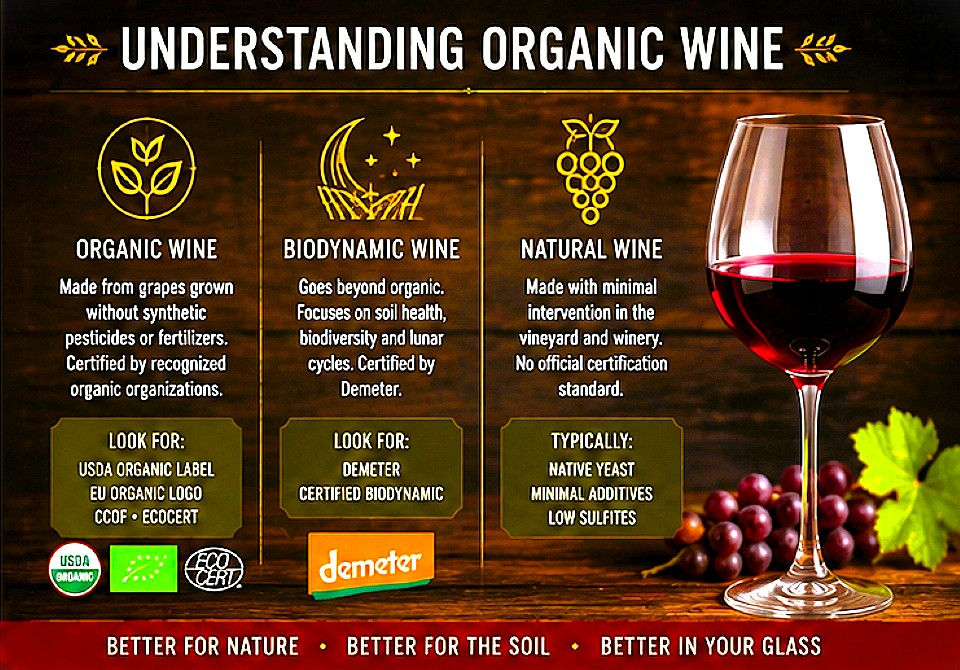
- Organic vs. Biodynamic vs. Natural Wine
- How to Read an Organic Wine Label
- The 25 Best Organic Red Wine Brands in the World
- Bonterra Organic Estates
- Frey Vineyards
- Domaine Bousquet
- Tablas Creek Vineyard
- Château Maris
- Albet i Noya
- Matarromera / Granza
- Troon Vineyard
- Arianna Occhipinti
- Emiliana Organic Vineyards
- Domaine de la Janasse and Other Organic Rhône Producers
- Organic Red Wine Regions
- Best Organic Cabernet Sauvignon
- Best Organic Malbec
- Best Organic Pinot Noir
- Best Organic Tempranillo
- Best Organic Sangiovese
- Best Organic Grenache and Syrah
- Best Organic Red Blends
- Best Organic Red Wines for Food Pairing
- Best Organic Red Wines for Beginners
- Are Organic Red Wines Better?
- Does Organic Wine Mean No Sulfites?
- How to Choose the Best Organic Red Wine
- Frequently Asked Questions
- Final Thoughts
What Is Organic Red Wine?
Organic red wine is wine produced from grapes grown according to certified organic farming standards, with the exact rules depending on the country and certification system.
Organic viticulture generally focuses on avoiding prohibited synthetic pesticides, herbicides and fertilizers and encouraging healthier agricultural ecosystems.
However, organic certification does not automatically mean:
- Natural wine
- Vegan wine
- Sulfite-free wine
- Low-alcohol wine
- Low-sugar wine
- Biodynamic wine
- Unfiltered wine
- Minimal-intervention wine
Those are separate considerations.
This distinction is particularly important because the wine world uses many overlapping terms.
A winery can farm organically but make a fairly traditional, polished Cabernet Sauvignon. Another winery can be certified biodynamic and produce a minimal-intervention wine with native yeast. Another may farm organically but use conventional cellar techniques.
In other words:
Organic describes a regulated production system—not a flavor profile.
The European Union also has specific rules for organic wine. The European Commission states that organic wine must be made from organic grapes and yeast and must meet additional winemaking restrictions, including lower sulfite levels than conventional equivalents.
Organic vs. Biodynamic vs. Natural Wine
These three terms are often confused.
Organic Wine
Organic certification focuses on regulated farming and production practices.
Look for recognized certification such as:
- USDA Organic
- EU Organic
- CCOF
- Ecocert
- Other recognized national organic certification bodies
Biodynamic Wine
Biodynamic farming goes beyond conventional organic requirements and treats the farm as an interconnected ecosystem.
Demeter, the major international biodynamic certification organization, describes biodynamic viticulture as emphasizing biodiversity, living soils and a farm viewed as an integrated organism.
Many biodynamic wineries are also certified organic, but organic does not automatically mean biodynamic.
Natural Wine
Natural wine does not have one universally standardized global certification system equivalent to USDA Organic or EU Organic.
Natural wine commonly refers to low-intervention cellar practices, which may include:
- Native yeast
- Minimal additives
- Lower sulfur use
- Less filtration
- Minimal manipulation
A wine can therefore be:
organic but not natural
or
natural but not certified organic.
For shoppers who specifically want certified organic farming, the certification mark is more useful than the vague term “natural.”
How to Read an Organic Wine Label
This is one of the most important sections for anyone shopping for organic red wine.
“Organic”
In the United States, a wine labeled organic under USDA rules must meet the applicable organic production requirements, and added sulfites are not permitted.
“Made With Organic Grapes”
This means the grapes are certified organic, but the finished wine does not qualify for the USDA “organic” category.
In the United States, sulfur dioxide may be added, subject to the applicable limit, and the USDA Organic seal cannot be used.
EU Organic
European organic wine follows EU organic production rules and can carry the EU organic logo when the product meets the certification requirements. The logo is intended to help consumers identify certified organic products.
This means a European organic red wine may be labeled differently from an organic wine sold under USDA rules.
Always consider the country where you are buying the wine and the certification system used by that bottle.
The 25 Best Organic Red Wine Brands in the World
There is no universally accepted global ranking of “the best” organic red wine brands because wine quality is subjective and different wineries specialize in different grapes, regions and styles.
The following list therefore focuses on high-quality, established or particularly noteworthy organic and biodynamic producers, with an emphasis on red wines and strong environmental credentials.
1. Bonterra Organic Estates — California, USA
Best for:
Accessible organic Cabernet Sauvignon, Pinot Noir and red blends
Bonterra is one of the most recognizable names in American organic wine.
The winery began organic farming in Mendocino County in 1987 and says every bottle in its portfolio is made with organically farmed grapes. Bonterra verifies its organic claims through California Certified Organic Farmers (CCOF).
Its red-wine portfolio includes varieties such as:
- Cabernet Sauvignon
- Pinot Noir
- Merlot
- Red blends
- Rhône-inspired blends
The winery has also moved into regenerative organic agriculture. Its estate collection includes Regenerative Organic Certified wines, while its McNab Ranch has been biodynamically certified since 1996.
Why Bonterra Stands Out
Bonterra is particularly interesting for people who want organic wine without sacrificing familiarity.
You don’t need to be an adventurous natural-wine drinker to enjoy it.
Its Cabernet Sauvignon is an especially useful introduction to organic red wine because the style remains recognizable to conventional California Cabernet drinkers.
Best Pairings
Try Bonterra Cabernet Sauvignon with:
- Steak
- Burgers
- Roast beef
- Grilled vegetables
- Lamb
- Aged cheddar
Best choice for:
Someone buying organic wine for the first time.
2. Frey Vineyards — Mendocino County, California
Best for:
USDA organic and no-added-sulfite wines
Frey Vineyards is one of the most important names in American organic wine.
The winery states that it was the first certified organic winery in the United States and later became the first U.S. winery to achieve Demeter Biodynamic certification.
Frey is particularly notable because its wines are made without added sulfites.
Its organic red portfolio has included wines based on varieties such as:
- Cabernet Sauvignon
- Merlot
- Zinfandel
- Syrah
- Red blends
What Makes Frey Different?
For consumers specifically looking for USDA organic wine with no added sulfites, Frey is one of the most recognizable producers to investigate.
The wines also appeal to shoppers who are interested in biodynamic agriculture and minimal-intervention philosophies.
Best Pairings
Frey red wines can work well with:
- Pizza
- Pasta
- Grilled vegetables
- Burgers
- Roast chicken
- BBQ
Best choice for:
Consumers specifically seeking USDA organic and no-added-sulfite wine.
3. Domaine Bousquet — Mendoza, Argentina
Best for:
Organic Malbec and high-altitude Argentine reds
Domaine Bousquet is one of the strongest organic wine names coming from Argentina.
Located in Mendoza’s Uco Valley, the winery has built an extensive portfolio of certified organic wines, including Malbec, Cabernet Sauvignon, Cabernet Franc, Pinot Noir and red blends.
The winery’s Gaia range goes further, using grapes from vineyards farmed under certified organic and biodynamic practices. Its Gaia Organic & Biodynamic Malbec is made from 100% Malbec from Gualtallary.
Why Organic Malbec Works So Well
Mendoza is naturally associated with Malbec, and the combination of:
- High elevation
- Intense sunlight
- Large temperature differences
- Dry climate
- Mountain influence
can produce concentrated yet fresh wines.
Domaine Bousquet offers organic Malbec at several price levels, making it particularly useful for everyday drinking as well as more serious occasions.
Best Pairings
Serve organic Malbec with:
- Steak
- Argentine BBQ
- Lamb
- Burgers
- Empanadas
- Grilled vegetables
Best choice for:
Value-conscious red-wine lovers.
4. Tablas Creek Vineyard — Paso Robles, California
Best for: Organic and biodynamic Rhône-style reds
Tablas Creek is one of the most respected sustainable and organic estates in California.
The estate has been organically farmed since its founding and certified organic since 2003. It became biodynamically certified in 2017 and was the world’s first Regenerative Organic Certified vineyard in 2020, according to the winery.
Its wines include Rhône-inspired red blends based on grapes such as:
- Mourvèdre
- Grenache
- Syrah
- Counoise
- Tannat in selected bottlings
Its flagship Esprit de Tablas is based on Mourvèdre and offers a richer, more structured interpretation of Paso Robles Rhône varieties.
Why Tablas Creek Stands Out
This is a producer for wine drinkers who want organic farming and serious wine complexity.
It is not simply an “organic alternative.”
The wines are intended to express vineyard character and the Paso Robles terroir.
Best Pairings
- Roast lamb
- Braised beef
- Grilled steak
- Mediterranean cuisine
- Roasted vegetables
- Hard cheeses
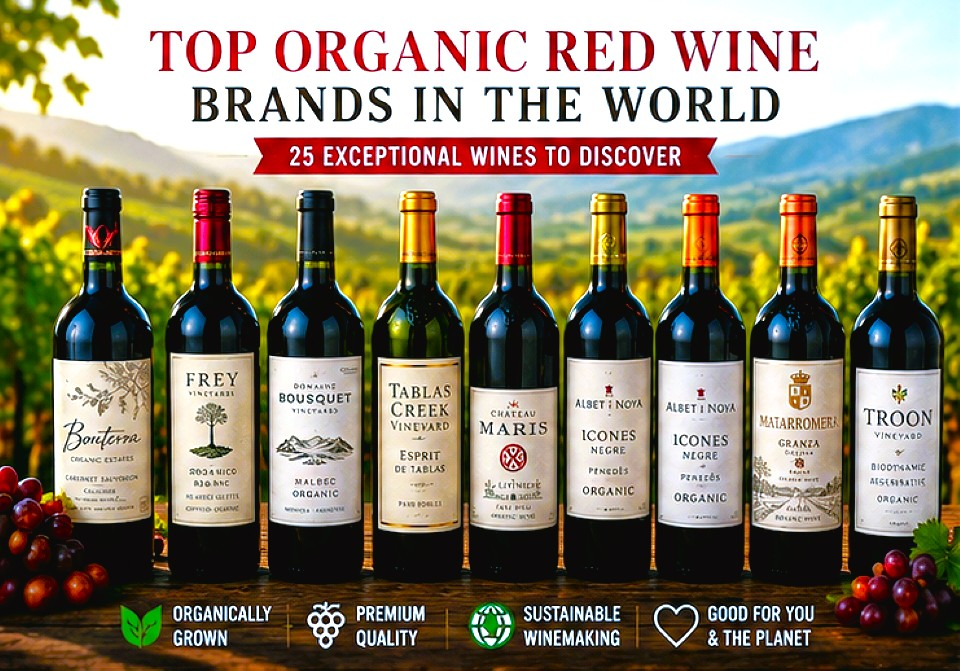
Best organic red wine brands in the world featuring Bonterra, Frey Vineyards, Domaine Bousquet, Tablas Creek, Château Maris and Albet i Noya
5. Château Maris — Languedoc, France
Best for:
French organic and biodynamic red wine
Château Maris in the Languedoc is an important organic and biodynamic producer.
The estate received Ecocert certification in 2002, Biodyvin certification in 2004 and Demeter certification in 2008.
The Languedoc is particularly well suited to organic viticulture because its Mediterranean climate allows many vineyards to operate with relatively low disease pressure compared with wetter regions.
Typical Red Varieties
Depending on the wine:
- Syrah
- Grenache
- Mourvèdre
- Carignan
Style
Expect wines with:
- Dark fruit
- Herbs
- Spice
- Mediterranean character
- Structured tannins
Best choice for:
Drinkers seeking organic French reds with a strong sense of place.
6. Albet i Noya — Penedès, Spain
Best for: Organic Spanish reds and excellent value
Albet i Noya is one of Spain’s pioneering organic wineries.
The winery says its organic journey began in 1978, making it one of the country’s longest-established organic wine producers. Its vineyards are located in the Penedès and Ordal Mountains.
The producer makes organic wines from varieties including:
- Tempranillo
- Cabernet Sauvignon
- Grenache
- Merlot
- Indigenous Catalan grapes
Its Icones Negre is a particularly approachable organic red blend based on Cabernet Sauvignon, Grenache and Tempranillo.
Why Albet i Noya Is Important
Organic wine is sometimes associated with expensive boutique bottles.
Albet i Noya demonstrates that organic Spanish wine can be accessible, food-friendly and suitable for everyday drinking.
Best choice for:
Affordable organic Spanish red wine.
7. Bodegas Familiares Matarromera — Spain
Best for: Organic Tempranillo and Spanish regional reds
Matarromera is another major Spanish wine company with organic production.
Its Granza range includes organic wines from regions such as Toro and Ribera del Duero. The company says its organic vineyards and wineries use production methods designed to limit synthetic pesticides, herbicides and fertilizers.
One notable example is Granza Crianza de Toro, an organic red made from Tinta de Toro and aged for 12 months in French and American oak.
Flavor Profile
Organic Toro reds can be:
- Dark
- Full-bodied
- Fruit-driven
- Spicy
- Tannic
- Oak-influenced
Best choice for:
Fans of powerful Spanish reds.
8. Troon Vineyard — Oregon, USA
Best for: Regenerative organic and biodynamic wine
Troon Vineyard in Oregon’s Applegate Valley is particularly interesting because it combines Demeter Biodynamic and Regenerative Organic Gold certification.
The winery describes itself as the world’s only Demeter Biodynamic and Regenerative Organic Gold Certified winery and farm.
Its approach includes:
- Biodynamic farming
- Regenerative agriculture
- Native yeast
- Minimalist winemaking
- Biodiversity
- Integrated farming
Troon’s red wines can appeal to consumers who want something more distinctive than mainstream Cabernet or Merlot.
Best choice for:
Wine enthusiasts interested in organic, biodynamic and regenerative agriculture combined with low-intervention winemaking.
9. Arianna Occhipinti — Sicily, Italy
Best for:
Organic Sicilian Frappato and Nero d’Avola
Sicily has become one of the most exciting regions for organic and natural wine.
Arianna Occhipinti is one of the island’s best-known producers in this movement.
Her wines are associated with indigenous Sicilian grapes such as:
- Frappato
- Nero d’Avola
The result is a style that can be very different from heavy international varieties.
Frappato
Typically lighter and more aromatic, Frappato can offer:
- Red cherry
- Strawberry
- Floral notes
- Herbs
- Fresh acidity
Nero d’Avola
Usually deeper and fuller, Nero d’Avola can offer:
- Blackberry
- Plum
- Spice
- Dark cherry
- Earthy notes
Best choice for:
Adventurous drinkers who want organic Italian reds beyond Chianti and Barolo.
10. Emiliana Organic Vineyards — Chile
Best for: Organic Chilean Cabernet, Syrah and red blends
Chile is one of the world’s major organic wine-producing countries, and Emiliana is one of its best-known organic producers.
Its portfolio includes organic and biodynamic wines made from grapes such as:
- Cabernet Sauvignon
- Syrah
- Merlot
- Carmenère
- Mourvèdre
- Grenache
Chile’s dry climate in many wine regions can be advantageous for organic viticulture.
Why Chilean Organic Wine Is Interesting
Chile can offer excellent value because its combination of climate, geography and established export infrastructure allows producers to make high-quality wines at competitive prices.
Best choice for:
Value-focused organic red wine shoppers.
11. Bonterra Estate Collection
While Bonterra has already earned a place on this list, its Estate Collection deserves separate attention.
The Estate Collection was introduced as a tier of Regenerative Organic Certified wines, including Cabernet Sauvignon. Bonterra says its estate vineyards and winery in Mendocino County achieved ROC certification.
This is a useful example of how the organic wine movement is evolving.
The conversation is increasingly moving from:
“Did you avoid prohibited chemicals?”
toward:
“Can agriculture actively improve soil, biodiversity and the wider ecosystem?”
That is the central philosophy behind regenerative organic farming.
12. Gaia Organic & Biodynamic Wines — Domaine Bousquet
Domaine Bousquet’s Gaia wines are particularly attractive to consumers who want the combination of:
Argentina + organic + biodynamic + high altitude.
The Gaia Malbec comes from certified organic and biodynamic vineyards in Gualtallary.
The wine is 100% Malbec and uses indigenous yeasts, previously used French oak and manual harvesting according to the winery’s description.
This is a good example of an organic wine that can still be serious, structured and gastronomic.
understanding organic wines
13. Granza Organic Wines — Spain
Granza is the organic wine brand developed by Bodegas Familiares Matarromera.
Its portfolio has included organic wines from:
- Toro
- Ribera del Duero
- Rueda
For red-wine drinkers, Toro and Ribera del Duero are particularly interesting because Tempranillo/Tinta de Toro can produce rich, structured wines.
Granza demonstrates that organic wine can be produced on a scale large enough to reach international consumers while maintaining certified organic production.
14. Frey Organic Cabernet Sauvignon
Frey’s Cabernet Sauvignon deserves special attention for shoppers looking for an organic red that resembles the structure of familiar California Cabernet.
Cabernet Sauvignon remains one of the world’s most popular red grapes because of its:
- Blackcurrant character
- Dark fruit
- Tannins
- Oak compatibility
- Aging potential
An organic Cabernet can therefore be a very easy transition for someone who already enjoys traditional California reds.
15. Domaine Bousquet Organic Cabernet Sauvignon
Domaine Bousquet also offers organic Cabernet Sauvignon, making the producer useful for shoppers who want a darker, more structured alternative to its Malbec.
The winery’s current organic portfolio includes Cabernet Sauvignon across multiple tiers.
Compared with Malbec, Cabernet Sauvignon generally offers:
- Firmer tannins
- More cassis-like fruit
- Greater structure
- More pronounced aging potential
It pairs especially well with grilled beef and rich dishes.
16. Tablas Creek Esprit de Tablas
For serious organic red-wine enthusiasts, Esprit de Tablas is an important wine to investigate.
It is a Rhône-style blend based on Mourvèdre, with additional Rhône varieties contributing complexity. The winery describes it as rich, balanced and ageworthy.
This style demonstrates how organic farming can coexist with:
- Complex blending
- Long aging
- Traditional French-inspired techniques
- Premium positioning
17. Albet i Noya Curiós
Curiós is particularly significant because Albet i Noya identifies it as its first organic wine.
The wine is based on Ull de Llebre, the Catalan name for Tempranillo, and is designed as a youthful red emphasizing fruit and freshness.
This is an excellent example of a young organic Spanish red.
18. Château Maris Syrah-Based Reds
Syrah is one of the grapes that performs particularly well in southern France.
At Château Maris, organic and biodynamic farming provides a foundation for wines with Mediterranean character.
Typical Syrah flavors include:
- Blackberry
- Black pepper
- Violet
- Plum
- Herbs
- Spice
A biodynamic Languedoc Syrah can therefore be a strong alternative to more familiar California or Australian Shiraz.
19. Troon Vineyard Red Wines
Troon is particularly compelling for consumers who are interested in the intersection of:
organic + biodynamic + regenerative + minimal intervention.
The winery uses native yeasts and describes its winemaking as minimalist, with no additives used in fermentation and a preference for avoiding new oak so the wines can express their vineyard character.
These wines are generally more appropriate for curious wine drinkers than people looking for an inexpensive supermarket Cabernet.
20. Regenerative Organic Red Wines
Regenerative organic certification is becoming increasingly important in wine.
It goes beyond simply avoiding certain agricultural inputs.
The Regenerative Organic framework emphasizes areas such as:
- Soil health
- Animal welfare
- Social fairness
Troon and Tablas Creek are particularly notable examples, while Bonterra has developed a major regenerative organic program.
This is one of the most important trends to watch in the future of organic wine.
21. Organic Spanish Tempranillo
Spain is one of the world’s strongest regions for organic viticulture.
Tempranillo is particularly suitable for consumers who enjoy:
- Cabernet Sauvignon
- Merlot
- Malbec
because it can deliver substantial body and tannin without becoming excessively heavy.
Look for organic Tempranillo from:
- Ribera del Duero
- Toro
- Rioja
- Penedès
- La Mancha
22. Organic Italian Red Wine
Italy offers an enormous variety of organic reds.
Look for organic examples of:
- Sangiovese
- Nero d’Avola
- Frappato
- Montepulciano
- Barbera
- Nebbiolo
Sicily and Tuscany are particularly interesting areas for consumers exploring organic Italian wine.
The advantage of Italian organic wine is that it offers indigenous grape diversity, rather than simply repeating the same international varieties.
23. Organic French Red Wine
France is another essential country for organic wine.
Important organic red regions include:
- Languedoc
- Rhône
- Bordeaux
- Provence
- Burgundy
- Loire
- Beaujolais
The Languedoc is especially important because it combines a Mediterranean climate with a huge range of grapes and vineyard sizes.
Organic French reds can range from inexpensive everyday blends to serious ageworthy wines.
24. Organic California Red Wine
California is home to some of North America’s most established organic wineries.
The state offers organic versions of:
- Cabernet Sauvignon
- Pinot Noir
- Zinfandel
- Syrah
- Merlot
- Rhône blends
Mendocino is particularly notable for organic viticulture.
Bonterra and Frey are two of the most recognizable names for consumers seeking certified organic California wine.
25. Organic Argentine Red Wine
Argentina deserves a special place in the organic red wine conversation.
Mendoza’s high-altitude vineyards are particularly well suited to producing organic Malbec.
Domaine Bousquet is an especially strong example because its portfolio spans:
- Organic
- Biodynamic
- Regenerative
- USDA Organic
- Kosher organic
depending on the specific range.
Its organic Malbecs offer an accessible entry point into the world of certified organic red wine.
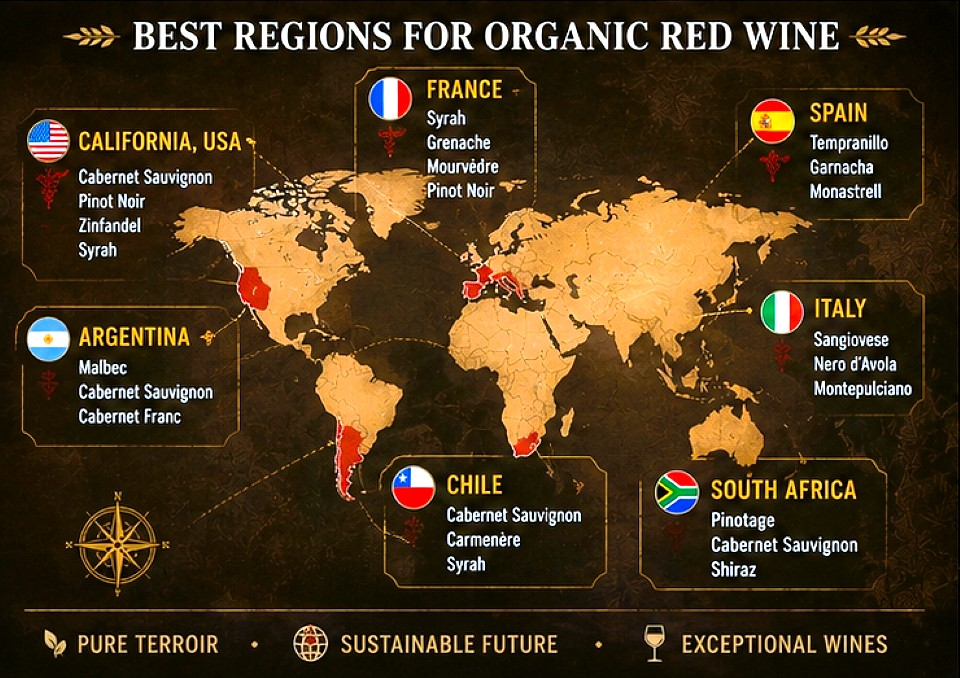
Top organic red wine regions including California, Mendoza, France, Spain, Italy and Chile
The Best Organic Red Wine Regions in the World
1. Argentina
Best grape: Malbec
Argentina is one of the easiest places to start.
The dry climate and high-altitude vineyards of Mendoza can produce concentrated fruit while maintaining freshness.
2. Spain
Best grapes: Tempranillo, Garnacha
Spain has a particularly strong organic-wine tradition.
Look to:
- Ribera del Duero
- Toro
- Rioja
- La Mancha
- Penedès
- Jumilla
3. Italy
Best grapes: Sangiovese, Nero d’Avola, Frappato
Italy is ideal for drinkers seeking indigenous grape varieties and regional diversity.
4. France
Best grapes: Syrah, Grenache, Mourvèdre, Carignan
Southern France is especially strong for organic red blends.
5. California
Best grapes: Cabernet Sauvignon, Pinot Noir, Zinfandel
California provides some of the most recognizable certified organic wines in North America.
6. Chile
Best grapes: Cabernet Sauvignon, Carmenère, Syrah
Chile is particularly attractive for value-oriented organic wine.
Best Organic Red Wine by Grape Variety
Best Organic Cabernet Sauvignon
Look to:
- Bonterra
- Frey
- Domaine Bousquet
- Emiliana
Cabernet is ideal for:
Steak + BBQ + aged cheese
Best Organic Malbec
Look to:
- Domaine Bousquet
- Other certified organic Mendoza producers
Malbec is ideal for:
Steak + burgers + grilled lamb
Best Organic Pinot Noir
Look to organic producers in:
- California
- Oregon
- France
- Chile
- New Zealand
Pinot Noir is ideal for:
Salmon + roast chicken + mushrooms + pork
Best Organic Tempranillo
Look to:
- Albet i Noya
- Granza
- Other organic Ribera del Duero and Toro producers
Tempranillo is excellent with:
Tapas + lamb + roast pork + Spanish cured meats
Best Organic Sangiovese
Look to Tuscany and central Italy.
Sangiovese works exceptionally well with:
Tomato-based pasta + pizza + grilled vegetables
Best Organic Grenache
Grenache-based organic reds are particularly good from:
- Languedoc
- Rhône
- Spain
They pair beautifully with:
Lamb + Mediterranean food + grilled vegetables
Best Organic Red Wines for Food Pairing
Organic wine doesn’t require special food-pairing rules.
Choose based on the wine’s grape, body, acidity, tannin and flavor profile.
Organic Cabernet + Steak
The tannins and structure work naturally with fatty grilled beef.
Organic Malbec + BBQ
Dark fruit and moderate tannin complement smoky meat.
Organic Pinot Noir + Mushroom Pasta
Earthy flavors can create a harmonious pairing.
Organic Tempranillo + Tapas
The acidity and savory character work with cured meats, roasted peppers and Spanish cheeses.
Organic Grenache Blend + Lamb
The combination of fruit, spice and herbs complements roasted or grilled lamb.
Organic Sangiovese + Pizza
Sangiovese’s acidity works especially well with tomato sauce.
Are Organic Red Wines Better?
This question is more complicated than it sounds.
Organic does not automatically mean better tasting.
A great organic wine can be outstanding.
A poor organic wine can still be poor wine.
Organic certification primarily tells you something about production practices and permitted inputs, not whether you personally will love the wine.
What organic certification can provide is greater transparency about farming and production requirements.
For many wine consumers, that matters because they want to support:
- Organic agriculture
- Biodiversity
- Reduced reliance on synthetic agricultural inputs
- Soil-health initiatives
- More transparent farming
Bonterra, for example, describes its organic farming as supporting biodiversity, soil health and water stewardship.
Does Organic Wine Mean No Sulfites?
No—not necessarily.
This is one of the biggest misconceptions in the organic wine category.
Sulfites can occur naturally during fermentation.
In the United States, wines in the USDA organic category cannot have added sulfites, while wines labeled “made with organic grapes” can use sulfur dioxide within the permitted limit.
The U.S. TTB also requires a sulfite declaration when total sulfur dioxide reaches 10 ppm or more.
So if your goal is specifically to find a wine with no added sulfites, don’t simply look for the word “organic.”
Look at the exact certification and label language.
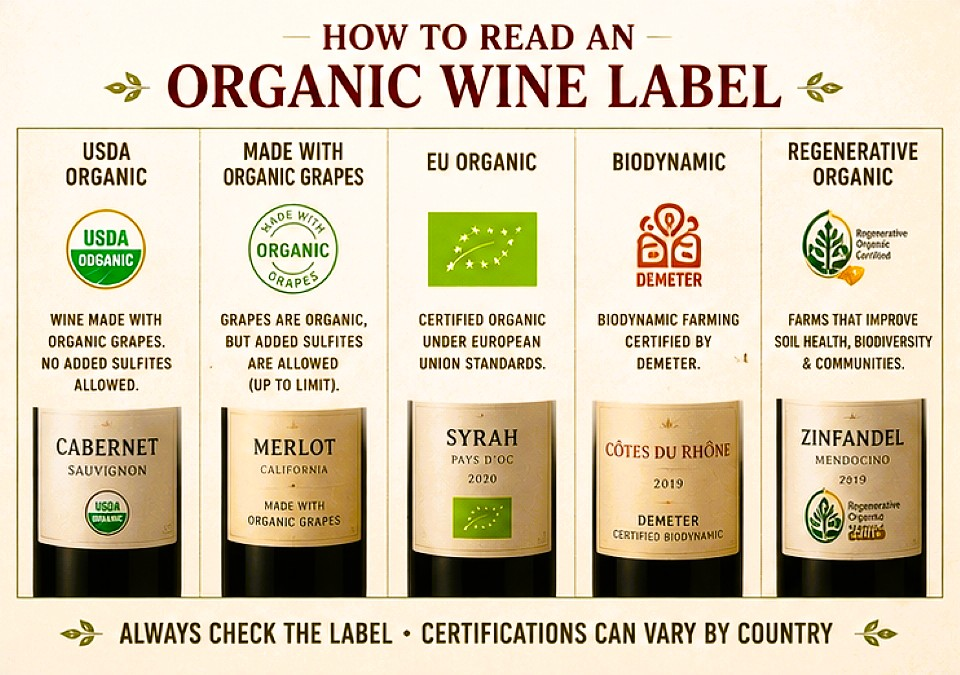
How to read an organic wine label showing USDA Organic, EU Organic, biodynamic and regenerative organic certifications
How to Choose the Best Organic Red Wine
Use this five-step method.
Step 1: Choose Your Grape
Start with something you already enjoy.
Like Cabernet?
Try organic Cabernet.
Like Malbec?
Start with Mendoza.
Like Pinot Noir?
Look to Oregon, California, Burgundy or New Zealand.
Step 2: Check the Certification
Look for:
- USDA Organic
- EU Organic
- CCOF
- Demeter
- Ecocert
- Other recognized certifiers
Step 3: Decide How Traditional You Want the Wine
Do you want:
Classic and polished?
Choose organic Cabernet, Merlot or Malbec.
Light and elegant?
Choose organic Pinot Noir.
Rustic and Mediterranean?
Choose Grenache, Carignan or Syrah.
Minimal intervention?
Explore biodynamic and natural-wine producers.
Step 4: Match the Wine to Food
For steak:
Cabernet or Malbec
For pasta:
Sangiovese or Tempranillo
For roast chicken:
Pinot Noir
For lamb:
Grenache or Rhône blends
Step 5: Consider Your Budget
Organic wine exists at almost every price level.
You don’t have to spend $50 or $100 to find an enjoyable organic red.
Spain, Argentina and Chile can offer particularly strong value.
Why Organic Red Wine Is Becoming More Popular
The global organic wine movement is benefiting from several trends.
Consumers increasingly want to know:
- Where their food comes from
- How agricultural products are produced
- What certifications mean
- Whether vineyards protect biodiversity
- How wineries manage soil
- Whether producers are reducing environmental impact
Recent wine-industry reporting also shows growing interest in organic wine, although organic remains a minority of total still-wine consumption. One 2025 industry report cited IWSR data putting organic at about 4% of still-wine consumption in 2024.
The opportunity is particularly strong in Europe, where Spain, France and Italy have large areas of certified organic vines.
Organic Wine and Regenerative Agriculture
The next major evolution may be regenerative agriculture.
Organic farming asks important questions about prohibited inputs and production methods.
Regenerative agriculture asks an additional question:
Can farming actively improve the land?
That can include:
- Building soil organic matter
- Cover crops
- Compost
- Biodiversity
- Grazing animals
- Reduced tillage
- Water conservation
- Carbon-focused practices
Bonterra, Tablas Creek and Troon are particularly notable examples.
Tablas Creek became the world’s first Regenerative Organic Certified vineyard in 2020, while Troon achieved Regenerative Organic Gold certification.
This makes regenerative organic wine one of the most interesting areas to watch over the next decade.
Organic Red Wine for Beginners
If you’ve never tried organic wine before, don’t start by choosing the strangest natural wine you can find.
Instead, start with familiar grapes.
Beginner Choice #1: Organic Cabernet Sauvignon
Full-bodied and familiar.
Beginner Choice #2: Organic Malbec
Fruit-forward and approachable.
Beginner Choice #3: Organic Tempranillo
Balanced, savory and food-friendly.
Beginner Choice #4: Organic Pinot Noir
Lighter and more elegant.
Beginner Choice #5: Organic Red Blend
A good option for someone who isn’t sure which grape they prefer.
Organic Red Wine for Dinner Parties
If you’re hosting a dinner party, organic red wine can be a great way to offer guests something interesting without making the event feel overly technical.
A simple three-bottle lineup could be:
Bottle 1 — Organic Pinot Noir
For guests who prefer lighter reds.
Bottle 2 — Organic Malbec
For the main course.
Bottle 3 — Organic Cabernet Sauvignon
For guests who want a fuller-bodied red.
This gives you three distinctly different styles.
Organic Red Wine for Gifts
Organic wine can also make an excellent gift for:
- Wine lovers
- Environmentally conscious friends
- Dinner hosts
- Corporate clients
- Birthdays
- Anniversaries
- Christmas
- Housewarmings
For a gift, I would choose an organic wine with a recognizable grape and region.
For example:
Organic Argentine Malbec
or
Organic California Cabernet Sauvignon
These are easier for most recipients to understand than an obscure natural-wine blend.
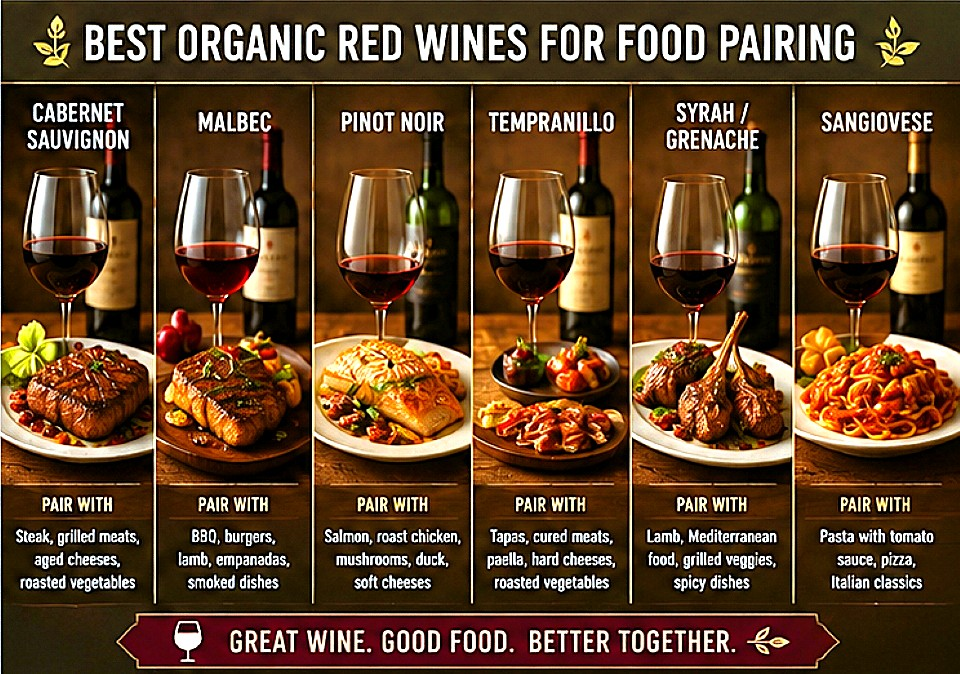
Best organic red wine and food pairings featuring Cabernet Sauvignon, Malbec, Pinot Noir, Tempranillo, Syrah and Sangiovese
Frequently Asked Questions About Organic Red Wine
What is the best organic red wine?
There is no single best organic red wine for everyone. Bonterra is an excellent accessible California option, Frey is notable for USDA organic and no-added-sulfite wines, Domaine Bousquet is particularly strong for organic Malbec, and Tablas Creek is a standout for organic, biodynamic and regenerative Rhône-style wines.
What are the best organic red wine brands?
Some of the most interesting producers include Bonterra, Frey Vineyards, Domaine Bousquet, Tablas Creek, Château Maris, Albet i Noya, Matarromera, Troon Vineyard and Arianna Occhipinti.
Is organic red wine healthier?
It is not appropriate to assume that organic wine is inherently healthier. Organic certification primarily concerns production standards. Wine still contains alcohol, and alcohol consumption carries health risks. Organic certification should not be treated as a health claim.
Does organic wine have pesticides?
Certified organic farming restricts the use of prohibited synthetic pesticides and other prohibited inputs, but “organic” does not mean a vineyard is completely free of every pesticide or agricultural treatment. The exact permitted practices depend on the certification standard.
Does organic wine contain sulfites?
It can. Sulfites can occur naturally, and the rules concerning added sulfites vary by certification and market. Under USDA rules, added sulfites are prohibited in wine labeled “organic,” while wine labeled “made with organic grapes” can contain added sulfur dioxide within the permitted limit.
Is biodynamic wine the same as organic wine?
No. Biodynamic agriculture has additional requirements and principles beyond organic farming. Many biodynamic vineyards are organic as well, but organic certification does not automatically mean biodynamic certification.
Is natural wine organic?
Not necessarily. Natural wine and organic wine describe different concepts. Some natural wines come from certified organic vineyards, while others may not carry organic certification.
What is the best organic red wine for steak?
Organic Cabernet Sauvignon and Malbec are excellent choices. Cabernet provides more tannic structure, while Malbec generally emphasizes dark fruit and a softer texture.
What is the best organic red wine for pasta?
Organic Sangiovese, Tempranillo and lighter Italian red blends are excellent with tomato-based pasta dishes.
What is the best organic red wine for beginners?
Start with organic Malbec, Cabernet Sauvignon or a fruit-forward red blend. These varieties are generally easier for conventional red-wine drinkers to understand.
Which country makes the best organic wine?
There is no single winner. Spain, France, Italy, Argentina, Chile, the United States and other wine-producing countries all have excellent organic producers.
Is organic wine more expensive?
It can be, but it doesn’t have to be. Argentina, Spain and Chile offer many good-value organic wines, while premium organic and biodynamic wines from regions such as California, France and Italy can command much higher prices.
Final Thoughts: The Best Organic Red Wine Brands in the World
The world of organic red wine is now too large and diverse to be considered a niche category.
From California Cabernet Sauvignon to Argentine Malbec, Spanish Tempranillo, Italian Nero d’Avola, French Syrah and Oregon Rhône-style blends, organic wine can offer virtually every major red-wine style.
For beginners, Bonterra and Frey Vineyards are excellent places to start in the United States.
For Malbec lovers, Domaine Bousquet is one of the most compelling producers to explore.
For Spanish wine enthusiasts, Albet i Noya and Matarromera’s Granza range demonstrate how broad the organic category has become.
For serious wine lovers interested in biodynamic and regenerative agriculture, Tablas Creek, Troon Vineyard and Château Maris offer particularly fascinating examples.
And for adventurous drinkers, producers such as Arianna Occhipinti demonstrate that organic wine can be about much more than certification—it can also be about indigenous grapes, regional identity and a distinctive interpretation of terroir.
The most important thing to remember is that organic does not describe one flavor profile.
An organic Cabernet can be bold.
An organic Pinot Noir can be delicate.
An organic Malbec can be rich and fruity.
An organic Tempranillo can be savory and structured.
A biodynamic Rhône blend can be earthy and complex.
The certification tells you something about how the wine was produced. The grape, region, vintage and winemaking decisions tell you what the wine will taste like.
So when searching for the best organic red wine brands in the world, start with the wine style you already enjoy, check the certification, consider the producer’s farming philosophy and then match the bottle with your food and occasion.
That approach will lead you to much better bottles than simply choosing a wine because the front label says “organic.”
And as organic, biodynamic and regenerative viticulture continue to expand, wine lovers have more opportunities than ever to discover reds that combine quality, regional character and responsible farming practices.