
Blog
The Ultimate Guide to Buying Wine: How to Choose the Perfect Bottle

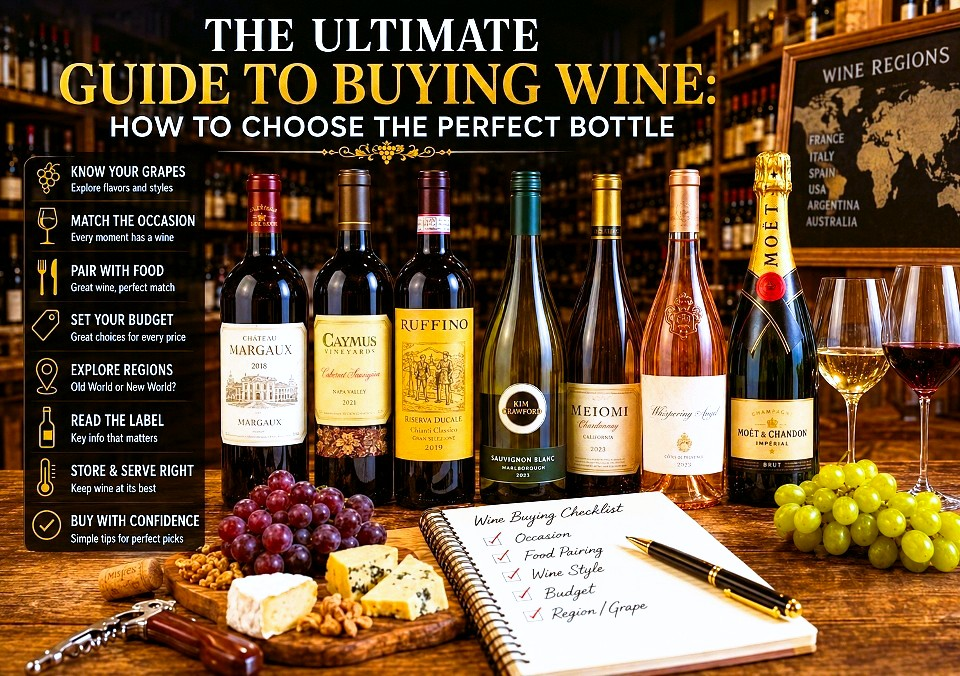
Learn how to buy the perfect bottle of wine for any occasion. This complete wine-buying guide explains grape varieties, wine styles, regions, sweetness, acidity, body, tannins, vintage, food pairing, price, labels, serving, storage, gifts and how to choose wine with confidence.
Buying wine should be enjoyable.
But walk into a wine store, browse an online wine shop, or look at a restaurant wine list and the experience can quickly become confusing.
There are hundreds—or even thousands—of bottles to choose from. Labels mention unfamiliar grape varieties, regions, appellations, vintages and producers. A $15 bottle may sit beside a $150 bottle, and both may have attractive labels and excellent descriptions.
So how do you know which wine to buy?
The good news is that you don’t need to become a sommelier.
You don’t need to memorize every wine region in France or know every producer in Italy.
You simply need to understand a few basic principles:
What grape is it?
Is it red, white, rosé or sparkling?
Is it dry or sweet?
Is it light- or full-bodied?
What food will you serve?
What is your budget?
Are you drinking it tonight or saving it?
Once you understand those questions, buying wine becomes much easier.
This guide will show you how to choose the perfect bottle of wine for almost any occasion, whether you’re shopping for a casual dinner, a romantic evening, a holiday celebration, a corporate gift, a summer barbecue, a wedding or simply a bottle to enjoy at home.
Table of Contents
- How to Choose Wine in 5 Simple Steps
- Start With the Type of Wine
- Understanding Wine Grape Varieties
- Red Wine Buying Guide
- White Wine Buying Guide
- Rosé Wine Buying Guide
- Sparkling Wine Buying Guide
- Fortified and Dessert Wine
- Dry vs. Sweet Wine
- Light-, Medium- and Full-Bodied Wine
- Understanding Acidity
- Understanding Tannins
- How to Read a Wine Label
- Does Vintage Matter?
- Old World vs. New World Wine
- Wine by Country
- Wine by Occasion
- Wine by Food
- How Much Should You Spend on Wine?
- Best Wine Under $20, $30, $50 and $100
- How to Buy Wine as a Gift
- How to Buy Wine for a Dinner Party
- How to Buy Wine for Summer
- How to Buy Wine for Winter
- How to Buy Wine Online
- How to Store Wine
- Common Wine-Buying Mistakes
- Wine Buying Cheat Sheet
- Frequently Asked Questions
- Final Thoughts
How to Choose Wine in 5 Simple Steps
If you don’t have time to read the entire guide, use this simple five-step method.
Step 1: Choose the color and style
Decide between:
- Red
- White
- Rosé
- Sparkling
- Dessert or fortified
Step 2: Choose the grape
Popular options include:
Red: Cabernet Sauvignon, Merlot, Pinot Noir, Malbec, Syrah, Sangiovese, Tempranillo
White: Chardonnay, Sauvignon Blanc, Riesling, Pinot Grigio, Albariño, Chenin Blanc
Step 3: Think about body
Light wines are generally fresher and more delicate.
Full-bodied wines are richer and more powerful.
Step 4: Match the wine to the food
A good pairing can make an average meal much better—and can make a great bottle seem even better.
Step 5: Set your budget
Don’t assume the most expensive bottle is automatically the best choice.
A well-chosen $25 bottle may be much more enjoyable than a poorly chosen $75 bottle.
Start With the Type of Wine
The easiest way to narrow your options is to decide which style you want.
Red wine
Red wine generally offers more tannin and structure than white wine.
Popular grapes include:
- Cabernet Sauvignon
- Merlot
- Pinot Noir
- Malbec
- Syrah
- Sangiovese
- Tempranillo
- Grenache
Choose red wine when you’re serving:
Steak, lamb, burgers, pasta with rich sauces, barbecue and hearty dishes.
White wine
White wine is often associated with freshness, acidity and lighter textures, although rich white wines such as oaked Chardonnay can be quite full-bodied.
Popular grapes include:
- Chardonnay
- Sauvignon Blanc
- Riesling
- Pinot Grigio
- Albariño
- Chenin Blanc
- Viognier
Choose white wine for:
Seafood, chicken, salads, vegetables, lighter pasta and many cheeses.
Rosé wine
Rosé ranges from extremely pale and dry to darker, fruitier and sweeter styles.
- Provence
- Tavel
- Bandol
- California
- Spain
- Italy
Rosé is especially useful when you want something between a light white wine and a red.
Choose it for:
Summer lunches, grilled seafood, salads, Mediterranean food and outdoor entertaining.
Sparkling wine
Sparkling wine is one of the most versatile categories.
Popular styles include:
- Champagne
- Prosecco
- Cava
- Crémant
- Franciacorta
- Asti
Sparkling wine works with much more than celebrations.
It’s excellent with:
Seafood, sushi, fried foods, brunch, appetizers and salty snacks.
Understanding Wine Grape Varieties
One of the easiest ways to become better at buying wine is to learn the major grapes.
Cabernet Sauvignon
Usually:
- Full-bodied
- Tannic
- Structured
- Dark-fruited
Typical flavors:
- Blackcurrant
- Blackberry
- Plum
- Cedar
- Dark chocolate
Best with: steak, lamb and grilled meats.
Merlot
Usually softer than Cabernet Sauvignon.
Typical flavors:
- Plum
- Cherry
- Blackberry
- Chocolate
- Vanilla
Best with: burgers, pork, chicken, pasta and roast meats.
Pinot Noir
Generally lighter-bodied, but capable of enormous complexity.
Typical flavors:
- Cherry
- Raspberry
- Strawberry
- Earth
- Mushroom
- Spice
Best with: salmon, duck, chicken, mushrooms and pork.
Malbec
Especially famous from Argentina.
Typical flavors:
- Blackberry
- Plum
- Blueberry
- Violet
- Cocoa
Best with: steak, barbecue and grilled meats.
Syrah/Shiraz
Can range from savory and peppery to rich and fruit-driven.
Typical flavors:
- Blackberry
- Blueberry
- Black pepper
- Plum
- Smoke
- Spice
Best with: steak, lamb, barbecue and sausages.
Sangiovese
The principal grape of many important Tuscan wines.
Typical flavors:
- Sour cherry
- Red plum
- Herbs
- Earth
- Spice
Best with: pizza, pasta, tomato sauces and Italian dishes.
Tempranillo
Spain’s great red grape.
Typical flavors:
- Cherry
- Plum
- Tobacco
- Vanilla
- Leather
- Herbs
Best with: lamb, roast pork, tapas and Manchego cheese.
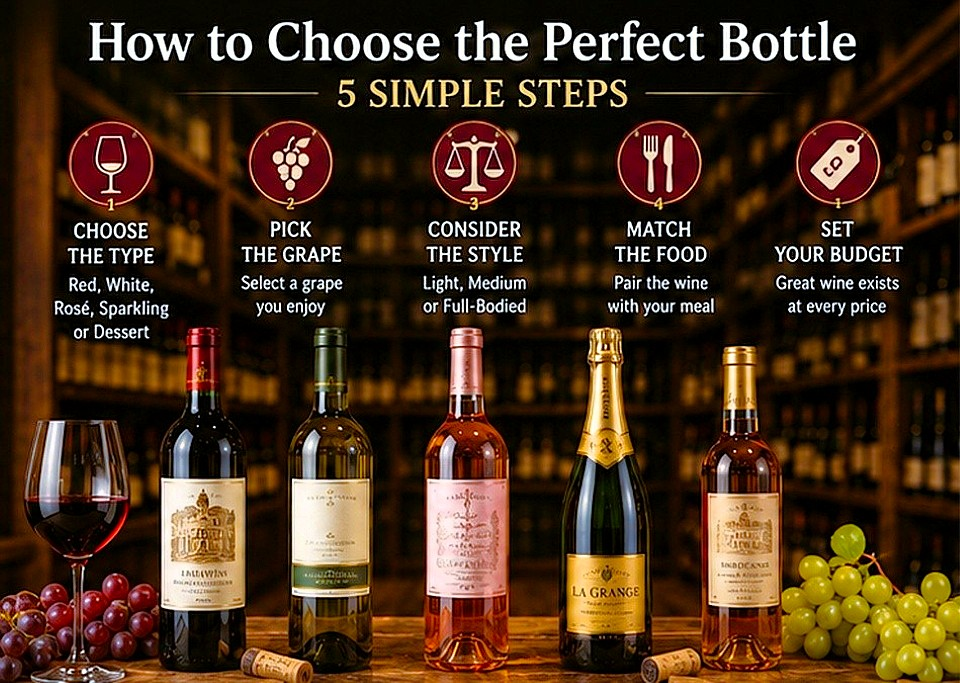
How to choose the perfect wine bottle based on grape variety, occasion, food pairing, wine style and budget
White Wine Buying Guide
Chardonnay
One of the most versatile wines you can buy.
Unoaked Chardonnay can be:
- Crisp
- Citrusy
- Mineral
- Apple-driven
Oaked Chardonnay can be:
- Rich
- Creamy
- Toasty
- Vanilla-scented
Best with: lobster, crab, roast chicken, creamy pasta and salmon.
Sauvignon Blanc
Generally bright and refreshing.
Typical flavors:
- Lime
- Lemon
- Grapefruit
- Green apple
- Herbs
- Passion fruit
Best with: oysters, goat cheese, salads, seafood and sushi.
Riesling
One of the most misunderstood grapes.
Riesling can be:
- Bone dry
- Off-dry
- Sweet
- Sparkling
Typical flavors:
- Lime
- Lemon
- Green apple
- Peach
- Apricot
Best with: spicy food, seafood, pork and Asian cuisine.
Pinot Grigio / Pinot Gris
Italian Pinot Grigio is generally crisp and refreshing.
Alsace Pinot Gris can be richer and fuller.
Typical flavors:
- Pear
- Apple
- Citrus
- Peach
Best with: seafood, salads, chicken and light pasta.
Albariño
A Spanish white wine known for:
- Citrus
- Green apple
- Peach
- Minerals
- Salinity
Best with: oysters, shrimp, mussels, crab and grilled fish.
Rosé Wine Buying Guide
Many people mistakenly assume all rosé tastes the same.
It doesn’t.
Dry Provence-style rosé
Usually:
- Pale
- Crisp
- Dry
- Refreshing
Common flavors:
- Strawberry
- Peach
- Citrus
- Herbs
Best for: seafood, salads and summer lunches.
Fuller rosé
Darker rosé can have:
- More fruit
- More body
- More structure
Best with: grilled meats, spicy food and stronger dishes.
Sweet rosé
If you prefer sweeter wine, look for styles specifically labeled sweet or semi-sweet rather than assuming pale color means sweetness.
Sparkling Wine Buying Guide
Champagne
Generally the benchmark for prestige sparkling wine.
Often shows:
- Citrus
- Apple
- Toast
- Brioche
- Mineral notes
Best for: weddings, anniversaries, luxury dinners and major celebrations.
Prosecco
From northeastern Italy.
Typically:
- Fresh
- Fruity
- Floral
- Approachable
Common flavors:
- Pear
- Apple
- Peach
- White flowers
Best for: brunch, aperitivo, parties and casual celebrations.
Cava
Spain’s traditional-method sparkling wine.
Can be:
- Fresh
- Citrusy
- Nutty
- Toasty
Best for: tapas, seafood, fried food and celebrations.
Crémant
French sparkling wine made outside Champagne.
It can offer excellent value for buyers who want traditional-method sparkling wine without paying Champagne prices.
Fortified and Dessert Wine
Don’t overlook these categories.
Port
Sweet and fortified.
Excellent with:
- Blue cheese
- Chocolate
- Nuts
- Desserts
Madeira
Remarkably long-lived.
Can range from dry to intensely sweet.
Sherry
One of the world’s most diverse wine categories.
Styles range from very dry Fino and Manzanilla to rich, sweet Pedro Ximénez.
Sauternes
A classic French sweet wine.
Excellent with:
- Foie gras
- Blue cheese
- Fruit desserts
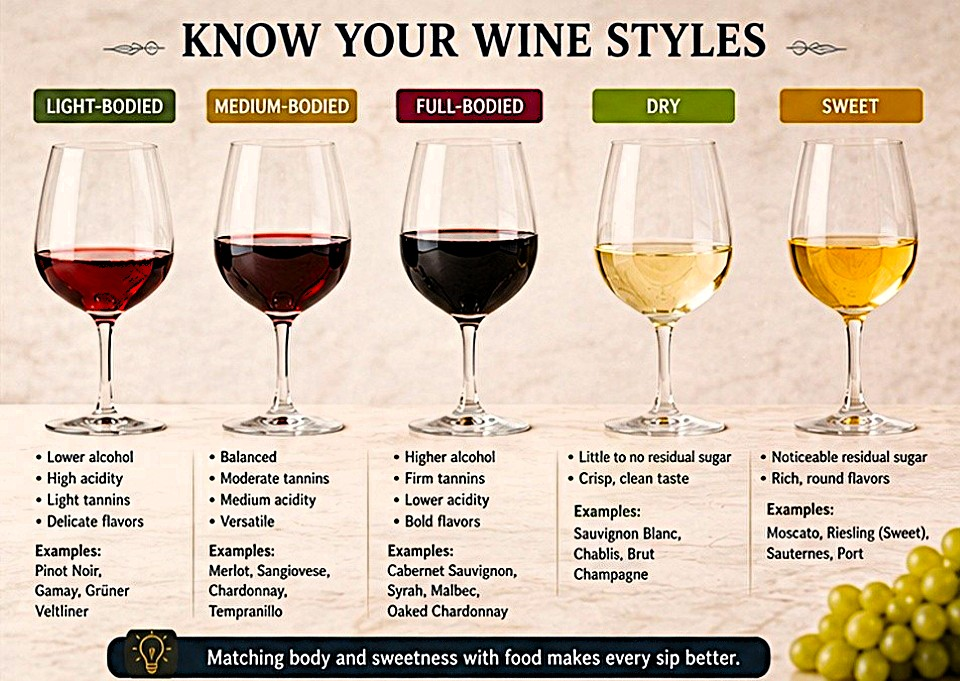
Wine styles explained with light-bodied, medium-bodied, full-bodied, dry and sweet wines
Dry vs. Sweet Wine
This is one of the most important distinctions when buying wine.
Dry wine
Contains little residual sugar.
Examples include:
- Cabernet Sauvignon
- Sauvignon Blanc
- Chablis
- Rioja
- Brut Champagne
Off-dry wine
Contains noticeable but limited sweetness.
Often found in:
- Riesling
- Chenin Blanc
- Some rosé
Sweet wine
Clearly sweet on the palate.
Examples include:
- Moscato
- Sauternes
- Port
- Icewine
- Tokaji
Important point
Fruity does not necessarily mean sweet.
A dry wine can smell intensely fruity without containing much residual sugar.
This is one of the most common misunderstandings among new wine buyers.
Light-, Medium- and Full-Bodied Wine
Think about body like the difference between skim milk, regular milk and cream.
It’s not a perfect scientific comparison, but it helps.
Light-bodied
Examples:
- Pinot Noir
- Beaujolais
- Pinot Grigio
- Sauvignon Blanc
Medium-bodied
Examples:
- Merlot
- Chianti
- Chardonnay
- Rioja Crianza
Full-bodied
Examples:
- Cabernet Sauvignon
- Syrah
- Malbec
- Amarone
- Napa Cabernet
General rule
Light food → lighter wine
Heavy food → fuller wine
But acidity and tannin matter too.
Understanding Acidity
Acidity makes wine feel:
- Fresh
- Bright
- Vibrant
- Crisp
High-acid wines include:
- Sauvignon Blanc
- Riesling
- Albariño
- Chablis
- Sangiovese
- Champagne
Low-acid wines may feel:
- Rounder
- Softer
- Fuller
Acidity is particularly important for food pairing.
A wine with high acidity can cut through:
- Fat
- Cream
- Fried food
- Rich sauces
That’s why Champagne works surprisingly well with fried chicken and why Sauvignon Blanc works beautifully with goat cheese.
Understanding Tannins
Tannins are primarily associated with red wine.
They create a drying, slightly grippy sensation in your mouth.
High-tannin wines include:
- Cabernet Sauvignon
- Barolo
- Barbaresco
- Nebbiolo
- Young Bordeaux
Lower-tannin reds include:
- Pinot Noir
- Gamay
- Grenache
- Barbera
Tannin and food
Fatty foods soften the perception of tannin.
That’s why Cabernet Sauvignon and steak are such a classic combination.
How to Read a Wine Label
Wine labels can look complicated, but learn to identify five pieces of information.
1. Producer
Who made the wine?
2. Region
Where was it made?
3. Grape
What grape variety is used?
Some labels clearly state the grape.
Others primarily identify the region.
4. Vintage
What year were the grapes harvested?
5. Alcohol percentage
Alcohol can provide a rough clue about body, although it shouldn’t be used alone.
Additional label terms
Look for phrases such as:
- Reserve
- Gran Reserva
- Riserva
- Old Vine
- Estate
- Grand Cru
- Single Vineyard
These can have different meanings depending on the country and appellation.
Don’t assume “Reserve” automatically means “better.”
Does Vintage Matter?
Yes—but not always as much as beginners think.
Vintage means the year the grapes were harvested.
Weather affects:
- Ripeness
- Acidity
- Sugar
- Yield
- Disease
- Tannin development
For wines intended to age, vintage can be extremely important.
For everyday wines designed for early drinking, producer and style may matter more.
When should you care about vintage?
Pay more attention when buying:
- Fine Bordeaux
- Burgundy
- Barolo
- Vintage Port
- Collectible Napa Cabernet
- Aged Riesling
- Prestige Champagne
For inexpensive everyday wines, don’t obsess over it.
Old World vs. New World Wine
This is an oversimplification, but it can help beginners.
Old World
Primarily Europe.
Examples:
- France
- Italy
- Spain
- Germany
- Portugal
Labels often emphasize:
region and appellation.
New World
Examples:
- United States
- Canada
- Australia
- New Zealand
- Argentina
- Chile
- South Africa
Labels often emphasize:
grape variety and producer.
There are many exceptions.
Still, understanding this difference makes wine labels easier to navigate.
How to Buy Wine by Country
France
Look for:
- Bordeaux
- Burgundy
- Rhône
- Loire
- Champagne
- Alsace
- Provence
Great French wines for beginners
- Bordeaux
- Sancerre
- Chablis
- Côtes du Rhône
- Provence rosé
- Champagne
Italy
Look for:
- Tuscany
- Piedmont
- Veneto
- Sicily
- Friuli
- Alto Adige
Popular Italian wines include:
- Chianti Classico
- Barolo
- Barbaresco
- Amarone
- Prosecco
- Pinot Grigio
Spain
Look for:
- Rioja
- Ribera del Duero
- Rías Baixas
- Priorat
- Jerez
Popular choices include:
- Rioja
- Tempranillo
- Albariño
- Cava
- Sherry
United States
California is the powerhouse.
Look for:
- Napa Valley
- Sonoma
- Paso Robles
- Monterey
Popular varieties:
- Cabernet Sauvignon
- Chardonnay
- Pinot Noir
- Zinfandel
Oregon is particularly famous for Pinot Noir and Chardonnay.
Washington State is also important for Cabernet Sauvignon, Merlot and Riesling.
Argentina
Best known for:
- Malbec
- Cabernet Sauvignon
- Torrontés
Mendoza is the country’s flagship wine region.
Chile
Look for:
- Cabernet Sauvignon
- Carmenère
- Sauvignon Blanc
- Chardonnay
Chile is particularly strong when you want high-quality wine at competitive prices.
Australia
Look for:
- Shiraz
- Chardonnay
- Cabernet Sauvignon
- Riesling
Famous regions include:
- Barossa Valley
- Margaret River
- Hunter Valley
- Clare Valley
- Yarra Valley
New Zealand
Especially famous for:
- Sauvignon Blanc
- Pinot Noir
- Chardonnay
Marlborough is the world’s best-known New Zealand wine region.
How to Buy Wine for Different Occasions
Casual Dinner
Try:
Merlot, Pinot Noir, Sauvignon Blanc or Chardonnay
You don’t need an expensive bottle.
Romantic Dinner
Try:
Pinot Noir, Champagne, Burgundy or Chardonnay
For many people, elegance matters more than power.
Steak Dinner
Choose:
Cabernet Sauvignon, Malbec, Syrah or Bordeaux
Seafood Dinner
Choose:
Chablis, Sauvignon Blanc, Albariño, Champagne or Pinot Gris
Pizza Night
Choose:
Chianti, Sangiovese, Barbera or Montepulciano
Summer Party
Choose:
Prosecco, rosé, Sauvignon Blanc, Pinot Grigio or Sangria
Holiday Dinner
Choose:
Champagne, Chardonnay, Pinot Noir, Rioja, Cabernet Sauvignon or Riesling
Wedding or Major Celebration
Choose:
Champagne, premium Prosecco or Cava
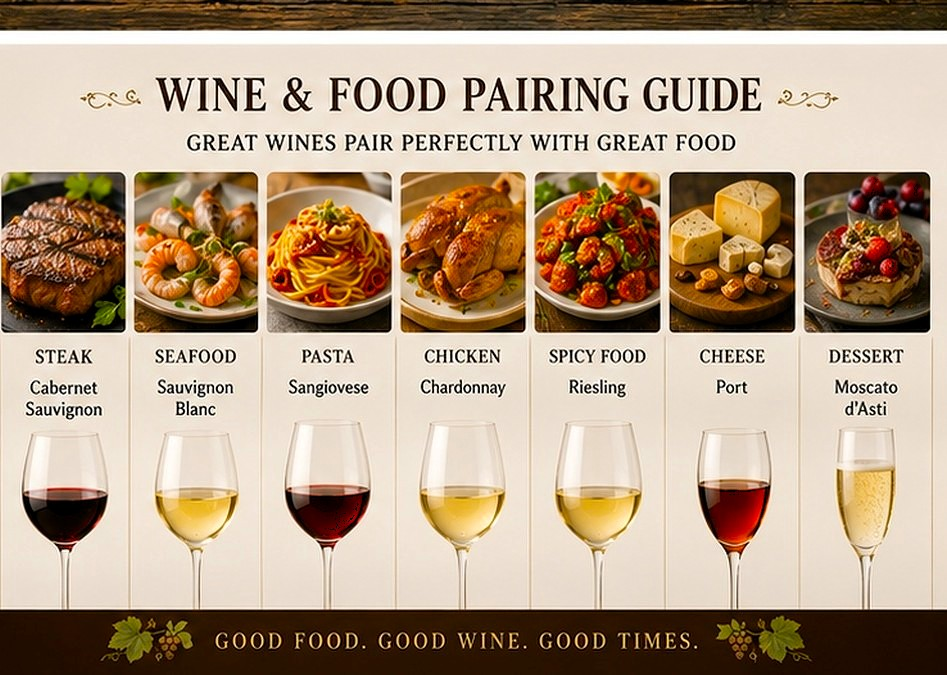
Wine and food pairing guide matching Cabernet Sauvignon with steak, Sauvignon Blanc with seafood, Chardonnay with chicken and Port with cheese
How to Buy Wine for Food
The easiest way to think about food pairing is to match the weight and intensity of the wine with the food.
Steak
Cabernet Sauvignon
Rich, tannic and structured.
Roast chicken
Chardonnay or Pinot Noir
Salmon
Pinot Noir or Chardonnay
Oysters
Chablis, Champagne or Sauvignon Blanc
Spicy food
Riesling, Gewürztraminer or off-dry Chenin Blanc
Pizza
Chianti or Barbera
Pasta with cream sauce
Chardonnay
Pasta with tomato sauce
Sangiovese
Blue cheese
Goat cheese
Sauvignon Blanc
Chocolate
Port, Madeira or sweet red wine
How Much Should You Spend on Wine?
This is one of the biggest questions wine buyers ask.
The answer is:
Spend according to the occasion, not your ego.
For an ordinary weeknight dinner, you may find excellent bottles around the $15–$25 range.
For a nice dinner, $25–$50 opens up many more options.
Above $50, you’re increasingly paying for:
- Scarcity
- Vineyard reputation
- Aging
- Production
- Estate prestige
- Collector demand
That doesn’t mean inexpensive wine is bad.
It means the relationship between price and quality becomes more complicated as price rises.
Best Wine Under $20
At this range, look for value-driven regions.
Good places to explore include:
- Chile
- Argentina
- Spain
- Portugal
- Southern France
- Italy
- South Africa
Good varieties include:
- Malbec
- Sauvignon Blanc
- Tempranillo
- Côtes du Rhône blends
- Pinot Grigio
Best Wine Around $30
This is a sweet spot for wine shoppers.
You can often find:
- Better Burgundy alternatives
- High-quality Rioja
- Premium Chilean Cabernet
- Good Argentine Malbec
- Quality New Zealand Sauvignon Blanc
- Serious Italian wines
Best Wine Around $50
At this level, you’re starting to access wines with more:
- Regional expression
- Aging
- Complexity
- Vineyard character
Look for:
- Premium Napa
- Better Bordeaux
- Barolo
- Brunello
- High-quality Champagne
- Serious Burgundy
When Is Expensive Wine Worth It?
Expensive wine can be worthwhile when:
- You’re celebrating something important.
- You understand what you’re buying.
- You appreciate the producer or region.
- You’re interested in aging wine.
- The bottle is meant to be a memorable experience.
Don’t buy expensive wine simply because someone tells you that expensive equals better.
How to Buy Wine as a Gift
Wine makes an excellent gift, but choosing the right bottle requires a little thought.
For a wine lover
Choose something unusual or ageworthy.
Examples:
- Barolo
- Burgundy
- Rioja Gran Reserva
- Vintage Port
- Champagne
For someone who prefers simple wines
Choose recognizable varieties:
- Cabernet Sauvignon
- Chardonnay
- Pinot Noir
- Sauvignon Blanc
- Prosecco
For a romantic gift
Consider:
- Champagne
- Rosé Champagne
- Premium Pinot Noir
- Beautiful Provence rosé
For a corporate gift
Choose a recognizable premium wine rather than an obscure style unless you know the recipient’s preferences.
How to Buy Wine for a Dinner Party
A common mistake is buying only one bottle.
A better strategy is variety.
For eight guests, you could offer:
Before dinner
Prosecco or Champagne
White wine
Sauvignon Blanc or Chardonnay
Red wine
Pinot Noir or Cabernet Sauvignon
Dessert
Port or another dessert wine
This gives guests choices.
How to Buy Wine for Summer
Summer usually calls for:
- Freshness
- Acidity
- Moderate alcohol
- Fruit
- Carbonation
Excellent options include:
Prosecco
Sauvignon Blanc
Albariño
Pinot Grigio
Provence rosé
Riesling
Cava
You don’t need to stop drinking red wine in summer, either.
Lighter reds such as Pinot Noir, Gamay and some chilled Barbera can be excellent.
How to Buy Wine for Winter
Winter often calls for:
- Richer reds
- Fuller whites
- Structured wines
- Fortified wines
Try:
Cabernet Sauvignon
Syrah
Malbec
Barolo
Rioja Reserva
Amarone
Chardonnay
Port
Madeira
How to Buy Wine Online
Online shopping can actually make choosing wine easier if you know what information to look for.
Check the producer
Don’t choose only by bottle design.
Read the grape information
Look for:
- Variety
- Region
- Vintage
Check the size
A standard wine bottle is usually 750 ml.
Larger formats may be useful for parties.
Check shipping and storage conditions
Wine should not spend excessive time exposed to extreme heat or cold.
Look for tasting notes—but don’t treat them as absolute truth
A description such as:
“blackberry, cedar and cocoa”
doesn’t mean everyone will taste exactly those flavors.
Tasting notes are guides.
Your palate is ultimately the judge.
How to Store Wine
If you’re buying wine to drink soon, storage is relatively straightforward.
Keep bottles:
Cool
Dark
Stable
Away from excessive vibration
Avoid prolonged exposure to:
- Sunlight
- Heat
- Freezing temperatures
Bottles with corks
Traditionally stored on their side for long-term aging to help keep the cork from drying out.
Screw-cap bottles
Can be stored upright without the same cork-moisture concern.
Most important rule
Avoid temperature extremes.
A consistently cool environment is generally better than a room that repeatedly becomes very hot and cold.
Should You Buy Wine Based on Awards?
Awards can be useful.
But don’t rely on them alone.
A medal may indicate that a wine performed well in a particular competition.
It does not necessarily mean:
you will love it.
Use awards as one data point.
Combine them with:
- Producer
- Region
- Grape
- Price
- Reviews
- Your personal taste
Should You Buy Highly Rated Wine?
Ratings can be helpful, especially when you’re buying unfamiliar wines.
But remember:
A critic’s palate is not your palate.
If you consistently enjoy:
- High-acid wines
- Dry Riesling
- Light Pinot Noir
a highly rated full-bodied Cabernet may still not be your ideal wine.
Use ratings to narrow choices, not to make every decision.
Common Wine-Buying Mistakes
Mistake 1: Buying only by price
Expensive does not automatically mean delicious.
Mistake 2: Choosing the prettiest label
Packaging tells you very little about what’s inside.
Mistake 3: Assuming fruity means sweet
Fruitiness and sweetness are different.
Mistake 4: Ignoring food
The perfect wine for drinking alone may not be the perfect wine for dinner.
Mistake 5: Buying too much of one style
For parties, variety is usually better.
Mistake 6: Ignoring storage
Poor storage can damage even an expensive bottle.
Mistake 7: Buying wine you don’t like because someone says it’s “the best”
Your taste matters.
Mistake 8: Overthinking the bottle
Sometimes a simple, fresh wine is exactly what you need.
Wine Buying Cheat Sheet
If you like bold red wine
Try:
Cabernet Sauvignon, Malbec, Syrah, Amarone
If you like smooth red wine
Try:
Merlot, Grenache, Pinot Noir
If you like crisp white wine
Try:
Sauvignon Blanc, Pinot Grigio, Albariño
If you like rich white wine
Try:
Oaked Chardonnay, Viognier
If you like aromatic wines
Try:
Riesling, Gewürztraminer, Muscat
If you like sparkling wine
Try:
Prosecco, Champagne, Cava, Crémant
If you like sweet wine
Try:
Moscato, Sauternes, Tokaji, Port, Madeira
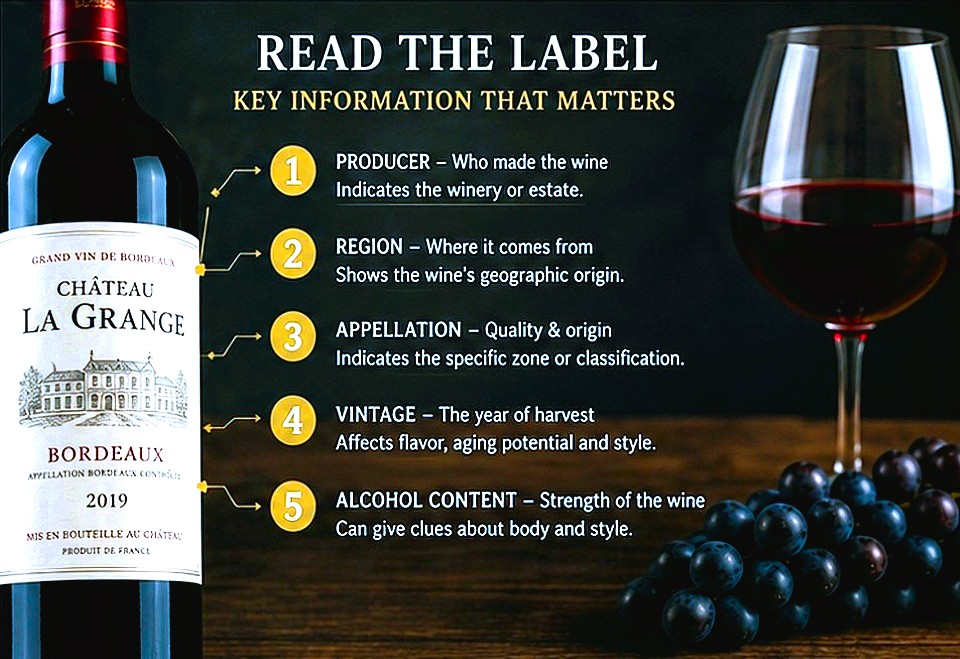
How to read a wine label showing producer, region, appellation, vintage and alcohol content
A Simple Wine-Buying Formula
The next time you’re staring at a shelf full of bottles, use this:
Grape + Region + Style + Food + Budget
For example:
Cabernet Sauvignon + Chile + dry/full-bodied + steak + $25
or:
Sauvignon Blanc + New Zealand + crisp/dry + seafood + $20
or:
Prosecco + Italy + sparkling/dry + brunch + $20
That formula removes much of the guesswork.
10 Great Wines to Try as You Learn
If you’re developing your palate, taste these styles in roughly this order:
- Sauvignon Blanc
- Chardonnay
- Pinot Grigio
- Pinot Noir
- Merlot
- Cabernet Sauvignon
- Malbec
- Riesling
- Prosecco
- Port
You don’t have to buy expensive versions.
The purpose is comparison.
Once you understand how these wines differ, shopping becomes much easier.
How to Become Better at Buying Wine
The best wine education is tasting.
Keep a simple note on your phone.
Whenever you try a bottle, write:
Wine:
Grape:
Country:
Price:
Did I like it?
What food did I have with it?
After six months, you’ll have your own personal wine database.
You’ll start noticing patterns.
Maybe you consistently love:
high-acid white wines.
Maybe you prefer:
medium-bodied reds.
Maybe you dislike:
heavy oak.
Maybe you love:
Italian wines.
That information is more useful than memorizing wine scores.
Frequently Asked Questions About Buying Wine
How do I choose a good bottle of wine?
Start with the grape, region, style, food pairing and budget. Then consider producer reputation and reviews. The “best” bottle depends on your preferences.
What wine should a beginner buy?
Good starting points include Sauvignon Blanc, Chardonnay, Pinot Noir, Merlot, Cabernet Sauvignon and Prosecco because these styles are widely available and easy to compare.
How much should I spend on a good bottle of wine?
You can find enjoyable wines at many price points. A budget of approximately $15–$30 can provide a large range of good everyday options, while $30–$50 often opens the door to more distinctive regional wines.
Is expensive wine always better?
No. Price can reflect scarcity, land, aging, production costs, reputation and collector demand. Personal taste is more important.
What is the best wine for steak?
Cabernet Sauvignon, Malbec, Syrah and Bordeaux-style reds are excellent choices.
What is the best wine for seafood?
Sauvignon Blanc, Chardonnay, Albariño, Chablis and Champagne are excellent starting points.
What is the best wine for chicken?
Chardonnay and Pinot Noir are versatile choices. Sauvignon Blanc also works particularly well with lighter preparations.
What wine is best for spicy food?
Riesling is one of the best choices, especially when some residual sweetness balances heat. Gewürztraminer and Chenin Blanc can also work beautifully.
What is the best wine for pizza?
Chianti, Sangiovese and Barbera are particularly good choices because their acidity works well with tomato sauce.
What wine is best for cheese?
It depends on the cheese. Sauvignon Blanc works well with goat cheese, Rioja with Manchego, Chardonnay with Brie and Port with blue cheese.
Should red wine always be served at room temperature?
Not necessarily. “Room temperature” comes from a time when rooms were cooler. Many reds benefit from being served slightly below modern indoor temperatures.
Should white wine always be ice cold?
Very cold temperatures can mute aromas. Fresh, lighter whites should be well chilled, while richer whites such as Chardonnay can be served somewhat warmer.
How long does an opened bottle of wine last?
It depends on the wine and storage conditions. Sparkling wine usually loses carbonation relatively quickly, while some fortified wines can remain enjoyable much longer. Refrigerating an opened still wine can help preserve it.
Is screw-cap wine lower quality?
No. Screw caps are widely used for quality wine and can be particularly effective for preserving freshness.
Does organic wine taste better?
Organic certification concerns production practices, not a guarantee of taste. Excellent and mediocre wines exist across organic and conventional categories.
What is the easiest wine to choose for a party?
Prosecco, Sauvignon Blanc, Chardonnay, Pinot Noir and a crowd-friendly red blend are practical choices because they appeal to a broad range of preferences.
What is the best wine to give as a gift?
A recognizable quality Champagne, Bordeaux, Barolo, premium Napa Cabernet or elegant Burgundy can make excellent gifts, depending on the recipient.
What wine should I buy for someone who doesn’t usually drink wine?
A crisp Sauvignon Blanc, approachable Pinot Grigio, lightly fruity Prosecco or smooth Merlot can be easier starting points than highly tannic or very dry styles.
What is the best way to learn about wine?
Taste different grapes and regions side by side and keep notes about what you enjoy.
Final Thoughts: How to Choose the Perfect Bottle of Wine
Buying wine doesn’t have to be intimidating.
Once you stop trying to understand every bottle on the shelf and instead focus on a few fundamentals, the process becomes much easier.
Start with what you like.
Then think about:
grape
region
style
food
occasion
budget
That’s enough to make a remarkably informed decision.
If you want something bold and structured for steak, reach for Cabernet Sauvignon, Malbec or Syrah.
If you’re serving seafood, Sauvignon Blanc, Albariño, Chablis or Champagne may be better.
For summer, consider Prosecco, Sauvignon Blanc, Pinot Grigio or Provence rosé.
For a romantic dinner, Pinot Noir, Chardonnay or Champagne can create a more elegant experience.
For a holiday meal, choose a wine with enough acidity and structure to work across several dishes.
For a gift, think about the recipient rather than simply buying the most expensive bottle available.
And for everyday drinking, don’t be afraid of value.
Some of the most enjoyable wines are affordable, fresh and uncomplicated.
Your goal isn’t to impress a wine expert.
Your goal is to buy a bottle that you and the people you’re sharing it with will enjoy.
The more wines you taste, the better you’ll understand your own preferences. Eventually, you’ll know that a certain grape from a certain region is exactly what you want before you even walk into the store.
That’s when buying wine becomes easy.
And more importantly, that’s when wine becomes fun.
So the next time you’re choosing a bottle, forget about trying to find the single best wine in the world.
Find the best wine for tonight.
That might be a $20 Sauvignon Blanc, a $30 Rioja, a bottle of Prosecco for brunch, a special Champagne for an anniversary or a beautifully aged Barolo for a memorable dinner.
There is always another grape to discover, another region to explore and another bottle waiting to become a favorite.