
Blog
The 50 Most Popular Wines in the World: A Complete Guide to the World’s Favorite Wines

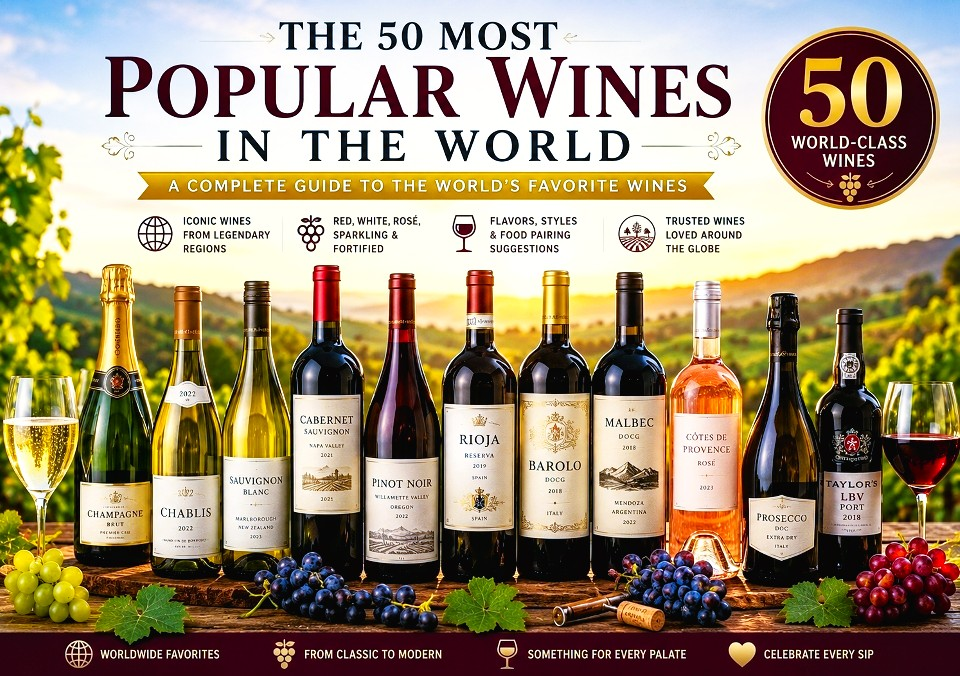
Discover 50 of the most popular wines in the world, from Cabernet Sauvignon, Chardonnay and Pinot Noir to Prosecco, Champagne, Cava, Port and Madeira. Learn what each wine tastes like, where it comes from, what food to pair it with and which style is right for you.
Wine is one of the world’s most diverse beverages.
There are thousands of grape varieties, countless wine regions and an extraordinary range of styles, from crisp and mineral white wines to powerful reds, delicate rosés, sparkling wines and long-aged fortified wines.
But what are the most popular wines in the world?
There is no single official global ranking that can definitively put 50 wines in exact order. The world’s wine market is fragmented by country, grape variety, local traditions, price and consumer preferences. The International Organisation of Vine and Wine (OIV) reported that global wine consumption fell to an estimated 208 million hectolitres in 2025, while the United States remained the world’s largest wine-consuming country at about 31.9 million hectolitres. France, Italy, Germany and the UK were also among the largest markets.
Wine production is similarly concentrated in major wine nations. OIV’s preliminary 2025 figures put Italy first in production at 47.4 million hectolitres, followed by France at 35.9 million and Spain at 29.4 million.
So in this guide, “most popular” means a combination of global recognition, production scale, international availability, cultural importance, consumer demand and long-term popularity rather than an invented exact sales ranking.
The modern wine market is also changing. Overall wine volume declined again in 2025, but sparkling wine—especially Prosecco—was a notable bright spot. IWSR reported that wine volumes declined 5% globally in 2025, while sparkling wines, particularly Prosecco and Crémant, continued to show resilience.
That makes this a fascinating time to explore the world’s favorite wines.
The 50 Most Popular Wines in the World
1. Cabernet Sauvignon
Origin: France
Major regions: Bordeaux, Napa Valley, Chile, Australia, Argentina
Cabernet Sauvignon is one of the world’s best-known red grapes and one of the most important varieties in international wine.
It produces structured wines with:
- Blackcurrant
- Blackberry
- Plum
- Cedar
- Herbs
- Dark chocolate
- Firm tannins
Cabernet can be made into inexpensive everyday wines or some of the world’s most collectible bottles.
Best food pairing
Cabernet Sauvignon is excellent with:
Steak, lamb, roast beef, burgers, grilled vegetables and aged cheese.
2. Chardonnay
Origin: France
Major regions: Burgundy, California, Australia, Chile, Argentina, South Africa
Chardonnay is arguably the world’s most versatile white grape.
Its style depends heavily on climate and winemaking.
Cooler Chardonnay can taste like:
- Lemon
- Green apple
- Pear
- Minerals
Warmer or oak-aged Chardonnay can show:
- Peach
- Pineapple
- Vanilla
- Toast
- Butter
- Cream
Best food pairing
Chardonnay is outstanding with seafood, lobster, crab, roast chicken, creamy pasta and soft cheeses.
3. Merlot
Origin: France
Major regions: Bordeaux, California, Chile, Italy
Merlot is famous for its smooth, generous character.
Compared with Cabernet Sauvignon, Merlot is generally softer and more approachable when young.
Typical flavors include:
- Plum
- Blackberry
- Cherry
- Chocolate
- Herbs
- Vanilla
Best food pairing
Try Merlot with:
Roast chicken, burgers, pork, pasta, pizza and medium-aged cheeses.
4. Pinot Noir
Origin: France
Major regions: Burgundy, Oregon, California, New Zealand, Australia, Chile
Pinot Noir is famous for elegance rather than sheer power.
Typical aromas include:
- Red cherry
- Raspberry
- Strawberry
- Violet
- Earth
- Mushroom
- Spice
It is one of the world’s most food-friendly red wines.
Best food pairing
Pinot Noir works beautifully with salmon, roast chicken, duck, mushrooms, pork and soft cheeses.
5. Sauvignon Blanc
Origin: France
Major regions: Loire Valley, Bordeaux, New Zealand, Chile, South Africa, California
Sauvignon Blanc is one of the world’s most popular crisp white wines.
Common flavors include:
- Lemon
- Lime
- Grapefruit
- Green apple
- Fresh herbs
- Grass
- Passion fruit
New Zealand Sauvignon Blanc is especially famous for intensely aromatic examples.
Best food pairing
Excellent with goat cheese, oysters, seafood, salads, asparagus and sushi.
6. Syrah / Shiraz
Origin: France
Major regions: Rhône, Australia, South Africa, California, Chile
Syrah and Shiraz are the same grape, although the name often reflects regional style.
French Syrah often emphasizes:
- Black pepper
- Blackberry
- Herbs
- Violet
- Earth
Australian Shiraz can be:
- Richer
- Riper
- Fuller-bodied
- More intensely fruity
Best food pairing
Try with steak, lamb, barbecue, sausages and roasted vegetables.
7. Malbec
Origin: France
Most famous region: Mendoza, Argentina
Argentina transformed Malbec into one of the world’s most recognizable wine styles.
Modern Argentine Malbec typically shows:
- Blackberry
- Plum
- Blueberry
- Violet
- Cocoa
- Spice
Mendoza’s high-altitude vineyards are particularly famous for producing concentrated yet fresh examples.
Best food pairing
Steak and Malbec remains one of the world’s classic wine pairings.
8. Tempranillo
Origin: Spain
Tempranillo is the foundation of some of Spain’s most famous wines.
It is central to regions including:
- Rioja
- Ribera del Duero
- Toro
- La Mancha
The grape can produce wines with flavors of:
- Cherry
- Plum
- Dried herbs
- Tobacco
- Vanilla
- Leather
Best food pairing
Perfect with Spanish tapas, lamb, roast pork, cured meats and Manchego cheese.
9. Riesling
Origin: Germany
Riesling is one of the world’s greatest white grapes.
It can make everything from bone-dry wines to intensely sweet dessert wines.
Typical aromas include:
- Lime
- Lemon
- Green apple
- Peach
- Apricot
- Floral notes
Its naturally high acidity allows it to age beautifully.
Best food pairing
Riesling is especially good with Thai food, Indian food, spicy dishes, pork and seafood.
10. Pinot Grigio / Pinot Gris
Origin: France/Italy
Pinot Grigio and Pinot Gris are two regional expressions of the same grape.
Italian Pinot Grigio is often:
- Light
- Crisp
- Citrusy
- Refreshing
French Alsace Pinot Gris can be:
- Richer
- More aromatic
- Fuller-bodied
Best food pairing
Excellent with seafood, salads, chicken, light pasta and fresh cheese.
11. Sangiovese
Origin: Italy
Most famous region: Tuscany
Sangiovese is the principal grape behind famous Tuscan wines.
It typically delivers:
- Sour cherry
- Red plum
- Herbs
- Earth
- Spice
- Bright acidity
Its acidity makes it particularly successful with food.
Best food pairing
Sangiovese is practically made for pizza, tomato pasta, lasagna, roast pork and Italian cheeses.
12. Grenache / Garnacha
Origin: Spain
Grenache is one of the world’s most important Mediterranean grapes.
It is found throughout:
- Spain
- Southern France
- Australia
- California
Typical flavors include:
- Strawberry
- Raspberry
- Cherry
- Plum
- Herbs
- Pepper
Grenache is often blended with Syrah and Mourvèdre.
Best food pairing
Try it with lamb, grilled vegetables, Mediterranean food and roast chicken.
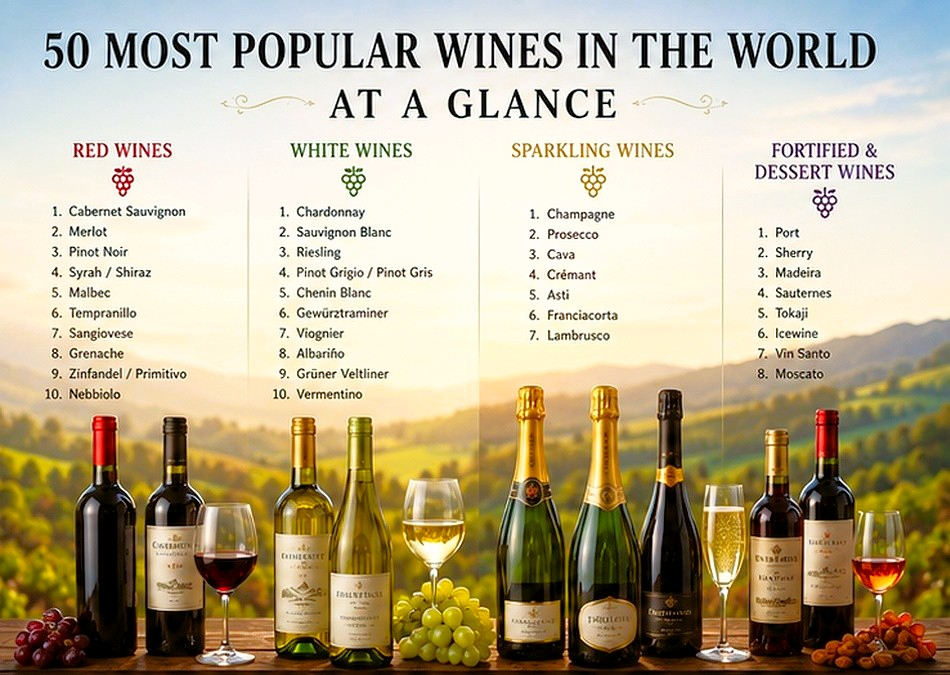
50 most popular wines in the world including red, white, sparkling, fortified and dessert wines
13. Zinfandel / Primitivo
Zinfandel in California and Primitivo in southern Italy are closely related genetically.
The wines are often:
- Rich
- Fruity
- Spicy
- High in alcohol
- Jammy
Typical flavors include:
- Blackberry
- Raspberry
- Plum
- Fig
- Pepper
Best food pairing
Excellent with barbecue, ribs, burgers and spicy grilled foods.
14. Moscato / Muscat
Muscat is one of the world’s oldest and most aromatic grape families.
Styles range from dry to sweet and still to sparkling.
Moscato commonly shows:
- Peach
- Apricot
- Orange blossom
- Grape
- Honeysuckle
Moscato d’Asti is particularly famous for its light sparkle and low alcohol.
Best food pairing
Try it with fresh fruit, light pastries, fruit tarts and spicy food.
15. Chenin Blanc
Origin: France
Major regions: Loire Valley, South Africa
Chenin Blanc is one of the most versatile white grapes.
It can produce:
- Dry wines
- Off-dry wines
- Sparkling wines
- Sweet dessert wines
Typical flavors include:
- Apple
- Pear
- Quince
- Honey
- Citrus
- Mineral notes
Best food pairing
Excellent with seafood, roast chicken, pork, creamy dishes and spicy Asian cuisine.
16. Gewürztraminer
Origin: Central Europe
Major regions: Alsace, Germany, Austria, northern Italy
Gewürztraminer is one of the world’s most aromatic white grapes.
Its famous characteristics include:
- Lychee
- Rose
- Tropical fruit
- Ginger
- Spice
It can be dry or slightly sweet.
Best food pairing
One of its best uses is with spicy Thai, Indian and Chinese cuisine.
17. Viognier
Origin: France
Major region: Rhône
Viognier is an aromatic white wine with a naturally rich texture.
Typical aromas include:
- Peach
- Apricot
- Honeysuckle
- Orange blossom
- Tropical fruit
It can be fuller and softer than Sauvignon Blanc.
Best food pairing
Excellent with spicy chicken, Thai food, creamy seafood and aromatic cheeses.
18. Albariño
Origin: Spain
Major region: Rías Baixas
Albariño has become one of Spain’s most internationally recognizable white wines.
It is known for:
- Lime
- Lemon
- Green apple
- Peach
- Salinity
- Bright acidity
This makes it an outstanding seafood wine.
Best food pairing
Think oysters, shrimp, mussels, crab, grilled fish and ceviche.
19. Grüner Veltliner
Origin: Austria
Grüner Veltliner is Austria’s signature white grape.
It commonly displays:
- Green apple
- Citrus
- White pepper
- Herbs
- Minerals
Its combination of acidity and savory character makes it unusually versatile with food.
Best food pairing
Excellent with vegetables, schnitzel, sushi, salads and asparagus.
20. Nebbiolo
Origin: Italy
Most famous regions: Piedmont, Barolo, Barbaresco
Nebbiolo is responsible for some of Italy’s most prestigious red wines.
Despite its relatively pale color, it can produce powerful, tannic wines with enormous aging potential.
Typical aromas include:
- Rose
- Violet
- Cherry
- Tar
- Herbs
- Leather
- Spice
Best food pairing
Ideal with truffles, braised beef, game, mushrooms and aged cheese.
21. Barbera
Origin: Italy
Major regions: Piedmont, California
Barbera is known for its vibrant acidity and dark-fruit character.
It usually has:
- Cherry
- Blackberry
- Plum
- Spice
and relatively low tannin compared with Nebbiolo.
Best food pairing
Excellent with pizza, pasta, roasted meats and tomato sauces.
22. Carmenère
Origin: France
Modern identity: Chile
Carmenère has become one of Chile’s signature grapes.
It often shows:
- Blackberry
- Plum
- Red pepper
- Herbs
- Chocolate
- Spice
It can resemble a cross between Merlot and Cabernet in structure while retaining its own herbal personality.
Best food pairing
Excellent with grilled meats, roasted vegetables and Chilean cuisine.
23. Monastrell / Mourvèdre
Origin: Spain
Known as Mourvèdre in France, Monastrell is important in Spain’s Mediterranean wine regions.
It produces wines with:
- Blackberry
- Plum
- Herbs
- Pepper
- Earth
- Firm structure
It is frequently blended with Grenache and Syrah.
Best food pairing
Excellent with lamb, barbecue, sausages and roasted Mediterranean vegetables.
24. Gamay
Origin: France
Most famous region: Beaujolais
Gamay is best known for Beaujolais, including the internationally popular Beaujolais Nouveau.
It produces wines with:
- Strawberry
- Raspberry
- Cherry
- Violet
- Fresh acidity
Young Gamay can be extraordinarily vibrant and easy to drink.
Best food pairing
Try it with charcuterie, roast chicken, burgers, pork and picnic food.
25. Vermentino
Major regions: Italy, France
Vermentino is one of the Mediterranean’s most refreshing white wines.
It often shows:
- Lemon
- Grapefruit
- Green apple
- Herbs
- Salinity
- Minerals
Best food pairing
Excellent with seafood, grilled fish, salads, olives and Mediterranean cuisine.
26. Fiano
Origin: Italy
Region: Campania
Fiano is one of Italy’s most interesting indigenous white grapes.
It can produce wines with:
- Pear
- Apple
- Citrus
- Almond
- Floral aromas
- Mineral character
Fiano can develop considerable texture and complexity.
Best food pairing
Excellent with seafood, pasta, roast chicken and soft cheeses.
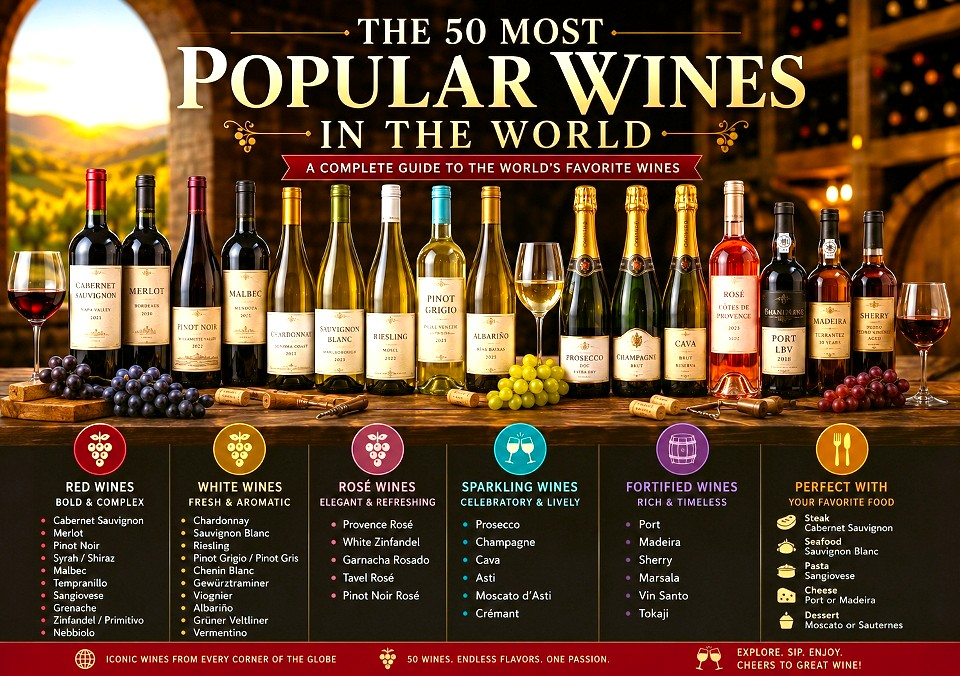
50 most popular wines in the world featuring red, white, rosé, sparkling and fortified wine styles
27. Torrontés
Origin: Argentina
Torrontés is Argentina’s signature aromatic white grape.
It is especially associated with high-altitude vineyards.
Typical aromas include:
- Peach
- Grapefruit
- Orange blossom
- Rose
- Tropical fruit
Despite its intense perfume, good examples can finish dry and refreshing.
Best food pairing
Excellent with spicy Asian food, empanadas, grilled chicken and seafood.
28. Roussanne
Origin: France
Region: Rhône
Roussanne is a classic Rhône white grape.
It produces fuller wines with flavors of:
- Pear
- Apricot
- Honey
- Flowers
- Nuts
It is often blended with Marsanne.
Best food pairing
Excellent with roast chicken, creamy seafood, lobster and richer cheeses.
29. Pinotage
Origin: South Africa
Pinotage is a uniquely South African grape created from Pinot Noir and Cinsault.
It can show:
- Plum
- Blackberry
- Smoke
- Spice
- Dark chocolate
Modern examples can be much more refined than the grape’s older reputation suggests.
Best food pairing
Excellent with BBQ, grilled meats, sausages and spicy dishes.
30. Nero d’Avola
Origin: Sicily, Italy
Nero d’Avola is Sicily’s best-known red grape.
It produces wines with:
- Blackberry
- Black cherry
- Plum
- Spice
- Mediterranean herbs
It can range from fresh and approachable to deeply structured.
Best food pairing
Excellent with pizza, pasta, grilled lamb and Sicilian cuisine.
31. Montepulciano d’Abruzzo
Origin: Italy
Region: Abruzzo
This is one of Italy’s most widely recognized everyday red styles.
It generally offers:
- Dark cherry
- Plum
- Blackberry
- Herbs
- Soft tannins
Best food pairing
Excellent with pizza, pasta, sausage and grilled meats.
32. Barolo
Grape: Nebbiolo
Region: Piedmont, Italy
Barolo is one of Italy’s most prestigious wines.
It is powerful yet elegant and can develop extraordinary complexity with age.
Typical aromas include:
- Rose
- Cherry
- Violet
- Tar
- Tobacco
- Spice
Best food pairing
Barolo is a spectacular match for truffles, braised beef, mushrooms and aged cheese.
33. Brunello di Montalcino
Grape: Sangiovese
Region: Tuscany, Italy
Brunello is one of Italy’s most famous collectible red wines.
Compared with simple young Sangiovese, Brunello is generally more concentrated, structured and ageworthy.
Expect:
- Sour cherry
- Herbs
- Earth
- Tobacco
- Leather
- Spice
Best food pairing
Ideal with Tuscan beef, lamb, game, pasta and aged cheese.
34. Chianti Classico
Grape: Primarily Sangiovese
Region: Tuscany, Italy
Chianti Classico is one of the world’s most recognizable Italian wine styles.
It combines:
- Cherry
- Herbs
- Spice
- Acidity
- Savory character
Its acidity makes it exceptionally good with Italian food.
Best food pairing
Pizza and Chianti remains one of the world’s classic combinations.
35. Rioja
Country: Spain
Major grape: Tempranillo
Rioja is arguably Spain’s most internationally recognized wine region.
Rioja can produce young fruity reds as well as long-aged wines classified as:
- Crianza
- Reserva
- Gran Reserva
Typical flavors include:
- Cherry
- Plum
- Vanilla
- Tobacco
- Leather
- Spice
Best food pairing
Excellent with lamb, tapas, grilled meats and Manchego cheese.
36. Ribera del Duero
Country: Spain
Major grape: Tempranillo
Ribera del Duero offers a more powerful expression of Tempranillo than many classic Rioja styles.
The wines can be:
- Rich
- Dark-fruited
- Tannic
- Structured
- Oak-influenced
Best food pairing
Excellent with roast lamb, steak, cured meats and hard cheese.
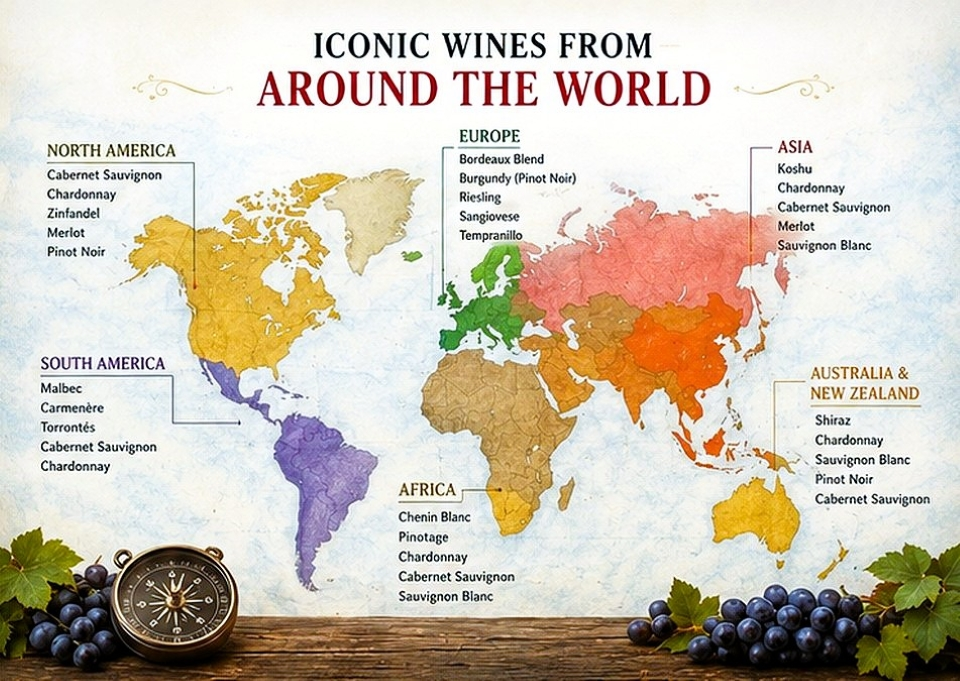
Popular wines from around the world including Cabernet Sauvignon, Chardonnay, Riesling, Malbec, Sangiovese and Tempranillo
37. Bordeaux Red Blend
Region: Bordeaux, France
Bordeaux is famous for blends rather than a single grape.
Common varieties include:
- Cabernet Sauvignon
- Merlot
- Cabernet Franc
- Petit Verdot
The wines range from approachable regional bottles to some of the world’s most prestigious and expensive wines.
Best food pairing
Classic pairing: beef, lamb, duck and aged cheese.
38. Burgundy / Red Burgundy
Grape: Pinot Noir
Region: Burgundy, France
Burgundy is one of the most influential wine regions in the world.
Red Burgundy is made primarily from Pinot Noir.
The wines can be:
- Elegant
- Aromatic
- Earthy
- Mineral
- Silky
Best food pairing
Try with duck, mushrooms, roast chicken, pork and delicate sauces.
39. Napa Valley Cabernet Sauvignon
Napa Cabernet deserves recognition as a distinct wine style because of its enormous international popularity.
These wines are typically:
- Full-bodied
- Rich
- Tannic
- Concentrated
- Oak-aged
Common flavors include:
- Cassis
- Blackberry
- Plum
- Cedar
- Vanilla
- Dark chocolate
Best food pairing
Ideal with prime steak, lamb and rich grilled dishes.
40. Châteauneuf-du-Pape
Region: Rhône, France
Châteauneuf-du-Pape is one of France’s most recognizable Southern Rhône wines.
It can contain a combination of grape varieties, frequently led by Grenache with Syrah and Mourvèdre.
The style often shows:
- Red and black fruit
- Herbs
- Pepper
- Spice
- Earth
Best food pairing
Excellent with lamb, roast meats, Mediterranean cuisine and herbs.
41. Amarone della Valpolicella
Region: Veneto, Italy
Amarone is one of Italy’s most distinctive red wines.
The grapes are partially dried before fermentation, concentrating sugars and flavors.
The resulting wine can be:
- Rich
- Powerful
- Concentrated
- High in alcohol
Expect:
- Dried cherry
- Plum
- Chocolate
- Spice
- Raisin
Best food pairing
Excellent with braised beef, aged cheese and rich winter dishes.
42. Chablis
Grape: Chardonnay
Region: Burgundy, France
Chablis is one of the world’s most famous expressions of Chardonnay.
Unlike heavily oaked California Chardonnay, Chablis generally emphasizes:
- Citrus
- Green apple
- Mineral notes
- Fresh acidity
Best food pairing
It is exceptional with oysters, shellfish, seafood and goat cheese.
43. Sancerre
Grape: Sauvignon Blanc
Region: Loire Valley, France
Sancerre is one of the world’s most recognizable Sauvignon Blanc styles.
It typically emphasizes:
- Citrus
- Green apple
- Minerals
- Herbs
- Fresh acidity
Best food pairing
Sancerre and goat cheese is a classic combination.
It also works with seafood, salads and shellfish.
44. Provence Rosé
Country: France
Provence Rosé has become one of the world’s most recognizable rosé styles.
These wines are usually:
- Pale
- Dry
- Fresh
- Delicate
- Fruit-driven
Common aromas include:
- Strawberry
- Raspberry
- Peach
- Citrus
- Herbs
Best food pairing
Perfect with salads, grilled fish, Mediterranean cuisine, seafood and summer dishes.
45. Prosecco
Country: Italy
Major region: Veneto and Friuli-Venezia Giulia
Prosecco is one of the world’s most popular sparkling wines.
Its success is driven by:
- Accessibility
- Fruity freshness
- Affordability
- Versatility
- Aperitivo culture
IWSR reported strong Prosecco performance in recent years, with 2025 global volume growth of about 2% even while overall wine volumes declined.
Prosecco can show:
- Pear
- Apple
- White flowers
- Citrus
- Peach
Best food pairing
Excellent with brunch, seafood, antipasti, light appetizers and salty snacks.
46. Champagne
Country: France
Region: Champagne
Champagne remains the world’s most famous prestige sparkling wine.
The primary grapes are:
- Chardonnay
- Pinot Noir
- Meunier
Traditional-method production and long aging contribute to aromas of:
- Citrus
- Apple
- Pear
- Toast
- Brioche
- Nuts
Although Champagne has faced pricing and volume challenges, it remains one of the world’s defining luxury wine categories. IWSR notes that Champagne’s premium positioning and higher prices have limited growth relative to more affordable sparkling categories such as Prosecco.
Best food pairing
Champagne is excellent with oysters, caviar, seafood, fried foods, sushi and soft cheese.
47. Cava
Country: Spain
Cava is Spain’s most important traditional-method sparkling wine.
It can range from fresh young sparkling wines to complex Reserva, Gran Reserva and Cava de Paraje Calificado bottles.
Typical flavors include:
- Citrus
- Apple
- Almond
- Toast
- Brioche
Best food pairing
Cava is particularly good with Spanish tapas, seafood, fried foods and cured meats.
48. Port
Country: Portugal
Region: Douro Valley
Port is one of the world’s most famous fortified wines.
Styles include:
- Ruby
- Tawny
- Vintage
- Late Bottled Vintage
- White
- Rosé
- Colheita
Port can range from fruity and youthful to incredibly complex and mature.
Best food pairing
Try Port with:
Blue cheese, chocolate, dried fruit, nuts and rich desserts.
49. Sherry
Country: Spain
Region: Andalusia
Sherry is one of the world’s most diverse wine categories.
It ranges from extremely dry styles such as:
- Fino
- Manzanilla
through:
- Amontillado
- Oloroso
and intensely sweet:
- Pedro Ximénez
This variety makes Sherry one of the most versatile and misunderstood wines in the world.
Best food pairing
Sherry can work with everything from tapas and seafood to aged cheese and desserts.
50. Madeira
Country: Portugal
Region: Madeira
Madeira is one of the world’s most distinctive fortified wines.
Its famous styles include:
- Sercial
- Verdelho
- Bual
- Malvasia
Madeira is unusual because controlled oxidation and heat exposure are central to its traditional production, helping the wine develop extraordinary longevity.
Typical flavors can include:
- Dried citrus
- Caramel
- Nuts
- Raisins
- Spice
- Coffee
Best food pairing
Madeira works beautifully with nuts, desserts, aged cheese, chocolate and rich savory dishes.
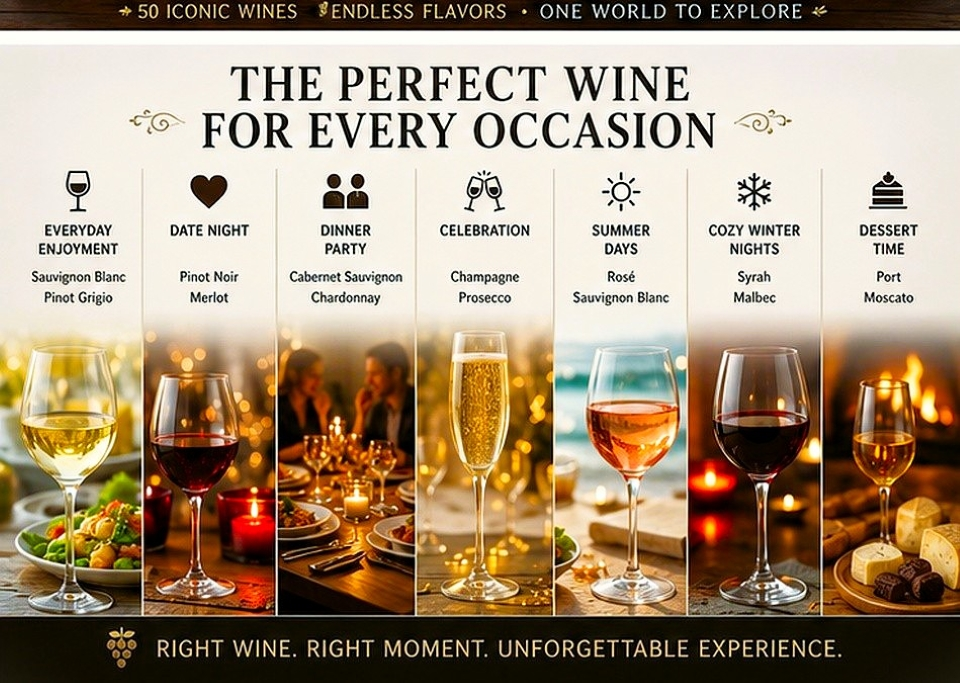
Best wines for every occasion including everyday dinners, date nights, celebrations, summer and dessert
What Are the World’s Most Popular Wine Grapes?
The answer depends on whether you’re measuring vineyard area, production, consumer recognition or sales.
But grapes such as Cabernet Sauvignon, Chardonnay, Merlot, Pinot Noir, Sauvignon Blanc, Syrah, Grenache and Riesling have enormous international importance.
The OIV maintains global statistical resources covering vineyard area, production, consumption and international trade, and its grape-variety studies provide a useful reminder that “popular” can mean very different things depending on the metric.
That’s why the 50 wines above intentionally combine major grape varieties with famous regional wine styles and appellations.
The Most Popular Red Wines in the World
If you prefer red wine, start with these:
Full-bodied
- Cabernet Sauvignon
- Syrah/Shiraz
- Malbec
- Nebbiolo
- Napa Cabernet
- Amarone
Medium-bodied
- Merlot
- Tempranillo
- Sangiovese
- Grenache
- Barbera
Lighter reds
- Pinot Noir
- Gamay
- Frappato-style wines
- Lighter Nebbiolo expressions
The Most Popular White Wines in the World
For white wine lovers:
Crisp and refreshing
- Sauvignon Blanc
- Pinot Grigio
- Albariño
- Grüner Veltliner
- Vermentino
- Chablis
Richer
- Chardonnay
- Viognier
- Roussanne
Aromatic
- Riesling
- Gewürztraminer
- Muscat
- Torrontés
The Most Popular Sparkling Wines in the World
The most recognizable styles include:
- Champagne
- Prosecco
- Cava
- Crémant
- Franciacorta
- Asti
- Lambrusco
Among current global trends, sparkling wine remains more resilient than much of the still-wine category, with IWSR identifying Prosecco and Crémant as notable bright spots.
The Most Popular Dessert and Fortified Wines
If you like sweet or fortified wines, try:
- Port
- Sherry
- Madeira
- Sauternes
- Tokaji
- Icewine
- Moscato
- Vin Santo
- Recioto
These wines cover an enormous range of sweetness and complexity.
The Best Wines for Food Pairing
Steak
Choose:
Cabernet Sauvignon, Malbec, Napa Cabernet or Syrah
Pizza
Choose:
Chianti, Sangiovese, Barbera or Montepulciano
Seafood
Choose:
Sauvignon Blanc, Albariño, Chablis, Pinot Gris or Champagne
Sushi
Choose:
Riesling, Grüner Veltliner, Champagne or Pinot Grigio
Chicken
Choose:
Chardonnay, Pinot Noir, Sauvignon Blanc or Viognier
Lamb
Choose:
Syrah, Grenache, Cabernet Sauvignon or Rioja
Spicy Asian Food
Choose:
Riesling, Gewürztraminer, Sauvignon Blanc or off-dry Chenin Blanc
Cheese
Choose according to the cheese:
- Goat cheese → Sauvignon Blanc
- Brie → Chardonnay
- Blue cheese → Port or Sauternes
- Manchego → Rioja or Tempranillo
- Aged cheddar → Cabernet Sauvignon
The Best Wines for Beginners
If you’re new to wine, don’t try all 50 at once.
Start with a simple six-bottle exploration:
1. Sauvignon Blanc
Learn what crisp acidity tastes like.
2. Chardonnay
Compare unoaked and oaked styles.
3. Pinot Noir
Discover lighter red wine.
4. Cabernet Sauvignon
Experience tannin and structure.
5. Prosecco
Explore sparkling wine.
6. Port
Finish with a fortified dessert wine.
That six-bottle journey will teach you more about wine styles than simply drinking six similar bottles.
The Best Wines for Summer
For hot weather, prioritize:
- Sauvignon Blanc
- Albariño
- Pinot Grigio
- Riesling
- Provence Rosé
- Prosecco
- Cava
- Champagne
These wines generally emphasize freshness, acidity and moderate weight.
The Best Wines for Winter
Cold-weather drinking often favors fuller and richer styles:
- Cabernet Sauvignon
- Syrah
- Malbec
- Amarone
- Rioja Reserva
- Barolo
- Brunello di Montalcino
- Vintage Port
These wines are particularly good with hearty foods.
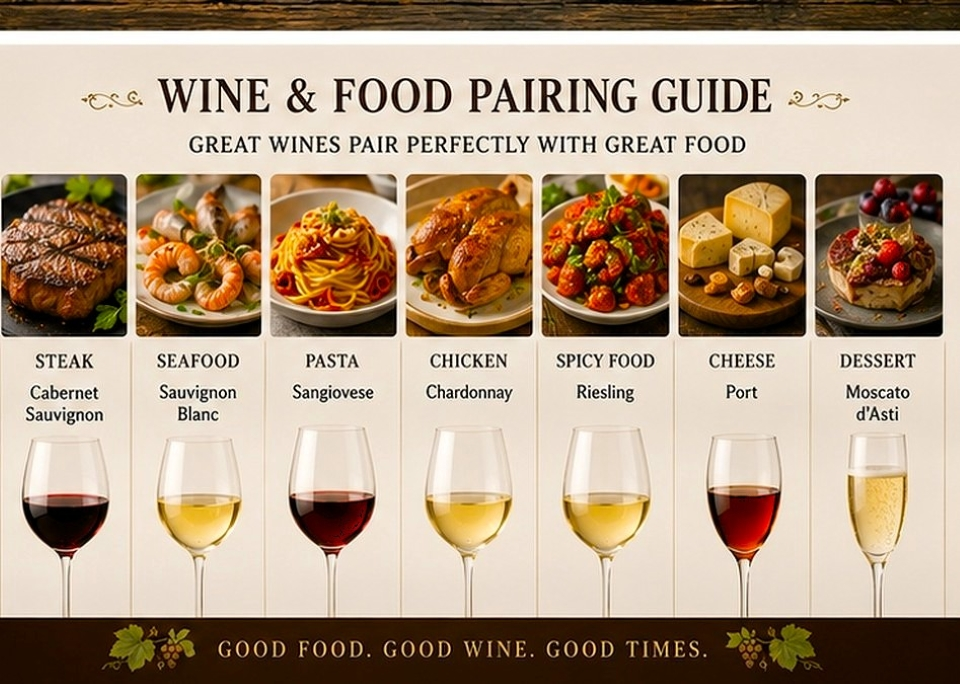
Wine and food pairing guide matching Cabernet Sauvignon with steak, Sauvignon Blanc with seafood, Sangiovese with pasta and Port with cheese
The Best Wines for Dinner Parties
For a dinner party, serve a variety rather than only one style.
A strong lineup might be:
Before dinner: Prosecco
Seafood course: Sauvignon Blanc or Chardonnay
Main course: Cabernet Sauvignon or Pinot Noir
Cheese: Rioja or Barolo
Dessert: Port or Madeira
This gives guests a complete journey through the wine world.
How to Choose the Best Wine
You don’t need to memorize every grape and region.
Use this simple formula:
1. Think about the food.
Heavy food needs more structure.
Light food needs freshness.
2. Think about your preferred body.
Light → Pinot Noir, Sauvignon Blanc, Pinot Grigio
Medium → Merlot, Sangiovese, Chardonnay
Full → Cabernet Sauvignon, Syrah, Malbec
3. Think about acidity.
High acidity makes wine refreshing and food-friendly.
4. Think about sweetness.
Dry doesn’t mean low fruit—it means little residual sugar.
5. Think about oak.
Oak can add:
- Vanilla
- Toast
- Spice
- Creaminess
But not everyone prefers oaky wines.
Why Wine Popularity Changes
Wine tastes evolve.
Consumer behavior changes.
Prices change.
Climate changes.
And new generations discover wine differently.
IWSR says the wine category is currently under pressure, with global wine volumes falling sharply in recent years and younger consumers engaging with wine differently from older generations. At the same time, sparkling wine and particular value-oriented categories continue to show opportunities.
This means that the list of “world’s favorite wines” is never completely fixed.
Prosecco’s recent resilience is one example.
The continued appeal of no- and low-alcohol wine is another.
Organic and regenerative wines represent another important direction.
The future of wine will probably be defined not by one new grape but by greater variety and more diverse occasions for drinking wine.
Frequently Asked Questions About the World’s Most Popular Wines
What is the most popular wine in the world?
There is no universally accepted single number-one wine. Popularity can be measured by production, vineyard area, retail sales, consumer recognition or geographic reach. Cabernet Sauvignon and Chardonnay are among the world’s most globally important grapes, while wines such as Prosecco and Champagne have enormous international recognition.
What are the 10 most popular wines?
A reasonable global list would include Cabernet Sauvignon, Chardonnay, Merlot, Pinot Noir, Sauvignon Blanc, Syrah/Shiraz, Malbec, Tempranillo, Riesling and Pinot Grigio/Pinot Gris.
What is the world’s most popular red wine?
Cabernet Sauvignon is one of the strongest candidates based on global recognition and vineyard presence, although there is no universally accepted worldwide sales ranking by grape.
What is the world’s most popular white wine?
Chardonnay is arguably the best-known global white grape, with Sauvignon Blanc, Pinot Grigio/Pinot Gris and Riesling also among the most internationally recognized.
What is the most popular sparkling wine?
Champagne has the strongest luxury recognition, while Prosecco has become one of the world’s most widely consumed and fastest-growing sparkling styles in recent years. IWSR reported continued Prosecco growth in 2025.
What are the best wines for beginners?
Start with Sauvignon Blanc, Chardonnay, Pinot Noir, Merlot, Cabernet Sauvignon and Prosecco.
What is the best wine with steak?
Cabernet Sauvignon, Malbec, Syrah and Napa Valley Cabernet are excellent choices.
What is the best wine with fish?
Sauvignon Blanc, Albariño, Pinot Gris, Chablis and Champagne are particularly versatile with seafood.
What is the best wine with cheese?
There is no single answer. Sauvignon Blanc is excellent with goat cheese, Chardonnay with soft cheeses, Rioja with Manchego, and Port with blue cheese.
What is the best sweet wine?
Popular sweet and fortified styles include Port, Sauternes, Tokaji, Icewine, Madeira and Moscato.
Is expensive wine always better?
No. Price reflects many things, including vineyard location, scarcity, production costs, aging and reputation. Excellent value wines exist at many price levels.
Which country makes the best wine?
There is no single winner. France, Italy, Spain, Portugal, the United States, Australia, Argentina, Chile, Germany, South Africa and many other countries produce excellent wines.
What country drinks the most wine?
OIV estimates that the United States was the world’s largest wine-consuming country in 2025, at about 31.9 million hectolitres, ahead of France and Italy.
Final Thoughts: Exploring the World’s Favorite Wines
The 50 most popular wines in the world represent only a fraction of the incredible diversity available to wine drinkers.
Cabernet Sauvignon shows the power and structure of red wine.
Chardonnay demonstrates how dramatically one grape can change from region to region.
Pinot Noir shows elegance.
Sauvignon Blanc delivers freshness.
Malbec offers dark fruit and generous texture.
Tempranillo brings the traditions of Spain.
Sangiovese delivers the acidity and savory character of Italy.
Riesling proves that a white grape can be dry, sweet, youthful or extraordinarily ageworthy.
Prosecco brings sparkling wine into everyday aperitivo culture, while Champagne remains one of the world’s great prestige wines. IWSR’s current data suggest that sparkling wine is one of the more resilient parts of the wine market, even as overall wine consumption remains under pressure.
Port, Sherry and Madeira demonstrate that fortified wines can be among the most complex and long-lived wines on Earth.
And wines such as Amarone, Barolo, Brunello di Montalcino, Rioja, Bordeaux and Burgundy show why individual wine regions can become as famous as the grapes themselves.
The best way to understand this enormous category isn’t to memorize a list.
Taste broadly.
Try the same grape from different countries.
Compare oaked Chardonnay with unoaked Chardonnay.
Compare Argentine Malbec with French Cahors.
Compare Italian Pinot Grigio with Alsace Pinot Gris.
Compare California Cabernet with Bordeaux.
Compare Prosecco with Champagne and Cava.
Try a young Tawny Port, an aged Madeira and a dry Fino Sherry.
Every comparison teaches you something.
And that is ultimately what makes wine so fascinating.
There is no single “best wine in the world.”
There is only the best wine for your palate, your meal, your occasion and your budget.