
Blog
The Best Organic White Wine Brands in the World: 15 Wines Worth Discovering

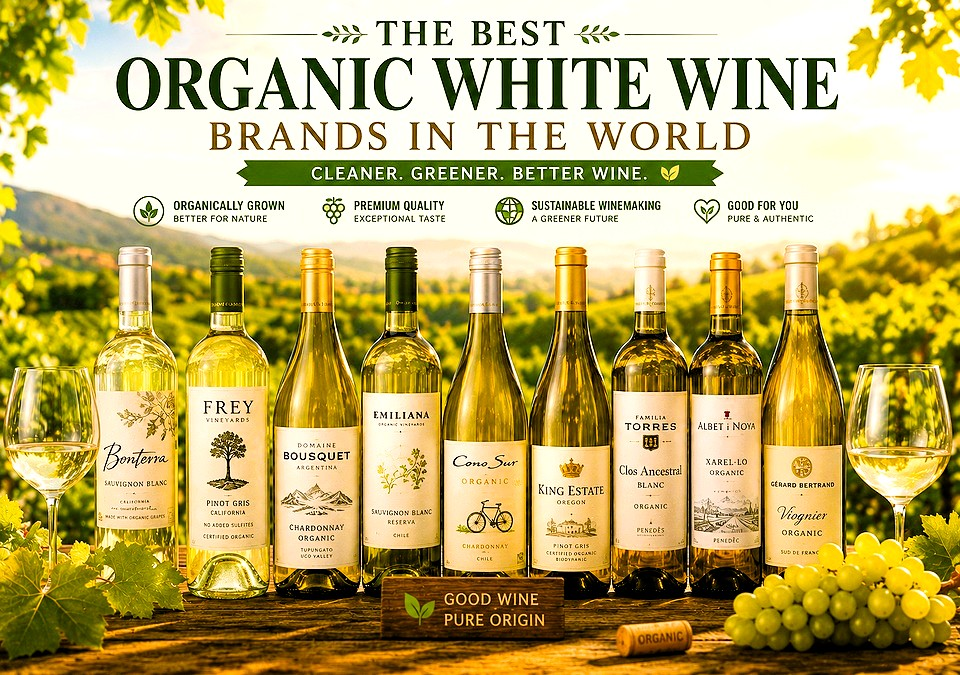
Discover the best organic white wine brands in the world, including Bonterra, Frey Vineyards, Domaine Bousquet, Emiliana, Cono Sur, King Estate and other leading organic producers. Learn about organic Chardonnay, Sauvignon Blanc, Pinot Gris, Riesling, Viognier and other white wines, plus certifications, sulfites, food pairings and buying tips.
Organic white wine has evolved dramatically over the last few decades.
What was once a relatively small niche of wine production has become an important part of the global wine industry. Today, wine lovers can choose from organic Chardonnay, Sauvignon Blanc, Pinot Gris, Riesling, Viognier, Chenin Blanc, Albariño, Verdejo and white blends produced in some of the world’s most respected wine regions.
The best organic white wines are not simply about avoiding certain agricultural chemicals. Increasingly, leading wineries are combining organic viticulture with biodynamic farming, regenerative agriculture, biodiversity programs, water conservation and lower-impact winemaking.
That makes organic white wine particularly interesting for consumers who want to know more about how their wine is produced.
But there is an important point to understand before buying:
Organic does not mean that every organic white wine tastes the same.
An organic Sauvignon Blanc can be crisp, citrusy and intensely aromatic. An organic Chardonnay can be unoaked and mineral-driven or rich and barrel-aged. Organic Pinot Gris can range from light and refreshing to textured and complex, while an organic Riesling can be bone-dry, aromatic and highly ageworthy.
The certification primarily tells you about the farming and production standards, while grape variety, climate, soil, vintage and winemaking determine what you taste in the glass.
In this guide, we’ll explore some of the best organic white wine brands and producers in the world, the most important organic white-wine regions, the best grapes to try, what organic certification actually means, how sulfites fit into the picture, and which organic whites work best with different foods.
Table of Contents
- What Is Organic White Wine?
- Organic vs. Biodynamic vs. Natural Wine
- How Organic Wine Certification Works
- Organic Wine and Sulfites
- The Best Organic White Wine Brands in the World
- Bonterra Organic Estates
- Frey Vineyards
- Domaine Bousquet
- Emiliana Organic Vineyards
- Cono Sur
- King Estate
- Familia Torres
- Albet i Noya
- Gérard Bertrand
- Organic White Wine from France
- Organic White Wine from Italy
- Organic White Wine from Spain
- Organic White Wine from Argentina
- Organic White Wine from Chile
- Organic White Wine from California
- Organic White Wine from Oregon
- Best Organic Chardonnay
- Best Organic Sauvignon Blanc
- Best Organic Pinot Gris
- Best Organic Riesling
- Best Organic Viognier
- Best Organic White Wine for Seafood
- Best Organic White Wine for Chicken
- Best Organic White Wine for Cheese
- Best Organic White Wine for Beginners
- How to Choose Organic White Wine
- Frequently Asked Questions
- Final Thoughts
What Is Organic White Wine?
Organic white wine is produced using grapes grown according to recognized organic farming standards and, depending on the certification, additional organic winemaking requirements.
Organic agriculture generally emphasizes:
- Soil health
- Biodiversity
- Resource cycling
- Reduced use of synthetic materials
- Ecological balance
- Responsible agricultural practices
The USDA explains that organic production is intended to promote ecological balance, maintain or improve soil and water quality, conserve biodiversity and minimize the use of synthetic materials.
However, organic wine does not automatically mean natural wine, vegan wine, sulfite-free wine or low-alcohol wine.
These are separate characteristics.
That distinction matters because the wine industry contains several overlapping terms that can easily confuse consumers.
Organic vs. Biodynamic vs. Natural Wine
Organic Wine
Organic wine is governed by a recognized certification system.
Depending on where the wine is produced and sold, you may see certifications or standards such as:
- USDA Organic
- EU Organic
- CCOF
- Ecocert
- Demeter
- Other recognized national certification organizations
The exact rules differ between markets.
Biodynamic Wine
Biodynamic farming goes beyond conventional organic requirements.
It views the vineyard as an interconnected agricultural ecosystem and places additional emphasis on:
- Soil vitality
- Biodiversity
- Farm ecosystems
- Compost and preparations
- Ecological balance
Some wineries produce wines that are both organic and biodynamic.
King Estate, for example, describes its estate as certified organic and Biodynamic, while Frey Vineyards has also maintained Demeter Biodynamic certification alongside its organic certification.
Natural Wine
Natural wine is different.
There is no single worldwide legal definition equivalent to USDA Organic or EU Organic for the term “natural wine.”
Natural-wine producers commonly emphasize minimal intervention, native fermentation, low sulfur additions or other low-intervention techniques.
A wine can therefore be:
organic but not natural
or:
natural but not certified organic.
For shoppers specifically looking for certified organic wine, the certification on the bottle is more meaningful than the word “natural.”
How Organic Wine Certification Works
One of the biggest mistakes consumers make is assuming that all organic wine labels mean exactly the same thing.
They don’t.
In the United States, the USDA has several organic labeling categories.
For general organic products, the USDA distinguishes between categories such as “Organic” and “Made with Organic” based on the percentage of organic ingredients and other requirements.
Wine has additional rules.
According to the USDA, wine containing added sulfites is eligible only for the “made with organic grapes” category and cannot use the USDA Organic seal.
This means that a bottle of wine made from organically grown grapes isn’t necessarily the same thing as a bottle legally labeled USDA Organic wine in the United States.
The simplest way to remember it:
Organic grapes ≠ automatically USDA Organic wine.
What happens in the winery matters too.
Does Organic White Wine Contain Sulfites?
Yes, depending on the certification and market.
This is probably the biggest misconception surrounding organic wine.
Sulfites can occur naturally during fermentation. However, wineries may also add sulfur dioxide to help protect wine against oxidation and microbial spoilage.
Under USDA rules, added sulfites are not permitted in wine labeled “Organic,” while wine labeled “Made with Organic Grapes” can contain added sulfur dioxide within the applicable limit.
European organic wine follows a different regulatory framework.
The European Commission states that EU organic wine must be made with organic grapes and yeast and has additional restrictions on winemaking, including lower sulfite levels than conventional wine.
So don’t assume that:
Organic = zero sulfites
Instead, check the exact certification and label.
The Best Organic White Wine Brands in the World
There is no official global ranking that determines the single “best” organic white wine.
Taste is subjective, vintages change and different wineries specialize in different grape varieties.
The producers below are therefore selected because they are important, established or particularly interesting names in organic white wine, with an emphasis on producers whose organic credentials and white-wine portfolios can be documented.
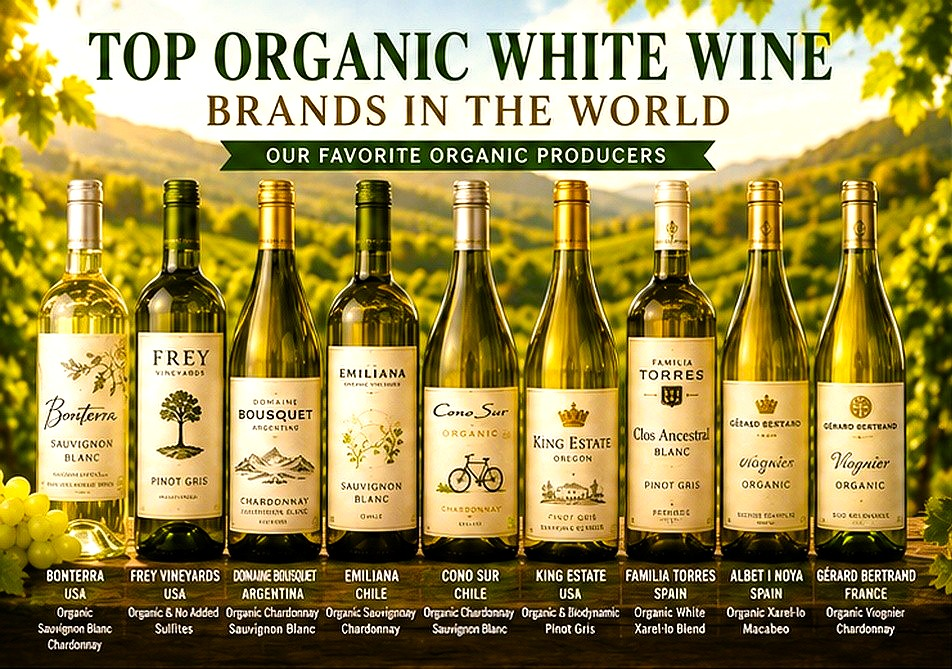
Top organic white wine brands in the world including Bonterra, Frey Vineyards, Domaine Bousquet, Emiliana, Cono Sur and King Estate
1. Bonterra Organic Estates — California, USA
Best for: Organic Chardonnay and Sauvignon Blanc
Bonterra is one of the most recognizable organic wine names in the United States.
Its entire identity is closely connected to organic farming, and the winery currently promotes a range of organically farmed white wines. Its portfolio includes wines such as Chardonnay and Sauvignon Blanc.
Bonterra is particularly attractive to consumers who want a recognizable California wine style combined with organic farming.
Organic Chardonnay
Bonterra Chardonnay is a natural starting point for consumers who already enjoy California Chardonnay.
Depending on the specific bottling, California Chardonnay can offer:
- Apple
- Pear
- Citrus
- Tropical fruit
- Vanilla
- Creamy texture
- Subtle oak
Organic Sauvignon Blanc
Sauvignon Blanc takes a completely different direction.
Expect:
- Citrus
- Melon
- Green herbs
- Fresh acidity
- White fruit
Bonterra’s organic Sauvignon Blanc has historically been made with organically grown grapes and designed to preserve the grape’s freshness and varietal character.
Best for: Consumers who want an easy introduction to organic California white wine.
2. Frey Vineyards — Mendocino County, California
Best for: Organic and no-added-sulfite white wine
Frey Vineyards is one of the pioneers of American organic wine.
The winery says it began making organic wine in 1980 and that all of its wines are certified organic. It also emphasizes that its wines are made without added sulfites.
Its white-wine portfolio includes varieties such as:
- Chardonnay
- Sauvignon Blanc
- Pinot Gris
- Other white varieties depending on the vintage
Frey’s current white-wine range includes USDA Organic and Demeter Biodynamic wines.
One particularly interesting example is its Biodynamic Sauvignon Blanc, which the winery describes with citrus, tropical and guava notes and naturally occurring sulfites below 5 ppm.
Why Frey Is Different
Frey isn’t simply a conventional winery with one organic product line.
The winery describes organic wine as its central philosophy.
That makes Frey one of the strongest choices for consumers specifically interested in:
USDA Organic + no added sulfites + biodynamic options.
Best for: Shoppers specifically looking for certified organic wine without added sulfites.
3. Domaine Bousquet — Mendoza, Argentina
Best for: Organic Chardonnay and Sauvignon Blanc
Domaine Bousquet is particularly impressive for consumers interested in organic wine from Argentina.
The winery is based in Mendoza’s high-altitude Uco Valley and offers a large organic portfolio.
Its current white-wine lineup includes several organic Chardonnay and Sauvignon Blanc expressions.
Organic Sauvignon Blanc
Domaine Bousquet’s Natural Origins Organic Sauvignon Blanc is 100% Sauvignon Blanc and uses stainless-steel fermentation without barrel aging, emphasizing freshness and aromatic purity.
Organic Chardonnay
Its Natural Origins Organic Chardonnay is also unoaked, with stainless-steel fermentation designed to preserve freshness and varietal expression.
For consumers who prefer a richer style, the producer also offers Reserve Organic Chardonnay with partial French-oak aging, producing a wine with greater texture and subtle oak influence.
At the premium end, the Gaia Organic & Biodynamic Chardonnay comes from Gualtallary vineyards farmed under certified organic and biodynamic practices. It is fermented with indigenous yeasts and aged in French oak.
Why Domaine Bousquet Stands Out
You can effectively explore several styles of organic Chardonnay from one producer:
Fresh + unoaked → richer + oak-aged → organic + biodynamic premium wine.
Best for: Argentine organic Chardonnay and Sauvignon Blanc.
4. Emiliana Organic Vineyards — Chile
Best for: Organic Sauvignon Blanc, Chardonnay and aromatic whites
Emiliana is one of Chile’s best-known organic wine producers.
Its portfolio includes organic white varieties such as:
- Sauvignon Blanc
- Chardonnay
- Gewürztraminer
- Viognier
- Riesling
Its organic portfolio spans several price and quality tiers.
Organic Sauvignon Blanc
Emiliana’s Sauvignon Blanc offers a classic fresh style, with citrus, grapefruit, lime and herbal characteristics.
Organic Chardonnay
Its organic Chardonnay from Casablanca Valley emphasizes citrus and tropical fruit with fresh acidity and a balanced, fruity character.
Why Chile Works for Organic Wine
Chile’s geography and dry conditions can provide favorable conditions for organic vineyard management in many regions.
Emiliana combines that environment with a broad organic portfolio.
Best for: Affordable and approachable organic Chilean white wine.
5. Viña Cono Sur — Chile
Best for: Organic Sauvignon Blanc and Chardonnay
Cono Sur is another major Chilean producer with a strong organic range.
Its Organic line includes Sauvignon Blanc and Chardonnay, alongside organic red wines. The winery states that its organic range has received V-Label certification for vegan production.
Its organic Sauvignon Blanc is described as:
- Mineral
- Citrusy
- Herbal
- Floral
- Fresh
- Juicy
- Balanced
Its organic Chardonnay emphasizes citrus, fruit and mineral notes with fresh acidity.
Best Food Pairings
Cono Sur’s organic Sauvignon Blanc is especially suitable for:
- Fish
- Shellfish
- Salads
- Spicy food
- Vegetables
- Fresh goat cheese
The winery specifically recommends Sauvignon Blanc as a pairing for spicy food, fish and vegetables.
Best for: Fresh, affordable organic Chilean whites.
6. King Estate — Oregon, USA
Best for: Organic and biodynamic Pinot Gris
King Estate is one of the most important names in Oregon Pinot Gris.
Its estate has been certified organic and Biodynamic, and its Domaine Pinot Gris is made from certified organic and biodynamic estate grapes.
This is an excellent example of a white wine where organic agriculture and premium wine production come together.
Pinot Gris Style
Oregon Pinot Gris can combine:
- Pear
- Apple
- Citrus
- White peach
- Floral notes
- Bright acidity
King Estate’s Domaine Pinot Gris is fermented in stainless steel and aged on its lees, contributing texture without relying on heavy oak.
Why King Estate Matters
Pinot Gris is sometimes overlooked in discussions of premium white wine.
That is a mistake.
A well-made Oregon Pinot Gris can be:
Fresh + textured + aromatic + food-friendly.
Best for: Pinot Gris lovers and consumers looking for biodynamic white wine.
7. Familia Torres — Spain
Best for: Organic Spanish white wines
Familia Torres is one of Spain’s most internationally recognized wine producers and has been deeply involved in organic and sustainable viticulture.
Its portfolio includes organic white wines, including Clos Ancestral White, made with varieties including Forcada and Xarel·lo. Familia Torres describes the wine as organic, with citrus and floral characteristics and a fresh palate.
Why Torres Is Interesting
Spain is one of the world’s most important organic wine-producing countries, and Torres offers a useful way to explore Spanish white grapes.
Rather than focusing exclusively on Sauvignon Blanc or Chardonnay, Spanish producers can showcase indigenous varieties.
Look for wines made from:
- Xarel·lo
- Verdejo
- Albariño
- Macabeo
- Forcada
Best for: Drinkers interested in organic Spanish white wine and indigenous varieties.
8. Albet i Noya — Penedès, Spain
Best for: Organic Catalan white wine
Albet i Noya is one of Spain’s pioneering organic wineries.
The producer is particularly interesting because Penedès offers white varieties that can be quite different from mainstream international Chardonnay.
Look for wines featuring varieties such as:
- Xarel·lo
- Macabeo
- Chardonnay
- Other Catalan varieties
Xarel·lo is especially interesting for wine lovers who want something beyond the familiar Sauvignon Blanc–Chardonnay–Pinot Gris trio.
Xarel·lo
Organic Xarel·lo can offer:
- Citrus
- Green apple
- Herbs
- Mineral notes
- Fresh acidity
- Textured finishes
It is particularly good with Mediterranean cuisine.
Best for: Adventurous wine lovers discovering organic Catalan whites.
9. Gérard Bertrand — Languedoc, France
Best for: Organic and biodynamic French wine
Southern France is one of the most important regions in the organic wine movement.
The Mediterranean climate can provide favorable conditions for organic viticulture, while the diversity of grape varieties makes the region particularly interesting.
Gérard Bertrand is strongly associated with organic and biodynamic viticulture and produces white wines from grapes including:
- Chardonnay
- Grenache Blanc
- Viognier
- Roussanne
- Vermentino
The wines range from accessible everyday bottles to more serious premium expressions.
Why Languedoc White Wine Is Interesting
You can find both:
familiar international grapes
and:
traditional southern French varieties.
This makes the region ideal for exploring organic white wine.
Best for: Consumers wanting French organic wine beyond Bordeaux and Burgundy.
10. Cono Sur Organic Chardonnay
Although Cono Sur has already been mentioned, its Chardonnay deserves special attention.
The wine is based on organically grown Chardonnay and offers a style emphasizing:
- Citrus
- Fruit
- Mineral character
- Fresh acidity
It is particularly suitable for consumers who want an inexpensive organic Chardonnay for:
- Weeknight dinners
- Seafood
- Chicken
- Salads
- Light pasta
- Cheese
11. Domaine Bousquet Reserve Organic Chardonnay
For drinkers who think organic Chardonnay must always be light and simple, Domaine Bousquet’s Reserve bottling provides an interesting counterexample.
The Reserve Organic Chardonnay uses selected low-yield parcels, with part of the wine fermented and aged for six months in French oak.
The result is a more textured style.
Pair It With
- Roast chicken
- Lobster
- Crab
- Cream sauces
- Grilled salmon
- Soft cheeses
This is the kind of organic white wine that can comfortably accompany a more elaborate dinner.
12. Domaine Bousquet Gaia Organic & Biodynamic Chardonnay
For a more premium experience, Gaia is one of the most interesting organic white wines from the producer.
The Chardonnay comes from high-altitude Gualtallary vineyards farmed under certified organic and biodynamic practices.
It is hand-harvested, fermented with indigenous yeasts in oak and aged for six months in French oak.
Style
Compared with an unoaked Sauvignon Blanc, this is a completely different experience:
- More texture
- More depth
- Greater richness
- Oak influence
- Mineral freshness
Best for: Special dinners and serious Chardonnay drinkers.
13. Frey Biodynamic Sauvignon Blanc
Frey’s Biodynamic Sauvignon Blanc is a fascinating option for consumers interested in the intersection of:
organic + biodynamic + no added sulfites.
The winery describes notes of lemon custard, pineapple and guava, balanced by acidity.
The wine is fermented with organic grapes and organic yeast and has naturally occurring sulfites below 5 ppm according to the winery.
This is an excellent example of how biodynamic white wine can remain aromatic and contemporary rather than tasting “rustic.”
14. Emiliana Organic Chardonnay
Emiliana’s Casablanca Valley Chardonnay offers a very approachable style.
Its profile includes:
- Grapefruit
- Lime
- Pineapple
- Herbs
- Fresh acidity
- Fruity texture
Casablanca Valley is one of Chile’s most famous regions for cool-climate white wine.
That makes organic Chilean Chardonnay particularly attractive when you want a combination of:
freshness + fruit + value.
15. Cono Sur Organic Sauvignon Blanc
For consumers who prefer Sauvignon Blanc to Chardonnay, Cono Sur’s Organic Sauvignon Blanc is a strong starting point.
The wine emphasizes:
- Citrus
- Green fruit
- Herbs
- White flowers
- Mineral character
- Fresh acidity
It is especially appropriate as an aperitif or with seafood and vegetables.
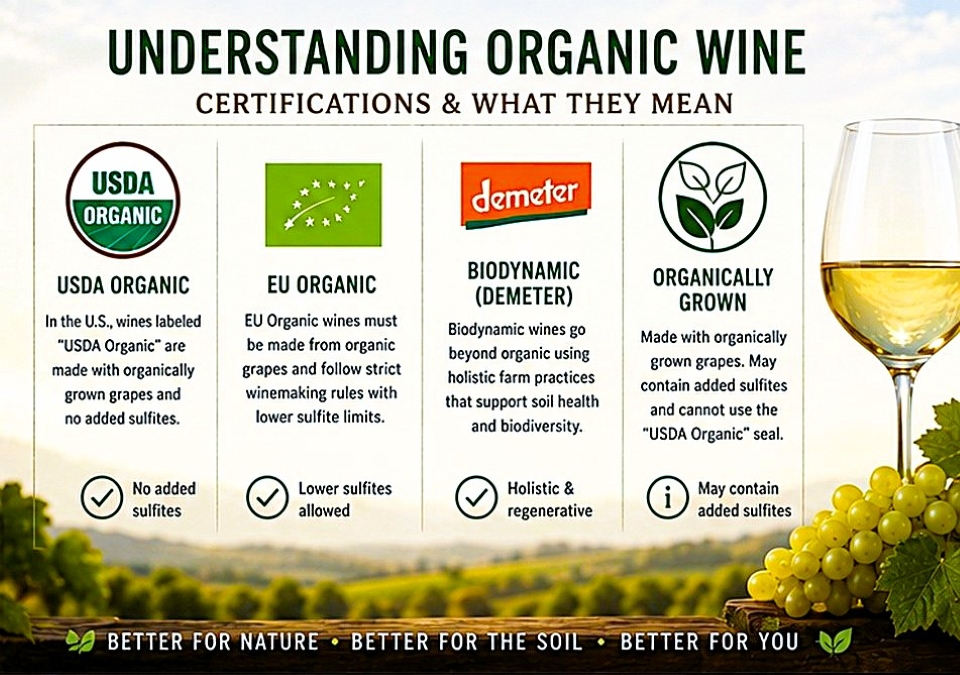
Organic wine certifications including USDA Organic, EU Organic, Biodynamic and organically grown wine labels
Why Organic White Wine Is Becoming More Popular
Several factors are driving interest in organic wine.
Consumers increasingly want greater transparency around:
- Farming practices
- Pesticide use
- Soil management
- Biodiversity
- Water
- Sustainability
- Winemaking ingredients
The USDA’s organic framework itself emphasizes ecological balance, resource cycling, soil and water quality and biodiversity.
For wine lovers, this means the organic label can represent more than a marketing statement—it can provide information about the agricultural system behind the bottle.
The Best Organic White Wine Regions
California
Best grapes: Chardonnay, Sauvignon Blanc, Pinot Gris
California has a long-established organic-wine movement.
Mendocino County is particularly important, with producers such as Frey and Bonterra.
Oregon
Best grapes: Pinot Gris, Chardonnay, Riesling
Oregon’s cool climate makes it particularly well suited to fresh, aromatic white wines.
King Estate is one of the most important names here, especially for organic and biodynamic Pinot Gris.
Chile
Best grapes: Sauvignon Blanc, Chardonnay, Riesling, Gewürztraminer
Chile is one of the best regions for affordable organic whites.
Emiliana and Cono Sur are two producers worth exploring.
Argentina
Best grapes: Chardonnay, Torrontés, Sauvignon Blanc
Mendoza is famous for Malbec, but the region can also produce excellent high-altitude white wine.
Domaine Bousquet demonstrates the diversity of organic Chardonnay and Sauvignon Blanc from the Uco Valley.
Spain
Best grapes: Xarel·lo, Verdejo, Albariño, Macabeo
Spain is particularly exciting because it offers indigenous grapes that can provide a completely different white-wine experience.
France
Best grapes: Chardonnay, Sauvignon Blanc, Viognier, Grenache Blanc, Roussanne, Vermentino
Southern France is particularly important for organic viticulture.
Best Organic White Wine by Grape Variety
Best Organic Chardonnay
Chardonnay is probably the easiest place for most wine drinkers to start.
Look for:
- Bonterra
- Domaine Bousquet
- Emiliana
- Cono Sur
- Frey
Unoaked Chardonnay
Expect:
- Apple
- Pear
- Citrus
- Mineral notes
- Fresh acidity
Oaked Chardonnay
Expect:
- Vanilla
- Toast
- Cream
- Butter
- Baking spice
- Greater texture
Domaine Bousquet offers both styles, making it particularly useful for comparing organic Chardonnay.
Best Organic Sauvignon Blanc
Sauvignon Blanc is ideal if you prefer crisp, refreshing white wine.
Typical characteristics include:
- Grapefruit
- Lime
- Lemon
- Green apple
- Fresh herbs
- Grass
- Mineral notes
Top organic producers to investigate include:
Frey Vineyards, Bonterra, Domaine Bousquet, Emiliana and Cono Sur.
Cono Sur specifically describes its Organic Sauvignon Blanc as expressive, delicate, juicy and balanced.
Best Organic Pinot Gris
Pinot Gris is particularly interesting from Oregon.
Look for:
King Estate
The variety can produce wines with:
- Pear
- Peach
- Citrus
- Apple
- Floral aromas
- Moderate body
- Bright acidity
It is an excellent summer wine and an extremely versatile food wine.
Best Organic Riesling
Riesling is one of the world’s most versatile white grapes.
Organic Riesling can range from:
bone dry
to:
off-dry
to:
Look for organic examples from:
- Germany
- Austria
- Oregon
- Chile
- France
- Portugal
Riesling is particularly useful if you enjoy wines with high acidity and pronounced aromatic character.
Best Organic Viognier
Viognier is ideal for people who prefer fuller, more aromatic white wines.
Typical flavors include:
- Peach
- Apricot
- Honeysuckle
- Orange blossom
- Tropical fruit
Emiliana includes Viognier among its organic portfolio.
Viognier pairs beautifully with:
- Thai food
- Indian cuisine
- Roast chicken
- Spiced seafood
- Creamy dishes
Best Organic White Wine for Seafood
For seafood, the safest choices are generally wines with:
fresh acidity + moderate alcohol + clean fruit.
Best choices:
Sauvignon Blanc
Excellent with oysters, shrimp, mussels and grilled fish.
Pinot Gris
Excellent with delicate fish and shellfish.
Chardonnay
Excellent with richer seafood such as salmon, lobster and crab.
Albariño
Excellent with shellfish and Mediterranean seafood.
Best Organic White Wine for Chicken
Chicken gives you enormous flexibility.
Roast Chicken
Choose:
Chardonnay
Herb-Roasted Chicken
Choose:
Sauvignon Blanc
Spicy Chicken
Choose:
Riesling or Gewürztraminer
Creamy Chicken
Choose:
Oaked Chardonnay
Best Organic White Wine for Cheese
White wine and cheese are often underrated.
Try:
Goat Cheese + Sauvignon Blanc
The acidity cuts through the creamy texture.
Brie + Chardonnay
A richer Chardonnay works beautifully with soft cheeses.
Blue Cheese + Riesling
The combination of sweetness and acidity can balance salty blue cheese.
Fresh Cheese + Pinot Gris
The fruit and acidity complement mild cheeses without overpowering them.
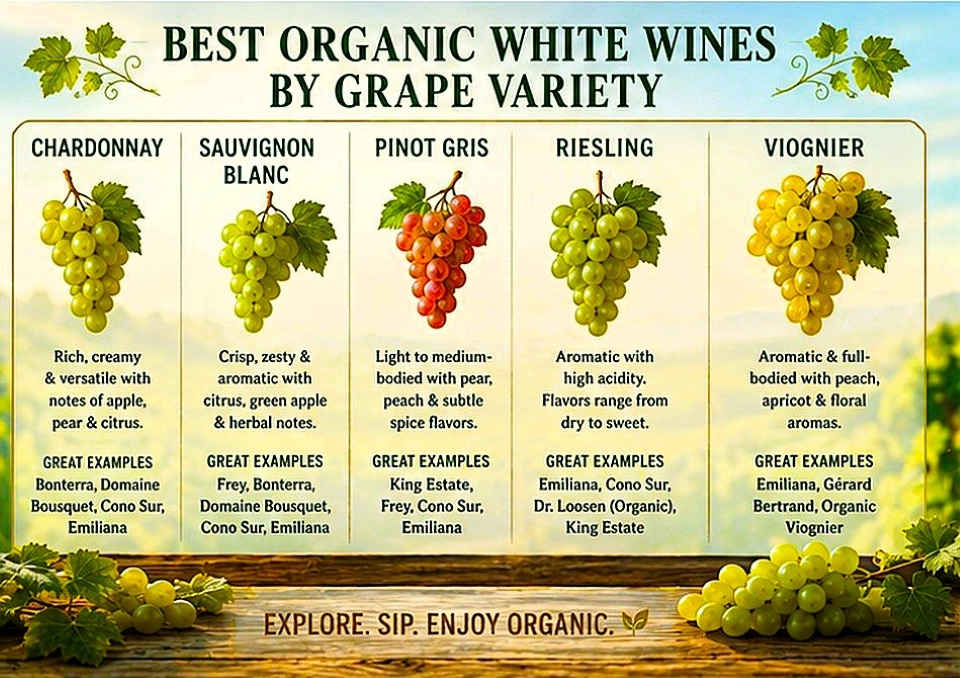
Best organic white wine grape varieties including Chardonnay, Sauvignon Blanc, Pinot Gris, Riesling and Viognier
Best Organic White Wine for Vegetarian Food
Organic white wines can be particularly good with vegetarian dishes.
Sauvignon Blanc
Great with:
- Asparagus
- Green salads
- Herbs
- Peppers
- Goat cheese
Chardonnay
Excellent with:
- Mushroom dishes
- Cream sauces
- Roasted vegetables
Riesling
Excellent with:
- Spicy Asian vegetables
- Thai curries
- Sweet-and-spicy dishes
Pinot Gris
Great with:
- Vegetable pasta
- Risotto
- Light salads
Best Organic White Wine for Summer
For hot summer days, prioritize:
Acidity + freshness + moderate alcohol.
The best choices include:
- Sauvignon Blanc
- Pinot Gris
- Albariño
- Riesling
- Unoaked Chardonnay
Serve them properly chilled—but not ice cold.
Extremely cold temperatures can suppress aromas and make even excellent wine taste flat.
Best Organic White Wine for Beginners
If you’ve never tried organic wine, start with a grape you already recognize.
Beginner #1 — Chardonnay
Best if you like:
- Creamy wines
- Apple
- Tropical fruit
- Richer textures
Beginner #2 — Sauvignon Blanc
Best if you like:
- Crisp wines
- Citrus
- Fresh herbs
- High acidity
Beginner #3 — Pinot Gris
Best if you like:
- Pear
- Peach
- Light-to-medium body
Beginner #4 — Riesling
Best if you like:
- Aromatic wines
- High acidity
- Dry or slightly sweet styles
Are Organic White Wines Better?
Not automatically.
This is an important distinction.
Organic certification doesn’t guarantee that a wine will taste better than a conventional wine.
The quality of wine depends on many factors:
- Vineyard location
- Climate
- Soil
- Grape quality
- Vintage
- Harvest timing
- Winemaking
- Storage
- Bottle age
What organic certification tells you is primarily about the production system and permitted practices.
For consumers who care about environmental stewardship, biodiversity and organic agriculture, that information can be extremely valuable.
But taste remains personal.
A mediocre organic Chardonnay is still a mediocre Chardonnay.
A great organic Chardonnay can be exceptional.
Is Organic White Wine Healthier?
It is important not to make broad health claims about organic wine.
Organic certification is not a health guarantee.
Wine contains alcohol, and alcohol consumption has health risks regardless of whether the grapes were farmed organically.
If you choose organic wine, the strongest reasons are generally related to:
- Farming practices
- Environmental considerations
- Certification
- Personal preferences
- Winemaking philosophy
—not assuming that the wine is “healthy.”
How to Choose the Best Organic White Wine
Use this simple process.
Step 1: Pick Your Grape
If you like crisp whites:
Sauvignon Blanc
If you like richer whites:
Chardonnay
If you want something lighter:
Pinot Gris
If you want aromatic complexity:
Riesling or Viognier
Step 2: Look for the Certification
Don’t rely solely on marketing language.
Look for:
- USDA Organic
- EU Organic
- Demeter
- Recognized certification-body logos
Step 3: Decide Whether You Want Oak
No Oak
Expect:
- Freshness
- Citrus
- Fruit
- Clean finish
Oak
Expect:
- Creaminess
- Vanilla
- Toast
- Greater texture
Domaine Bousquet provides a good illustration of this difference with its unoaked and oak-influenced organic Chardonnay expressions.
Step 4: Consider the Food
Buying wine for seafood?
Choose Sauvignon Blanc or Pinot Gris.
Buying wine for lobster?
Choose Chardonnay.
Buying wine for spicy food?
Choose Riesling or Sauvignon Blanc.
Buying wine for cheese?
Consider Chardonnay or Riesling.
Step 5: Consider Your Budget
Organic white wine is available at almost every price point.
Chile and Argentina can offer particularly strong value.
California and Spain also provide many approachable options.
Premium organic and biodynamic wines from France, Oregon and other established regions can cost considerably more.
Organic White Wine and Sustainability
The organic wine movement is increasingly connected to broader sustainability initiatives.
These can include:
- Soil health
- Cover crops
- Biodiversity
- Pollinator habitat
- Water conservation
- Reduced chemical inputs
- Renewable energy
- Regenerative agriculture
But it is important not to treat all these terms as interchangeable.
A winery can be:
organic but not biodynamic
biodynamic but not regenerative-certified
sustainable but not organic
or use several certifications simultaneously.
For example, Stoller Family Estate in Oregon emphasizes LIVE sustainable viticulture, Salmon Safe certification, B Corp status and environmentally efficient winery design, but those credentials are not the same as organic certification.
That distinction is useful when evaluating environmental claims.
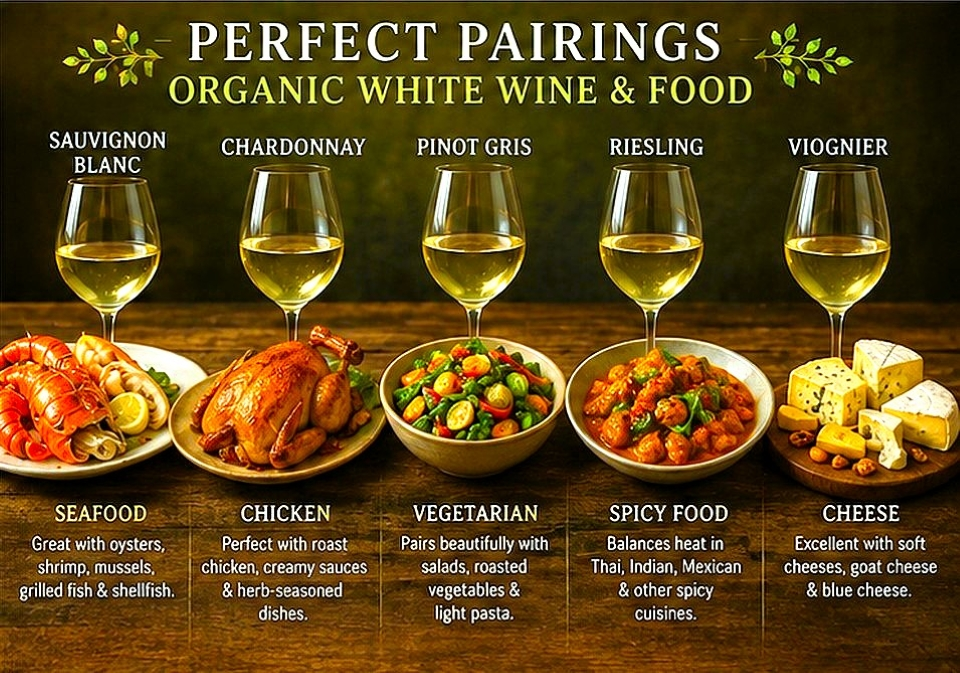
Organic white wine and food pairings with seafood, chicken, vegetarian dishes, spicy food and cheese
Organic White Wine vs. Sustainable White Wine
These terms are often confused.
Organic
Focuses on regulated organic farming and production requirements.
Biodynamic
Adds additional biodynamic farming requirements.
Sustainable
Can include a broader set of environmental, economic and social practices.
Regenerative
Focuses particularly on restoring or improving soil and ecosystem health.
A winery can have one or several of these approaches.
Certification matters because it tells you which standard is actually being followed.
Frequently Asked Questions About Organic White Wine
What are the best organic white wine brands?
Some of the most interesting producers include Bonterra Organic Estates, Frey Vineyards, Domaine Bousquet, Emiliana Organic Vineyards, Viña Cono Sur, King Estate, Familia Torres and Albet i Noya.
What is the best organic white wine?
There isn’t one universal winner. For Sauvignon Blanc, Frey, Bonterra, Domaine Bousquet, Emiliana and Cono Sur are strong producers to explore. For Chardonnay, Bonterra, Domaine Bousquet, Emiliana and Cono Sur offer excellent starting points. For Pinot Gris, King Estate is particularly notable.
What is the best organic Chardonnay?
Domaine Bousquet is especially interesting because it offers multiple organic Chardonnay styles, from fresh unoaked wines to Reserve and Gaia Organic & Biodynamic expressions.
What is the best organic Sauvignon Blanc?
Good producers to investigate include Frey Vineyards, Bonterra, Domaine Bousquet, Emiliana and Cono Sur. Their styles range from crisp and mineral to fruit-forward and aromatic.
Does organic white wine contain sulfites?
It can. Sulfite rules vary by certification and country. In the United States, added sulfites are prohibited in wine labeled USDA Organic, while wine made with organic grapes can contain added sulfur dioxide under applicable rules.
Is organic wine the same as natural wine?
No. Organic wine is governed by certification standards, while natural wine is a broader term generally associated with minimal-intervention winemaking and does not have one universal global legal definition.
Is biodynamic wine organic?
Biodynamic farming incorporates organic principles but has additional requirements. A biodynamic wine may also be certified organic, but the two certifications are not identical.
Is organic white wine vegan?
Not automatically. Some organic wines are vegan and some are not. If vegan wine is important to you, look for a specific vegan certification or statement from the producer.
What is the best organic white wine for seafood?
Sauvignon Blanc, Pinot Gris and Albariño are excellent choices for lighter seafood, while Chardonnay is better suited to richer fish, lobster and crab.
What is the best organic white wine for spicy food?
Sauvignon Blanc and Riesling are particularly good choices. Their acidity and aromatic character can work well with spicy dishes.
What is the best organic white wine for beginners?
Chardonnay and Sauvignon Blanc are probably the easiest starting points because they are widely available and their styles are familiar to most wine drinkers.
Which country makes the best organic white wine?
There is no single best country. California, Oregon, Chile, Argentina, Spain and France all offer excellent organic white wines, while other regions are increasingly producing certified organic examples.
Is organic white wine more expensive?
Not necessarily. Organic wine exists at many price levels. Chile, Argentina and Spain can offer excellent value, while premium biodynamic and organic wines can command higher prices.
Final Thoughts: The Best Organic White Wine Brands in the World
The world of organic white wine is now remarkably diverse.
You don’t have to choose between environmentally conscious farming and enjoyable wine.
There are excellent organic whites for almost every palate.
If you want a familiar California style, explore Bonterra.
If you specifically want certified organic wine without added sulfites, Frey Vineyards deserves serious attention. Frey says all of its wines are certified organic and made without added sulfites.
If you’re looking for high-altitude Argentine Chardonnay or Sauvignon Blanc, Domaine Bousquet is one of the most versatile producers to explore, with everything from fresh unoaked Chardonnay to premium organic and biodynamic bottlings.
For Chilean whites, Emiliana and Cono Sur offer broad organic portfolios featuring Sauvignon Blanc, Chardonnay and several aromatic varieties.
For Oregon Pinot Gris, King Estate is a particularly compelling name, especially for consumers interested in organic and biodynamic farming.
And for Spanish wine lovers, producers such as Familia Torres and Albet i Noya offer opportunities to explore organic wines made with grapes that provide a stronger sense of Iberian regional identity.
The most important lesson is simple:
Organic is not a flavor profile.
Organic Chardonnay can be crisp or creamy.
Organic Sauvignon Blanc can be mineral, tropical or intensely herbal.
Organic Pinot Gris can be light or textured.
Organic Riesling can be bone dry or sweet.
Organic Viognier can be floral, rich and aromatic.
The certification tells you how the wine was produced. The grape, region, vintage and winemaking tell you what the wine tastes like.
So the best way to discover organic white wine is to begin with the style you already enjoy, then explore producers and regions that match your preferences.
For a first bottle, try a crisp organic Sauvignon Blanc.
For a richer dinner, choose an organic Chardonnay.
For summer entertaining, pour organic Pinot Gris.
For spicy Asian food, open an organic Riesling.
And if you’re ready to explore beyond the familiar, seek out organic white wines made from Xarel·lo, Verdejo, Albariño, Torrontés, Viognier or other regional varieties.
The organic wine movement is also moving beyond the basic question of what wineries avoid in the vineyard. Increasingly, the conversation is about soil health, biodiversity, regenerative agriculture, water management and the long-term health of wine-growing regions.
That makes organic white wine one of the most interesting categories in modern wine.
Whether you’re buying a bottle for a summer evening, a seafood dinner, a dinner party or simply looking for a better everyday white, there has never been a better time to explore the best organic white wine brands in the world.