
Blog
Most Popular Sake Brands in the World: 30 Famous Japanese Sake Brands Every Sake Lover Should Know

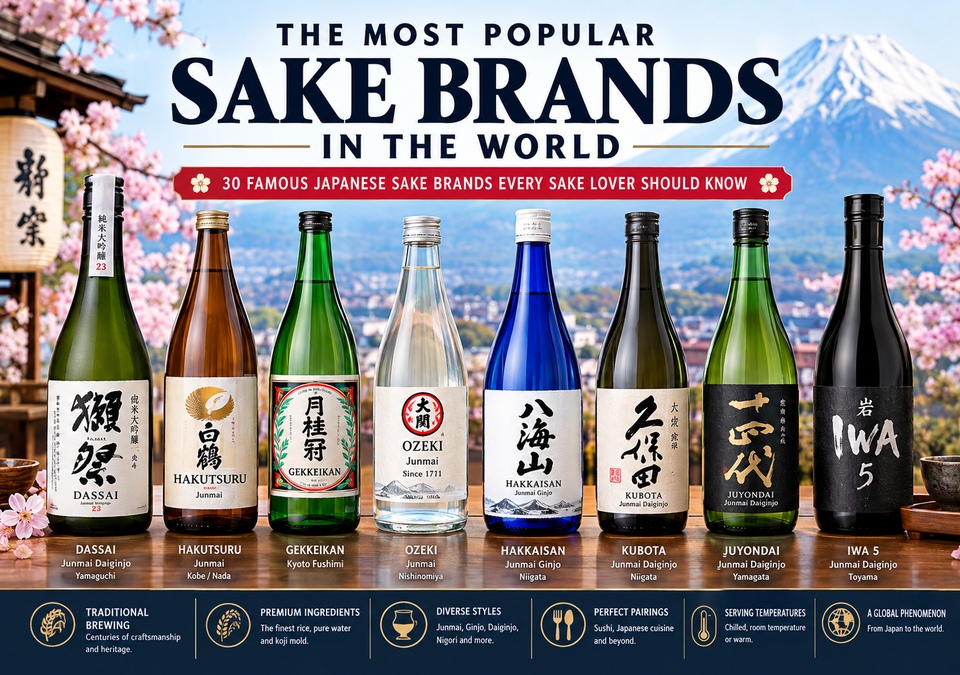
Discover the most popular sake brands in the world, from Dassai, Hakutsuru, Gekkeikan and Ozeki to Hakkaisan, Kubota, Kokuryu, Suigei and Juyondai. Explore the best Japanese sake brands, popular junmai, ginjo and daiginjo styles, sake for beginners, food pairing, serving temperatures, premium bottles and how to choose the perfect sake.
Sake has become one of the world’s most exciting drinks.
Once primarily associated with Japanese restaurants and traditional Japanese dining, sake is now appearing on wine lists, cocktail menus, tasting flights and fine-dining tables around the globe.
The growth is not difficult to understand.
Sake can be delicate and floral like a white wine, rich and savory like a premium broth, crisp and refreshing like a light beer, or deeply complex with dried-fruit and nutty characteristics after maturation. It can be served chilled, gently warmed, at room temperature, sparkling, cloudy or unpasteurized.
And perhaps most importantly, there is no single “sake flavor.” There are thousands of breweries and an enormous range of regional styles.
That makes the question “What are the most popular sake brands in the world?” surprisingly difficult to answer.
There is no single worldwide ranking that perfectly combines domestic Japanese sales, export volume, restaurant popularity, search demand and premium reputation. A giant producer such as Hakutsuru, Gekkeikan or Ozeki can have enormous domestic and international distribution, while a smaller premium producer such as Dassai, Juyondai or Hakkaisan can have extraordinary recognition among enthusiasts and fine-dining customers.
So this guide uses a broader definition of popularity, considering brand recognition, Japanese market presence, export visibility, international reputation, premium positioning, restaurant relevance and enthusiast interest.
The timing is particularly interesting.
Japan’s sake exports continued to grow in 2025. According to figures from the Japan Sake and Shochu Makers Association, sake export value reached approximately ¥45.9 billion, up 5.5% year over year, while export volume increased 8.0% to about 33,500 kiloliters. China was the largest export market by value at about ¥13.3 billion, while the United States was the largest by volume at roughly 7,720 kiloliters.
And one premium brand is expanding particularly aggressively.
Dassai reported fiscal-year sales of approximately ¥21.3 billion, with exports reaching ¥7.9 billion, a 40% increase. The company has explicitly positioned itself for global expansion, including its DASSAI BLUE brewery in New York.
That tells us something important:
Japanese sake is no longer merely a domestic beverage category. It is becoming a global premium drink.
Table of Contents
- What Is Sake?
- Sake vs. Japanese Rice Wine
- How Sake Is Made
- Understanding Sake Grades
- What Does Sake Taste Like?
- The 30 Most Popular Sake Brands
- Dassai
- Hakutsuru
- Gekkeikan
- Ozeki
- Hakkaisan
- Kubota
- Kiku-Masamune
- Nihonsakari
- Sho Chiku Bai
- Kenbishi
- Suigei
- Juyondai
- Kokuryu
- Dewazakura
- Born
- Tengumai
- Masumi
- Shichiken
- Hananomai
- Urakasumi
- Kokuryu Junmai
- Kizakura
- SakeOne
- IWA 5
- Tatenokawa
- Kamoizumi
- Best Sake Brands for Beginners
- Best Premium Sake Brands
- Best Sake for Food Pairing
- Best Sake for Sushi
- Best Sake for Beginners
- Best Sake Served Warm
- How to Read a Sake Label
- How to Choose the Right Sake
- Current Sake Trends
- Frequently Asked Questions
- Final Thoughts
What Is Sake?
Sake is a traditional Japanese alcoholic beverage brewed primarily from rice, water, yeast and koji, rather than distilled like whisky or vodka.
The Japan Sake and Shochu Makers Association explains that sake brewing involves several carefully controlled stages, including rice preparation, koji making, fermentation and filtration. A typical brewing cycle takes roughly two months, followed by maturation before the finished product is shipped.
One of the most important ingredients is koji.
Koji is steamed rice on which Aspergillus oryzae has been cultivated. Its enzymes break rice starch into sugars that yeast can ferment. This process is one of the defining technical differences between sake and fermented beverages such as wine.
Sake therefore combines:
rice + koji + yeast + water + carefully controlled fermentation to create its final flavor.
Sake vs. Japanese Rice Wine
You will often see sake described as “Japanese rice wine.”
It’s a useful shortcut for beginners, but technically it isn’t a perfect description. Wine is generally made by fermenting sugar naturally present in fruit. Sake is made from rice starch, which must first be converted into fermentable sugar through koji.
This is why sake is better understood as a brewed alcoholic beverage made through parallel saccharification and fermentation.
That technical difference is also one reason sake can have such distinctive combinations of:
- Umami
- Fruit
- Acidity
- Rice sweetness
- Creaminess
- Floral aromas
How Sake Is Made
The process is remarkably precise.
1. Rice polishing
Rice begins as whole grain. Brewers polish away the outer layers, removing proteins, fats and other components that can affect aroma and flavor. The percentage remaining is called the rice polishing ratio.
For example:
50% polishing ratio
means 50% of the original rice grain remains.
The Japan Sake and Shochu Makers Association emphasizes that polishing percentage is an indicator of sake style rather than a guarantee of quality. Highly polished rice generally costs more because more of the grain is removed, but a lower remaining percentage does not automatically mean the sake tastes better.
2. Koji making
Koji is produced by cultivating koji mold on steamed rice. It provides the enzymes needed to convert starch into sugar. This stage is one of the most carefully controlled parts of sake production.
3. Starter preparation
Yeast is cultivated with rice, koji and water to prepare the fermentation starter.
4. Main fermentation
Sake uses a characteristic multiple-parallel fermentation in which starch conversion and alcohol fermentation take place together. This is one reason the process is technically sophisticated.
5. Pressing
After fermentation, the liquid is separated from the remaining rice solids.
6. Filtration and finishing
Depending on the style, sake may be:
- Filtered
- Carbon filtered
- Pasteurized
- Diluted with water
- Left undiluted
- Left cloudy
- Bottle fermented
- Aged
The finished product can therefore vary enormously.
Understanding Sake Grades
This is where many beginners become confused. The Japanese sake classification system includes specially designated sake, such as:
- Junmai
- Ginjo
- Daiginjo
- Honjozo
- Junmai Ginjo
- Junmai Daiginjo
- Tokubetsu Junmai
- Tokubetsu Honjozo
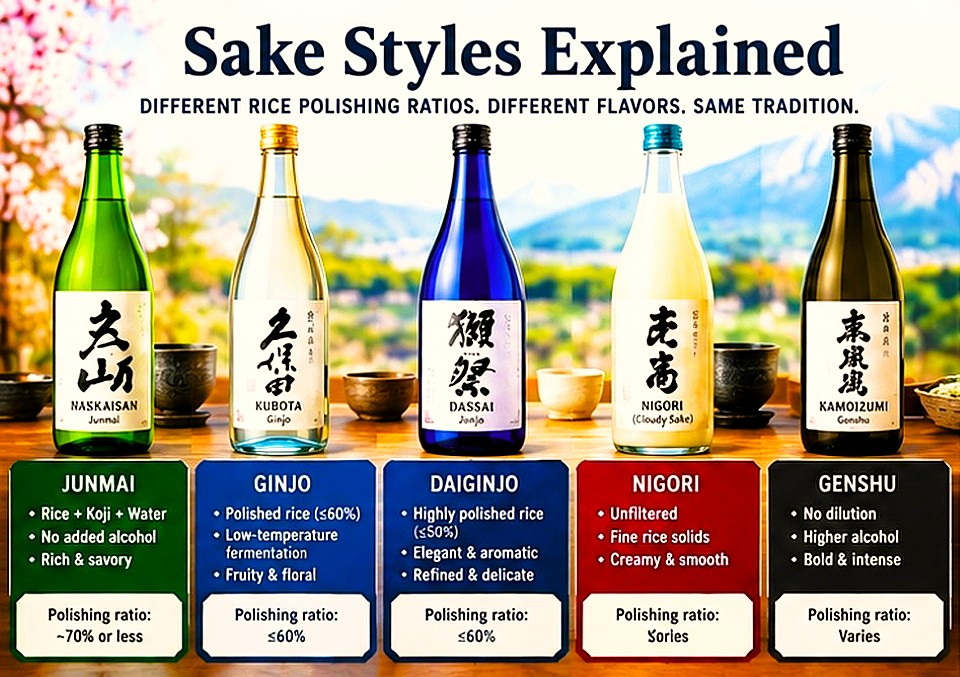
The Japan Sake and Shochu Makers Association’s label guide explains that Ginjo and Daiginjo involve highly polished rice and low-temperature fermentation, while Junmai is made from rice, koji and water without added brewing alcohol.
Junmai
Generally:
rice + koji + water
with no added neutral brewing alcohol. Junmai can be rich, savory and full-bodied, although styles vary considerably.
Ginjo
Rice polished to 60% or less remaining, with specialized low-temperature fermentation.
Often associated with:
- Fruit
- Floral aromas
- Light texture
Daiginjo
Rice polished to 50% or less remaining. Usually highly aromatic and refined.
Junmai Ginjo
A Junmai sake made using Ginjo production techniques.
Junmai Daiginjo
One of the most premium mainstream categories. It combines:
Junmai production + Daiginjo-level rice polishing.
What Does Sake Taste Like?
Sake can taste completely different depending on the brewery and style. The Japan Sake and Shochu Makers Association’s four-style framework groups sake into:
aromatic, light and smooth, full-bodied, matured styles.
Light and fruity
Look for:
- Apple
- Pear
- Melon
- Peach
- Citrus
- Banana
Rich and savory
Look for:
- Rice
- Umami
- Cream
- Nuts
- Mushroom
- Mineral notes
Dry and crisp
Look for:
- Clean acidity
- Mineral character
- Herbal notes
- Dry finish
Matured sake
Look for:
- Dried fruit
- Nuts
- Caramel
- Spice
- Sherry-like aromas
There is also nigori, which is cloudy because some fine rice solids remain after pressing.
The 30 Most Popular Sake Brands in the World
1. Dassai
Brewery: DASSAI Inc.
Location: Yamaguchi Prefecture
Style focus: Junmai Daiginjo
Dassai is arguably the most recognizable premium Japanese sake brand internationally.
The producer has built its identity around highly polished rice and Junmai Daiginjo sake, with Dassai 23 becoming particularly famous among international consumers. The company has also made global expansion a central strategy.
In 2025 it changed its corporate name from Asahi Shuzo to DASSAI Inc., explicitly stating its ambition to become a global brand. Its New York brewery, which began operating in 2023, is part of that effort.
That strategy appears to be working. In the latest reported fiscal year, Dassai sales reached ¥21.3 billion, while exports were ¥7.9 billion, up 40%.
Flavor profile
Dassai is known for:
- Floral aromas
- Pear
- Apple
- Melon
- Peach
- Elegant sweetness
Famous expressions
Dassai 39
Dassai 45
Best for
Sake beginners, premium gifting, sushi and fine dining.
Why try it?
For many people outside Japan, Dassai is the bottle that introduces them to premium sake.
2. Hakutsuru
Location: Kobe / Nada
Hakutsuru is one of Japan’s best-known major sake producers. Unlike small premium breweries, Hakutsuru operates at a scale that gives its products extensive domestic and international reach.
Its portfolio covers:
- Junmai
- Junmai Ginjo
- Daiginjo
- Nigori
- Sparkling sake
- Everyday sake
The brand appears near the top of current 2026 sake-brand lists based on broad consumer recognition and engagement, alongside Dassai, Gekkeikan and Ozeki. These rankings aren’t official sales rankings, but they illustrate the breadth of Hakutsuru’s public recognition.
Best for
Beginners and everyday drinking.
3. Gekkeikan
Location: Kyoto / Fushimi
Gekkeikan is one of the world’s most recognizable sake names. Its history stretches back hundreds of years, and its modern portfolio includes a huge variety of styles.
The official range currently includes:
- Junmai
- Junmai Daiginjo
- Ginjo
- Daiginjo
- Honjozo
- Nama-style products
- Sparkling sake
- Seasonal releases
Famous expressions
Gekkeikan Traditional, Horin, Gekkeikan Junmai
Best for
Beginners, restaurants and everyday meals.
Why try it?
Gekkeikan demonstrates how traditional sake brewing can operate on a global scale while maintaining a very broad portfolio.
4. Ozeki
Location: Nishinomiya, Hyogo
Ozeki is another enormous name in Japanese sake. The company says its sake-making history dates to 1711, and it remains one of Japan’s major sake producers.
Its portfolio includes:
- Junmai
- Junmai Daiginjo
- Daiginjo
- Honjozo
- Nigori
- One Cup
- Seasonal sake
One Cup Ozeki is particularly famous. Ozeki says it launched One Cup Ozeki in 1964, helping create an entirely new portable single-serving sake format.
Best for
Everyday drinking and casual sake experiences.
Why try it?
Ozeki combines centuries of history with remarkably modern packaging and accessibility.
5. Hakkaisan
Location: Niigata
Hakkaisan is one of Japan’s most respected premium sake producers. Niigata is famous for its snowy climate, pristine water and rice-growing culture.
Hakkaisan is particularly associated with:
- Clean flavors
- Dry finishes
- Elegant texture
- Food-friendly sake
Best for
Sushi, sashimi and refined Japanese cuisine.
It also has international relevance beyond Japan, including a partnership with New York craft sake brewery Brooklyn Kura. National Geographic reported that Brooklyn Kura began exporting to Japan in 2025 through a partnership involving Hakkaisan.
Sake styles explained including Junmai, Ginjo, Daiginjo, Nigori and Genshu with different rice polishing ratios and flavor profiles
6. Kubota
Brewery: Asahi Shuzo
Location: Niigata
Kubota is another highly respected Niigata sake brand. Its portfolio includes several styles, but Kubota has become particularly famous for clean, dry and elegant sake.
Typical profile
- Pear
- Citrus
- Rice
- Mineral
- Clean acidity
Best for
Sushi and food pairing. Kubota is also an excellent introductory brand for consumers who prefer dry sake rather than overtly sweet or aromatic styles.
7. Kiku-Masamune
Location: Kobe / Nada
Kiku-Masamune is one of Japan’s historic sake names. It is strongly associated with the Nada brewing region and traditional dry sake. The brand is particularly well known domestically.
Best for
- Japanese meals
- Warm sake
- Traditional dining
Kiku-Masamune can be an excellent choice when exploring the classic karakuchi dry style.
8. Nihonsakari
Location: Nishinomiya
Nihonsakari is a long-established Japanese sake producer.
Its range includes:
- Junmai
- Ginjo
- Daiginjo
- Everyday sake
- Seasonal releases
Best for
Food pairing and everyday drinking. It is another useful brand for people exploring the major Nada brewing region.
9. Sho Chiku Bai
Producer: Takara Shuzo
Sho Chiku Bai is particularly well known outside Japan because of its availability in international markets.
The brand offers a broad range of:
- Junmai
- Ginjo
- Nigori
- Everyday sake
Best for
Sake beginners in North America. Its availability can make it a practical first bottle for consumers who aren’t yet ready to search for smaller producers.
10. Kenbishi
Location: Hyogo
Kenbishi is one of Japan’s historic sake brands. It is associated with the traditional Nada style and a crisp, dry profile.
Best for
Traditional sake enthusiasts.
11. Suigei
Location: Kochi Prefecture
Suigei is one of Kochi’s best-known sake brands. Kochi sake is often associated with dry, crisp and food-friendly styles.
Typical profile
- Dry
- Crisp
- Clean
- Refreshing
- Savory
Best for
Seafood, sushi and rich savory foods. Suigei is an excellent introduction to the idea that sake can function like a serious food wine.
12. Juyondai
Brewery: Takagi Shuzo
Location: Yamagata
Juyondai is one of Japan’s most coveted premium sake brands. It is not primarily a mass-market brand.
Instead, it has become famous among enthusiasts for:
- Exceptional rice
- Aromatic character
- Fruitiness
- Texture
- Scarcity
Typical profile
- Melon
- Pear
- Peach
- Rice sweetness
- Floral aromas
Best for
Collectors and serious sake enthusiasts.
Important distinction
Juyondai’s importance is measured more by prestige and enthusiast demand than by global sales volume.
13. Kokuryu
Location: Fukui Prefecture
Kokuryu is one of Japan’s respected premium sake producers. It is particularly associated with elegant, refined sake suitable for fine dining.
Best for
- Sushi
- Kaiseki
- Fine dining
- Premium gifting
Flavor profile
Often: clean + floral + dry + refined
14. Dewazakura
Location: Yamagata
Dewazakura became internationally recognized for helping popularize fragrant, aromatic sake.
The brewery is particularly associated with:
- Ginjo
- Daiginjo
- Elegant fruit aromas
Typical flavors
- Pear
- Apple
- Melon
- Banana
- Floral notes
Best for
Wine drinkers discovering sake. This is one of the best brands to recommend to someone who says: “I don’t know whether I’ll like sake.”
15. Born
Brewery: Kato Kichibee Shoten
Location: Fukui
Born is a premium Japanese sake brand known for refined presentation and elegant sake. Its portfolio includes multiple Junmai and premium expressions.
Best for
Special occasions and gifting.
16. Tengumai
Location: Ishikawa
Tengumai is associated with Ishikawa’s rich sake culture. The brewery produces sake with more savory and umami-forward characteristics.
Best for
Traditional Japanese cuisine and richer dishes.
17. Masumi
Location: Nagano
Masumi is one of Nagano’s most internationally recognized sake producers.
The brewery has a strong history and offers:
- Junmai
- Ginjo
- Daiginjo
- Sparkling
- Seasonal sake
Flavor profile
Depending on the expression:
- Apple
- Pear
- Melon
- Floral aromas
- Rice
- Gentle acidity
Best for
Beginners and experienced drinkers.
18. Shichiken
Location: Yamanashi
Shichiken is increasingly respected internationally for elegant sake and its mountain-water setting.
Its sake often emphasizes:
- Freshness
- Clean acidity
- Fruit
- Mineral character
Best for
Modern Japanese cuisine and fine dining.
19. Hananomai
Location: Shizuoka
Hananomai produces a broad portfolio and has become increasingly visible outside Japan.
Best for
Food pairing and exploration of regional Japanese sake.
20. Urakasumi
Location: Miyagi
Urakasumi is one of Tohoku’s historic sake producers. The brewery is especially known for producing elegant and balanced sake.
Best for
Seafood and Japanese cuisine.
21. Kizakura
Kizakura is a widely recognized Japanese sake producer with a broad portfolio.
The company’s products include:
- Junmai
- Ginjo
- Daiginjo
- Nigori
- Seasonal products
It also has a strong presence in the wider Japanese beverage market.
Best for
Beginners and casual drinking.
22. SakeOne
Location: United States
SakeOne is important because it demonstrates how sake has moved beyond Japan. The company produces sake in Oregon and has helped introduce American consumers to locally produced sake.
Best for
North American sake beginners.
Why it matters
Sake’s global story is no longer simply:
Japan exports sake to the world.
It is increasingly:
The world is learning to make sake. National Geographic’s 2026 coverage of American craft sake highlighted this trend, including Brooklyn Kura’s export relationship with Hakkaisan.
23. IWA 5
Location: Toyama
IWA 5 is one of the most luxury-oriented names in modern sake.
It was developed by Richard Geoffroy, former chef de cave of Dom Pérignon, in collaboration with Shiraiwa K.K. in Toyama. Forbes described IWA as a “wine-lover’s sake” because of its refined structure and layered character.
Best for
Luxury dining, Champagne drinkers and collectors.
IWA is particularly interesting because it deliberately bridges the worlds of:
fine wine + Japanese sake.
24. Tatenokawa
Location: Yamagata
Tatenokawa is another premium brewery associated with highly polished rice and aromatic sake.
Typical profile
- Floral
- Fruity
- Elegant
- Refined
Best for
Premium dining and gifting.
25. Kamoizumi
Location: Hiroshima
Kamoizumi is especially interesting for drinkers who prefer fuller, richer sake.
Typical characteristics
- Rice
- Umami
- Nuts
- Savory notes
- Depth
Best for
Rich dishes and more traditional sake experiences.
Top sake brands for beginners including Dassai, Hakutsuru, Gekkeikan, Ozeki, Kubota, Kiku-Masamune, Masumi, Dewazakura, Hakkaisan and Suigei
26. Dassai Blue
Although technically connected to the Dassai brand rather than a separate Japanese brewery, Dassai Blue deserves mention because it represents a major development in sake’s global future.
Dassai established its New York brewery in 2023, and the company has said global expansion is a core part of its strategy.
Why it matters
It shows that premium sake can be produced outside Japan while the brand’s broader identity remains deeply rooted in Japanese sake culture.
27. Hakkaisan Tokubetsu Honjozo
This expression is worth highlighting for consumers who want a more traditional, food-oriented Hakkaisan.
Best for
Japanese meals, sushi and sashimi. It demonstrates that Hakkaisan isn’t only about premium Ginjo-style bottles.
28. Gekkeikan Horin
Horin represents the premium side of the Gekkeikan portfolio.
Its presentation and refined style make it particularly suitable for:
- Gifts
- Celebrations
- Fine dining
Best for
Special occasions.
29. Ozeki One Cup
One Cup Ozeki deserves a place of its own because it changed how sake could be consumed.
Ozeki says the product launched in 1964, introducing a convenient single-serving format at a time when sake was commonly purchased in larger bottles and poured from traditional serving vessels.
Best for
Casual drinking and discovering Japanese drinking culture.
30. Dassai 23
Dassai 23 is so important that it deserves separate consideration from the broader Dassai brand. The expression became famous for its highly polished rice and aromatic, elegant style. It has also become one of the most internationally recognizable premium sake bottles.
Best for
Premium gifting, fine dining and sake beginners seeking a luxury introduction.
Best Sake Brands for Beginners
If you have never tasted sake, don’t start with the rarest possible bottle. Start with something expressive but accessible.
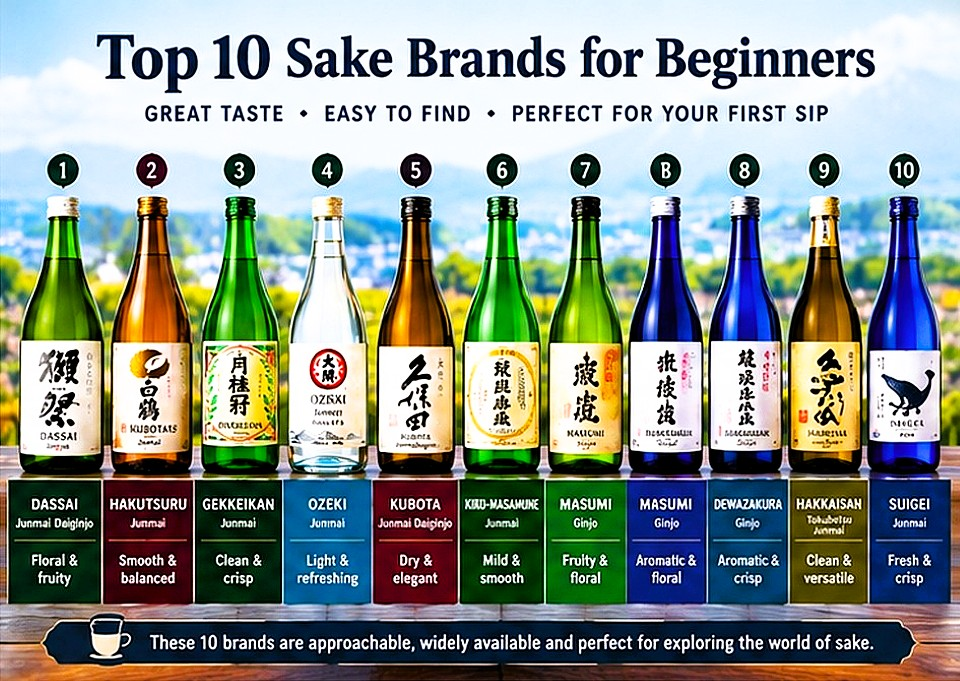
Excellent starting choices
Dassai, Hakkaisan, Kubota, Gekkeikan, Ozeki, Masumi, Dewazakura
For fruity sake
Try:
Dassai, Dewazakura, Masumi
For dry sake
Try:
Kubota, Suigei, Kiku-Masamune
For richer sake
Try:
Kamoizumi, Kikuhime/Tengumai-style regional sake
For premium sake
Try:
Dassai 23, Juyondai, Kokuryu, IWA 5
Best Premium Sake Brands
If you’re looking for a luxury bottle, focus on producers where craft, rice selection, polishing and brewery reputation are central.
Dassai
The global premium leader.
Juyondai
Extremely coveted among enthusiasts.
Kokuryu
Elegant and refined.
IWA 5
Luxury sake with a strong fine-wine connection.
Born
Premium presentation and refined styles.
Tatenokawa
Highly polished and aromatic.
Best Sake for Sushi
Sake and sushi are natural partners, but not every sake works equally well.
For delicate fish:
Dassai, Hakkaisan, Kubota
For fatty fish:
Suigei, Kokuryu
For richer rolls:
Junmai-style sake. The idea is balance. A delicate sake can complement subtle sashimi.
A richer Junmai can stand up to:
- Eel
- Miso
- Grilled fish
- Rich sauces
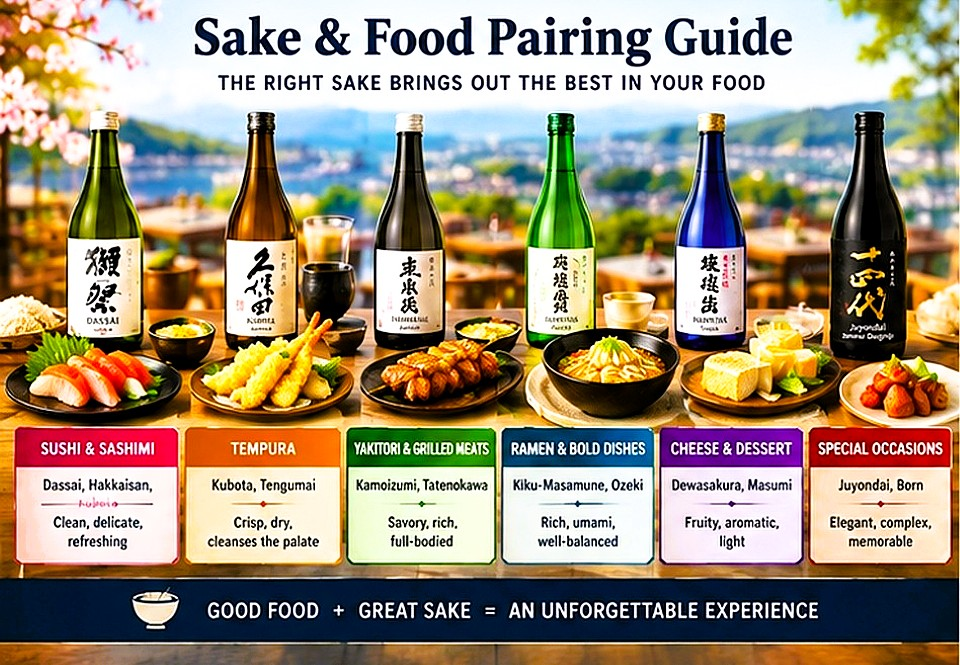
Best Sake for Japanese Food
Sake is one of the world’s most versatile food beverages.
Tempura
Try:
Ginjo
The acidity and aromatic freshness can cut through the fried exterior.
Sushi
Try:
Junmai Ginjo or Daiginjo
Yakitori
Try:
Junmai
The savory character works well with grilled meat.
Ramen
Try:
Full-bodied Junmai
Wagyu
Try:
Rich Junmai or aged sake
Dessert
Try:
Nigori
or sweeter styles.
Warm Sake vs. Cold Sake
Sake is not simply:
cold = good
warm = bad
Temperature changes the drink significantly.
Chilled
Best for:
- Ginjo
- Daiginjo
- Aromatic sake
Cold temperatures emphasize:
- Fruit
- Floral notes
- Freshness
Room temperature
Useful for:
- Junmai
- Fuller-bodied sake
- More savory styles
Warm
Often excellent for:
- Honjozo
- Junmai
- Traditional dry sake
Warmth can emphasize:
- Rice
- Umami
- Texture
- Savory flavors
The ideal serving temperature should therefore match the sake’s style rather than follow a universal rule.
How to Read a Sake Label
Sake labels can initially look intimidating. Here are the most useful words.
Junmai
No added brewing alcohol.
Ginjo
Highly polished rice and low-temperature fermentation.
Daiginjo
Even more highly polished rice.
Nama
Unpasteurized sake.
Nigori
Cloudy sake containing fine rice solids.
Genshu
Sake that has not been diluted with water after pressing. The JSS glossary notes that Genshu generally has a higher alcohol content because it is not diluted, often exceeding 17%.
Koshu
Aged sake. Matured sake can develop very different flavors from fresh sake, including dried fruit, spice and sherry-like aromas.
Dry / Sweet
The Sake Meter Value, or SMV, can provide an indication of perceived dryness, although sweetness and acidity also influence how a sake tastes.
What Is the Best Rice for Sake?
Many premium sake producers use specialized sake-rice varieties. One of the most famous is:
Yamada Nishiki
It is prized for brewing because its large grains and internal structure work well for polishing and koji cultivation.
The Japan Sake and Shochu Makers Association says Japan has approximately 900 rice varieties, with more than 100 classified as sake-rice varieties.
Other notable sake rice varieties include:
- Gohyakumangoku
- Omachi
- Miyama Nishiki
- Hattan Nishiki
The rice variety can influence:
- Aroma
- Acidity
- Texture
- Umami
- Fermentation behavior
Sake and food pairing guide featuring sake with sushi, sashimi, tempura, grilled meats, ramen, cheese and dessert
Why Rice Polishing Matters
Rice polishing is one of the easiest ways for a beginner to understand sake. Suppose you see:
Daiginjo — 50%
That means half of the original rice grain remains after polishing. Suppose you see:
Junmai Ginjo — 60%
That means 60% remains. Generally, more polishing can produce more aromatic and delicate sake, but it isn’t automatically better.
The Japan Sake and Shochu Makers Association explicitly warns that polishing percentage is best understood as an indicator of style rather than a direct measurement of quality.
That’s an important point. A beautifully made Junmai with a richer 70% polishing ratio can be more enjoyable with dinner than an ultra-polished Daiginjo.
Current Sake Trends
Sake’s global expansion is one of the most interesting developments in the beverage world.
Export growth
Japanese sake exports increased in 2025. Total export value reached approximately ¥45.9 billion, while volume reached around 33,549 kiloliters.
That’s meaningful because the growth isn’t limited to one destination. The official data show exports going to markets throughout:
- North America
- Asia
- Europe
- Australia
- Southeast Asia
The United States remains particularly important by volume, while China leads by value.
Sake Is Becoming a Premium Restaurant Beverage
Sake is increasingly being treated like wine.
Premium restaurants are exploring:
- Vintage sake
- Aged sake
- Sparkling sake
- Food pairing
- Sake tasting menus
- Large-format bottles
Fine dining has played an especially important role in introducing consumers to premium labels such as Dassai, Juyondai and IWA.
Forbes’ 2025 sake guide noted the category’s global expansion and described growing interest from consumers and restaurant professionals.
American Craft Sake Is Growing
Another major development is sake production outside Japan.
National Geographic’s 2026 report highlights the growth of American craft sake and notes that Brooklyn Kura became the first American craft sake brewery to export sake to Japan in March 2025, through a partnership with Hakkaisan.
This is a fascinating reversal. Japanese sake culture is influencing American brewing. And American sake is now beginning to enter Japan. That suggests sake may be moving toward the same kind of global development seen earlier with:
wine
craft beer
and whisky.
Dassai’s Global Strategy
Dassai is particularly aggressive about globalization.
The company changed its corporate name to DASSAI Inc. in 2025 and explicitly said the change was intended to strengthen its identity as a global brand. The company’s long-term target is dramatically larger than its current sales, with management envisioning a substantial majority of future growth coming from overseas.
Its overseas strategy includes:
- New York production
- International restaurants
- Premium dining partnerships
- Global events
- High-profile cultural partnerships
And the numbers already show momentum. Export sales reached ¥7.9 billion in the latest reported fiscal year, up 40%.
How to Choose the Right Sake
Use this simple formula:
style + sweetness + aroma + body + occasion
Want something fruity?
Choose:
Daiginjo, Ginjo
Want something dry?
Choose:
Kubota, Suigei, Kiku-Masamune
Want something rich?
Choose:
Junmai, Kamoizumi
Want something luxurious?
Choose:
Dassai 23, Juyondai, IWA 5
Want something easy?
Choose:
Gekkeikan, Ozeki, Hakutsuru
How to Serve Sake
Sake glasses can influence perception. A wine glass can emphasize aromatic sake. A traditional ochoko can create a more compact, intimate drinking experience. For premium Daiginjo:
Try a small white-wine glass.
For warm Junmai:
Try a traditional sake cup.
Temperature matters just as much as glassware.
Storing Sake
Unlike distilled spirits, many types of sake are relatively sensitive to heat and light.
For most premium sake:
- Keep refrigerated when recommended
- Avoid direct sunlight
- Avoid high temperatures
- Follow the producer’s storage instructions
Once opened, sake is generally best enjoyed reasonably soon, especially aromatic premium expressions. Nama sake is particularly delicate and commonly requires refrigeration.
Frequently Asked Questions About Sake
What is the most popular sake brand in the world?
There is no universal global sales ranking for every sake brand. Dassai is one of the strongest internationally recognized premium brands, while Hakutsuru, Gekkeikan and Ozeki have enormous broader-market recognition and distribution. Dassai’s reported exports grew 40% in its latest fiscal year.
What is the best sake brand?
There is no single best sake brand. Dassai, Hakkaisan, Kubota, Juyondai, Kokuryu, Gekkeikan and many others appeal to different tastes and budgets.
What is the best sake for beginners?
Dassai, Hakkaisan, Kubota, Gekkeikan and Ozeki are excellent starting points.
What is the smoothest sake?
Smoothness is subjective, but aromatic Ginjo and Daiginjo sake are often good choices for drinkers who prefer delicate textures.
What is the sweetest sake?
Nigori and certain dessert-style or lower-fermentation styles can taste sweeter, but sweetness varies by product.
Is sake sweet or dry?
Both. Sake can range from dry and crisp to rich and sweet.
What is Junmai sake?
Junmai is a type of sake made from rice, koji and water without added brewing alcohol.
What is Ginjo sake?
Ginjo sake uses rice polished to 60% or less remaining and is associated with low-temperature fermentation and fruity aromas.
What is Daiginjo sake?
Daiginjo uses rice polished to 50% or less remaining and is generally associated with highly aromatic, refined sake.
What is Junmai Daiginjo?
It combines Junmai production with Daiginjo-level rice polishing.
What is Nigori sake?
Nigori is cloudy sake containing fine rice solids because it is only coarsely filtered.
What is Genshu sake?
Genshu is sake that has not been diluted with water after pressing and therefore often has higher alcohol content.
Should sake be served cold?
Aromatic Ginjo and Daiginjo are commonly enjoyed chilled, while fuller styles can work at room temperature or warm.
Can sake be served warm?
Yes. Warm sake can emphasize rice, umami and savory characteristics.
Can you drink sake with sushi?
Absolutely. Sake’s acidity, umami and clean finish make it an excellent partner for sushi and sashimi.
What sake goes best with sushi?
Dassai, Hakkaisan and Kubota are good starting points for delicate sushi, while richer Junmai can work well with fatty fish and stronger flavors.
What is the most expensive sake?
Rare and aged bottles from producers such as Juyondai, premium Kokuryu releases and luxury expressions such as IWA 5 can command high prices, but pricing varies significantly by release, market and scarcity.
Is premium sake worth it?
It can be, particularly when the additional price reflects better rice, greater polishing, careful brewing, limited production or exceptional maturation. But price alone does not guarantee quality.
How long does sake last after opening?
Storage life varies considerably by style. Follow the brewery’s recommendation, refrigerate when advised and consume opened premium sake relatively soon.
Is sake stronger than wine?
Sake commonly has a higher alcohol content than table wine, often around the mid-teens, although individual products vary. Genshu can be considerably stronger because it is not diluted.
Is sake distilled?
No. Sake is brewed through fermentation rather than distilled.
What is koji?
Koji is rice cultivated with koji mold. Its enzymes convert rice starch into sugars that yeast can ferment.
What is Yamada Nishiki?
Yamada Nishiki is one of Japan’s most famous sake-rice varieties and is widely used for premium sake.
Is Dassai a good sake?
Yes. Dassai is particularly well regarded internationally for its premium Junmai Daiginjo style and has become one of the strongest global sake brands.
Is Hakutsuru a good sake?
Yes. Hakutsuru offers a broad portfolio ranging from everyday sake to premium styles and is one of Japan’s most recognizable major producers.
Is Gekkeikan a good sake?
Yes. Gekkeikan offers a wide range of styles, from everyday sake to premium Junmai Daiginjo and Daiginjo expressions.
Is Ozeki a good sake?
Yes. Ozeki offers everything from accessible everyday bottles to premium Daiginjo and Junmai Daiginjo sake, and has been brewing since 1711.
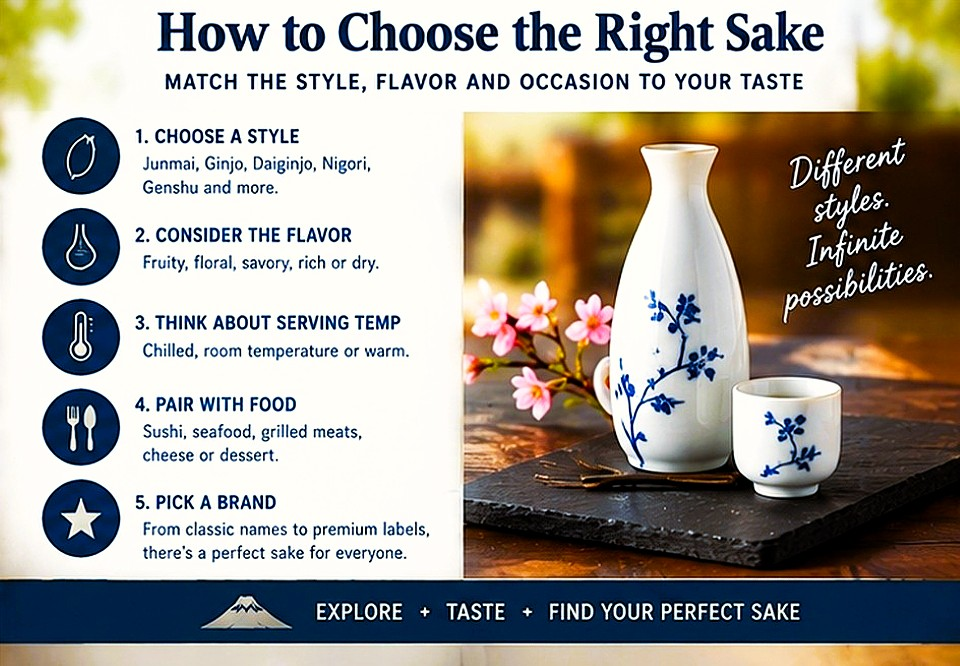
How to choose the right sake based on style, flavor, serving temperature, food pairing and occasion
Final Thoughts: The World’s Most Popular Sake Brands
Sake is one of the world’s most diverse alcoholic beverages.
It’s easy to look at a bottle of Japanese sake and think:
“It’s rice alcohol.” But that description misses almost everything interesting about it.
Sake is shaped by:
rice variety, rice polishing, koji, yeast, water, fermentation temperature, brewing technique, filtration, pasteurization, maturation, and serving temperature. That is why two bottles of sake can taste as different as Champagne and Shiraz.
At one end of the category are enormous producers such as:
Hakutsuru, Gekkeikan, Ozeki, Kiku-Masamune and Nihonsakari. These brands provide the scale, accessibility and distribution that keep sake firmly established as part of Japanese drinking culture.
Then there are the major premium names:
Dassai, Hakkaisan, Kubota, Kokuryu, Dewazakura, Masumi.
And then there are the highly sought-after bottles:
Juyondai, Born, IWA 5, Tatenokawa and other limited releases. The global market is also changing.
Japanese sake exports reached about ¥45.9 billion in 2025, while export volume reached approximately 33,549 kiloliters, demonstrating continued international demand.
Dassai’s export sales grew 40% in its latest reported fiscal year, while the brand continues to invest heavily in international expansion.
And the globalization of sake is no longer happening only through exports. American craft producers are now making sake themselves.
Brooklyn Kura’s export relationship with Hakkaisan shows that the relationship between Japan and international sake producers is becoming increasingly two-way. That could be the beginning of something much bigger.
Sake is following a path similar to wine and whisky:
traditional regional beverage → international curiosity → premiumization → global production → worldwide category.
For consumers, that’s excellent news. It means there are more bottles to discover than ever before. Start with something approachable.
Try:
Dassai
Then:
Hakkaisan
Then:
Kubota
After that, explore:
Suigei, Dewazakura, Masumi and Kokuryu.
Once you understand the basics, experiment with:
Junmai, Ginjo, Daiginjo, Nigori, Genshu and aged sake.
Try different serving temperatures. Try different foods. Try sake with sushi. Then try it with grilled meat. Try it with cheese. Try it with spicy food. You may discover that your favorite sake isn’t the most expensive bottle on the shelf.
Maybe you’ll love a crisp Kubota. Maybe a floral Dassai. Maybe a savory Junmai. Maybe a rich Nigori. Maybe you’ll fall in love with an aged sake that tastes nothing like the first bottle you ever tried. And that’s the beauty of sake.
There is no single definition of the perfect bottle. The best sake is the one that matches:
your palate, your meal, your occasion and your budget.
As Japanese sake continues to expand around the world, the number of people asking that question is only going to increase.
For anyone who enjoys exploring wine, whisky or other premium beverages, sake offers an entirely new world of aromas, textures and flavors.
And it is a world worth discovering.