
Blog
The World’s Most Premium Vodka Brands: 25 Luxury Bottles Worth Knowing

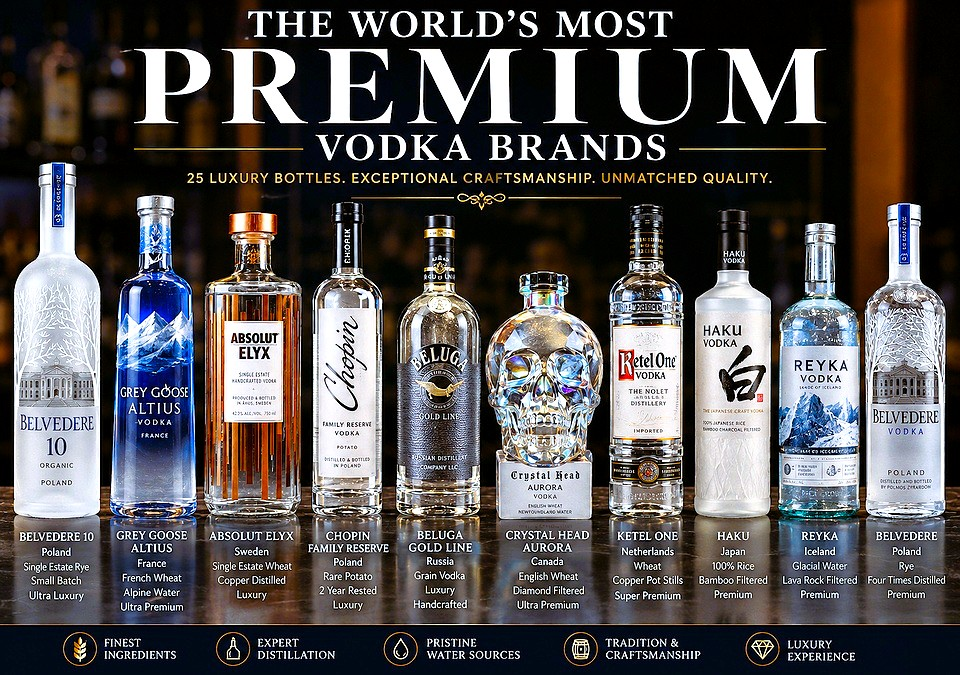
Discover the world’s most premium vodka brands, from Belvedere 10 and Grey Goose Altius to Absolut Elyx, Chopin Family Reserve, Haku, Crystal Head, Ketel One, Reyka and more. Learn what makes luxury vodka different, which bottles are best for sipping or Martinis, how premium vodka is made, and how to choose the right bottle.
Vodka has changed dramatically.
For much of its modern history, vodka was marketed around one central idea: purity and neutrality. The perfect vodka was supposed to be exceptionally clean, smooth and free of strong flavors.
Today’s premium vodka market tells a different story.
Luxury and super-premium producers increasingly emphasize origin, ingredients, distillation techniques, texture, craftsmanship, water source, unusual raw materials and distinctive bottles. IWSR’s research into vodka innovation identified provenance, sustainability, ingredients and premium launches as important forces reshaping the category.
That evolution has created an impressive range of luxury vodka.
You can now find:
- French wheat vodka
- Polish rye vodka
- Japanese rice vodka
- Icelandic vodka filtered through lava rock
- Canadian corn vodka
- English wheat vodka
- Swedish single-estate wheat vodka
- Small-batch potato vodka
- Grape-based vodka
- Single-field and single-harvest releases
And the definition of premium is changing too.
The latest IWSR analysis says the long-running premiumization trend has become more selective as consumers scrutinize expensive spirits more carefully. In 2025, global premium-plus spirits volume excluding national spirits declined 1%, but super-premium spirits in global travel retail grew 10%, illustrating that consumers can still be willing to pay more when the experience clearly justifies it.
That makes today’s premium-vodka category particularly interesting.
The most expensive vodka isn’t automatically the best vodka.
The best bottle for a Martini may not be the best bottle to drink neat. A spectacular presentation does not necessarily mean spectacular liquid. And a $50 bottle can sometimes be more interesting than a $200 bottle if its ingredients and production give it genuine character.
This guide explores 25 of the world’s most notable premium and luxury vodka brands and expressions, focusing on craftsmanship, provenance, style, drinking experience and cocktail potential.
Table of Contents
- What Makes a Vodka Premium?
- Premium vs. Super-Premium vs. Luxury Vodka
- The 25 Most Premium Vodka Brands
- Belvedere 10
- Grey Goose Altius
- Absolut Elyx
- Chopin Family Reserve
- Beluga Gold Line
- Crystal Head Aurora
- Ketel One
- Haku
- Reyka
- Belvedere
- Grey Goose
- Chopin
- Chase Vodka
- Black Cow Vodka
- Nikka Coffey Vodka
- X Muse
- Boatyard Vodka
- Stoli Elit
- Cîroc
- Mamont Vodka
- NEFT Vodka
- 42BELOW
- Wheatley Vodka
- Luxury Vodka by Style
- Best Premium Vodka for Martinis
- Best Premium Vodka for Sipping
- Best Premium Vodka for Cocktails
- Best Premium Vodka by Country
- How Vodka Ingredients Affect Taste
- How to Choose a Luxury Vodka
- Is Expensive Vodka Worth It?
- Current Premium Vodka Trends
- Frequently Asked Questions
- Final Thoughts
What Makes a Vodka Premium?
“Premium” isn’t simply a price tag.
A vodka can be premium because of:
Ingredients
The producer may use:
- Single-estate wheat
- Special rye
- Rare potatoes
- Japanese rice
- French grapes
- Heritage grains
Water
Water makes up a major portion of vodka.
Its mineral composition and treatment can affect the final texture.
Distillation
Different producers may use:
- Column stills
- Copper pot stills
- Hybrid systems
- Multiple distillations
- Single distillation
- Specialized stills
More distillation is not automatically better.
In some premium vodkas, the goal is actually to preserve more of the raw ingredient’s character.
Filtration
Premium producers may use:
- Activated carbon
- Quartz
- Bamboo charcoal
- Lava rock
- Other specialized filtration systems
Again, filtration should serve a purpose.
Texture
Texture is becoming increasingly important.
Instead of simply asking:
“How neutral is it?”
premium vodka enthusiasts increasingly ask:
“How does it feel?”
Does it feel:
- Creamy?
- Silky?
- Round?
- Crisp?
- Peppery?
- Soft?
- Mineral?
- Rich?
That is one reason provenance and production methods are becoming more important to premium vodka.
Premium vs. Super-Premium vs. Luxury Vodka
These categories aren’t universally standardized.
A retailer, producer or industry analyst may define them differently.
Generally:
Premium
A step above standard mainstream vodka, usually offering more attention to ingredients, production or brand positioning.
Super-Premium
Greater emphasis on craftsmanship, provenance and cocktail-bar positioning.
Luxury / Ultra-Premium
Often characterized by:
- Limited production
- Rare ingredients
- Extensive craftsmanship
- Distinctive packaging
- High price
- Prestige positioning
The category can overlap considerably.
For that reason, this article uses premium broadly to include notable super-premium and luxury expressions.
1. Belvedere 10
Country: Poland
Base: Rye
Position: Luxury
Belvedere 10 is one of the clearest examples of modern luxury vodka.
The expression is produced from a single annual harvest of organic Diamond Rye from one field, according to Belvedere, and is crafted in small batches. The brand says it undergoes four distillations and is then rested for 10 months to bring the flavors together.
The presentation is deliberately luxurious.
The current bottle is built around a ten-level design that references its ten-step production process.
Tasting profile
- Coconut
- Cacao
- Vanilla
- Fresh lemon
- Honeyed sweetness
- Caramel
- Green coffee
- Praline
Best way to drink it
Neat or over a large ice cube.
This is a bottle designed to be appreciated rather than buried under mixers.
Best occasion
- Luxury gifts
- Special dinners
- Collectors
- High-end celebrations
Why it stands out: Single-field rye + small-batch production + luxury presentation.
2. Grey Goose Altius
Country: France
Base: French wheat
Position: Ultra-Premium
Grey Goose Altius is a newer luxury extension of the Grey Goose range.
The official Grey Goose description says it combines soft winter wheat from Picardie with spring water from the French Alps, using a production approach intended to create an exceptionally smooth spirit with subtle mineral character. It is hand bottled and individually numbered in limited batches.
Flavor profile
Expect a profile focused on:
- Smoothness
- Soft grain
- Subtle minerality
- Clean texture
Best way to drink it
Chilled neat or in an ultra-simple Martini.
Best for
- Luxury gifts
- Collectors
- Special occasions
- Premium sipping
Why it stands out: French ingredients, Alpine water and limited luxury positioning.
3. Absolut Elyx
Country: Sweden
Base: Single-estate winter wheat
ABV: 42.3%
Absolut Elyx occupies the luxury end of the Absolut family.
According to the official Canadian Absolut site, every drop uses winter wheat from the Råbelöf estate in southern Sweden and is distilled using a manually operated vintage copper column still dating to 1921. The spirit is produced within a small geographic radius from seed to bottle.
Tasting profile
Official notes include:
- Fresh bread
- White chocolate
- Cereal
- Macadamia
- Creamed cereal
- Butter
- Gentle spice
Best way to drink it
Martini, neat or over ice.
Why it stands out
It’s an excellent example of how a global vodka brand can create a luxury expression around single-estate provenance and a distinctive distillation method.
4. Chopin Family Reserve
Country: Poland
Base: Potato
Chopin is one of the world’s most important premium vodka specialists.
The producer describes itself as Poland’s last family-owned vodka maker and emphasizes ingredient-forward vodka rather than completely neutral vodka. Its collection includes potato, rye and wheat vodkas, while Family Reserve is made from a rare potato variety and rested for two years.
Flavor profile
Expect:
- Creamy texture
- Earthy potato
- Subtle sweetness
- Long finish
Best way to drink it
Neat, lightly chilled or with food.
Why it stands out
Chopin is important because it challenges the idea that vodka should be completely odorless and tasteless.
5. Beluga Gold Line
Country: Russia / international luxury brand
Base: Grain
Beluga Gold Line has long been associated with luxury vodka presentation.
Its hand-finished bottle, detailed label, cork and presentation packaging helped establish the expression as a high-end gift-oriented vodka.
Flavor profile
Typically associated with:
- Grain
- Soft sweetness
- Vanilla
- Light spice
Best way to drink it
Neat or chilled.
Best for
- Gifting
- Formal dinners
- Celebrations
- Collectors
Why it stands out: An expression where packaging, ritual and presentation are a major part of the luxury experience.
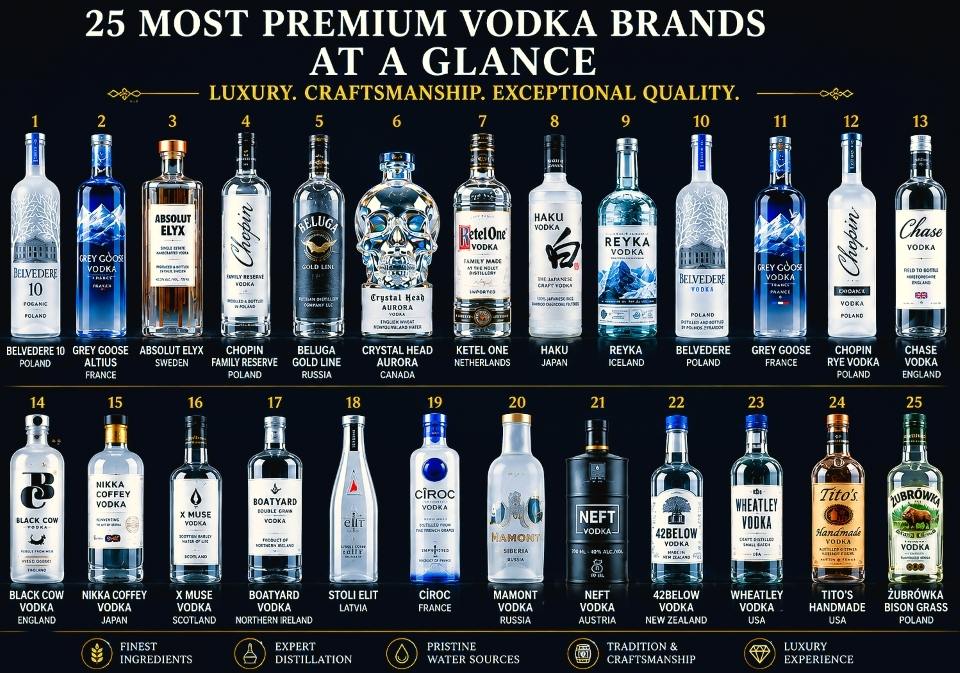
25 premium vodka brands including Belvedere 10, Grey Goose Altius, Absolut Elyx, Chopin, Beluga, Crystal Head, Ketel One and Haku
6. Crystal Head Aurora
Country: Canada
Base: English wheat
Crystal Head Aurora is the more distinctive sibling to the brand’s original corn-based vodka.
The official producer says Aurora is made from English wheat and Newfoundland water, distilled five times and filtered seven times, including filtration through layers of Herkimer diamonds. It is also additive-free according to the producer.
Tasting profile
The official notes describe:
- Floral aromas
- Anise
- Peppercorn
- Sweetness
- Dry finish
Best for
- Sipping
- Premium cocktails
- Gifts
- Collectors
Why it stands out
The combination of English wheat, Canadian water and the instantly recognizable skull bottle creates a distinctly Canadian premium-vodka identity.
7. Ketel One
Country: Netherlands
Position: Super-Premium
Ketel One may not be as expensive as some ultra-luxury bottles, but it is one of the most influential premium vodkas in cocktail culture.
The Nolet family traces its distilling heritage back eleven generations, and Ketel One was created in 1983. The producer emphasizes a combination of traditional copper pot stills and modern distillation techniques.
Its position among elite cocktail bars is particularly strong.
Drinks International’s 2026 Brands Report identified Ketel One as the most popular house pour, selected by 28% of the bars surveyed.
Best for
- Martini
- Vodka Soda
- Bloody Mary
- Espresso Martini
- Gimlet
Why it stands out
Ketel One demonstrates that premium vodka isn’t necessarily about extreme rarity.
Sometimes it’s about consistent quality and exceptional performance behind the bar.
8. Haku
Country: Japan
Base: 100% Japanese white rice
Haku is one of the most interesting premium vodkas in the category.
The House of Suntory says Haku is distilled from 100% Japanese white rice and filtered through bamboo charcoal. The result is designed to be soft, silky and subtly sweet.
The producer’s tasting notes emphasize:
- Rice sweetness
- Floral aromas
- Rich mouthfeel
- Silky finish
Haku also received a gold medal at the 2024 International Spirits Competition, according to Suntory’s product page.
Best for
- Japanese-style highballs
- Martini
- Vodka Soda
- Minimalist cocktails
Why it stands out
Haku is an outstanding example of ingredient-driven premium vodka.
9. Reyka
Country: Iceland
Reyka takes one of the most distinctive approaches to vodka production.
The brand says its water comes from a glacial spring flowing through a 4,000-year-old lava field, while the vodka is distilled in Carter-Head stills and filtered through Icelandic lava rock.
Flavor profile
Expect:
- Crisp texture
- Clean spirit
- Subtle mineral character
Best for
- Vodka Soda
- Martini
- Chilled sipping
Why it stands out
Reyka demonstrates how place can become a central part of premium-vodka identity.
10. Belvedere
Country: Poland
Base: Rye
The standard Belvedere expression is one of the best-known luxury-positioned vodkas in the world.
Unlike some ultra-expensive limited releases, Belvedere occupies an accessible premium tier while retaining strong luxury recognition.
The brand’s modern portfolio also includes Belvedere Organic Vodka and Belvedere 10. Its official information emphasizes Polish rye, production expertise and a long vodka-making tradition.
Best for
- Martinis
- Vodka Sodas
- Premium cocktails
- Neat drinking
Why it stands out
A strong combination of Polish rye identity, premium reputation and global recognition.
11. Grey Goose
Country: France
Base: French winter wheat
Grey Goose is one of the defining luxury-vodka brands of the modern era.
The official Canadian site says it uses soft winter wheat from Picardie and spring water from Gensac in the Cognac region. The producer describes its profile as delicate and floral on the nose, sweet and round on the palate, and bold and toffee-like on the finish.
Grey Goose is also exceptionally strong in cocktail culture.
Drinks International’s 2026 Brands Report ranked it as the best-selling vodka in the world’s best bars.
Best for
- Martini
- Vodka Soda
- Cosmopolitan
- French Martini
Why it stands out
Grey Goose is a rare example of a vodka that combines mainstream global recognition with elite cocktail-bar credibility.
12. Chopin Vodka
Country: Poland
Chopin deserves a separate entry from Family Reserve because the standard collection is particularly interesting for consumers who want to compare vodka ingredients.
The company produces single-ingredient expressions from:
- Potato
- Rye
- Wheat
and actively encourages drinkers to taste them comparatively.
Best way to explore it
Buy:
Chopin Potato + Chopin Rye + Chopin Wheat
and taste them side by side.
That is one of the best ways to learn how raw materials affect vodka.
13. Chase Vodka
Country: England
Base: Potato
Chase helped establish a modern British craft-vodka identity by putting the agricultural ingredient front and center.
Potato vodka can offer a fuller, slightly creamier texture than extremely neutral grain vodka.
Best for
- Sipping
- Martinis
- Food pairing
- Craft cocktails
Why it stands out
Chase is a strong option for buyers interested in farm-to-bottle British spirits.
14. Black Cow Vodka
Country: England
Base: Whey
Black Cow may have one of the most unusual production stories in the premium-vodka category.
The vodka is made using milk whey, turning a by-product of cheesemaking into a spirit.
Flavor profile
The resulting vodka is generally presented as:
- Creamy
- Soft
- Smooth
- Slightly sweet
Best for
- Martinis
- Neat sipping
- Dessert cocktails
Why it stands out
It demonstrates that modern premium vodka doesn’t necessarily start with grain or potatoes.
15. Nikka Coffey Vodka
Country: Japan
Nikka is primarily famous for whisky, but its Coffey Vodka illustrates how Japanese distilling expertise can extend into vodka.
It uses the Coffey still technology associated with Nikka’s whisky production and provides a softer, more textural alternative to completely neutral vodka.
Best for
- Martini
- Sipping
- Japanese-inspired cocktails
Why it stands out
It is an excellent choice for drinkers who want a vodka with a connection to Japanese whisky craftsmanship.
Drinks International included Nikka Coffey in its 2026 best-bars vodka ranking.
16. X Muse Vodka
Country: Scotland
Base: Scottish barley
X Muse is an interesting example of the premium-vodka industry’s growing focus on grain provenance.
IWSR highlighted X Muse as a vodka brand using Scottish barley varieties to create a spirit with more identifiable character rather than presenting vodka simply as a neutral alcohol.
Best for
- Neat sipping
- Martinis
- Experimental cocktails
Why it stands out
Scottish provenance without being whisky.
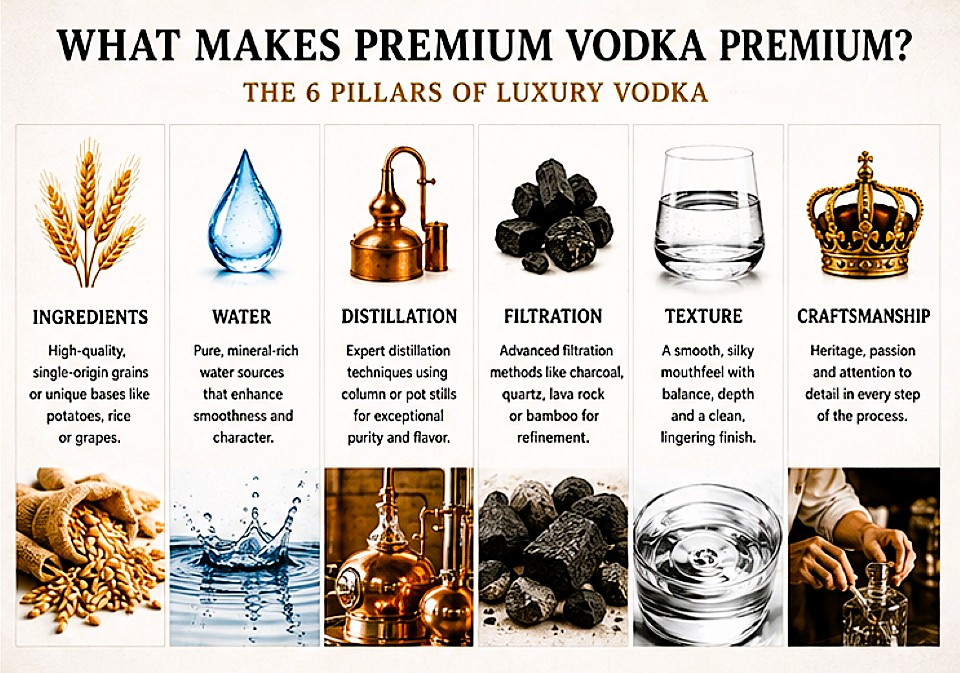
What makes premium vodka different including ingredients, water, distillation, filtration, texture and craftsmanship
17. Boatyard Vodka
Country: Northern Ireland
Base: Wheat
Boatyard is another important grain-to-glass premium vodka.
IWSR highlighted the brand because it traces the wheat used for its vodka to a specific farmer and field, illustrating the broader movement toward agricultural transparency and provenance in premium vodka.
Best for
- Martinis
- Neat sipping
- Premium cocktails
Why it stands out
The brand focuses on traceability, something increasingly important in premium spirits.
18. Stoli Elit
Country: Latvia / Stoli heritage
Stoli Elit occupies a higher tier than standard Stoli and has long been positioned toward premium vodka drinkers.
Best for
- Martinis
- Vodka Tonic
- Neat drinking
Why it stands out
Stoli has one of the longest-running international reputations in premium vodka and remains relevant in classic cocktail culture.
19. Cîroc
Country: France
Base: Grapes
Cîroc is different from most traditional vodkas because it is made from French grapes rather than grain or potatoes.
That distinction helped make it one of the most recognizable contemporary premium vodka brands.
Flavor profile
Typically:
- Soft
- Light
- Fruity
- Smooth
Best for
- Fruit cocktails
- Martinis
- Contemporary mixed drinks
Why it stands out
Cîroc is one of the strongest examples of alternative raw materials + luxury lifestyle branding.
Its global sales performance has weakened recently, however, making it a useful reminder that premium positioning alone doesn’t guarantee long-term category momentum. The Spirits Business reported a 64.7% decline in Cîroc’s global volume in 2025.
20. Mamont Vodka
Country: Russia
Position: Premium
Mamont is especially recognizable for its distinctive mammoth-tusk-inspired bottle design.
The brand’s identity centers on Siberian provenance and a luxury interpretation of Russian vodka.
Best for
- Chilled sipping
- Premium gifting
- Contemporary cocktails
Why it stands out
The packaging creates an unusually strong connection between geography, history and luxury presentation.
21. NEFT Vodka
Country: Austria / Europe
NEFT is one of the more unusual premium-vodka brands because of its distinctive cylindrical packaging and adventure-oriented branding.
Best for
- Outdoor entertaining
- Chilled sipping
- Contemporary cocktails
Why it stands out
NEFT illustrates how premium vodka brands increasingly sell an experience and lifestyle, not just liquid.
22. 42BELOW
Country: New Zealand
42BELOW helped establish New Zealand vodka as an internationally recognizable premium category.
It is associated with New Zealand wheat and a clean, modern profile.
Best for
- Vodka Soda
- Martinis
- Highballs
Why it stands out
A strong example of how premium vodka can use country-of-origin storytelling to distinguish itself.
23. Wheatley Vodka
Country: United States
Wheatley is a craft-oriented American vodka that offers another perspective on the country’s increasingly diverse premium-spirits landscape.
Best for
- Martinis
- Vodka Soda
- Contemporary cocktails
Why it stands out
It gives drinkers an accessible route into American craft vodka without jumping immediately to ultra-luxury pricing.
24. Chopin Rye Organic Vodka
Country: Poland
Chopin’s organic rye expression is particularly interesting for drinkers exploring the relationship between organic agriculture and premium vodka.
The brand’s overall philosophy is explicitly ingredient-forward, and its portfolio demonstrates how much the base ingredient can affect vodka’s personality.
Best for
- Martinis
- Neat tasting
- Food pairing
Why it stands out
It combines Polish rye tradition with contemporary organic production.
25. Crystal Head Original
Country: Canada
Base: Canadian corn
Crystal Head Original is produced from locally sourced Canadian corn.
The brand says it is distilled four times, blended with Newfoundland water and filtered seven times, including three filtration stages through Herkimer diamonds.
Flavor profile
Official notes include:
- Neutral grain
- Citrus
- Vanilla
- Sweetness
- Creamy finish
Best for
- Sipping
- Martinis
- Premium cocktails
- Gifts
Why it stands out
The skull-shaped bottle is one of the most recognizable packages in spirits, making Crystal Head particularly effective as a gift.
Premium Vodka by Style
One of the easiest ways to choose a luxury vodka is to stop thinking about brand prestige and start thinking about what kind of vodka you enjoy.
Best wheat vodkas
Try:
- Grey Goose
- Absolut Elyx
- Crystal Head Aurora
- Boatyard
These often lean toward smooth, soft and clean profiles.
Best rye vodkas
Try:
- Belvedere
- Chopin Rye
- Belvedere 10
- Polish premium rye expressions
Rye can provide more grain character and spice.
Best potato vodkas
Try:
- Chopin Potato
- Chopin Family Reserve
- Chase
Potato vodka can offer a richer texture.
Best rice vodka
Haku
A particularly good choice for drinkers interested in soft, subtly sweet texture.
Best grape vodka
Cîroc
Excellent for consumers curious about a non-grain approach.
Most unusual filtration
Haku — bamboo charcoal.
Crystal Head — Herkimer diamond filtration.
Reyka — lava rock.
Best Premium Vodka for Martinis
A Martini is one of the best tests of premium vodka.
Why?
Because there are relatively few ingredients.
The vodka cannot hide.
My strongest choices
Ketel One
Grey Goose
Belvedere
Haku
Absolut Elyx
Crystal Head Aurora
For a classic Martini, I’d prioritize texture and finish over flashy packaging.
Best Premium Vodka for Sipping
For drinking neat, choose vodkas with distinctive texture or ingredient character.
Top choices
Belvedere 10
Chopin Family Reserve
Absolut Elyx
Grey Goose Altius
Haku
Crystal Head Aurora
These are especially interesting because their producers emphasize craftsmanship and character.
Best Premium Vodka for Cocktails
Premium vodka can make sense in spirit-forward cocktails, but you don’t necessarily need a $200 bottle for every drink.
Martini
Ketel One / Grey Goose / Belvedere
Espresso Martini
Ketel One / Grey Goose / Haku
Bloody Mary
Tito’s / Ketel One / Absolut
Moscow Mule
Grey Goose / Ketel One / Absolut
Vodka Soda
Haku / Grey Goose / Ketel One
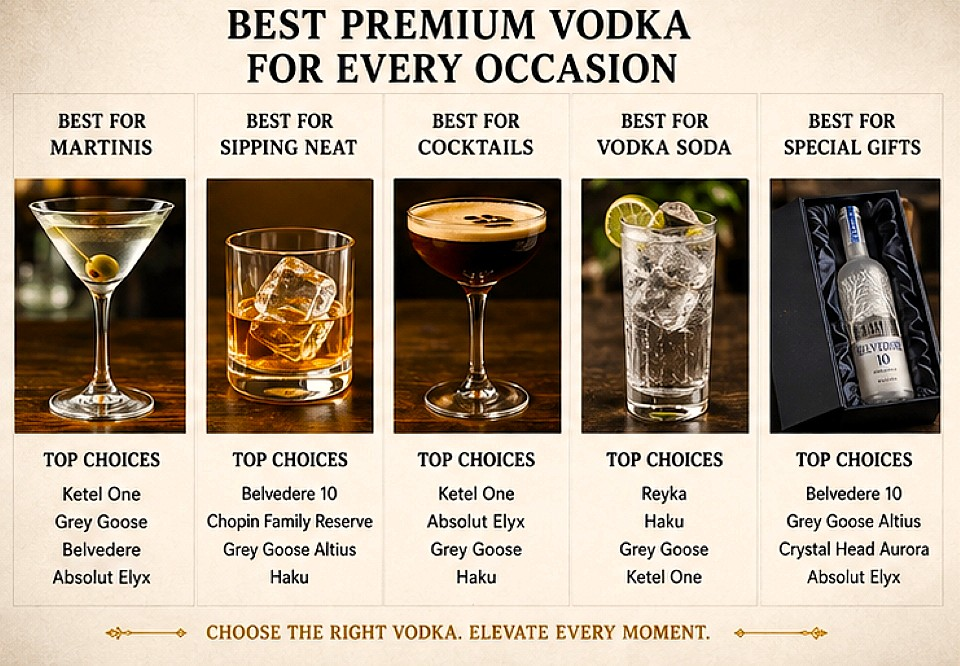
Best premium vodka brands for Martinis, sipping neat, cocktails, vodka soda and luxury gifts
Best Premium Vodka Brands by Country
Poland
Poland is one of the strongest premium-vodka countries.
Look for:
- Belvedere
- Belvedere 10
- Chopin
- Żubrówka
- Soplica
France
Look for:
- Grey Goose
- Grey Goose Altius
- Cîroc
Sweden
Look for:
- Absolut
- Absolut Elyx
Japan
Look for:
- Haku
- Nikka Coffey Vodka
Canada
Look for:
- Crystal Head
- Crystal Head Aurora
Iceland
Look for:
- Reyka
Netherlands
Look for:
- Ketel One
United Kingdom
Look for:
- Chase
- Black Cow
Ireland / Northern Ireland
Look for:
- Boatyard
United States
Look for:
- Tito’s
- Wheatley
- other craft American vodkas
What Makes a Luxury Vodka Worth the Money?
This is perhaps the most important question.
A $150 bottle should give you more than a beautiful bottle.
Look for genuine differentiation.
1. Provenance
Can the producer tell you:
where the grain came from?
where the water came from?
where the vodka was distilled?
2. Ingredient quality
Does the producer identify:
- Wheat
- Rye
- Potato
- Rice
- Grape
- Barley
3. Production transparency
Can you understand why the production method matters?
4. Texture
Can you actually taste or feel a difference?
5. Drinking occasion
Does the vodka make sense neat?
Or is it primarily designed for cocktails?
6. Packaging
Packaging is important—but it shouldn’t be the only reason you’re paying more.
Is Expensive Vodka Worth It?
Sometimes.
But not always.
IWSR’s current analysis of premiumization is particularly relevant here. Consumers are becoming more selective about spending on expensive drinks and increasingly want a clear reason to trade up.
That means the premium vodka market increasingly needs to answer:
What am I getting for the extra money?
If the answer is:
better ingredients + distinctive production + exceptional texture
the premium can make sense.
If the answer is simply:
a heavier bottle + fashionable packaging
you may be better off saving your money.
Why Provenance Matters More in Premium Vodka
For years, vodka brands often emphasized filtration and neutrality.
Now some premium producers are reversing the philosophy.
They are saying:
This is our wheat.
This is our rye.
This is our potato.
This is our rice.
This is our water.
Chopin explicitly argues that well-made vodka should be ingredient-forward and flavorful rather than simply odorless and tasteless.
IWSR has identified the same broader trend, highlighting brands such as X Muse, Boatyard and Tito’s for emphasizing where their ingredients originate and how their vodka is made.
That is one of the biggest changes happening in premium vodka.
The Rise of Japanese Premium Vodka
Haku and Nikka Coffey show how Japanese distilling culture can translate beyond whisky.
Haku starts with 100% Japanese white rice and uses bamboo charcoal filtration, creating a distinctly Japanese interpretation of premium vodka.
This is significant because it proves that premium vodka doesn’t have to imitate European traditions.
It can develop its own identity.
Luxury Vodka and the Cocktail Bar
There is an important difference between:
a luxury bottle
and
a bartender’s favorite bottle.
The latest Drinks International Brands Report makes that distinction particularly clear.
Grey Goose was the best-selling vodka in the world’s best bars, while Ketel One was the leading house pour in the 2026 survey. Belvedere remained among the strongest premium upsell choices, and Tito’s, Haku and other brands remained relevant to elite bars.
The methodology matters: Drinks International polls influential bars, asks them to use actual sales information for bestselling products, and separately asks about trending brands. (Drinks International methodology)
So when choosing a premium vodka, ask:
Do I want a collector’s bottle, a sipping vodka or a bartender’s workhorse?
Those are different jobs.
Best Premium Vodka for a Gift
Presentation matters more when you’re giving a bottle to someone else.
Best luxury gifts
Belvedere 10
Best for: luxury presentation.
Grey Goose Altius
Best for: ultra-premium French positioning.
Absolut Elyx
Best for: design-conscious drinkers.
Crystal Head Aurora
Best for: something memorable and visually distinctive.
Chopin Family Reserve
Best for: serious vodka enthusiasts.
How to Serve Premium Vodka
Neat
Serve chilled but not necessarily ice-cold.
Extremely low temperatures can suppress aroma and texture.
Over ice
Use one large cube.
This creates gradual chilling and dilution.
Martini
A dry Martini is excellent for premium vodka.
Use quality vermouth and avoid excessive dilution.
Vodka Soda
Use:
- Premium vodka
- Very cold soda
- Large ice
- Fresh citrus
The simpler the cocktail, the more important the underlying spirit becomes.
How to Store Luxury Vodka
Unlike wine, vodka generally does not require cellar aging after bottling.
Store it:
- Upright
- Cool
- Away from direct sunlight
- Away from major temperature swings
An unopened bottle can be kept for a very long time under appropriate conditions.
Once opened, the biggest concern is usually gradual changes from oxygen exposure and evaporation rather than rapid spoilage.
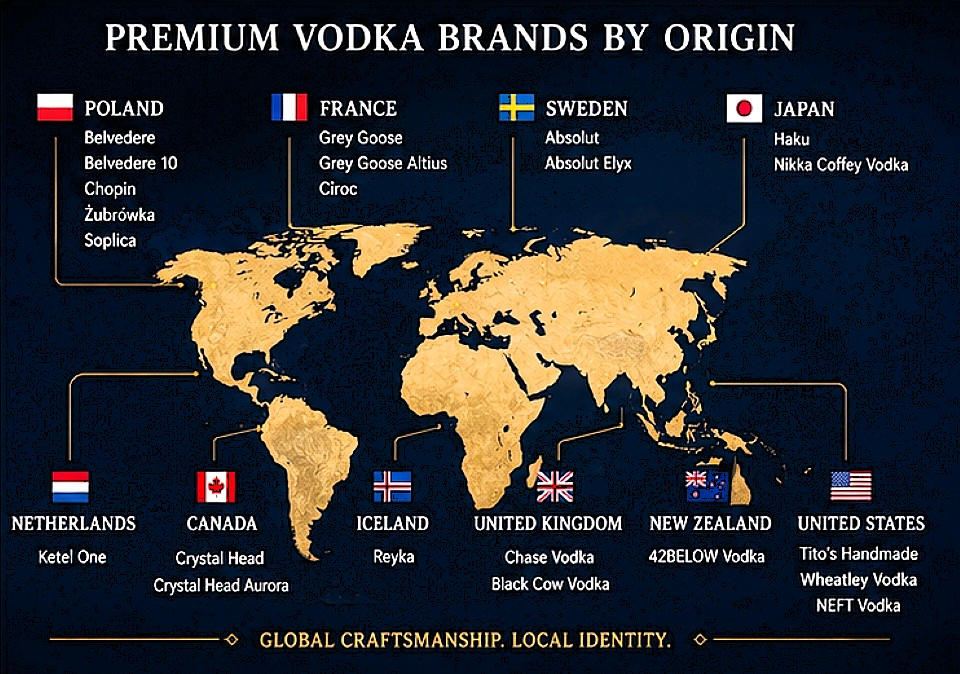
Premium vodka brands by country including Poland, France, Sweden, Japan, Canada, Iceland, the Netherlands, the United Kingdom and the United States
Current Premium Vodka Trends
The premium vodka market is entering a more selective phase.
The old message was:
“Premium means charge more.”
The new message is:
“Premium needs a reason.”
IWSR’s August 2026 analysis says consumers are scrutinizing expensive spirits more closely as inflation and cost-of-living pressures continue, while premiumization is becoming more about meaningful experiences than price alone.
Several trends stand out.
Provenance
Consumers increasingly want to know where their spirit comes from.
Ingredient identity
Rice, rye, wheat, potato and grapes can all create distinct vodka stories.
Craft production
Small batches and family ownership remain powerful premium signals.
Sustainability
IWSR identifies sustainability as one of the themes influencing vodka innovation.
Premium cocktails
Premium vodka continues to matter in top cocktail bars, even while consumers become more selective about expensive pours.
Competition from RTDs
Ready-to-drink beverages are putting pressure on traditional spirits occasions. IWSR reported RTD volumes grew 3% globally in 2025, while other major beverage-alcohol categories declined, and RTDs overtook vodka in global value during 2025.
This means premium vodka brands increasingly need to offer a distinctive story, experience and cocktail use case.
Frequently Asked Questions About Premium Vodka
What is the most premium vodka in the world?
There is no universally accepted number-one luxury vodka. Belvedere 10, Grey Goose Altius and Absolut Elyx are among the clearest examples of ultra-premium vodka, while Chopin Family Reserve and Haku offer distinctive ingredient-driven alternatives.
What is the most expensive vodka brand?
Prices vary substantially by market, bottle size, limited edition and retailer. A high retail price does not automatically indicate better vodka.
Is Belvedere better than Grey Goose?
That’s a matter of taste. Belvedere emphasizes Polish rye, while Grey Goose emphasizes French wheat and water. Both occupy important premium positions, and Grey Goose currently ranks particularly strongly in leading cocktail bars.
Is Haku a premium vodka?
Yes. Haku is positioned as a premium Japanese craft vodka made from 100% Japanese white rice and filtered through bamboo charcoal.
What is the best luxury vodka for a Martini?
Grey Goose, Ketel One, Belvedere, Haku and Absolut Elyx are all strong choices.
What is the best vodka to drink neat?
For sipping, consider Belvedere 10, Chopin Family Reserve, Grey Goose Altius, Haku or Absolut Elyx.
What is the smoothest premium vodka?
“Smooth” is subjective, but Grey Goose, Haku, Ketel One and Absolut Elyx are all designed around soft, polished textures.
What is the best Polish luxury vodka?
Belvedere 10 is one of the clearest luxury choices, while Chopin Family Reserve is particularly interesting for drinkers who want an ingredient-focused potato vodka.
What is the best Japanese vodka?
Haku is the most internationally recognized premium Japanese vodka, while Nikka Coffey Vodka provides a fascinating alternative connected to Nikka’s distilling expertise.
What is the best Canadian premium vodka?
Crystal Head and Crystal Head Aurora are two of Canada’s most recognizable premium vodka expressions.
What is the best vodka for cocktails?
For classic cocktails, Ketel One, Grey Goose, Belvedere, Absolut and Haku are strong choices. Drinks International’s 2026 report shows how strongly Grey Goose and Ketel One perform in elite bar environments.
Is premium vodka actually different?
It can be. Premium producers increasingly differentiate through ingredients, water, distillation, filtration and texture rather than simply trying to make vodka more neutral.
Does more distillation mean better vodka?
Not necessarily. Multiple distillations can increase purity, but some premium producers deliberately emphasize ingredient character and texture. The best production method is the one that achieves the producer’s intended style.
Does vodka made from potatoes taste different?
It can have a fuller and creamier texture than very neutral grain vodka. Chopin is one of the best-known premium examples.
Is Japanese rice vodka good?
Yes. Haku demonstrates how Japanese rice and bamboo-charcoal filtration can create a soft, subtly sweet premium vodka.
Why is Grey Goose so popular?
Its French provenance, premium positioning and global distribution have made it one of the world’s most recognizable luxury vodkas. It also remains the bestselling vodka in Drinks International’s 2026 world’s-best-bars survey.
Why is Ketel One popular with bartenders?
Ketel One combines premium positioning with a style designed for cocktails, and Drinks International’s 2026 survey identified it as the most popular house pour among its participating bars.
Final Thoughts: The World’s Most Premium Vodka Brands
The world of premium vodka has become far more interesting than the old idea of an entirely neutral spirit.
Today, luxury vodka can mean:
single-estate Swedish wheat
Polish rye from one field
rare potatoes
Japanese white rice
French wheat
English wheat
Newfoundland water
Icelandic lava-rock filtration
or even
grape-based distillation.
The biggest lesson is that premium vodka doesn’t have one universal flavor profile.
Some are crisp and clean.
Some are creamy.
Some are subtly sweet.
Some show grain character.
Some are floral.
Some are almost completely neutral.
And some are deliberately unusual.
Among the luxury category’s leading names, Belvedere 10 is particularly compelling for collectors and serious sippers. Grey Goose Altius represents ultra-premium French luxury. Absolut Elyx emphasizes single-estate Swedish wheat and copper craftsmanship. Chopin Family Reserve proves the potential of potato vodka. Haku offers a genuinely Japanese interpretation of premium vodka. And Crystal Head Aurora demonstrates how Canadian vodka can combine distinctive ingredients, filtration and iconic design.
For cocktails, the picture is slightly different.
Grey Goose and Ketel One are especially strong in leading cocktail bars, with Grey Goose topping the 2026 best-selling vodka ranking and Ketel One leading the house-pour category.
And that’s an important distinction.
The world’s most luxurious vodka isn’t necessarily the world’s best cocktail vodka.
Sometimes the best Martini is made with a bartender’s dependable premium bottle rather than the rarest collector’s expression.
For sipping, however, premiumization becomes more meaningful because you can experience the spirit’s texture and subtle flavors directly.
The current market suggests that consumers are increasingly asking the right question:
“Why is this bottle worth more?”
The strongest brands have a convincing answer.
Maybe it’s a single field.
Maybe it’s unusual grain.
Maybe it’s Japanese rice.
Maybe it’s a family tradition.
Maybe it’s a unique still.
Maybe it’s a remarkable water source.
Maybe it’s simply exceptional consistency in the world’s best bars.
But there should be a reason.
That is what makes today’s premium vodka category worth exploring.
You don’t need twenty-five bottles.
Start with three.
Choose one premium wheat vodka, one rye or potato vodka, and one rice or alternative-base vodka.
Taste them side by side.
Try each neat.
Then make the same Martini with each.
The differences may surprise you.
And once you understand what you personally enjoy—silky, creamy, crisp, spicy, floral, neutral or characterful—choosing your next luxury bottle becomes much easier.
The best premium vodka isn’t necessarily the most expensive one.
It is the one whose ingredients, craftsmanship, texture and story make the extra cost meaningful to you.