
Blog
World’s Most Popular Red Wine Varieties: The Ultimate Guide to 25 Famous Red Wines

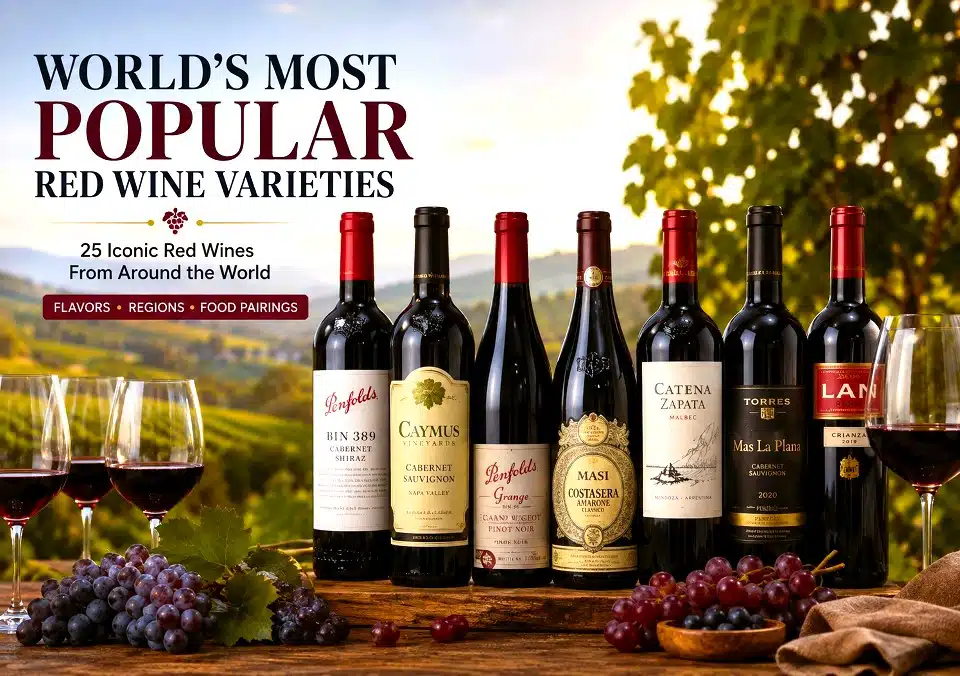
Discover the Most Popular Red Wine Varieties From Around the World
Red wine is one of the world’s most celebrated beverages, with thousands of grape varieties grown across famous wine regions in Europe, North America, South America, Australia, New Zealand, and beyond. From the bold and powerful Cabernet Sauvignon of Bordeaux and Napa Valley to the elegant Pinot Noir of Burgundy, every red wine variety offers its own combination of aroma, flavour, acidity, tannin, body, and character.
But what are the most popular red wine varieties in the world?
The answer depends on where you live, what you enjoy drinking, and how you define popularity. Some grapes are grown on enormous areas of vineyard land, while others are internationally famous because of their historic importance, premium reputation, or popularity among wine lovers.
In this guide, we explore 25 of the world’s most popular red wine varieties, including their flavour profiles, famous growing regions, food pairings, and ideal occasions.
Whether you’re a beginner learning about red wine or an experienced wine enthusiast looking for your next bottle, this guide will help you understand the world’s most important red grape varieties.
What Is a Red Wine Variety?
A red wine variety is a type of wine grape used to produce red wine. The grape’s genetics, growing environment, winemaking technique, and aging process all influence the final wine.
Some varieties naturally produce wines that are:
-
-
- Full-bodied and powerful
- Light and delicate
- Fruity and easy-drinking
- Dry and tannic
- Spicy and complex
- Earthy and savory
- Rich and concentrated
-
The same grape can also taste very different depending on where it is grown.
For example, Cabernet Sauvignon grown in Napa Valley can have a different flavour profile from Cabernet Sauvignon produced in Bordeaux, Australia, Chile, or Washington State.
This is one of the reasons wine is so fascinating.
The 25 Most Popular Red Wine Varieties in the World
-
Cabernet Sauvignon
Cabernet Sauvignon is arguably the world’s most famous red wine grape and one of the most widely recognized varieties among wine drinkers.
It is particularly famous in Bordeaux, France, where it plays an important role in many prestigious red blends. It is also exceptionally successful in Napa Valley, California, as well as Chile, Australia, Washington State, South Africa, and other wine-producing regions.
Cabernet Sauvignon generally produces full-bodied wines with firm tannins, noticeable acidity, dark fruit flavours, and excellent aging potential.
Typical Cabernet Sauvignon Flavours
-
-
- Blackcurrant
- Blackberry
- Black cherry
- Plum
- Cedar
- Tobacco
- Dark chocolate
- Herbs
- Vanilla when oak-aged
-
Young Cabernet Sauvignon can be powerful and structured, while mature examples may develop complex aromas of tobacco, leather, cedar, earth, and dried fruit.
Best Food Pairings
Cabernet Sauvignon pairs particularly well with:
-
-
- Steak
- Prime rib
- Roast beef
- Lamb
- Burgers
- Grilled meats
- Aged cheddar
-
Best for: Steak dinners, celebrations, cellar-worthy bottles, and hearty meals.
-
Pinot Noir
Pinot Noir is one of the world’s most beloved red wine varieties and is famous for producing elegant, aromatic wines with relatively light to medium body.
The grape is strongly associated with Burgundy, France, but it is now grown successfully in Oregon, California, New Zealand, Australia, Germany, and other cool-climate regions.
Pinot Noir is generally less tannic than Cabernet Sauvignon, making it approachable for people who prefer softer, more delicate red wines.
Typical Pinot Noir Flavours
-
-
- Cherry
- Raspberry
- Strawberry
- Cranberry
- Plum
- Violet
- Mushroom
- Forest floor
- Spice
-
Premium Pinot Noir can develop remarkable complexity with age.
Best Food Pairings
Try Pinot Noir with:
-
-
- Roast chicken
- Duck
- Salmon
- Mushroom dishes
- Pork
- Turkey
- Soft cheeses
-
Best for: Elegant dinners, lighter meats, seafood, and wine lovers who enjoy refined reds.
-
Merlot
Merlot is one of the world’s most popular red wine grapes and is particularly important in Bordeaux, where it is frequently blended with Cabernet Sauvignon and other varieties.
Merlot tends to be softer, rounder, and more approachable than Cabernet Sauvignon, with generous fruit flavours and moderate tannins.
Typical Merlot Flavours
-
-
- Plum
- Black cherry
- Blackberry
- Blueberry
- Chocolate
- Vanilla
- Mocha
- Herbs
-
Merlot can range from inexpensive everyday wines to some of the world’s most prestigious and expensive bottles.
Best Food Pairings
Merlot works well with:
-
-
- Roast beef
- Pork
- Chicken
- Burgers
- Pasta
- Pizza
- Mild cheeses
-
Best for: Everyday drinking, dinner parties, and people looking for a smooth, fruit-forward red.
-
Syrah / Shiraz
Syrah and Shiraz are names for the same grape variety, although the wines can have noticeably different styles depending on where the grapes are grown.
Syrah is strongly associated with the Rhône Valley in France, while Australia is famous for its Shiraz.
French Syrah often emphasizes pepper, herbs, dark fruit, and savory characteristics. Australian Shiraz can be richer, riper, and more powerful.
Typical Flavours
-
-
- Blackberry
- Blueberry
- Black plum
- Black pepper
- Spice
- Olive
- Smoke
- Chocolate
-
Best Food Pairings
-
-
- Grilled steak
- Lamb
- BBQ ribs
- Sausages
- Spicy foods
- Roasted vegetables
-
Best for: BBQs, grilled meats, rich dishes, and bold red wine enthusiasts.
-
Malbec
Malbec has French origins but became internationally famous through Argentina, particularly the high-altitude vineyards of Mendoza.
Argentine Malbec is known for its deep colour, ripe fruit flavours, smooth texture, and approachable tannins.
Typical Malbec Flavours
-
-
- Blackberry
- Plum
- Black cherry
- Blueberry
- Cocoa
- Violet
- Vanilla
- Spice
-
Malbec is particularly popular with steak lovers.
Best Food Pairings
-
-
- Argentine steak
- Grilled beef
- Burgers
- BBQ
- Sausages
- Roasted vegetables
-
Best for: Steak dinners, BBQs, and full-flavoured meals.
-
Zinfandel
Zinfandel is strongly associated with California, although DNA research has established its relationship to Croatian and European grape varieties.
California Zinfandel can range from relatively light and fruity to powerful, jammy, and high in alcohol.
Typical Flavours
-
-
- Blackberry
- Raspberry
- Strawberry
- Plum
- Black pepper
- Jam
- Spice
-
Old-vine Zinfandel can produce particularly concentrated and complex wines.
Best Food Pairings
-
-
- BBQ
- Burgers
- Pizza
- Ribs
- Spicy sausage
- Pulled pork
-
Best for: Backyard BBQs and casual entertaining.
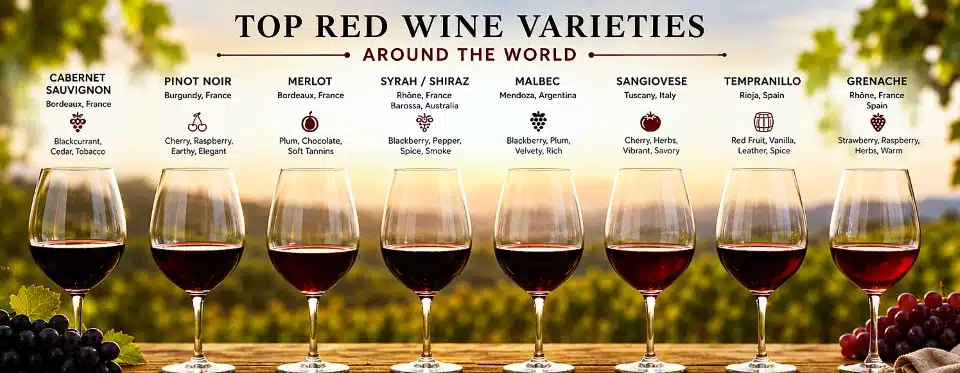
Top red wine varieties from around the world including Cabernet Sauvignon, Pinot Noir, Merlot, Syrah, Malbec and Sangiovese
-
Sangiovese
Sangiovese is Italy’s signature red grape and the foundation of some of Tuscany’s most famous wines.
It is the primary grape in Chianti and plays an important role in Brunello di Montalcino, where the local clone is known as Sangiovese Grosso.
Sangiovese typically has vibrant acidity and noticeable tannins, making it an excellent food wine.
Typical Flavours
-
-
- Sour cherry
- Red plum
- Raspberry
- Herbs
- Violet
- Earth
- Tobacco
- Spice
-
Best Food Pairings
Sangiovese is excellent with:
-
-
- Pizza
- Pasta with tomato sauce
- Lasagna
- Roast meats
- Italian sausages
- Aged cheese
-
Best for: Italian food and tomato-based dishes.
-
Tempranillo
Tempranillo is Spain’s most important red wine grape and is strongly associated with Rioja and Ribera del Duero.
Its character can range from fresh and fruity to deeply complex and oak-aged. Traditional Rioja wines may develop flavours of leather, vanilla, tobacco, dried fruit, and spice after extended aging.
Typical Flavours
-
-
- Cherry
- Plum
- Strawberry
- Fig
- Leather
- Tobacco
- Vanilla
- Coconut
- Spice
-
Best Food Pairings
-
-
- Lamb
- Roast pork
- Spanish tapas
- Chorizo
- Grilled meats
- Manchego cheese
-
Best for: Spanish cuisine, roasted meats, and aged cheeses.
-
Nebbiolo
Nebbiolo is one of Italy’s most prestigious red grape varieties and is responsible for the famous wines of Barolo and Barbaresco in Piedmont.
Despite its relatively pale colour, Nebbiolo can produce exceptionally structured, aromatic wines with high acidity and substantial tannins.
Typical Flavours
-
-
- Red cherry
- Raspberry
- Rose
- Violet
- Tar
- Leather
- Herbs
- Earth
-
Nebbiolo is particularly famous for its ability to develop complexity with bottle age.
Best Food Pairings
-
-
- Truffles
- Braised beef
- Osso buco
- Mushroom dishes
- Aged cheese
-
Best for: Serious wine lovers and sophisticated Italian dinners.
-
Grenache / Garnacha
Grenache, known as Garnacha in Spain, is an important grape in southern France and Spain. It often produces generous, fruit-driven wines with relatively high alcohol and soft tannins. Grenache is also an important component of many Rhône blends and Spanish wines.
Typical Flavours
-
-
- Strawberry
- Raspberry
- Cherry
- Plum
- Black pepper
- Spice
- Herbs
-
Best Food Pairings
-
-
- Roast lamb
- Grilled pork
- Mediterranean dishes
- Paella
- Tapas
- BBQ
-
Best for: Mediterranean food and relaxed entertaining.
-
Cabernet Franc
Cabernet Franc is one of the world’s classic red varieties and is particularly important in France’s Loire Valley and Bordeaux. It is generally lighter and more aromatic than Cabernet Sauvignon.
Typical Flavours
-
-
- Raspberry
- Red cherry
- Blackberry
- Violet
- Green herbs
- Pepper
- Tobacco
-
Cabernet Franc can be elegant, fresh, and highly food-friendly.
Best Food Pairings
-
-
- Roast chicken
- Lamb
- Pork
- Grilled vegetables
- Charcuterie
-
-
Barbera
Barbera is one of Italy’s most widely planted red grapes and is especially associated with Piedmont. It is notable for high acidity and relatively low tannins, creating lively wines that are extremely versatile with food.
Typical Flavours
-
-
- Sour cherry
- Red berries
- Plum
- Blackberry
- Herbs
- Spice
-
Best Food Pairings
Barbera is excellent with:
-
-
- Pizza
- Pasta
- Tomato sauces
- Salami
- Sausages
- Cheese
-
-
Gamay
Gamay is most famous for Beaujolais in France, particularly Beaujolais Nouveau and the region’s more serious Cru Beaujolais wines. Gamay is generally light-bodied, fresh, fruity, and low in tannins.
Typical Flavours
-
-
- Strawberry
- Raspberry
- Cherry
- Red plum
- Violet
- Banana in some young styles
-
Best Food Pairings
-
-
- Roast chicken
- Charcuterie
- Turkey
- Salads
- Soft cheeses
-
Best for: People who prefer fresh, light, fruit-forward red wines.
-
Mourvèdre / Monastrell
Mourvèdre is known as Monastrell in Spain and is an important variety in southern France and southeastern Spain. It produces dark, structured wines with savory and earthy character.
Typical Flavours
-
-
- Blackberry
- Plum
- Black cherry
- Pepper
- Herbs
- Leather
- Earth
- Game
-
It is often blended with Grenache and Syrah.
Best Food Pairings
-
-
- Lamb
- Beef
- Game
- BBQ
- Rich stews
-
-
Carmenère
Carmenère is strongly associated with Chile, where it has become an iconic national variety. The wines can be rich and dark while maintaining fresh herbal characteristics.
Typical Flavours
-
-
- Blackberry
- Black cherry
- Plum
- Bell pepper
- Herbs
- Spice
- Chocolate
-
Best Food Pairings
-
-
- Steak
- Grilled meats
- Beef stew
- Roasted vegetables
- Spicy dishes
-
-
Primitivo
Primitivo is an important Italian red grape from Puglia and is genetically related to California Zinfandel. It typically produces rich, ripe, fruit-forward wines.
Typical Flavours
-
-
- Blackberry
- Plum
- Black cherry
- Jam
- Chocolate
- Spice
- Vanilla
-
Best Food Pairings
-
-
- BBQ
- Pasta
- Pizza
- Beef
- Aged cheese
-
-
Touriga Nacional
Touriga Nacional is one of Portugal’s most important red grapes and is particularly famous in the Douro Valley. It is used in both dry red wines and Port.
Typical Flavours
-
-
- Blackberry
- Blueberry
- Black plum
- Violet
- Floral notes
- Spice
-
Best Food Pairings
-
-
- Roast beef
- Lamb
- Game
- Portuguese cuisine
- Strong cheeses
-
-
Pinotage
Pinotage is a uniquely South African grape created by crossing Pinot Noir and Cinsault. It has become an important part of South Africa’s wine identity.
Modern Pinotage can be fruit-forward and polished, although traditional examples may show distinctive smoky or earthy characteristics.
Typical Flavours
-
-
- Blackberry
- Plum
- Cherry
- Banana
- Smoke
- Coffee
- Chocolate
-
Best Food Pairings
-
-
- BBQ
- Grilled meats
- Sausages
- Burgers
- Spiced dishes
-
-
Petit Verdot
Petit Verdot is best known as a traditional blending grape in Bordeaux, where it contributes colour, tannin, structure, and spice. In warmer climates such as Australia, California, and parts of Spain, it is also made as a varietal wine.
Typical Flavours
-
-
- Blackberry
- Black plum
- Violet
- Blueberry
- Spice
- Dark chocolate
-
Petit Verdot is generally a powerful, structured wine that benefits from food.
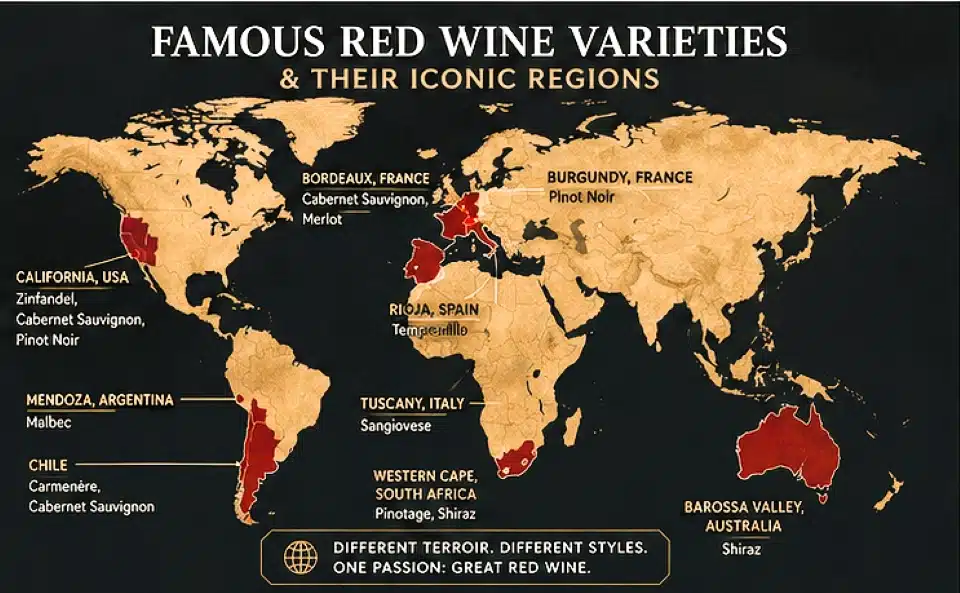
Famous red wine varieties from Bordeaux, Burgundy, Tuscany, Rioja, Mendoza, California and other major wine regions
-
Cinsault
Cinsault is an old Mediterranean grape variety used extensively in southern France and other warm wine regions. It often produces softer, fruit-forward wines and is frequently used in blends.
Typical Flavours
-
-
- Strawberry
- Raspberry
- Cherry
- Plum
- Floral notes
- Spice
-
Cinsault is particularly useful for people looking for softer, approachable red wines.
-
Aglianico
Aglianico is one of southern Italy’s most respected red grapes and is particularly associated with Campania and Basilicata. It can produce deeply coloured, structured wines with high acidity and tannins.
Typical Flavours
-
-
- Black cherry
- Plum
- Blackberry
- Violet
- Leather
- Earth
- Spice
-
Best Food Pairings
-
-
- Roast lamb
- Beef
- Game
- Pasta with rich sauces
- Aged cheeses
-
-
Corvina
Corvina is the principal grape associated with Valpolicella and plays an important role in Amarone della Valpolicella. It generally produces wines with bright acidity and red-fruit flavours.
Typical Flavours
-
-
- Cherry
- Sour cherry
- Red berries
- Plum
- Herbs
- Almond
- Spice
-
Best Food Pairings
-
-
- Pasta
- Pizza
- Roast meats
- Risotto
- Italian cheeses
-
Amarone, made using partially dried grapes, is significantly richer and more powerful than traditional Valpolicella.
-
Tannat
Tannat originated in southwestern France but has become especially famous in Uruguay. It is known for intense colour, substantial tannins, dark fruit, and strong structure.
Typical Flavours
-
-
- Blackberry
- Black plum
- Black cherry
- Chocolate
- Spice
- Leather
-
Best Food Pairings
-
-
- Steak
- Lamb
- BBQ
- Beef stew
- Hard cheeses
-
Tannat is an excellent choice for people who love bold, powerful red wines.
-
Petit Sirah
Petit Sirah, particularly associated with California, is a dark, robust red wine variety known for intense colour and firm tannins. Despite its name, it is not simply a smaller version of Syrah; the name is historically associated with Durif.
Typical Flavours
-
- Blackberry
- Blueberry
- Plum
- Black pepper
- Chocolate
- Spice
Best Food Pairings
-
-
- Steak
- Ribs
- Burgers
- Braised beef
- Strong cheeses
-
-
Zweigelt
Zweigelt is Austria’s most widely planted red grape variety. It is a crossing of Blaufränkisch and St. Laurent and generally produces fresh, fruit-driven wines with moderate tannins.
Typical Flavours
-
-
- Cherry
- Raspberry
- Red plum
- Spice
- Herbs
-
Best Food Pairings
-
-
- Pork
- Chicken
- Sausages
- Schnitzel
- Austrian cuisine
-
Red Wine Variety Comparison Chart
Understanding the differences between popular red wine varieties is much easier when they are compared side by side.
| Red Wine Variety | Body | Tannin | Acidity | Typical Flavours |
| Cabernet Sauvignon | Full | High | Medium-High | Blackcurrant, blackberry, cedar |
| Pinot Noir | Light-Medium | Low-Medium | High | Cherry, raspberry, earth |
| Merlot | Medium-Full | Medium | Medium | Plum, blackberry, chocolate |
| Syrah/Shiraz | Full | Medium-High | Medium | Blackberry, pepper, spice |
| Malbec | Medium-Full | Medium | Medium | Plum, blackberry, cocoa |
| Zinfandel | Medium-Full | Medium | Medium | Jam, blackberry, raspberry |
| Sangiovese | Medium | Medium-High | High | Cherry, herbs, earth |
| Tempranillo | Medium-Full | Medium | Medium | Cherry, plum, leather |
| Nebbiolo | Full | High | High | Cherry, rose, tar |
| Grenache | Medium-Full | Medium | Medium | Strawberry, raspberry, spice |
| Gamay | Light | Low | High | Strawberry, cherry, raspberry |
| Barbera | Medium | Low | High | Sour cherry, plum, spice |
| Aglianico | Full | High | High | Black cherry, leather, earth |
| Tannat | Full | Very High | Medium-High | Blackberry, plum, chocolate |
| Corvina | Light-Medium | Low-Medium | High | Cherry, red berries, herbs |
Which Red Wine Is the Most Popular?
There is no single answer because popularity can be measured in different ways.
Cabernet Sauvignon is widely regarded as one of the world’s most important and internationally recognized red wine varieties. Pinot Noir, Merlot, Syrah/Shiraz, and Malbec are also among the most popular choices internationally.
However, popularity varies significantly by country.
For example:
-
-
- France: Cabernet Sauvignon, Merlot, Pinot Noir, Syrah
- Italy: Sangiovese, Nebbiolo, Barbera, Montepulciano
- Spain: Tempranillo, Garnacha, Monastrell
- Argentina: Malbec
- Chile: Cabernet Sauvignon, Carmenère
- Australia: Shiraz, Cabernet Sauvignon
- United States: Cabernet Sauvignon, Pinot Noir, Zinfandel
- South Africa: Pinotage, Cabernet Sauvignon, Shiraz
- Portugal: Touriga Nacional and other indigenous varieties
-
This geographic diversity is one of the most exciting aspects of exploring red wine.
How to Choose the Best Red Wine Variety for Your Taste
If you’re new to red wine, start by thinking about the characteristics you already enjoy.
If You Like Smooth, Soft Red Wine
Try:
-
-
- Merlot
- Pinot Noir
- Grenache
- Cinsault
-
These varieties generally offer approachable textures and fruit-forward flavours.
If You Like Bold Red Wine
Try:
-
-
- Cabernet Sauvignon
- Syrah/Shiraz
- Malbec
- Tannat
- Petit Sirah
-
These wines typically have more body, tannin, and concentration.
If You Like Fruity Red Wine
Consider:
-
-
- Zinfandel
- Merlot
- Malbec
- Grenache
- Gamay
-
If You Like Earthy Red Wine
Try:
-
-
- Pinot Noir
- Nebbiolo
- Sangiovese
- Tempranillo
-
If You Like High-Acid Red Wine
Consider:
-
-
- Sangiovese
- Barbera
- Pinot Noir
- Nebbiolo
- Gamay
-
Best Red Wine Varieties for Beginners
People new to red wine often prefer varieties with moderate tannins and generous fruit flavours.
Good starting points include:
-
-
- Merlot: Smooth, fruity, and approachable.
- Pinot Noir: Light-bodied, aromatic, and elegant.
- Malbec: Rich, fruity, and easy to pair with grilled foods.
- Zinfandel: Fruit-forward and often generous in texture.
- Grenache: Soft, warm, and packed with red-fruit flavours.
-
Once you become comfortable with these styles, you can explore more structured varieties such as Cabernet Sauvignon, Nebbiolo, Aglianico, and Tannat.
Best Red Wine Varieties for Steak
Steak’s richness and protein work especially well with wines containing noticeable tannins.
The best choices include:
-
-
- Cabernet Sauvignon
- Malbec
- Syrah/Shiraz
- Tannat
- Petit Sirah
- Aglianico
- Tempranillo
-
The tannins help balance the richness of the meat, while the wine’s acidity keeps the pairing fresh.
Best Red Wine Varieties for Italian Food
For pasta, pizza, tomato sauces, and Italian cuisine, high-acid red varieties are particularly effective.
Top choices include:
-
-
- Sangiovese
- Barbera
- Nebbiolo
- Corvina
- Montepulciano
-
Sangiovese is especially well suited to tomato-based dishes because its acidity complements the acidity in the sauce.
Best Red Wine Varieties for BBQ
BBQ dishes generally benefit from wines with bold fruit and enough structure to stand up to smoky, grilled flavours.
Excellent choices include:
-
-
- Shiraz
- Zinfandel
- Malbec
- Cabernet Sauvignon
- Tannat
- Petit Sirah
-
For sweet and smoky BBQ sauces, fruit-forward wines can be particularly enjoyable.
Best Red Wine Varieties for Chicken
Red wine and chicken can be an excellent combination when the wine and preparation style are matched correctly.
For roast chicken, consider:
-
-
- Pinot Noir
- Gamay
- Merlot
- Grenache
-
For grilled or heavily seasoned chicken, try:
-
-
- Syrah
- Zinfandel
- Malbec
-
Best Red Wine Varieties for Cheese
Different cheeses call for different red wines.
-
-
- Soft Cheese; Try Pinot Noir or Gamay.
- Medium-Firm Cheese: Try Merlot or Sangiovese.
- Aged Cheese: Try Cabernet Sauvignon, Nebbiolo, or Syrah.
- Blue Cheese: Try fruit-forward reds such as Zinfandel or a rich, sweet-leaning red style.
-
Old World vs New World Red Wine
One of the easiest ways to understand global red wine is to compare Old World and New World styles.
Old World Wines
Old World generally refers to traditional European wine regions such as:
-
-
- France
- Italy
- Spain
- Portugal
- Germany
- Austria
-
These wines often emphasize acidity, structure, earthiness, herbs, and the influence of their vineyard location.
New World Wines
New World wine regions include:
-
-
- United States
- Canada
- Australia
- New Zealand
- Argentina
- Chile
- South Africa
-
These wines often emphasize ripe fruit, richness, and varietal character, although there is tremendous variation. These are broad generalizations, and modern winemaking has created significant overlap between the two styles.
What Does “Body” Mean in Red Wine?
Body refers to how heavy or substantial a wine feels in your mouth.
Light-Bodied
Examples:
-
-
- Pinot Noir
- Gamay
- Cinsault
-
Medium-Bodied
Examples:
-
-
- Merlot
- Sangiovese
- Grenache
-
Full-Bodied
Examples:
-
-
- Cabernet Sauvignon
- Syrah
- Malbec
- Tannat
- Aglianico
-
Body is influenced by alcohol, tannin, acidity, extraction, and winemaking techniques.
What Are Tannins?
Tannins are naturally occurring compounds found in grape skins, seeds, stems, and oak. They create the drying or gripping sensation you may notice on your gums after drinking certain red wines.
High-tannin varieties include:
-
-
- Cabernet Sauvignon
- Nebbiolo
- Tannat
- Aglianico
- Petit Sirah
-
Lower-tannin varieties include:
-
-
- Pinot Noir
- Gamay
- Cinsault
- Barbera
-
Tannins are important because they contribute structure and can help certain wines age gracefully.
What Is Acidity in Red Wine?
Acidity gives wine freshness and helps balance fruit, alcohol, and tannin.
High-acid red wines include:
-
-
- Pinot Noir
- Sangiovese
- Nebbiolo
- Barbera
- Gamay
-
Wines with good acidity are often particularly food-friendly because they refresh the palate between bites.
Do Red Wines Improve With Age?
Some red wines can improve significantly with bottle aging, but not all wines are designed for long-term cellaring.
Wines with aging potential often have a combination of:
-
-
- Tannin
- Acidity
- Concentration
- Alcohol
- Fruit intensity
- Oak structure
-
Cabernet Sauvignon, Nebbiolo, Barolo, Brunello di Montalcino, Bordeaux blends, and some premium Syrah/Shiraz can develop considerable complexity with age.
However, many affordable red wines are intended to be enjoyed relatively young.
How Should Red Wine Be Served?
Many people serve red wine too warm. A common misconception is that all red wine should be served at room temperature. In reality, serving temperature depends on the style.
-
-
- Light Red Wines; Pinot Noir and Gamay can benefit from slight chilling.
- Medium-Bodied Reds: Merlot, Sangiovese, and Grenache are usually best cool but not cold.
- Full-Bodied Reds: Cabernet Sauvignon, Syrah, and Malbec generally benefit from being served slightly below typical room temperature.
-
Serving red wine too warm can make alcohol seem more prominent and reduce freshness.
Should You Decant Red Wine?
Decanting can be useful for two reasons.
Aeration
Young, powerful wines can benefit from exposure to oxygen, which may soften their aromas and tannins.
Sediment
Older wines may develop sediment during aging. Decanting separates the wine from this sediment.
Cabernet Sauvignon, Syrah, Nebbiolo, and other structured wines can sometimes benefit from decanting, although the ideal approach depends on the individual bottle.
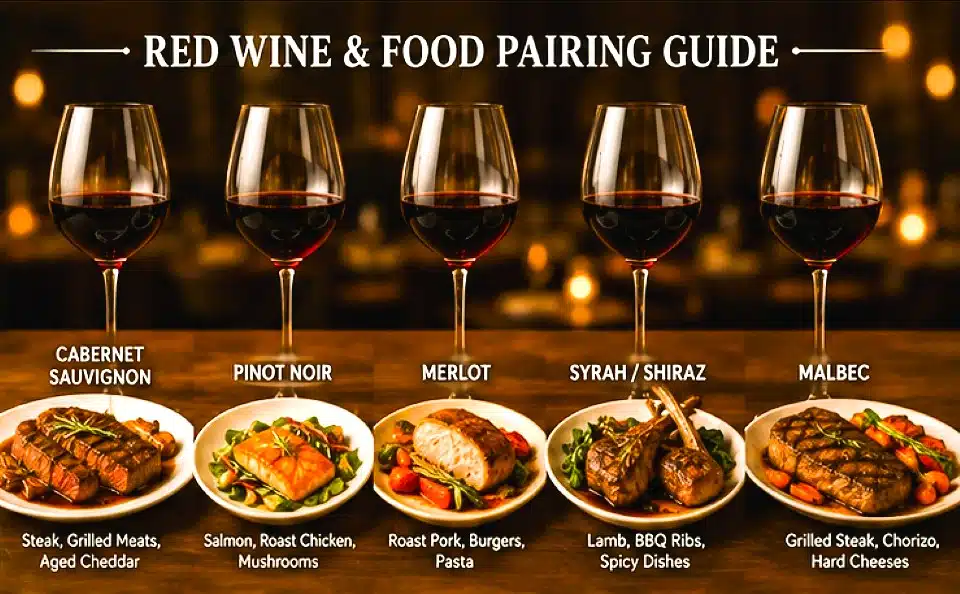
Red wine and food pairing guide featuring Cabernet Sauvignon, Pinot Noir, Merlot, Syrah and Malbec with popular dishes
Red Wine and Food Pairing: The Golden Rules
Successful wine pairing does not need to be complicated.
Keep these basic principles in mind:
-
-
- Match Intensity: Light dishes generally work best with lighter wines, while rich foods can handle fuller reds.
- Consider Tannins: Tannic wines often work beautifully with fatty meats.
- Use Acidity: High-acid wines can balance rich or creamy dishes.
- Think About Sauce; The sauce can be more important than the protein when selecting wine.
- Don’t Forget Personal Preference: There are no absolute rules. If you enjoy a particular combination, that’s what matters most.
-
Why Red Wine Varieties Taste Different
Several factors influence the flavour of a red wine:
-
-
- Grape Variety: The grape provides the fundamental flavour and structural characteristics.
- Climate: Cool climates often produce wines with greater acidity and less ripe fruit character. Warm climates can produce wines with riper fruit, higher alcohol, and fuller body.
- Soil and Vineyard Location: The vineyard environment influences vine growth, grape ripening, and ultimately wine style.
- Winemaking: Fermentation, extraction, oak aging, and blending can significantly change the final wine.
- Aging: Oak barrels and bottle aging can introduce additional aromas and textures.
-
This combination of grape, place, climate, and winemaking is why two wines made from the same variety can taste completely different.
The World’s Most Popular Red Wine Varieties at a Glance
For a quick reference:
-
-
- Best-known international variety: Cabernet Sauvignon
- Best light-bodied red: Pinot Noir
- Best smooth red: Merlot
- Best bold red: Syrah/Shiraz
- Best steak wine: Malbec or Cabernet Sauvignon
- Best Italian red variety: Sangiovese
- Best Spanish red variety: Tempranillo
- Best Argentine red: Malbec
- Best Chilean signature red: Carmenère
- Best South African signature red: Pinotage
- Best Portuguese red variety: Touriga Nacional
- Best Austrian red variety: Zweigelt
- Best red for tomato-based pasta: Sangiovese
- Best red for BBQ: Zinfandel, Shiraz, or Malbec
- Best lighter red for beginners: Pinot Noir or Gamay
- Best powerful, age-worthy red: Cabernet Sauvignon or Nebbiolo
-
Frequently Asked Questions About Red Wine Varieties
What are the most popular red wine varieties?
Some of the world’s most popular and internationally recognized red wine varieties include Cabernet Sauvignon, Pinot Noir, Merlot, Syrah/Shiraz, Malbec, Sangiovese, Tempranillo, Zinfandel, Grenache, and Nebbiolo.
What is the most popular red wine?
Cabernet Sauvignon is widely considered one of the world’s most popular and important red wine varieties. However, popularity varies by country and market.
Which red wine is best for beginners?
Merlot, Pinot Noir, Malbec, Grenache, and Zinfandel are good starting points because they can offer approachable fruit flavours and moderate tannins.
Which red wine is best with steak?
Cabernet Sauvignon, Malbec, Syrah/Shiraz, Tannat, and Petit Sirah are excellent choices for steak because their structure and tannins complement rich, fatty meat.
Which red wine is the smoothest?
There is no single objectively smoothest red wine, but Merlot, Pinot Noir, Grenache, and some softer styles of Cabernet Franc are often perceived as smooth and approachable.
Which red wine has the most tannins?
Nebbiolo, Tannat, Cabernet Sauvignon, Aglianico, and Petit Sirah are among the red varieties known for substantial tannin levels.
Which red wines are fruitiest?
Zinfandel, Grenache, Malbec, Merlot, and some styles of Pinot Noir can be particularly fruit-forward.
What red wine goes best with Italian food?
Sangiovese is one of the best choices for Italian cuisine, particularly tomato-based pasta, pizza, and many Tuscan dishes. Barbera, Nebbiolo, and Corvina are also excellent choices.
What red wine is best for BBQ?
Shiraz, Zinfandel, Malbec, Cabernet Sauvignon, and Tannat are strong choices for BBQ because their fruit, structure, and spice can complement smoky and grilled flavours.
What is the difference between Syrah and Shiraz?
Syrah and Shiraz refer to the same grape variety. The terms are often associated with different regional styles: Syrah commonly refers to French and cooler-climate expressions, while Shiraz is strongly associated with Australian styles.
Is Pinot Noir a sweet red wine?
Pinot Noir is generally a dry red wine. Its ripe fruit aromas can make it seem fruity, but that does not mean it contains significant residual sugar.
Is Cabernet Sauvignon sweet?
Cabernet Sauvignon is normally made as a dry red wine. Its ripe black-fruit flavours may create an impression of sweetness even though the wine itself contains little residual sugar.
Final Thoughts: Exploring the World’s Best Red Wine Varieties
The world of red wine is enormous, and exploring different grape varieties is one of the best ways to understand wine.
From the bold structure of Cabernet Sauvignon to the elegance of Pinot Noir, the softness of Merlot, the spice of Syrah, and the rich fruit of Malbec, every variety provides a different experience.
Italy offers Sangiovese and Nebbiolo. Spain brings Tempranillo and Garnacha. Argentina is famous for Malbec. Chile has made Carmenère an international signature. Australia is renowned for Shiraz, while South Africa has Pinotage. Portugal offers Touriga Nacional, and Austria has Zweigelt.
There is no single “best” red wine variety for everyone. The best red wine is the one that matches your personal taste, the food you’re eating, and the occasion you’re celebrating.
If you are exploring red wine for the first time, start with a few contrasting styles. Try a light Pinot Noir, a smooth Merlot, a bold Cabernet Sauvignon, and a fruit-forward Malbec. Comparing them side by side can quickly help you discover which characteristics you enjoy most.
For wine lovers in Toronto and the Greater Toronto Area, Always Dial A Bottle Toronto provides a convenient way to explore wine for dinners, celebrations, entertaining, and special occasions.
Whether you’re looking for Cabernet Sauvignon, Pinot Noir, Merlot, Malbec, Shiraz, Italian reds, French wines, or other popular varieties, wine delivery makes it easier to enjoy your favourite bottles at home.
Explore different grapes, regions, and styles, experiment with food pairings, and discover the red wines that best match your palate.
The world of red wine is waiting to be explored—one bottle at a time.